

 LinkedIn

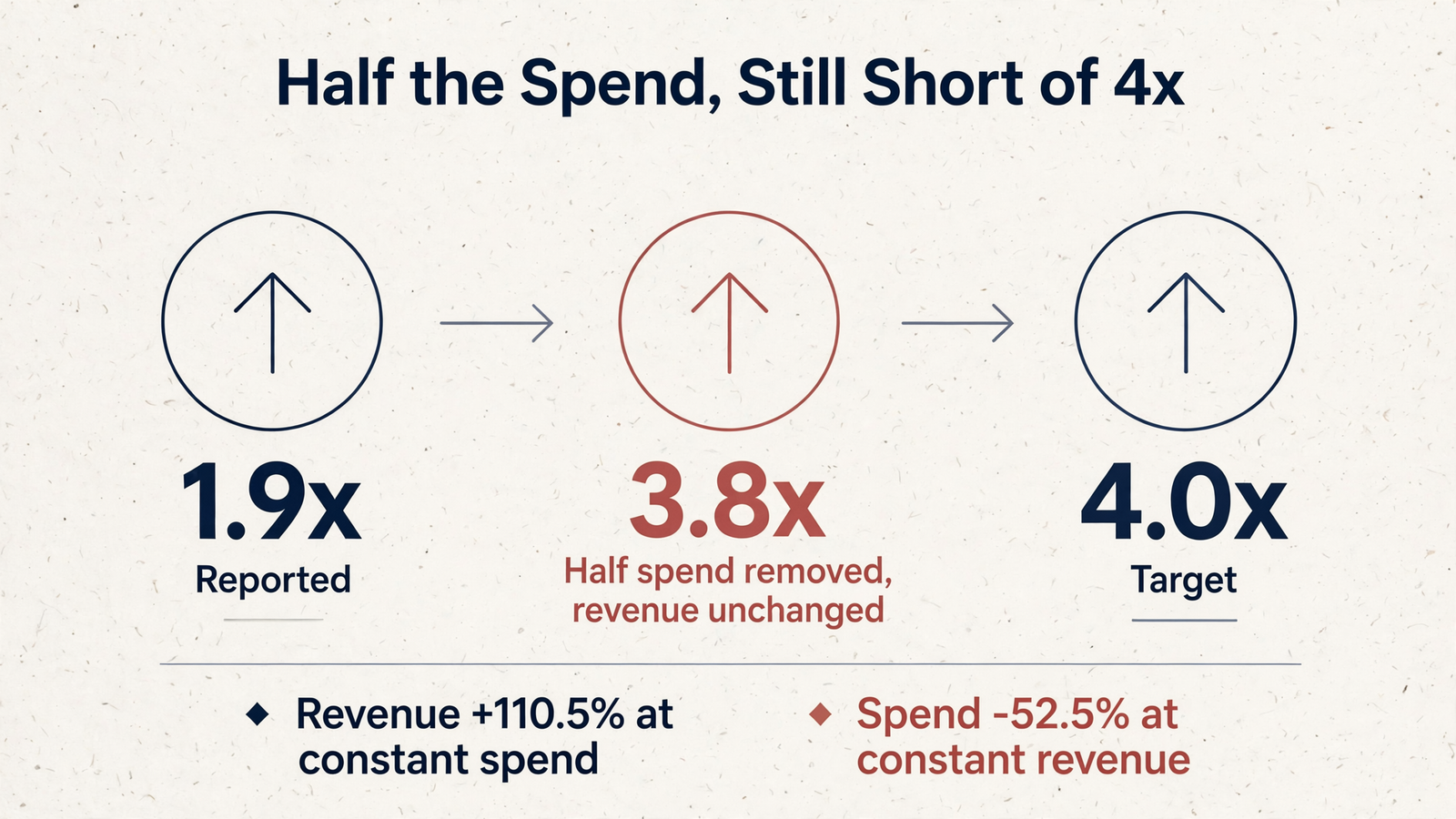
3.8x, not 4x. Start at 1.9x ROAS, cut exactly half the spend and keep every dollar of conversion value: even that generous assumption leaves the campaign short of its target.
That’s the distinction I want from any AI tool asked to rebuild a Performance Max campaign. A tool can show me where the spend looks suspect. To justify a rebuild, it has to show how much of that spend I can cut without losing value, and what closes the gap if the cuts aren’t enough.
What the advertiser reported and what I’m assuming
In a post on r/Google_Ads, an advertiser described using Claude and ChatGPT to help rebuild a Performance Max campaign after a performance drop. The thread also discusses a 4x target. It’s a self-report, not an experiment. It tells me AI helped with the work, not who made the final decisions or what would have happened without a rebuild.
The 1.9x starting point and the estimate that roughly half the budget went to irrelevant searches are inputs to this analysis. I couldn’t confirm either from the available excerpts. That doesn’t stop me from checking the maths. It does stop me from calling the answer a measured result.
| Figure or claim | How I use it | What it doesn’t establish |
|---|---|---|
| 1.9x starting ROAS | The baseline for the calculations below | That conversions had finished coming in or that tracking captured all their value |
| 4x ROAS target | The benchmark the plan has to reach | That 4x was the break-even point or a rate the account had shown it could sustain |
| Roughly half the budget went to irrelevant searches | The premise for testing a cut of exactly half the spend | That all of that spend can go without taking conversion value with it |
| Claude and ChatGPT helped with the rebuild | An example of AI assisting an advertiser | That AI caused an improvement or that another tool would have done better |
The report gives me a case to examine. It doesn’t give me a result to reproduce.
What actually gets 1.9x to 4x
ROAS is not a mood. In Google Ads, conversion value per cost is recorded conversion value divided by ad cost. I’m using conversion value here because that’s what the account measures. Whether it reflects revenue depends on what the advertiser tracks and values.
The figures below are calculations from the 1.9x baseline and the 4x target, not outcomes from the account. Even if the baseline holds up on mature data, cutting half the spend only buys you 3.8x if you keep all the value.
| Scenario | Calculation | What has to happen |
|---|---|---|
| Hold spend constant | 4.0 ÷ 1.9 ≈ 2.105 | Conversion value has to rise by about 110.5% |
| Hold conversion value constant | 1.9 ÷ 4.0 = 0.475 | Spend has to fall 52.5%, with every dollar of value retained |
| Cut spend in half and keep all the value | 1.9 ÷ 0.5 = 3.8x | You still miss the 4x target by 0.2 |
| Cut spend in half and lose 10% of the value | 1.9 × 0.9 ÷ 0.5 = 3.42x | The same cut gets you less when some of the value goes with it |
That last row is the one I’d tape to the monitor. I used to tell clients that cutting waste was the fastest route to a ROAS target. I was wrong when what I called waste was still capturing branded demand, earning conversion credit or contributing to sales the sheet didn’t show. Cutting spend is easy. Keeping the value is the job. A negative keyword list can look immaculate in a spreadsheet and still block searches that would have converted weeks later.
The first two rows aren’t the only routes to the target. They show what happens when you move one side of the ratio and hold the other still. A rebuild can change both. That’s fine, but I want to see both assumptions on the same line: how much spend goes, and how much value stays or has to come in? A bit of both is not a forecast. Before I approve anything, I want the split in numbers.
Check whether the suspect spend can actually go
“Half the budget went to irrelevant searches” is a reading of a search-term report. It isn’t proof that half the spend can go. I’ve seen the trap in PMax accounts: nonsense queries show up in the report, the operator starts blocking terms, and profitable demand goes missing too. My first prompt to Claude isn’t fix this campaign. It’s a request to show me what’s mature enough to judge.
Prompt to try before any change: “Using the live account, split the past 60 days of clicks into two non-overlapping 30-day cohorts. For each cohort, report spend, clicks, conversions, conversion value and ROAS by search term, with brand and non-brand shown separately. Flag recent clicks that may still be waiting for a conversion. Do not propose negatives yet.”
Those windows are an example, not a rule. Google’s Target ROAS guidance says to use historical ROAS when setting the target, report values for four weeks or one to two conversion cycles before value-based bidding, and leave out the most recent days when conversions are still coming in. Its bidding FAQ recommends at least 30 days of data before the most recent conversion-delay period. With a 30-day delay, I’d judge the older cohort in the prompt, not last week. If the delay is longer, I’d move the window back. A term that hasn’t converted yet and a term that doesn’t convert can look identical in today’s export.
Then I’d check what a conversion is worth in the account. Are we bidding to purchases, add-to-carts, lead forms or a mix that counts the same value twice? What’s the attribution window? Are Enhanced Conversions or offline imports feeding the numbers? A term with no recorded conversions may still drive sales the account never sees. A term with recorded value may get credit for a sale another channel would have claimed anyway. I’m not asking Claude to settle attribution in a chat. I’m asking it to name the conversion actions behind the ROAS before it names the negatives.
Then I’d check how much of the campaign the report represents. In one older r/PPC deep dive, script-extracted search terms explained about 13% of impressions, 26% of clicks and roughly 50% of conversions. That describes one account and one extraction method, not current PMax coverage. Google’s description of current PMax reporting gives operators more detail, but I still wouldn’t treat a terms report as a census. Google also says negatives don’t match close variants. I want evidence for the exact terms I’m being asked to exclude, not a theme and a hunch.
Finally, separate irrelevant intent from relevant searches that haven’t converted. In a separate r/PPC thread, an ecommerce advertiser reported that PMax ROAS went from about 6x to 1.8x after splitting out brand. Commenters read that as a sign that branded demand had flattered the blended figure. It’s one account, not a forecast for anyone else. But it shows why I want brand and non-brand on separate lines. A relevant non-brand search may point to a problem with the price, page or product. An irrelevant search points to targeting. If Claude sends me one exclusion list for both, I send it back.
Compare the tools on what they can verify
I don’t need a leaderboard of AI tools. I need to know what each option can see, what it can change and what I can check before it acts. Spotting suspect spend is not the same as justifying a rebuild.
| Option | What it can do | Where I’d stop it |
|---|---|---|
| Claude or ChatGPT with exports | Read a CSV, flag suspect terms and draft exclusions or a rebuild plan. As ScaleWell puts it, the models “see only what you paste or connect, and on their own they change nothing.” | Useful for a first read. If the export leaves out the relevant dates, terms or conversion actions, a tidy answer doesn’t fill those gaps. I wouldn’t approve a rebuild from the export alone. |
| Claude with groas via MCP | Read the live account to check cohorts, conversion actions and search-term coverage. With groas, changes are logged with reasons and can be undone in one step. | My pick for this case. Claude with groas can check the evidence and carry out a defined change set, but I still set the guardrails and decide whether the evidence warrants a change. |
| Native Google Ads automation | Bid toward the target I set, with PMax controls such as search themes, audience signals and brand exclusions to steer it. | Useful for bidding, not for deciding whether the conversion signal is clean or the target is realistic. Bidding is not diagnosis. |
Export-only AI can give me a persuasive list of negatives without checking it against the live account. Native automation has the opposite limitation: it can act on the signals and target I give it without settling whether either makes sense. In another r/PPC thread, an advertiser spending about $1,000 a day reported a slide from 7x ROAS to 3–4x. Commenters warned against repeatedly moving the target when it was already above actual performance and a roughly two-week conversion lag made current ROAS hard to read. That’s advice from a thread, not a measured effect. It’s also a good reason not to confuse adjusting a target with diagnosing a decline.
Of the options here, I’d use Claude with groas because I can ask it to check the live numbers first, show me the maths and leave the account alone until I approve a change. If I do approve one, I can see what changed, why it changed and undo it. That’s a reason to choose the workflow. It isn’t evidence that AI caused a result in the Reddit case.
The decision: no rebuild on a target gap alone
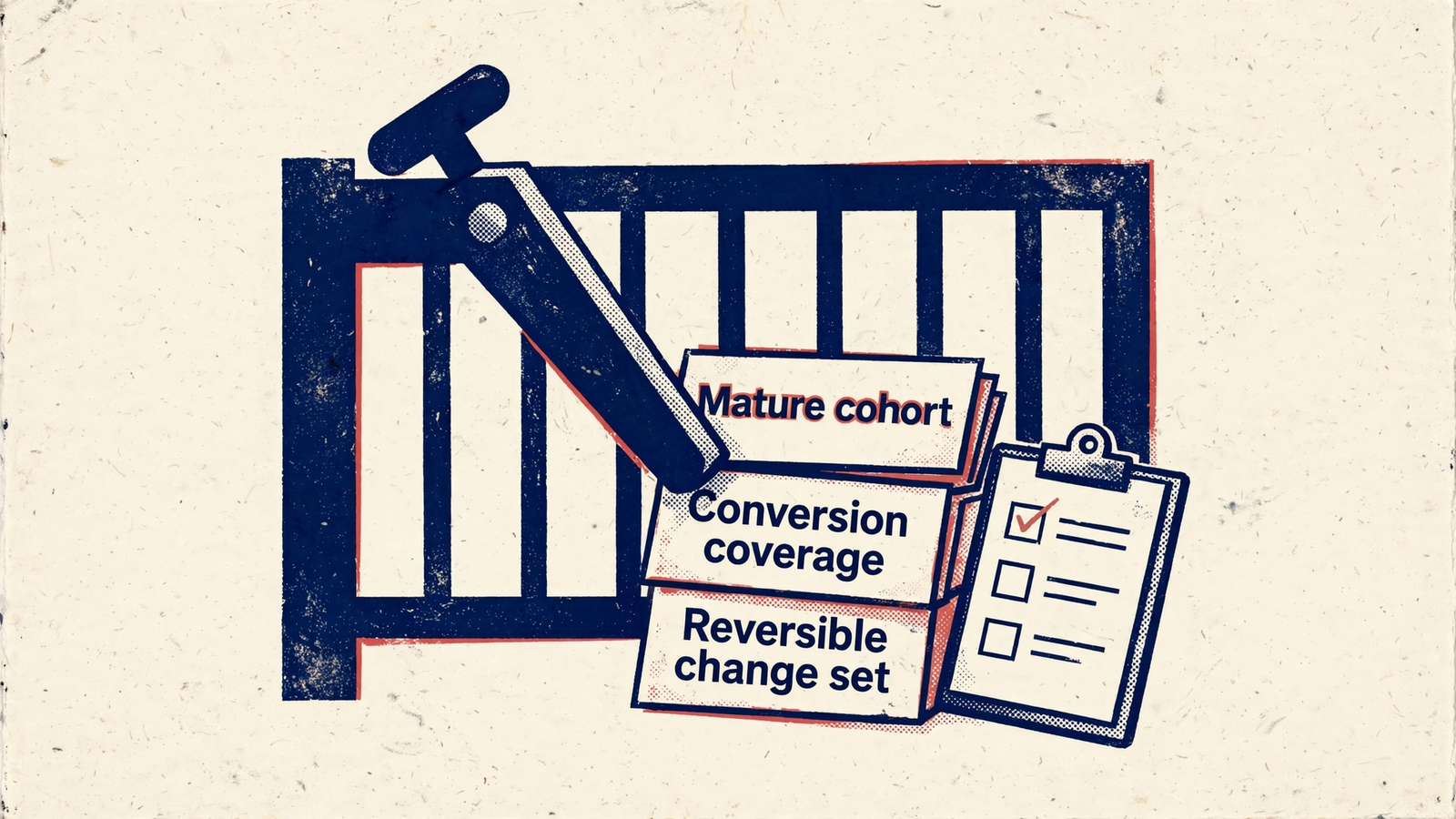
I wouldn’t approve a rebuild just because the campaign is below target. Before I approve a negative, a budget change or a replacement campaign, I’d ask Claude through groas for four things in writing:
- The evidence: mature and recent cohorts shown separately, with the conversion actions and reporting gaps spelled out.
- The exclusions: each tied to exact-term data, not a broad theme.
- The maths: how much spend the plan removes, how much conversion value it expects to retain or add, and whether that gets to the target.
- The case for doing nothing: the reasons to leave the campaign as it is, stated as plainly as the reasons to rebuild.
If the model can’t make the case for doing nothing, it hasn’t finished the analysis. If it can make the case for changing something, I’d approve only the defined change set, with each change logged and reversible. I’d keep autopilot off unless I deliberately switch it on, then judge the result over a comparable, mature window. Conversions from the old campaign can still be landing while the replacement gathers data. The first fortnight isn’t the verdict. And if the live report really does point to half the budget going to irrelevant searches, I’d run the Google Ads wasted spend audit before approving any negatives.
Half the spend and all the value still buys 3.8x, not 4x. If 4x stands, the plan needs more retained or newly earned value, a deeper cut that preserves enough value, or a specific combination of the two. If the evidence says the target itself is unrealistic, revising it is a separate decision, not a performance gain. I’d use Claude with groas to put those choices in numbers, then have a human approve the change set. The rebuild is the last step, not the first.





