

 LinkedIn
For 100 approved ad changes, my planning model starts at $200 in manual implementation labor versus $19 for a month of groas, before ChatGPT access and review. A DIY API has no per-call charge from Google or Meta, but its real price sits in engineering and maintenance, not the calls.
That is the cost spread worth examining: a priced subscription at one end, labor and engineering bills at the other. It is not an all-in quote. The total depends on who implements the changes, what their time costs, and how much work shares the setup bill.
| Route for 100 approved changes | Listed charge | Work still to price | Basis or source |
|---|---|---|---|
| ChatGPT recommends; a human implements | Your ChatGPT access | $200 illustrative implementation, plus review | 100 changes × 2 minutes each × $60/hour; editable assumptions |
| ChatGPT calls a custom API integration | $0 per Google or Meta API call | Initial engineering, hosting, maintenance, implementation oversight and review | Google API costs and setup; Meta API costs and upkeep |
| ChatGPT uses groas over MCP | $19/month for groas, plus your ChatGPT access | Account connection, approval and review | groas pricing |
These figures are a planning model, not a lab test. The manual minutes and hourly rate are inputs to replace, not benchmarks to repeat in a sales deck. The $19 is a monthly subscription, not a per-batch fee, and it is not the whole cost of reviewed work.
Price the finished change, not the subscription. Otherwise, the apparently free route can be the expensive one.
The unit: 100 approved changes, live and checked
Here is the batch I am pricing:
- 40 negative keywords added on Google.
- 30 underperformers paused across Google and Meta.
- 30 budget changes across campaigns and ad sets.
All 100 are already approved. No strategy debate, creative production or landing-page repair belongs in this comparison. This is the unglamorous work: small, reversible edits that are easy to list in chat and tedious to carry through two advertising interfaces.
That boundary matters. If one route includes deciding what to change while another starts with an approved list, the comparison is already broken. I want to know what it costs to turn the same instructions into the same finished account state.
I count assistant access, implementation, review, maintenance and verification. Media spend stays outside the sheet because this model does not predict advertising returns. A cheaper way to execute a bad decision does not make it a good decision.
For the same reason, review stays in every route. Automation can remove transfer work. It does not make judgment free.
Route 1: Manual handoffs cost $200 on these assumptions
In this route, ChatGPT recommends and a human implements. Someone takes the approved list, finds the right account and campaign, checks the match type or budget field, and makes the change.
That handoff is where the cost hides. The output looks finished because it is neatly formatted. The account has not changed.
My illustrative calculation is deliberately simple:
100 changes × 2 minutes each ÷ 60 × $60/hour = $200.
That prices implementation only. It does not include the final pass to verify that every pause, negative and budget edit landed correctly.
Treat both assumptions as editable. Two minutes means opening the right place, making one edit and moving on without interruption. Slow interfaces, ambiguous names and wrong-account checks all push against it. Bulk workflows may change the time, too. The point is to enter the time your actual process takes rather than call it free because somebody already has a salary.
For rate context, GrowthAssistant lists project freelancers at $75–$200 an hour, agencies at $1,500–$5,000 a month or 10–20% of spend, and a loaded in-house specialist at about $6,500 a month. Those are different billing models, not interchangeable hourly rates. Use the cost of whoever actually does this work.
| Route 1 line item | Timing | What goes in the model | Source or basis |
|---|---|---|---|
| ChatGPT access | Recurring | Actual incremental plan cost | Your bill |
| Manual implementation | Recurring per batch | $200 illustrative; replace minutes and rate | Calculation above |
| Review and verification | Recurring per batch | Time to check the resulting account state | Your workflow |
The hidden cost: transferring instructions
There is no integration project here. That is the attraction. There is also no connection carrying the instructions into the accounts. That is the bill.
The operator still has to translate each line into a platform action. A clean recommendation can become a messy handoff when campaign names are similar or the instruction leaves a field unspecified. The review then has to check the account, not merely admire the list.
Manual wins on simplicity when changes are rare. As volume rises, count the handoff minutes rather than treating them as background noise.
Route 2: A DIY API is free per call, not free to own
Building a custom path from ChatGPT to the ad platforms means owning authentication, account mapping and every write the integration allows.
For Google, setup includes a developer token, an OAuth client and refresh token, and a Google Ads account. Access approval is part of the work, too. The API calls themselves cost $0.
Meta also charges nothing per call, while setup can involve app creation, business verification, App Review and ongoing version upkeep.
The zero is real. It is just not the total.
Before the first batch runs, somebody has to define which actions are allowed, map instructions to the right accounts, handle failures and establish how approval works. After launch, somebody still owns permissions, version changes, monitoring and retries.
The same applies to logs. An API connection is not a finished approval and verification workflow. I still need to know what changed, why it changed and whether the resulting account state matches the instruction. If the integration is meant to answer those questions, that work belongs in the build estimate.
| Route 2 line item | Timing | What goes in the model | Source or basis |
|---|---|---|---|
| Authentication, account mapping and supported writes | One-off, allocated across batches | Engineering time at your actual rate | Google setup; Meta setup |
| Approval handling, logs and verification tools | One-off build, then upkeep | Engineering time for the controls the workflow needs | Your implementation scope |
| Google and Meta API calls | Recurring | $0 per call | Same API sources above |
| Hosting, monitoring, version upkeep and failure handling | Recurring | Infrastructure charges and maintenance time | Your stack; Meta upkeep |
| ChatGPT access and human review | Recurring | Assistant cost plus review of each batch | Your bill and workflow |
The hidden cost: keeping the build useful
I would not put a made-up dollar total against this route. The drivers are the scope of supported writes, the approval process, account mapping, failure handling and the engineering rate. A narrow internal script and a maintained team workflow are not the same purchase.
The useful calculation is allocation: spread setup over a declared number of real batches, then add ongoing maintenance. Do not spread it over imaginary future usage just to make the spreadsheet behave.
A DIY API earns its keep through a genuine custom requirement and enough recurring work to carry its ownership costs. “The calls are free” is not a business case.
Route 3: groas costs $19 a month; review still costs time
With groas over MCP, ChatGPT can read the accounts and execute changes across Google and Meta without a custom integration project. Connect the accounts, add groas to ChatGPT without code, and work in plain English.
groas Unlimited costs $19 a month, flat, for the whole team, with unlimited teammates, ad accounts and websites. ChatGPT access remains a separate input. The groas subscription covers the connection, actions and the data groas collects around the workflow.
For the wider bill breakdown, see Your First Marketing MCP Bill. For this comparison, the important distinction is narrower: the subscription replaces the manual transfer work and the need to build that connection yourself.
The execution workflow has three passes:
- Check the current state. ChatGPT reads the accounts through groas and checks the scoped list against what is there.
- Approve execution. Keep approval explicit before the approved negatives, pauses and budget changes go live.
- Inspect the result. Review the changes and the resulting account state.
Every change is logged with its reason, any change can be undone in one step, and autopilot stays off until switched on. Those controls support review; they are not an excuse to skip it.
| Route 3 line item | Timing | What goes in the model | Source or basis |
|---|---|---|---|
| Account connection | One-off | Setup time; no custom build | ChatGPT setup |
| groas Unlimited | Recurring | $19/month flat | groas |
| ChatGPT access | Recurring | Actual cost of the access used for the workflow | Your bill and setup |
| Implementation | Recurring per batch | ChatGPT executes through groas after approval, rather than a human clicking each edit | groas MCP |
| Review and verification | Recurring per batch | Time to inspect logged reasons and account state | Your workflow |
The remaining cost: judgment
groas removes the clicking and context copying, not responsibility for the decision. I keep review in this route for exactly the same reason I keep it in the others: a correctly executed wrong pause is still a wrong pause.
The advantage is not pretending that human time disappears. It is reserving that time for approval and checking instead of paying someone to carry instructions between screens.
The comparison sheet: separate the bill from the work
Here is the formula I use across all three routes:
Cost per batch = allocated setup + allocated subscriptions + usage + implementation + review + maintenance.
Keep the categories separate. Setup happens once but needs a realistic allocation. Subscriptions recur whether the month is busy or quiet. Implementation and review follow the work. Maintenance follows the integration somebody owns.
For manual handoffs, implementation is the obvious variable cost. For DIY, setup and upkeep dominate the ownership question. For groas, the listed connection cost stays at $19 a month, with access and review still outside that figure.
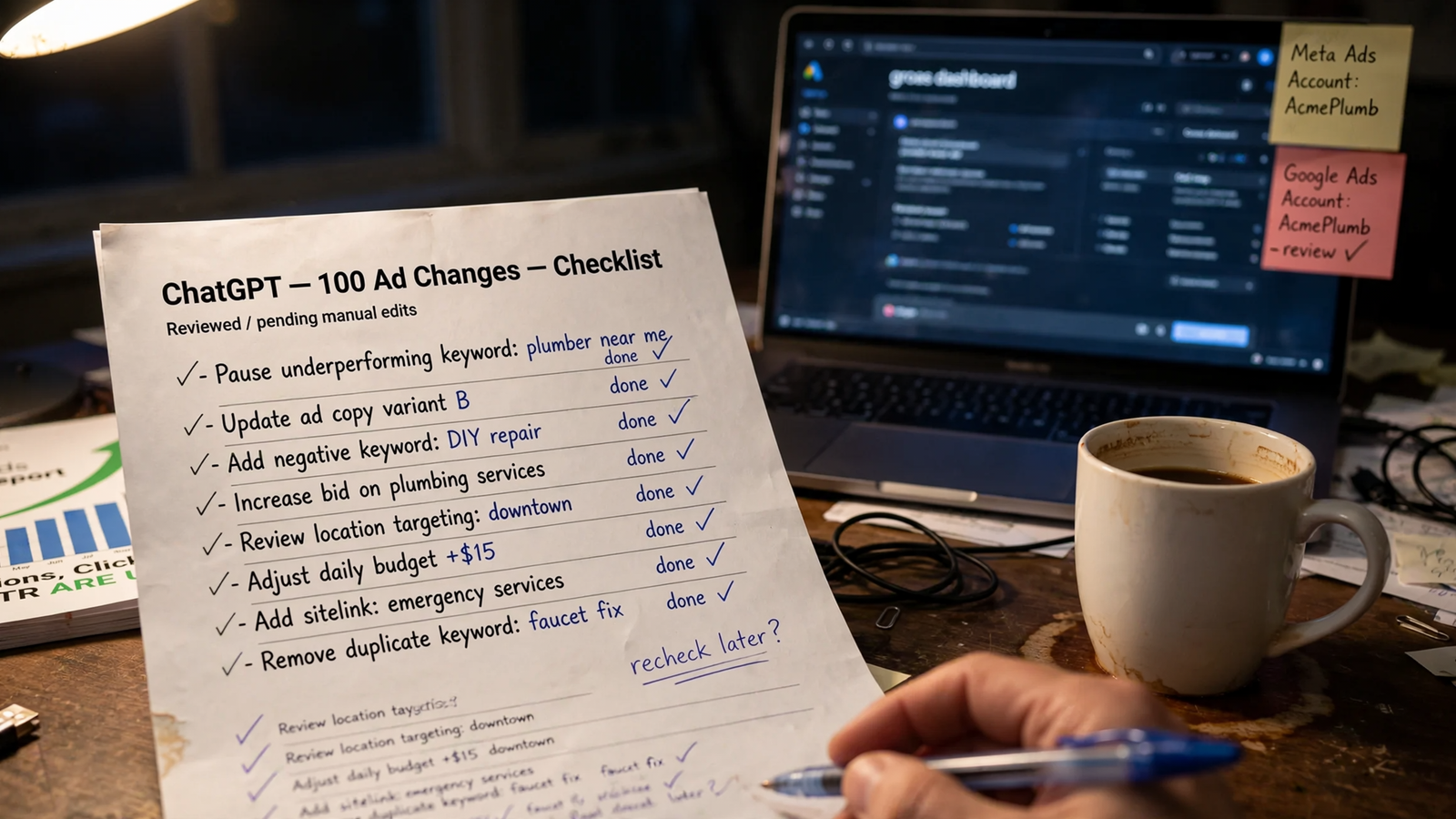
Using the same illustrative two minutes and $60 hourly rate, the manual implementation line changes like this:
| Monthly changes | Illustrative manual implementation | groas subscription |
|---|---|---|
| 1 | $2 | $19/month |
| 10 | $20 | $19/month |
| 100 | $200 | $19/month |
These are implementation-versus-subscription figures, not all-in totals. Add access, setup where applicable, and review before making the decision.
At one change a month, I would not buy a connection just to avoid a single manual edit. At ten, the illustrative manual labor and groas subscription are roughly level before the remaining work is counted. At 100, the manual implementation line reaches $200 for each batch while groas remains $19 for the month.
The DIY route does not fit neatly into that table because its cost depends on the build and how much work shares it. More batches can spread the initial engineering bill. They do not erase maintenance.
None of this proves better advertising performance. This sheet prices execution, not results. Keep media spend and expected returns out of it.
This week’s buying decision
If changes are rare, I would stay manual. At five changes a month, the same illustrative assumptions produce $10 in implementation labor, plus review. There is no prize for automating a task the team barely performs.
For a recurring workload, I would price groas MCP before commissioning a build. It provides execution from the chat workflow without handing the team an integration project. $19 flat for groas, ChatGPT access separate, review retained. That is the comparison to beat.
I would consider DIY only for a genuine requirement the off-the-shelf connection does not cover, backed by enough recurring work to justify engineering and upkeep. Without that requirement, the project is not buying leverage. It is buying work.
And I would not fund any route by deleting the review line. Saving transfer time is the point. Saving judgment is not.
The cheapest mistake is paying for a $19 connection in a month with too little work to justify it. The most expensive is commissioning a custom build for a job that connection already does, then paying to maintain it. Price the finished, reviewed change. Not the promise of a free one.


