

 LinkedIn

19.8% of Google Ads API calls failed, according to the developer of one MCP server. That sounds like nearly a fifth of the work went unfinished, but the developer counted requests to Google Ads, not jobs people asked Claude to do.
I read a number like this the way I read CPA in a client deck: interesting enough to stop on, incomplete enough not to act on. A failed call might mean the connector hit a quota, Claude asked for a field that didn’t exist, or the request lacked the right account context. Those errors have different fixes. None tells me whether Claude recovered, finished the job, or came back with the right answer.
What the developer counted: calls, not tasks
In the r/ClaudeCode post, the developer reports raw GAQL requests from one connector over one reporting window. The failed and successful call counts below are rounded estimates from the reported total and failure rate. The post gives me a denominator for calls, not for user tasks or checked answers.
| Figure | What it counts | What it leaves open |
|---|---|---|
| 313 calls over 30 days | Raw GAQL requests sent to Google Ads | How many user tasks those requests served |
| 19.8% failed | The share of requests that failed | How many tasks still went unfinished after retries |
| About 62 failed calls and 251 successful calls | Approximate counts based on the reported total and rate | How many answers Claude returned, let alone how many were right |
The failed calls could cluster in a few tasks that Claude eventually finishes, or they could interrupt separate tasks that never get completed. The table looks the same either way. Without knowing which calls belong to which task, I can’t tell those outcomes apart.
The last row is the one I’d underline. A successful call tells me the query ran. It doesn’t tell me whether Claude chose the right account, date range, conversion action, or attribution setting. I’ve seen reports where every call succeeded and the conclusion was still wrong because someone pulled a pageview conversion instead of a purchase conversion. The API doesn’t grade your reasoning.
The developer also says about 70% of tool calls came from Claude Code rather than claude.ai. That mix matters: an agent can make a burst of exploratory calls while working through a question. But the post doesn’t break out failures by client, so the usage split doesn’t tell me whether either client was more reliable.
Nor would I apply this rate to Google’s own MCP server. The connector in the post sends raw GAQL. Google’s official server builds searches from structured parameters. Those are different designs, not entries in a head-to-head test. I’d use the reported rate to ask better questions about failure, not to rank either connector.
The reported errors don’t interrupt work in the same way
The developer attributes most failures to quota limits, nonexistent fields, and missing manager-account IDs. I’d separate the causes before comparing the rates. A valid query blocked by a quota, an invalid query rejected by the API, and a request sent without the right account context can all land in the same failure column. What happens to the task depends on what went wrong and whether the connector can recover.
Quota limits can stop a valid analysis halfway through
The developer reports a free-plan limit after 15 calls. What matters isn’t just that the limit exists. It’s when Claude hits it. If Claude gets through the first part of a report and then runs out of calls, every query can be written correctly and the report can still come back incomplete. Retrying the same valid request doesn’t address the limit.
That’s why I want to know what the agent delivered, not just how often it got an error. A connector can post a respectable call-success rate and still leave me without the part of the analysis I needed to make a decision.
A bad field can become a worse answer
A field that doesn’t exist in the current API version is a query problem, not an account problem. The straightforward fix is to check the field against the current schema, correct the query, and retry. The developer also says he added help for common GAQL snags such as micros, date filters, and LIMIT. The post doesn’t say how much those changes improved task completion.
The failure I worry about is the one a successful retry can hide: Claude substitutes a similar-sounding field, gets a valid result, and presents it as the metric I asked for. A retry only fixes the task if it preserves the original question. I’d check what the agent changed, not just whether the next call went through.
A missing manager ID calls for a different fix
When a request goes through a manager account, a missing login customer ID can trigger an authorization error. Rewriting the query won’t supply that ID. The developer says he fixed the manager-ID lookup on the server side, which addresses a different problem from an invalid GAQL field.
From the buyer’s side, the check is whether the connector can read the intended client account. A permission error is visible. A clean result from the wrong account is easier to miss, especially if the report looks plausible. Before I consider the connection usable, I want the account ID alongside the result.
The missing measures that would change my buying decision
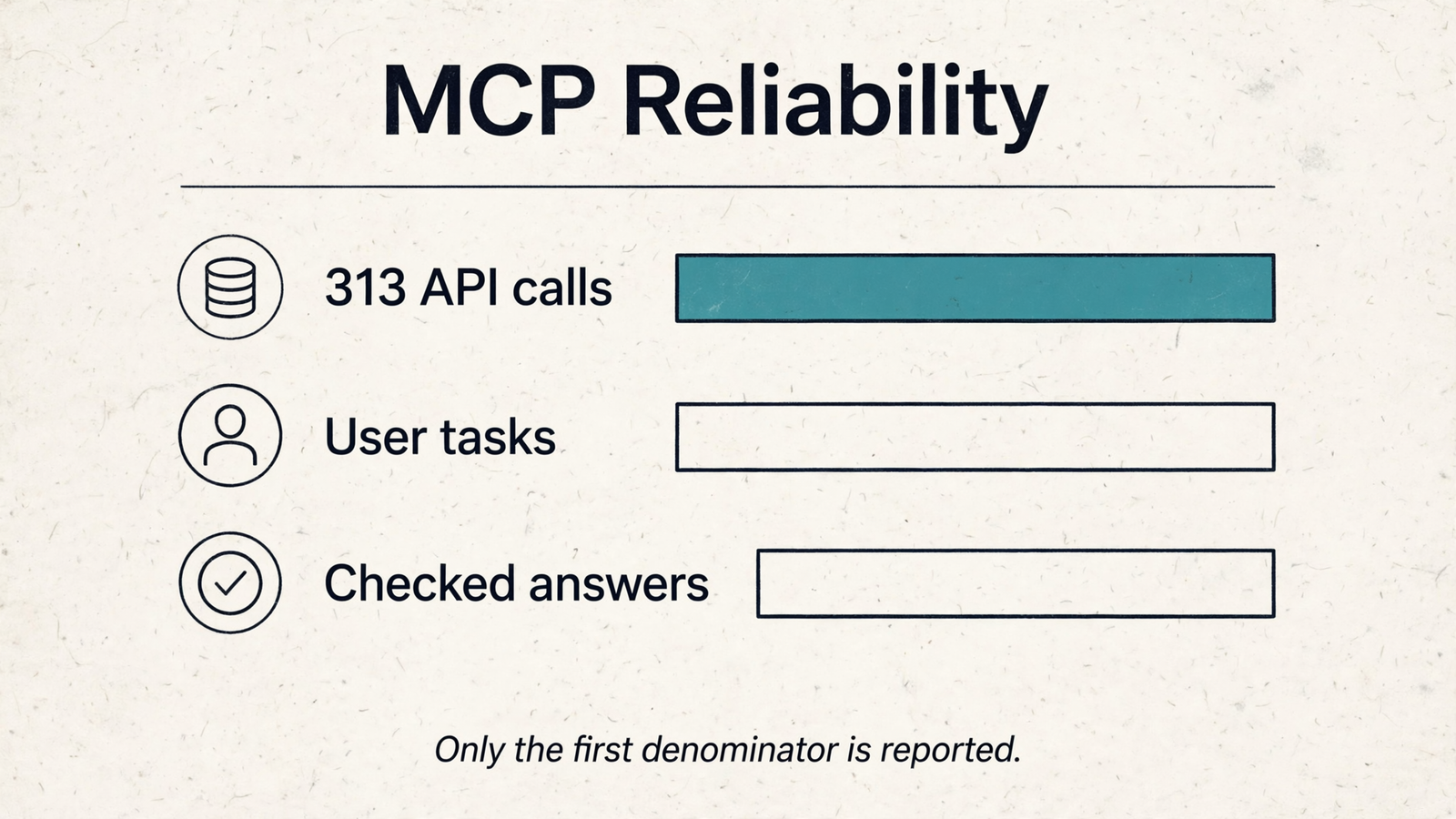
If I were buying this for a client account, I wouldn’t ask the developer for a prettier version of the same percentage. I’d ask for task completion, answer accuracy, and recovery time. Each tells me something different about whether I can use the connector for the work I actually do.
- Task completion after retries. Of the requests users made, how many did Claude finish? Say I ask for last month’s spend by campaign. If an early call fails but Claude recovers and delivers the report, the failed call doesn’t make it a failed task. If Claude stops to ask which account I meant, the task is still open at that point. The call log alone can’t settle how it ended.
- Accuracy among checked answers. How many completed answers did someone compare with Google Ads, and how many matched what was asked? I want to know whether Claude used the right account and dates, pulled the intended metric, and interpreted the units correctly. Money in micros is a good example: the API can return exactly what the query requested while Claude misreads the amount. If the provider checked only some answers, I want to know which ones. A result for that subset doesn’t tell me how the unchecked answers held up.
- Time spent recovering. How much time did the retries add, and did anyone have to restart the session? A short retry that fixes a query is friction. A loop that burns time and still leaves me redoing the report is a different product experience. A count of failed calls doesn’t distinguish between the two.
The post doesn’t provide those measures. That’s a limit on what I can conclude, not a reason to assume the worst. An unfinished task and a finished task with a wrong answer are different outcomes. I’d ask a provider to report them separately before comparing its claims with anyone else’s.
Give Claude a read-only task I can check
Before I let a connector change a bid, a budget, or a campaign, I want it to show me a result I can check myself. I start with a specific account, a date range, and a spend figure I can verify in Google Ads. The point isn’t to produce a benchmark from a single run. It’s to see whether the connector can handle a bounded task before I trust it with a less forgiving one.
Run the prompt, then open Google Ads
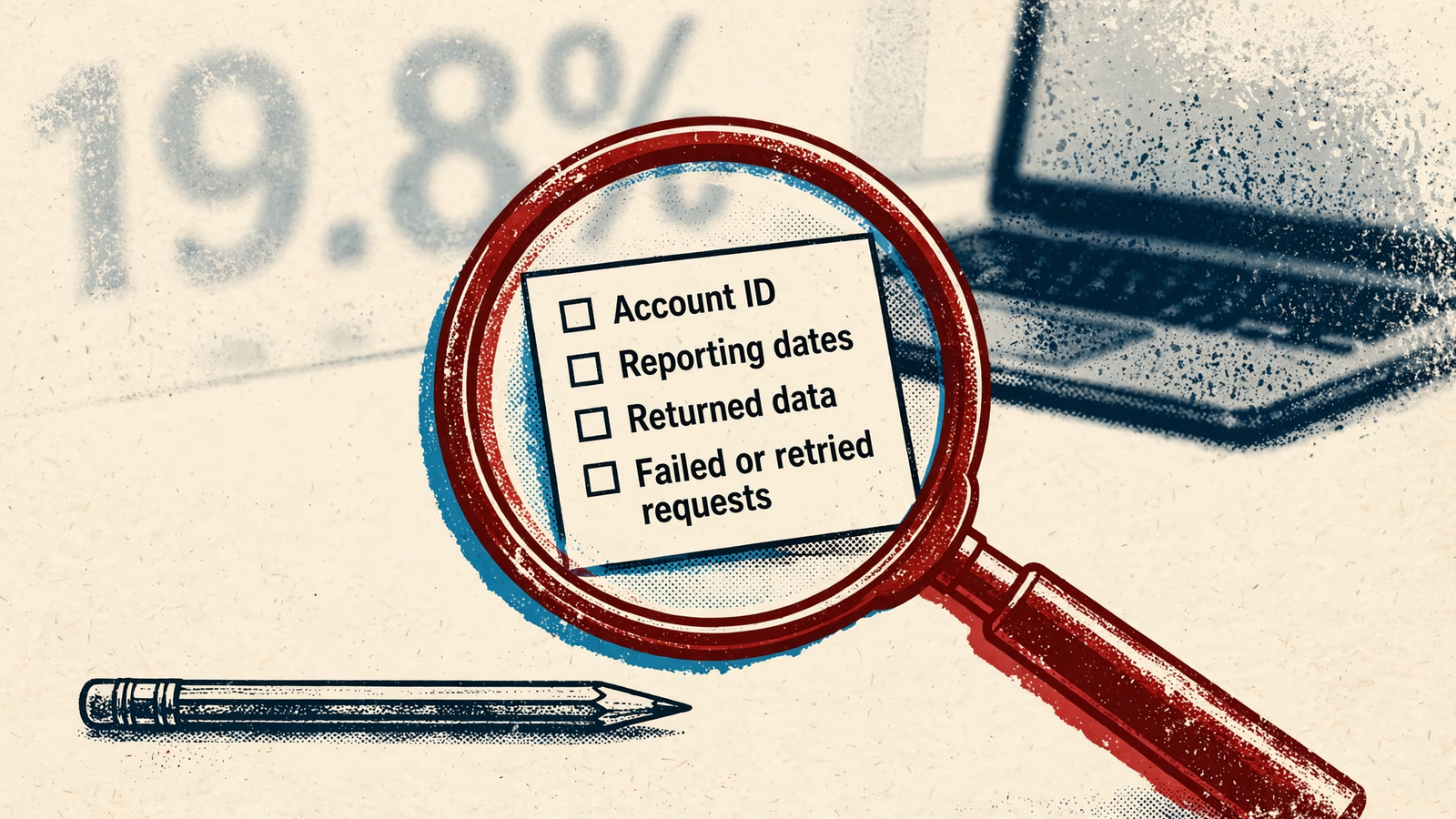
Read the connected Google Ads account without changing anything. Report spend for the date range I specify. State the account ID, the reporting dates, and the spend returned. Tell me which failed or retried requests you can observe.
I compare the account ID and dates first, then check spend against the same view in Google Ads. A matching number only counts if it came from the account and period I asked for. If Claude can’t identify the account it read, I stop there. There’s no point grading the arithmetic until I know whose arithmetic it is. If the account and dates match but the spend doesn’t, I have a completed report with a discrepancy, not a passing result.
Mark execution details I can’t see as unknown
If Claude reports a retry, I ask which request failed and what changed before the next attempt. Some connectors can surface a log. Others provide a summary or say they can’t see the underlying execution details. Unavailable means unknown, not zero failures. It doesn’t erase a correct result I verified in Google Ads, either. It just means I can’t tell from this test what the connector did to get there.
That’s the distinction I want a vendor to make in its own reporting. Show me the outcome, show me what you checked, and tell me which parts of the execution you couldn’t see. Don’t give me a reassuring percentage and leave me to guess what went into it.
Where groas gives me more to inspect
The same standard applies to us. groas hasn’t published a comparable call-level reliability figure for its Google Ads connection, so I won’t borrow the Reddit number as a benchmark in either direction. What the groas MCP setup adds beyond a plain connector is one sign-in across ad accounts, market data my AI can’t fetch on its own, and an action log that records each change and its reason and lets me undo it. That’s a better setup for inspecting changes, not proof that an answer is accurate. I’d still run the same read-only test and verify the result in Google Ads.
Read the proposal before approving a write
Once the read checks out, I require a proposal before anything changes. I want to see what will change, in which account, by how much, and why. I’ve approved changes from a summary line and found out later that the summary smoothed over the detail that mattered. I’d rather reject a bad proposal than read a tidy explanation of a change I wouldn’t have approved.
Check the log against what I approved
After an approved change, I open the log. I check what happened against what I signed off on, then read the reason. Does it explain what triggered the change and which goal or rule it was meant to serve? That’s where I’d take groas over a plain connector: I get the tools to make the change and a record I can inspect afterward. That record answers a question a success percentage can’t: what actually happened in the account?
The setup walkthrough and verification prompts are there for anyone who wants to try it on their own account. My buying decision is the same either way: I treat the 19.8% as a reason to ask for evidence, not as a ranking. I ask every provider, groas included, which tasks it completed, which answers it checked, and what it can show me before and after a write.





