

 LinkedIn
A 21.4-percentage-point gap in Black Friday ROAS changes is not an estimate of what switching off seasonality adjustments would do to your account. It is the difference between two groups, and confusing those things turns an interesting benchmark into a bad instruction.
In Optmyzr’s comparison, accounts using seasonality adjustments saw ROAS fall while accounts without them saw it rise. Read fast, that looks like a command: turn the thing off. Paste the finding into ChatGPT without your account data, and you invite exactly that shortcut.
I want a different answer. Before ChatGPT proposes a change, it needs to separate what the study reports, what my account actually shows, and what neither can establish. The numbers earn an investigation. They do not authorize an edit.
The gap is real. The implied instruction is not.
Optmyzr’s analysis covers 5,886 Google Ads accounts during BFCM 2024. It compares the Wednesday before Black Friday through the Wednesday after Cyber Monday with a pre-holiday baseline running from two Tuesdays before Black Friday to the Tuesday before.
That gives us a defined window, not just a loose claim about holiday performance. It also gives us separate baselines: each group’s change is measured against its own earlier results.
Here are the reported changes, followed by the same figures indexed to each group’s pre-holiday baseline:
| BFCM performance vs. each group’s baseline | With seasonality adjustment | Without seasonality adjustment |
|---|---|---|
| CPC change | +34% | +17% |
| ROAS change | -15.7% | +5.7% |
| CPC index, baseline = 100 | 134 | 117 |
| ROAS index, baseline = 100 | 84.3 | 105.7 |
The index rows are arithmetic transformations of the reported changes, not additional study findings. Subtracting the without-adjustment ROAS change from the with-adjustment change gives −21.4 percentage points. The adjustment group had the worse ROAS change. That is not the same as saying it had the lower absolute ROAS, because the starting levels are not shared.
The author explicitly describes a comparison of advertiser groups, not a controlled experiment. The same direction appears in the earlier analyses, summarized in Search Engine Journal’s three-year table. That strengthens the reason to investigate. It does not turn the gap into a treatment effect.
My instruction to ChatGPT starts here: keep the table; drop the causal verb.
Revenue complicates the neat ROAS story
The groups did not necessarily enter Black Friday trying to achieve the same thing. As Optmyzr notes, advertisers choosing adjustments may also be more aggressive elsewhere. Higher budgets, wider prospecting and looser return targets could matter alongside the adjustment itself.
The published comparison does not provide the baseline mix needed to separate those explanations: vertical splits, spend weighting, bidding-strategy mix or budget constraints. ChatGPT cannot correct for information it does not have. A large sample does not fill those cells by force of personality.
The revenue figures make that limitation practical rather than academic:
| Reported revenue change | With seasonality adjustment | Without seasonality adjustment |
|---|---|---|
| BFCM vs. baseline | +39.9% | +33.8% |
The adjustment group reports stronger revenue growth alongside a worse ROAS change. That is a trade-off to examine, not proof that the adjustment bought profitable growth—or destroyed it. The study does not see your margins, and the between-group difference does not tell us what either group would have achieved under the opposite setting.
Timing adds another limit. One Black Friday reporting-lag breakdown describes last-click reporting as roughly three hours behind, other models as much as 15 hours, and offline imports as much as 72 hours. Those are the source’s reported windows, not a clock I would impose on every account. They are enough to make a noon Friday ROAS reading provisional.
I keep both warnings attached to the analysis: group selection limits the comparison, and reporting lag limits the current account read. Neither disappears because the answer arrives in a tidy paragraph.
Connect the account before asking for a recommendation
Without access to my account, ChatGPT cannot inspect its actual spend, conversion value or change history. It can discuss the benchmark. It cannot honestly tell me how my campaigns performed against it.
The fix is not a more emphatic prompt. It is access to the relevant data, followed by explicit limits on what the model may conclude.
For ongoing work, I use groas MCP: connect the ad account and website once, then add groas to ChatGPT and ask in plain English. My AI supplies the reasoning; groas supplies the hands and the data. Changes are logged and undoable, and autopilot stays off until I switch it on.
A reporting bridge such as Windsor.ai’s Google Ads connector illustrates the basic requirement: ChatGPT needs a connection before it can read campaign, keyword and search-term data. A reporting connection alone is not the workflow I want for ongoing account operations. I use groas because it combines that account work with access across Google Ads, Bing, Meta, ChatGPT Ads, SEO and AI search visibility, plus competitor ads, funnels, Reddit research and SEO data from Semrush and Ahrefs.
That breadth is useful later. It is not permission to touch anything now.
My first request is an identity check, not an analysis:
Which account and date range can you see, and which conversion action are you reading? Do not make changes.
If ChatGPT cannot name the account and scope, I stop. There is no point being precise about the wrong data.
Use a read-only prompt with explicit missing-data rules
Once the identity checks out, I give it this:
Read the comparison periods, spend, clicks, conversions, conversion value and relevant change history. Mark unavailable data. Do not make changes. Keep published benchmarks separate from account observations. Do not infer a causal effect from the benchmark comparison.
A connected assistant can act. For this job, it should read only. Logging and undo are safeguards, not reasons to skip approval.
I also require the answer to state:
- Source periods: the exact windows used for each comparison.
- Conversion definition: the action or actions included in the calculation.
- Lag warning: what may still be incomplete when the data is read.
If conversion value or change history is unavailable for the requested dates, I want it marked missing. I do not want a study average quietly promoted into an account result.
That conversion definition matters to the setting itself. Google describes seasonality adjustments as scheduled conversion-rate changes for future events. Its guidance says Smart Bidding already handles standard seasonal shifts and positions adjustments for short events, typically one to seven days, with poor fit beyond 14 days.
The question is therefore not simply whether Black Friday is busy. It is whether the expected conversion-rate change warrants this particular intervention. No period, no definition, no lag note, no decision.
Keep the benchmark and account results in separate tables
I ask for the published evidence and my account observations in separate tables. Not a blended summary. Not a confident paragraph that borrows authority from the big sample to fill holes in the small one.
The benchmark table above gets the label external descriptive evidence. If ChatGPT adds the reported decline in the no-adjustment group’s conversion-rate lift—from 17.5% to 11.9% to 7.5% across 2022–2024—that stays in the benchmark table too. It is another reported pattern, not my account’s trajectory.
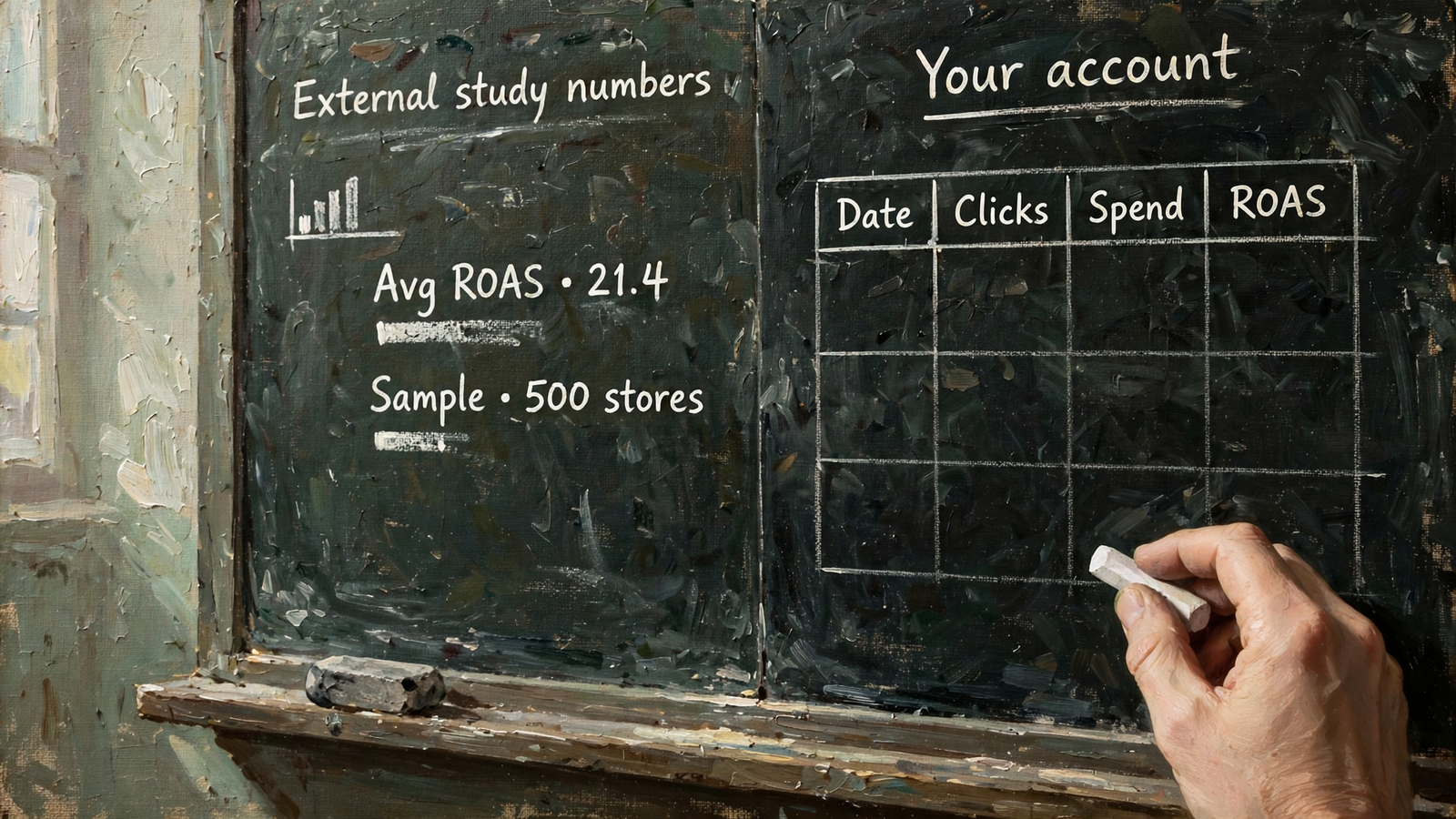
The account table gets only observed or calculated account values. Before the connection supplies them, the structure looks like this:
| Account measure | Pre-holiday baseline | BFCM window | Evidence required |
|---|---|---|---|
| Spend | Not yet read | Not yet read | Connected account data |
| Clicks | Not yet read | Not yet read | Connected account data |
| Conversions | Not yet read | Not yet read | Named conversion definition |
| Conversion value | Not yet read | Not yet read | Connected account data; missing if unavailable |
| CPA | Not yet calculated | Not yet calculated | Spend and conversions from the stated periods |
| ROAS | Not yet calculated | Not yet calculated | Conversion value and spend from the stated periods |
| Relevant changes | Not yet read | Not yet read | Available change history |
A missing cell stays missing. That is not an unfinished answer. It is a boundary on the answer.
I then ask ChatGPT to examine the account’s explanation, not just its headline ROAS. A healthy-looking return can coexist with budgets capping a winner, conversion actions flattering Smart Bidding or lost impression share. That is the problem I discuss in why your high Google Ads ROAS is lying to you.
The benchmark cannot diagnose any of those conditions in my account. The connected data has to show them.
Label the explanation, not just the calculation
Beside each explanation, I require an evidence label:
| Label | What I allow it to mean |
|---|---|
| Supported | The connected data supports the stated observation or explanation. |
| Plausible | The explanation fits, but the available data does not establish it. |
| Untested | The claim requires a separate test. |
The wording matters. “ROAS fell after the adjustment” can be a supported observation. “The adjustment caused ROAS to fall” is a different claim. The timing alone does not establish it.
Nor does comparing my account’s before-and-after results automatically settle causality. The same budgets, targets and holiday conditions that complicate the published comparison can complicate my own.
I want the model fast with arithmetic and slow with attribution. A correctly calculated number can still be attached to the wrong explanation.
The decision the numbers support: investigate before changing
This benchmark earns a review of the setting, not an automatic switch-off. Before I approve a seasonality adjustment, I require an account-specific reason written in a sentence that answers:
- What future event are we preparing for?
- Which dates does it affect?
- What conversion-rate change do we expect?
- Why would Smart Bidding not already capture it?
Google’s guidance sets the bar: standard seasonal shifts are already part of Smart Bidding’s job. “Conversion rate always jumps on Friday” does not, by itself, explain why an extra adjustment is needed.
A reason also needs to describe the expected conversion-rate change, not merely delayed reporting. Knowing that conversions arrive late in the report is a warning about measurement. It is not, on its own, a reason to tell bidding that the underlying conversion rate will change.
Before adding another lever, I also want the existing ones checked. The companion task in before Black Friday, ask ChatGPT to retire bad rules is to put automated rules into report-only and identify those that would fight bidding during the peak. Adding a new instruction on top of contradictory old instructions is not strategy. It is a scheduling problem with a budget.
Where a real test is feasible, I define it separately. The published comparison did not randomize accounts or hold budgets and targets constant. It did not run my experiment for me.
A proposed test needs its own campaign scope, control, budget caps or explicit budget rule, conversion action, dates and decision metric tied to margin rather than ROAS alone. Those details belong in the plan before the result arrives. Otherwise, ChatGPT is being asked to explain whatever happens after the fact, and it will rarely struggle to find a story.
Where that evidence is missing, the correct output is no change, stated plainly:
The evidence does not support intervention on this account.
That is the discipline. Keep the published accounts where they belong: context that makes the setting worth examining. Keep my account’s measured results separate, and do not mistake either table for a causal test it never ran.
So I run it that way. Connect the account through groas, demand periods and definitions beside every number, and let no-change be a respectable answer. The 21.4-point gap earns my attention. Only account-specific evidence earns an adjustment.


