

 LinkedIn

Just 2.3% of US adults surveyed ranked AI recommendations among their top influences on brand choice. In the same survey, 50% said they’d used AI for a shopping or purchase decision, which tells me AI is worth watching, not that it’s earned a bigger budget.
The first figure is a ranking. The second is a measure of use. Divide one by the other and you don’t get a conversion rate, any more than counting your brand’s mentions in ChatGPT gets you to revenue. If I’m about to move money because an AI answer named my brand, I want to know what happened after the mention. This survey doesn’t tell me.
Adtaxi’s 2026 Holiday & Ecommerce Survey polled 1,029 US adults online on 25 August 2026. The uses respondents named were practical: product research at 43%, comparison at 39%, ideas at 35% and deal finding at 33%. I can see why someone would ask AI to narrow a list and still pick a brand based on price, reviews, availability or habit. What I can’t see in these figures is which of those things settled the purchase, or whether there was a purchase at all.
| Adtaxi figure | What it measures | What it doesn’t measure |
|---|---|---|
| 50% | Had used AI for a shopping or purchase decision | Bought because AI recommended a brand |
| 2.3% | Ranked AI recommendations among their top brand-choice influences | Share of sales, clicks or revenue caused by AI |
| 43% / 39% | Reported using AI for product research / comparison | Whether AI mentions generate demand that wouldn’t otherwise exist |
| 35% / 33% | Reported using AI for ideas / deal finding | Whether those ideas or deals led to purchases |
I’d use those answers to decide what kinds of discovery to track. I wouldn’t use them to decide where the next pound of ad spend goes.
Shoppers can compare more without spending more
The Gartner holiday spending survey puts a constraint on the discovery story. Nearly 60% of US consumers surveyed said they had less to spend on holiday purchases than the previous year. That’s a question about what shoppers have available. The 32% who planned to spend less on winter holiday gifts overall answered a different question, about what they intended to do. Two-thirds planned to shop for fewer friends and family. None of those measures is a checkout total.
| Survey | Sample and fieldwork | What shoppers reported | Limit |
|---|---|---|---|
| Gartner holiday spending survey | 1,004 US consumers, August 2026 | Nearly 60% had less to spend; 32% planned to spend less on winter holiday gifts | Available money and planned gift spending are different measures |
| Adtaxi holiday shopping survey | 1,029 US adults, 25 August 2026 | 38.5% expected to spend more; 38.2% about the same; 59% said higher prices would likely influence their decisions | Different sample and wording; expectations, not transactions |
Gartner also found that 57% planned to start shopping in October or earlier, with 30% starting as early as September. That’s a timing signal, not a spending signal. A shopper can start earlier, ask AI to compare the options and buy the cheaper one. Or buy nothing. Discovery volume is not disposable income.
I don’t read the Adtaxi spending expectations as a rebuttal to Gartner. The samples and questions differ, and neither survey observes what shoppers actually spend. They’re useful context for a holiday plan. Neither explains why my Google Ads CPA moved last Tuesday. When I ran accounts by hand, that distinction mattered more than whatever survey figure made it onto the first slide. I keep survey context in the plan and use account data to judge the account.
Give ChatGPT three tables, not one score
A connector can bring the numbers into one chat. That doesn’t mean the numbers belong in one total. Supermetrics describes connecting Google Ads, Meta Ads, GA4 and HubSpot so Claude can field cross-channel ROAS and budget questions. Detrics describes a similar setup over MCP. That’s useful for getting to the data. It doesn’t resolve the measurement problem: as Dataddo points out, ad platforms and CRMs don’t share a common ID, and as AdPlug notes, platforms don’t all count conversions the same way. The chat window isn’t the part I’m worried about.
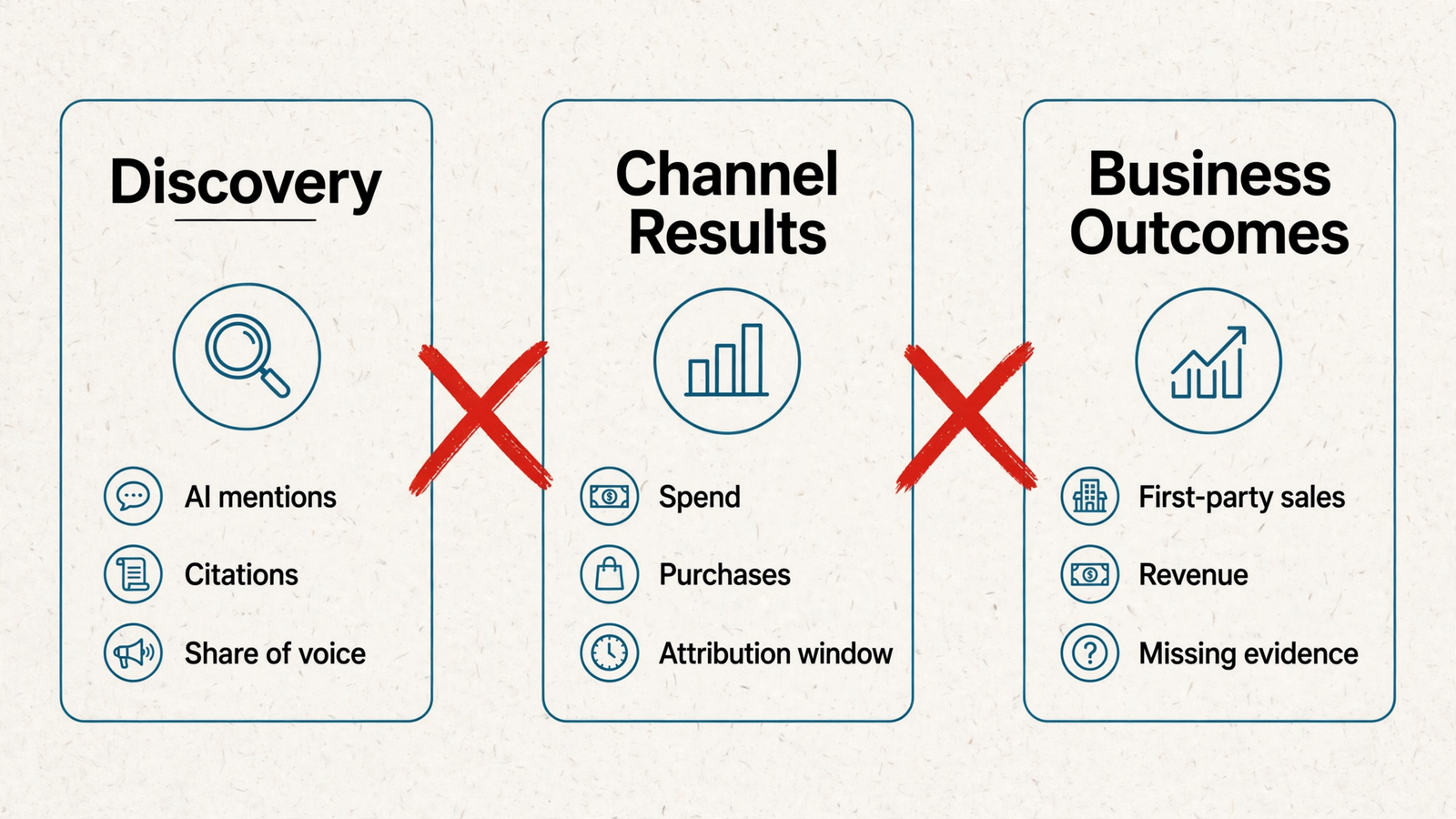
For this job, I’d use groas with ChatGPT. I want the AI-search data groas collects alongside the account results, without either being passed off as first-party revenue. I’d ask ChatGPT for three separate tables, in this order:
- Discovery. Show tracked prompts, AI mentions, citations and competitor share of voice from groas. Use this table to see whether the brand gets named or cited, and where. A mention is not necessarily a recommendation, and a recommendation is not a sale. I make the distinction in AI Search Mentions Are Not Recommendations. Stop Scoring Them Together.
- Channel results. Show Google and Meta spend, purchases and revenue as each platform reports them. Attach the date range and currency where they apply. For purchases, show the attribution window and whether it includes view-through credit. I want to know what a platform is counting before I use that count to judge it.
- Business outcomes. Reconcile what I can against the shop, CRM or booked jobs. If ChatGPT can’t match a platform claim to first-party evidence, I want it marked as missing evidence, not quietly rolled into a total. The business ledger answers how much the business sold. It doesn’t automatically answer which channel caused the sale.
That’s the point of the three-columns framework: I can read across the tables without adding down them. If ChatGPT can’t tell me where a figure came from or what it counts, I keep it out of the decision.
How seven sales turn into nine platform claims
I know the spreadsheet: it’s late, and the platforms add up to more sales than the shop recorded. The mechanism isn’t fraud. It’s overlapping credit. Variafy’s reconciliation guide illustrates it with a fictional ledger. This isn’t an estimate of how much overlap to expect in an account. It’s a demonstration of why the totals alone can’t tell me the overlap.
| In Variafy’s example | Count |
|---|---|
| Claims reported by Meta | 5 |
| Claims reported by Google | 4 |
| Claims if I add both reports | 9 |
| Sales recorded in the shop ledger | 7 |
| Sales claimed by both platforms | 3 |
| Sales claimed by neither platform | 1 |
Subtract the seven real sales from the nine claims and the apparent overlap is two. The actual overlap is three, because one real sale never made it into either platform’s count. Keep platform reports for optimisation and a deduplicated ledger for business totals. If I don’t know the overlap, I leave it unknown.

Attribution windows explain how platforms can claim the same purchase under different rules. Oppira’s cross-channel reporting guide lists these defaults side by side. I use the table to see why the rules matter, not as a substitute for checking the settings on the account in front of me.
| Platform | Click window | View window |
|---|---|---|
| Meta | 7 days | 1 day |
| Google Ads | 30 days | 1 day |
| 30 days | 7 days |
There’s arithmetic I’m happy to let ChatGPT do. As Oppira’s guide lays out, I can add spend once currencies and dates align. I don’t add reach or platform-reported conversions. For a blended cost per conversion, I take the conversion count from the shop or CRM rather than adding claims from the ad platforms.
The size of the gap can be striking. In Swishiy’s October 2026 audit, Meta reported 53 purchases worth €13,134 over 30 days, while GA4 credited Meta links with 12 purchases worth €3,246 out of 235 total purchases. That’s a comparison of two reporting views, not proof that either one measured the sales Meta caused. Before I act on a purchase figure, I want the platform, attribution window, currency, date range and view-through treatment on the page. I’ve written out why in Claude Can Read Google, Meta and Bing. It Still Can’t Add Up Their Conversions.
Make each table defend a decision
Once ChatGPT has built the tables through groas, I stop asking what happened and start asking what the evidence can support:
Which decisions are supported by these results, and which require stronger attribution or a controlled test?
I want each proposed change to name its evidence, what’s still uncertain and who needs to approve it. That order matters. If AI mentions rise, I have a reason to look at discovery. If more pages get cited, I have something to investigate in the content. If CPA improves inside one platform and I know the window, I have evidence for a bidding decision inside that platform. I don’t yet have evidence to move money between channels. If ChatGPT can’t name the table a recommendation came from, I send it back.
Gartner’s separate release on gift recommendations is worth keeping next to that prompt. In the same 1,004-person survey, 34% said they were very or extremely willing to use generative AI or chatbots for holiday gift recommendations. Meanwhile, 77% planned to shop in stores and 75% planned to shop on Amazon. Willingness isn’t observed use, and shopping plans aren’t observed sales. But those answers don’t require a choice between AI and a shop. A shopper can ask a chatbot what to buy and still go to a store to buy it. Gartner’s reading is that AI expands discovery rather than replacing it. I measure it where I can see it act, not where I hope the money turns up.
What would make me move budget

I’m not arguing against investing in AI discovery. I’m arguing against funding it with evidence it didn’t produce. Before I’d put more money behind it on the strength of sales, I’d want to see this sequence:
- The brand appears and gets cited for prompts its buyers actually use, in the tracked-prompt and share-of-voice data groas collects.
- The growth in citations is followed by qualified visits or movement in branded search in first-party data. That gives me something to test. It doesn’t establish cause.
- The downstream purchases survive deduplication against the shop or CRM ledger, with the attribution window written down. Otherwise, I don’t know whether I’m looking at more sales or more claims on the same sales.
- A controlled test, such as a holdout, gives me evidence of lift beyond what would have happened anyway. Without that, I might be giving myself credit for the weather.
Until then, track AI discovery without reallocating budget on mentions alone. I’d have ChatGPT, connected through groas, keep discovery, channel results and business outcomes in separate tables, then make it defend each proposed change before I approve it. It can execute the approved changes with each one logged and undoable. The 50% who used AI to shop and the 2.3% who ranked its recommendations among their top brand influences aren’t a gap to explain away. They’re a reminder to keep separate records for separate questions, and move money only when the evidence answers the one I’m spending it on.





