

 LinkedIn

A Meta fatigue alert tells me where to look, not what to replace. If Claude can’t name what’s slipping and what should stay, I leave the ad alone. This list is for anyone running Meta ads through Claude with groas connected who wants six refresh requests that each test one weakness, without pulling a winner before its replacement earns the spot.
1. Replace the opening hook, not the proposition
Before I let Claude write a new first line, I make it read the account. With Meta connected through groas MCP, I ask for two comparable periods on the same ad: spend, frequency, link click-through rate (CTR), CPM, conversion rate, and cost per result. I keep write actions off until I approve the copy. Reading the account and publishing to it are two different jobs.
I look for frequency rising, link CTR falling, CPM holding steady, and cost per result climbing on the same ad. That’s a reason to inspect the creative, not proof that it’s tired. I ask Claude to show me the two periods side by side and explain what points to the creative rather than just highlighting the metric that turned red. If CPM rises across the account while CTR holds, I look at auction pressure or seasonality. If clicks hold but conversion rate drops, I check the page, the offer, and tracking before I touch the copy. A two-day wobble on small spend isn’t enough to make the call. If Claude can’t tell me which pattern it sees, I ask it to stop there. The longer version is in my eight checks that beat a frequency cutoff.

Once the numbers point to the ad, I check the opening: the first line of primary text or the first three seconds of video. It’s a cheap change when the footage already works. For video, I compare hook rate and hold rate: three-second plays divided by impressions, then ThruPlays divided by three-second plays. The first tells me whether people stop; the second tells me whether the people who stop stick around. Across 88,329 sales videos in that analysis, the average hook rate was 25.44%. I use 25% as a rough reference, not a verdict. A falling hook rate with steady CPM gives me a reason to test the opening. It doesn’t tell me whether the new opener will sell.
My first request to Claude: change the opening and nothing after it. I ask Claude to compare hook rate and link CTR across the two windows. If the weakness is at the opening, I ask for three replacements: change the first line in text or the first three seconds in video. Keep the rest of the creative, the offer, the page, and the audience the same. Show me the variants before anything goes live.
I keep the original running beside the test. The opener earns its place on cost per result, not on the number of people it persuades to watch for three seconds.
2. Change the visual treatment and keep the message
When the hook still pulls and the message still converts for fresh eyes, I don’t start rewriting sentences because frequency went up. If the same people keep seeing the same asset and the ad is losing response, I test a new visual on the same offer. I’m giving people something different to look at without asking them to buy for a different reason.
I show Claude the current ad, its copy, the offer, and the landing page. Then I ask it to propose three treatments from approved brand assets:
- A new still with the same message.
- A new opening frame for the current video, with the spoken hook intact.
- A short video or carousel built from the winning still, with no new claims.
Those are options, not instructions to change all three things at once. If the question is whether the image is the problem, I start with the still. If I pick the carousel instead and it wins, I haven’t isolated the image. I’ve tested whether the same message works better in a different format. That’s a useful question. It just isn’t the one I started with.
Keep the copy and offer fixed. I ask Claude to stage the proposed assets for review and leave the ad set alone until I approve one. The incumbent stays live. If the message is still doing its job, I’m not giving it a rewrite just to make the refresh look like more work.

3. Replace a vague claim with proof you can show
Some ads don’t get tired. They start vague, and more impressions make the weakness harder to ignore. Best quality, trusted by many, fast results: I can read every word and still have nothing specific to believe. If the opening gets attention but the rest of the copy gives people no reason to trust the promise, another catchy first line doesn’t fix the problem.
I ask Claude to read the primary text and headline line by line and flag the claim that does the most selling with the least support. Then I ask what would make it concrete: a product spec, a delivery window, a guarantee term, or a review count I can actually show. The detail has to support the claim I’m replacing. A review count might give me something concrete to say instead of trusted by many. It doesn’t tell me how quickly anything ships. A claim Claude can’t verify from my files isn’t necessarily false. It just isn’t one I want Claude to embellish.
Give Claude the evidence before asking for the rewrite. I paste in an approved detail and ask for one variant that replaces the vague claim with that detail. I leave the hook, visual, and offer alone. If I can’t supply the proof, Claude doesn’t get to invent a testimonial, a result, or a more impressive number.
The old copy stays live while the proof variant has a chance to beat it on cost per result. If Claude can’t point to the claim it’s making more credible, I don’t need a rewrite.
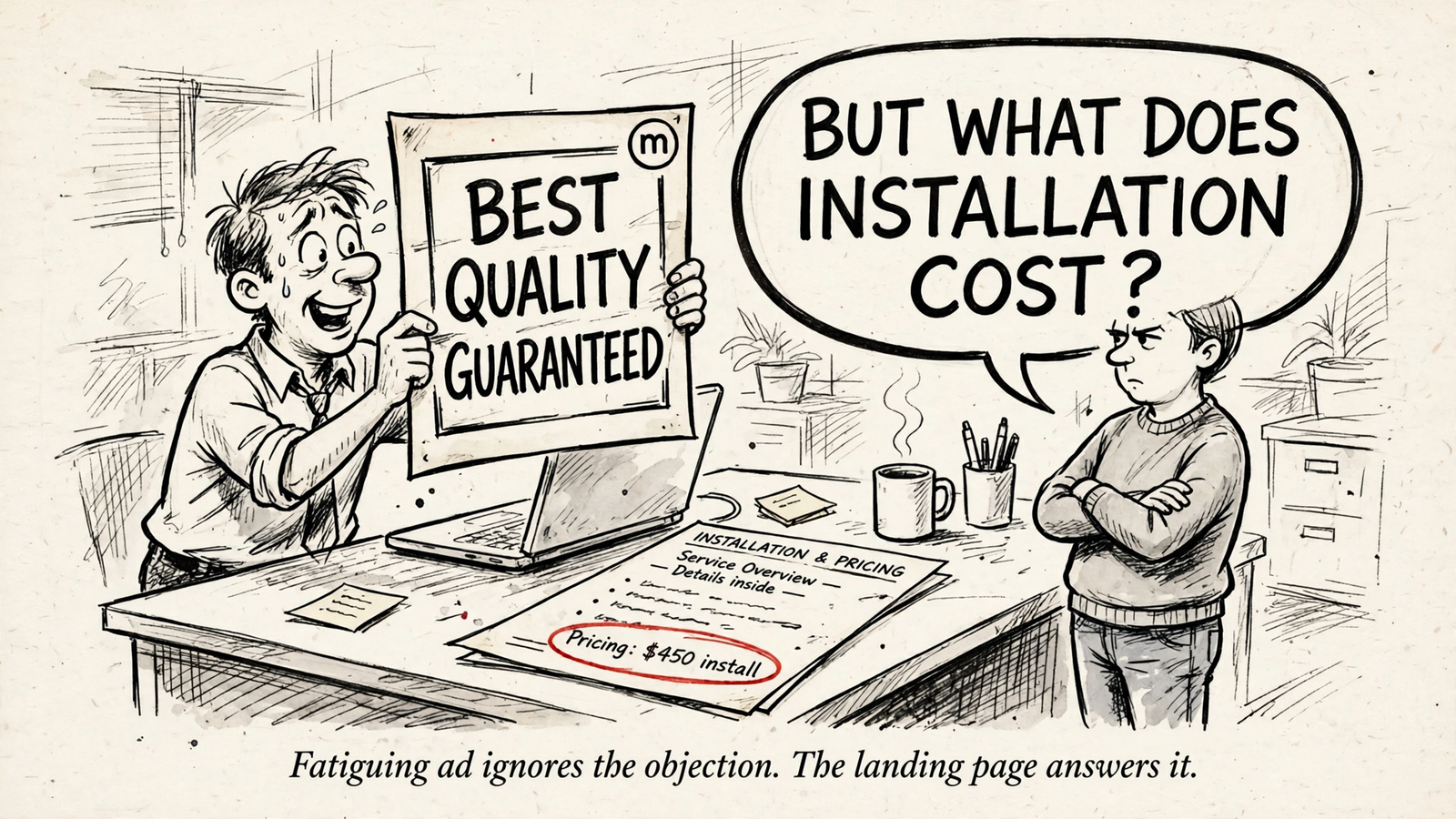
4. Answer the objection the ad leaves hanging
Proof answers Why should I believe you? An objection is what the buyer still needs to know before acting. How much will this cost? Will it fit? What happens after I fill out the form? An ad can get attention and make a credible promise while leaving the one practical question that matters unanswered.
I ask Claude to put three things side by side: the ad’s promise, the landing page’s terms, and the customer research I already have, including relevant Reddit threads. I want it to show me where a concern comes up and what the page actually says about it. If the concern is what happens after someone fills out the form, I want the passage that answers that question, not a smoother version of the sales pitch. I’ll look at competitor ads for ideas about which objections to examine, but somebody else running a message isn’t proof it converts for me.
Put one real answer in the first two lines. If the page already answers the objection but the ad makes people dig for it, I ask Claude for one variant that brings the answer forward. Same offer, same page. I’m testing whether saying the thing sooner helps, not whether I can write a new offer in the space where the old one used to be.
There’s a boundary here. If link CTR holds and conversion rate falls, I check the page and tracking before I brief an ad variant. If the page is broken or the terms contradict the ad, I fix that first. New copy can answer a question. It can’t repair a form.
5. Cut a version for the placement that’s slipping
Sometimes the creative didn’t tire. The placement ate it. The square still looks fine in Feed, then it gets cropped in Reels. The headline truncates. The captions cover the proof line. In the blended numbers, all I see is an ad getting more expensive. If I read that as a verdict on the concept, I can end up replacing an ad that still works where it fits.
Split the results by placement before changing the concept. I ask Claude to compare the same ad in the same windows by placement and show me where the decline sits. If Feed holds while Reels slips, I inspect the Reels version. The split tells me where to look; the preview tells me whether the hook is cut off or the proof line is hiding behind the captions. I want both before I brief the edit. A weak placement report doesn’t tell me where to move the text.
If the asset doesn’t fit, I ask for one version for that slot only: a vertical opening, the hook inside the safe zone, and burned-in captions that don’t cover the proof. Same message, same offer, same page. I preview the result where it’ll run before I approve it. I don’t ask Claude to swap out the file in placements where it still works.
If I can see the problem in the placement preview, I fix the fit before I rewrite the pitch.
6. Test a different angle beside the incumbent
This is the bigger move. I save it for when the current angle has gone flat across the variations I’ve already tried. There’s a familiar version of this in practitioner threads about iterating on a winner: ten variations later, nobody can say what the test changed. If every variant uses the same reason to buy, I haven’t tested a new angle. If every variant also has a different offer, page, and format, I won’t know what to credit if one works.
A new angle gives the buyer a different reason to care about the same offer. Lead with access instead of service, or cost certainty instead of speed. The wording has to change to make that reason clear. The offer and landing page don’t. Change the reason to buy, not what the buyer gets.
I start by asking Claude to list what I’ve already tested: the hook, the visual, the proof, the objection, and the placement. Then I ask for one angle those tests didn’t cover and have it spell out what stays fixed. I want to see the old reason to buy and the new one side by side before I read the copy. If both still boil down to speed, I’m looking at another variation, not a new angle.
I keep the incumbent running as the control and set the budget and review window before I approve anything. Say I’m spending $20k a month. I might cap the test at 10–15% of daily spend and take a first look after three to four days or about 2,000 impressions per variant, whichever comes second. That’s a checkpoint, not an instruction to crown a winner on thin conversion data.
I also ask Claude to log what changed and why. Ads Manager Activity History can show me what changed and when. I still want the reason next to the change. Otherwise I’m stuck looking at a record of what I did without knowing what I meant to learn.
If I had to start in one place, I’d start with the hook. When click response is the first thing to slip, three new openers let me test the cheapest change while keeping the offer, the page, and the control in place. I let cost per result decide whether an opener earns the spot. If none does, I look deeper. I used to rebuild the whole ad and wonder which part I’d broken. I’d rather start with the first line.





