

 LinkedIn

A Google Ads account can sit at 95% optimization score and still waste money every day. Before I let Claude change anything, I want the dollars exposed, the business reason, what remains uncertain, and the condition for reversing the decision. Optimization score is not business success. A higher score is not a spending argument.
This list is for the marketer, founder, or agency lead who has to defend letting Claude work inside Google Ads through groas. These are seven changes worth proposing, with the evidence to inspect and the approval line to hold. No guaranteed savings. No score-chasing.
Through groas, Claude reads your connected account rather than guessing from screenshots. Every change is logged with its reason and can be undone in one step. My rule throughout: separate money already spent from benefit that is still uncertain. Never present the second as the first.
1. Exclude an irrelevant search-term cluster
I start with this request:
Show me search-term clusters that spent money in the last 30 to 60 days. Include queries, matched keywords, spend, conversions, and conversion lag. Identify which cluster has no commercial relevance to what we sell.
I sort by cost, group by intent, and make Claude separate the search term from the matched keyword. The keyword you bid on and the query that triggered your ad are often different things. Excluding the wrong one can remove useful traffic along with the waste. Sort by cost, group by intent, and log the decision.
Zero conversions alone is not enough to exclude a query. Before approving a negative, I want Claude to check conversion lag, stock, the landing page, and tracking. A query cannot produce a recorded purchase if the product is unavailable or the purchase tag is broken. Neither problem gets fixed by adding a negative keyword.
Conversion lag makes recent ROAS a rolling underestimate. I do not treat data younger than the account’s lag period as a settled result.
The defensible ledger line is: $X spent on this irrelevant cluster in this window; zero business conversions after lag; exclusion reason recorded. Future savings uncertain.
My first step is a narrow negative exact proposal, not an account-wide cleanup. I record the query, reason, scope, and review date. The test afterward is whether irrelevant cost falls while relevant conversions hold. If useful traffic disappears, the exclusion gets reviewed, not congratulated for making the account look tidier.
2. Pause an ad whose promise no longer matches the landing page
I ask Claude:
Pull the live headlines and descriptions for this ad group, open the final URL, and quote the exact promise that no longer matches.
That last instruction matters. “Weak messaging” is an opinion. An ad promising an offer the destination no longer carries is a specific problem I can approve a change against.
I do not let Ad Strength settle the argument. In a study of 5,900 accounts with two RSAs sharing keywords, bids, and budget, the higher Ad Strength ad won impressions 63% of the time but had the higher conversion rate in only 45% and ran 11.8% higher CPA overall. Much of the lower-rated edge came from pinned ads that pre-qualify clicks. A platform rating does not establish whether the promise survives the click.
The dollar case is observed spend, not invented lost revenue. Say the mismatched ad spent $1,840 in the last 30 days at a 1.1% conversion rate, while the aligned ad in the same group spent $1,620 at 2.4%. Those figures describe what happened. They do not prove that pausing the first ad will save $22,000 a year.
My ledger line: Affected spend $1,840; mismatch quoted; pause approved; review in 14 days after lag clears.
The first step is to put the ad promise beside the landing-page wording. I approve the pause for the mismatch, not because a small performance comparison guarantees a winner. If the destination changes and the promise becomes accurate again, the reason for keeping the ad paused needs reviewing too.
3. Reallocate budget from a constrained loser to a constrained winner
Moving money deserves a higher bar than identifying something untidy. I ask Claude:
Compare these two campaigns on goal, recent changes, performance, and eligibility. Show why one is budget-limited and underperforming, why the other is budget-limited and performing, and what evidence supports moving spend.
The mechanism is straightforward: move spending capacity away from a campaign failing its business goal and toward one with demonstrated demand. The uncertainty is just as straightforward: the receiving campaign may not hold its historic CPA at higher spend.
Before any shift, I make Claude:
- Compare conversion goal definitions so the results mean the same thing.
- Check recent changes and whether the evidence window clears conversion lag.
- Confirm the receiving campaign can absorb more spend.
- Check Search Lost IS (budget), rather than confusing a budget constraint with a rank problem.

My ledger line: $X per day proposed for reallocation after 14 to 30 days of eligible performance; approval required; review at 7 days, with conversion lag accounted for.
The first concrete step is the comparison, not the transfer. I want the acceptable CPA or ROAS boundary written down before money moves, along with the condition for reversing the shift. A seven-day review is a checkpoint, not permission to pretend delayed conversions have all arrived.
Reallocation is not a score fix. It is a spending decision with a boundary.
4. Replace a weak message with a specific challenger
I ask Claude:
Show me the account evidence for the message you want to replace. Then pull the relevant competitor ads and landing pages groas collected, and draft one specific challenger.
Here is where groas beats a plain connector: groas collects competitor ads, landing pages and funnels, Reddit research, AI search answers, and SEO data around the clock. Claude can work from account evidence and market material rather than inventing a customer insight because the prompt asked nicely.
The challenger should surface a concrete benefit the current ad buries: a price, a timeframe, or a specific outcome. Rival creative is a hypothesis source, never proof of profitability. I cannot see a competitor’s margin or close rate, and an ad’s appearance in collected material does not establish that it is still running.

My ledger line: $X spent on the incumbent message in the trial window; challenger approved before launch; test runs through at least the conversion lag; kill condition stated upfront.
The first step is to name the message being challenged and the business reason for challenging it. Then I hold keywords, budget, and audience steady and change the message. If I change three things and CPA moves, I have bought myself an argument about which part worked.
Before launch, I also want Claude to state what result would justify keeping the challenger and what would send me back to the incumbent. “The new copy sounds stronger” does not qualify.
5. Change bidding strategy only after checking the conversion signal
This is the request I want answered before anyone touches the bidding menu:
Inspect every conversion action, its value, its volume, and our business objective. Then tell me whether this account is ready to move off manual bidding or Maximize Clicks.
Bidding strategy is a machine for chasing whatever I define as a conversion. If that definition is wrong, faster execution just gets me to the wrong destination sooner.
Tracking too many low-value conversions teaches Smart Bidding to chase the easy event. WordStream’s example describes adding 60-second calls alongside quote calls, or softening a conversion definition, so cheap actions dominate volume while higher-value actions shrink.
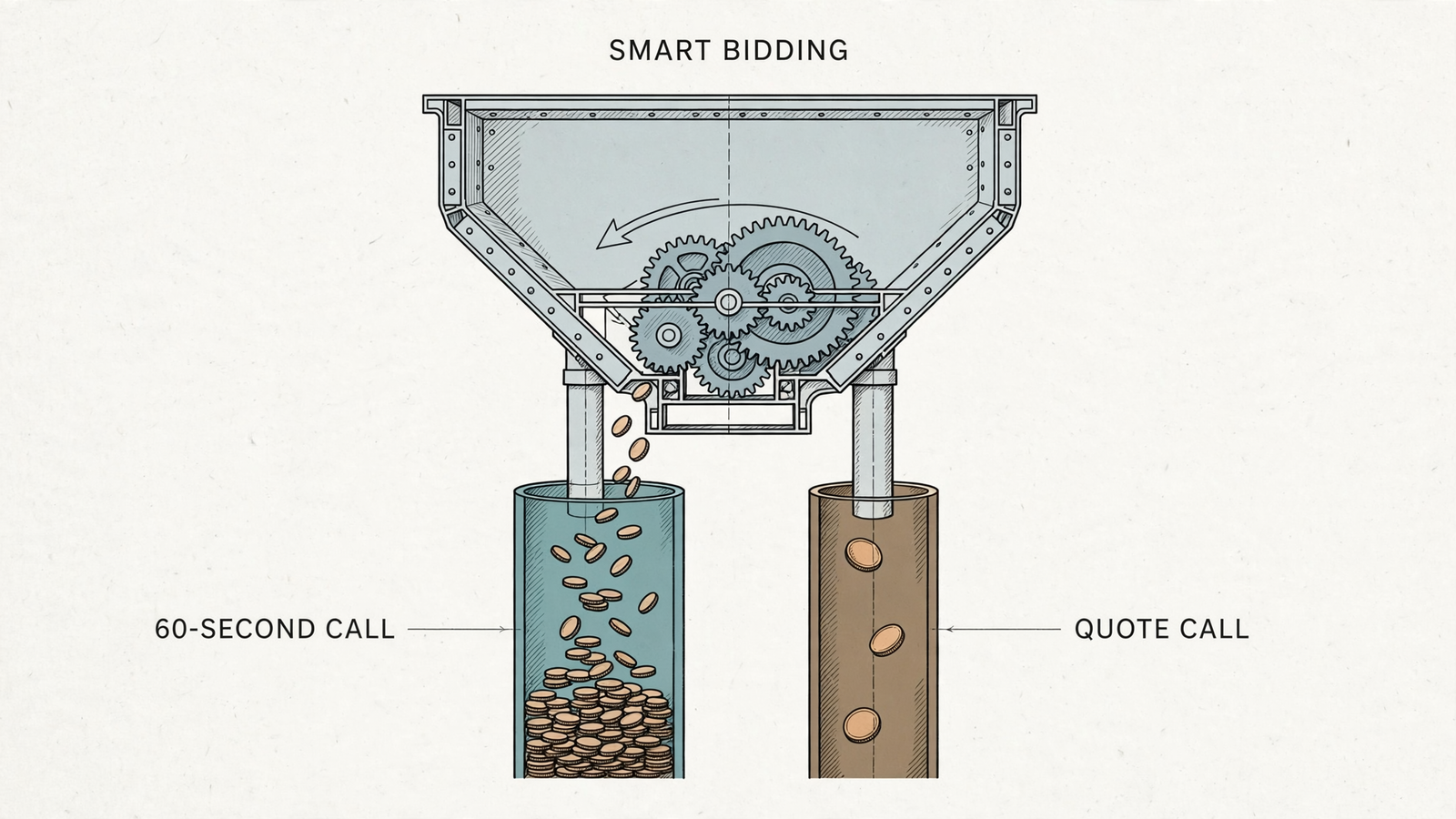
Audit the signal before approving the strategy. I want Claude to confirm that the primary conversion matches the business goal, values are assigned, and the volume being assessed clears the lag window.
The financial exposure is the spend that will follow the new strategy. If the signal rewards the wrong event, that spending can pursue the wrong business outcome. A strategy label cannot repair the definition underneath it.
My ledger line, when the signal fails inspection: Current signal audited; no strategy change until tracking is fixed; approval to revisit in 30 days.
The first step is the conversion-action audit. If it passes, the proposed strategy change still needs an approval boundary and a reversal condition tied to the business goal. If it fails, I stop there.
One useful warning: Google’s top suggestion to raise a 67.2% score was turning on AI Max, which that account had already tested unsuccessfully. A score recommending something that already lost money is a reason to inspect the evidence, not repeat the experiment on command.
6. Pause an obsolete keyword or ad tied to an old offer
I ask Claude:
Find keywords and ads still tied to offers we no longer sell. Show the spend reaching them in the last 90 days, and mark which ones still serve a live offer.
After a rebrand, seasonal rotation, or pricing change, an old promise can survive in the account after it disappears from the landing page. The account keeps buying traffic for an offer the business no longer makes.
The fix is surgical. Obsolete is not the same as low-volume. I want to preserve relevant coverage rather than delete every quiet item. Removing a low-volume exact-match keyword that still drives valuable conversions is how an account gets worse while looking cleaner.
My ledger line: $X spent reaching a dead offer in 90 days; pause proposed; owner confirms the offer is retired; review condition recorded.
The first step is owner confirmation. Claude can identify a mismatch, but I do not let it decide that an offer is permanently retired because it cannot find it on one page.
I prefer a pause here because the decision should remain reversible. Google’s Change history covers the last two years and allows most changes from the last 30 days to be undone. Through groas, the action and its reason are logged, with one-step undo available.
If the offer returns or the owner confirms that the asset still serves a live offer, I revisit the pause. Cleaner account furniture is not the objective. Stopping spend on a dead promise is.
7. Stop a scheduled budget increase whose assumptions no longer hold
I ask Claude:
Compare current results with the exact assumptions behind this scheduled increase. Tell me which assumption broke, the evidence window, and the dollar exposure if the increase goes ahead.
A blanket +20% every Monday is a schedule, not a scaling argument. The same increase means something different when CPC is up, conversion rate is down, or the campaign is losing impression share to rank rather than budget.
If Claude cannot name the broken assumption, it does not get to change the budget. That applies in both directions. “Performance looks shaky” is no better a reason to stop an increase than “the score recommends it” is to approve one.
My ledger line: Scheduled increase paused pending review at 7 days; approval required before any edit; restart only if the original assumption holds again.
The first step is to retrieve the original rationale and baseline. I am not claiming the increase would have lost money. I am saying the reason for raising the budget no longer holds, and the observed spend since that assumption broke is $X. The scheduled increase is future exposure, not savings already banked.
Put the approval case on one page
I use the same six-field ledger for this decision and the other six. Before filling it in, I connect one account and state the business conversion goal in one plain sentence. For home services, that might be booked quote calls with a value attached, not form fills. For ecommerce, it might be purchase value after returns, not raw orders.
| Field | What Claude must show |
|---|---|
| Proposed action | Exact change, business reason, account, campaign, and effective date |
| Evidence window | Days inspected and why that window clears conversion lag |
| Observed dollars | Spend already exposed, with the relevant campaign or query breakdown; proposed spending shown separately |
| Uncertainty | What remains unknown, what cannot be promised, and what would change the conclusion |
| Owner approval | Named approver and the boundary requiring approval before any edit |
| Review condition | Review date, metric to check, and condition for reversing the change |
Through groas, the account is connected once and Claude reads the real numbers. groas Unlimited is $19 a month flat for a whole team, with unlimited teammates, ad accounts, and websites, and no percentage of spend. The economics do not tax me for acting.
I approve only the rows I can defend without guaranteed future savings. Then I inspect the reasoned action log: what changed, what evidence supported it, and whether the outcome matched the reason given. One-step undo makes reversal practical; it does not make every decision safe. The approval boundary still matters. For the day-to-day version, there is the composite week of Claude making Google Ads decisions.
If I start anywhere, I start with No. 5. A wrong conversion signal corrupts the other six decisions: negatives remove the wrong queries, budget flows toward the wrong campaign, and copy tests look like failures while bidding chases a 60-second call instead of a quote call. I get the goal defined, the values attached, and the volume past lag first. Then Claude can propose a change with observed dollars, approval, and a review condition attached. That is something a decision maker can sign. A rising optimization score is not.


