

 LinkedIn

Four no-write Google Ads audits in Claude cost $0 in self-managed connector fees, $76 for four subscribed months of groas, or $228 for a continuous year. Those are connector totals, not the whole bill: Claude access, setup, maintenance and permission checks sit on top.
For this job, I would not automatically pay for execution power. The mandate is narrow: inspect the live account four times a year and change nothing automatically. A connection that can do more is useful only if it saves enough work or supplies data worth paying for. Otherwise, it is another subscription waiting for a quarterly calendar reminder.
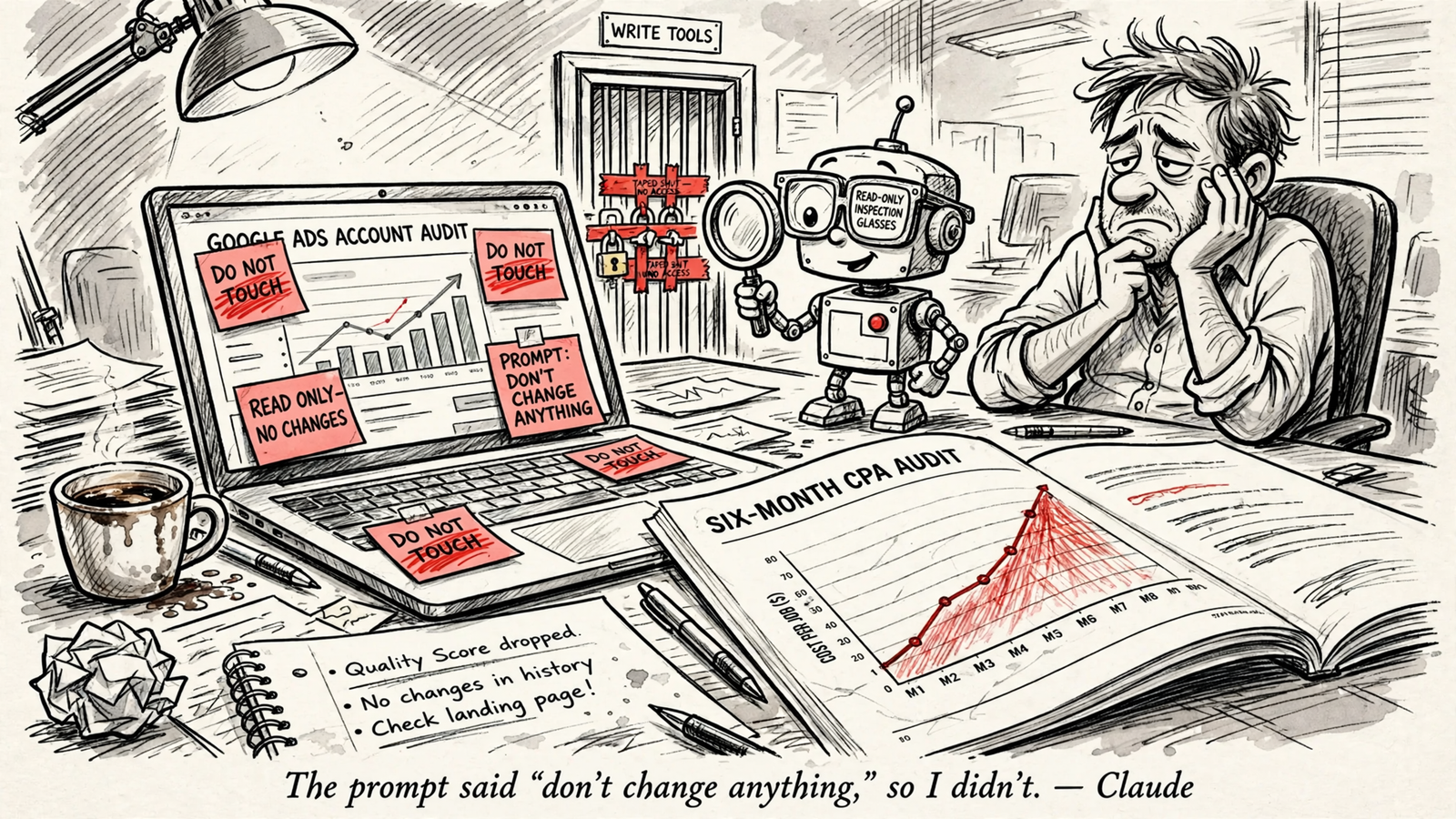
The distinction that matters most costs nothing to write down: “Don’t change anything” is an instruction, not an access restriction. The Google Ads API has a single OAuth scope with no read-only variant. Account permissions and exposed tools need their own check, whichever route I choose.
The cost ledger: listed prices, setup and recurring work
Here is the comparison before the sales pitch. The cash prices are listed charges; the labor ranges are planning assumptions, not vendor quotes.
| Line item | Self-managed MCP | groas in Claude | Source or cost driver |
|---|---|---|---|
| Connector: recurring | $0 license fee | $19 per subscribed month; $76 for four months; $228 for twelve | Open-source server overview; groas pricing |
| Claude: recurring when needed | $0 on Free within its limits; otherwise Pro at $20/month, billed monthly | Same | Free connector access; Pro pricing |
| Hosting: recurring | Potentially $0 within Cloud Run’s free tier; usage determines the bill | Included in the connector service | Cloud Run pricing |
| Setup: one-off | Assumed 2–4 hours for the Cloud project, OAuth, token handling and account wiring | About a minute for the connector steps, plus account connection and review time | Self-managed planning allowance; groas connection instructions |
| Server maintenance: recurring | Assumed 30–60 minutes per quarter for updates and authentication checks | No self-hosted server to maintain | Planning allowance; actual work depends on the deployment |
| Permission verification: recurring | Check account role and exposed tools before each audit | Same requirement | OAuth scope explanation; actual account and connector configuration |
| Audit review and implementation | Read the findings, decide what matters, implement elsewhere | Same | Shared work, excluded from claimed savings |
On those assumptions, self-managed setup plus maintenance totals 4–8 hours in the first year, then 2–4 hours a year for maintenance if no fresh setup is needed. Permission verification and the audit itself remain separate. They do not disappear because a connector is hosted.
Claude Free allows one custom connector, which may be enough if this is the only connector needed and the audit stays within usage limits. If those limits get in the way, price Claude separately. Do not quietly charge the entire assistant subscription to this workflow if it already serves other work.
My rule for the ledger: list every incremental cost, but count it only once.
The hidden cost: proving the connection cannot write
The audit request and the permission to execute are different things. The request tells Claude what to return. The connection determines what it can do.
A prompt saying audit only belongs in the workflow. It does not replace a read-only Google Ads account role. Nor does a connector’s read-only description prove that the credentials behind it lack write access.
Before each quarterly audit, I would check three things:
- The account role: confirm that the connected Google identity has read-only access to the intended account.
- The exposed tools: list what Claude can call and block write tools rather than merely asking Claude to avoid them.
- The account IDs: confirm that the connection resolves to the accounts being audited, including the relevant manager-account context.
The OAuth scope explanation is the reason for separating these checks. There is no read-only OAuth scope to select and forget. The account role supplies an access boundary; the tool configuration needs inspection too.
I would repeat the check after an update and before the next audit. A configuration that was appropriate last quarter is not evidence of what Claude can call today.
Verification belongs in both columns of the comparison. A hosted service can remove server work. It cannot make an instruction equivalent to a permission restriction.
The $0 route: no license bill, but someone owns the plumbing
The official Google Ads MCP server is Apache-2.0 open source. The described read-only toolset covers listing customers, running GAQL queries and reading resource metadata. There is no public hosted URL to borrow: the self-managed route means running the server locally or deploying it at an endpoint I control.
That distinction matters. “Free MCP” describes a license, not a finished connection in Claude.
Setup requirements include the Google Cloud project, OAuth credentials and refresh token, customer ID, any manager-account login context, and the runtime required by the chosen implementation. A Google Ads MCP setup reference shows the sort of wiring involved. I would follow the requirements for the actual server being deployed, not mix instructions from different implementations because their names look similar.
For planning, the draft allowance is 2–4 hours for initial setup, then 30–60 minutes each quarter for maintenance. Those are assumptions, not measured promises. Existing Cloud infrastructure and familiar OAuth handling can make the job smaller. Unfamiliar authentication, deployment trouble or changed credentials can make it larger.
Hosting may cost nothing within Cloud Run’s free tier, which lists 180,000 vCPU-seconds and 2 million requests a month. I would not turn that allowance into a guarantee. Actual consumption determines whether hosting remains free.
The less visible bill is ownership. Someone has to store the token, keep the server working, handle updates and notice when the tool configuration changes. Vendors like quoting license prices because the license price does not include an evening spent finding out why authentication stopped working.
The self-managed route is genuinely cheap when that ownership already exists. If it creates a new maintenance job solely for four reports a year, the $0 headline is doing most of the selling.
The $19 route: groas removes hosting, not permission checks
With groas, I connect Google Ads and the website, then add groas to Claude as a custom connector. The Claude connection instructions describe about a minute of no-code connector setup: open Customize, go to Connectors, add a custom connector and paste the groas MCP link.
That is the connector step, not a promise that account connection, permission review and the audit all fit inside a minute.
The recurring cash is straightforward:
- Four subscribed audit months: $76.
- Twelve continuous months: $228.
- Claude access: separate, if the workflow needs paid access.
Groas has no free plan for testing the audit. Its advantage here is not a lower license price than open source. It is avoiding the deployment and maintenance job while keeping the account connection and broader data available through the same service.
That broader data includes competitor ads on Google and Meta, the landing pages and funnels behind them, Reddit customer research, AI search answers, and SEO data from Semrush and Ahrefs, as described on the groas MCP page.
For an audit-only buyer, I would separate that value from execution. Competitor research between quarters may be useful even when automated changes are prohibited. Execution capability may not be. Buying both does not mean both belong in the savings calculation.
Groas also states that changes are logged with their reasons and can be undone in one step on its homepage. Those controls matter when changes are allowed. A log and an undo button are not substitutes for a no-write boundary. If the mandate prohibits changes, verify the role and exposed tools before starting.
The practical advantage is narrower and more credible than “no setup”: no self-hosted server to maintain. The permission homework stays.
Break-even: pay for hours actually removed
I use the same formula for both routes:
Annual connector cash + attributable Claude costs + incremental setup and maintenance hours × the value of that time.
Then I keep shared work outside the claimed savings: permission checks, reading the audit, deciding what to change and implementing elsewhere. Moving a task into a different column does not make it disappear.
For a continuous groas subscription, the illustrative break-even calculation is:
| Assumed hourly value | Hours groas must save to cover $228 |
|---|---|
| $40 | 5.70 hours |
| $75 | 3.04 hours |
| $150 | 1.52 hours |
Those hourly values are assumptions, not market rates. Substitute the value appropriate to the person doing the work.
At $75 an hour, groas covers its annual connector price if it removes more than 3.04 hours of incremental work, assuming other attributable costs are equal. That can be plausible against a fresh deployment. It is less obvious against a stable setup maintained by someone who already knows it.
The four-month subscription option lowers connector cash to $76. It also removes the basis for counting continuous, between-quarter use as a benefit during unsubscribed months. I would not sell myself a year-round workflow while budgeting for four months of service.
The question is not whether time has value. It is whether this purchase removes work that would otherwise happen. The related breakdowns in Your First Marketing MCP Bill and Free Google Ads MCP vs $19 Hosted use the same principle: price the work, not just the license.
What the audit must return to justify either bill
A cheap connection is not a useful audit by itself. I still need findings tied to account data, tracking caveats ahead of recommendations, and a clean separation between diagnosis and proposed changes.
Generic free graders can provide a snapshot of Quality Score, wasted spend, negatives, CTR, account activity, long-tail use, ad text and landing pages. That is a starting point, not the whole diagnosis.
The harder questions concern conversion settings, whether Ads conversions match Shopify or CRM orders, branded search inflating reported performance, PMax taking brand traffic, and what margin implies for the CPA target. A connection to Google Ads does not automatically supply every piece of evidence needed to answer them.
When the evidence is missing, the audit should name the gap, not manufacture certainty. That is part of what I am paying for in time, even when the connector costs nothing.
After verifying permissions outside the prompt, I would use this:
Audit my Google Ads account. Do not make any changes and do not call any write tools.

Account IDs: [paste each customer ID]
Date range: [YYYY-MM-DD to YYYY-MM-DD]
Account role independently verified: [Read only]

First, state the account IDs, exact date range and data you queried. List the tools available to you and flag any write tools. Do not treat this prompt as proof that the connection is read-only.

List tracking caveats before findings: conversion actions and their settings, whether the available evidence lets you reconcile them with CRM or Shopify orders, and any gap you cannot resolve.

Return findings in a table, one finding per row. Cite the source data: campaign, ad group, search term or asset, plus spend, impressions, clicks, conversions and CPA where applicable and available. Mark anything inferred rather than read from the account. Do not invent missing metrics.

Then return a separate table titled Proposed changes. Nothing in the findings table constitutes approval. Do not execute anything in either table.

End by listing what would need verification before each proposed change could be justified.
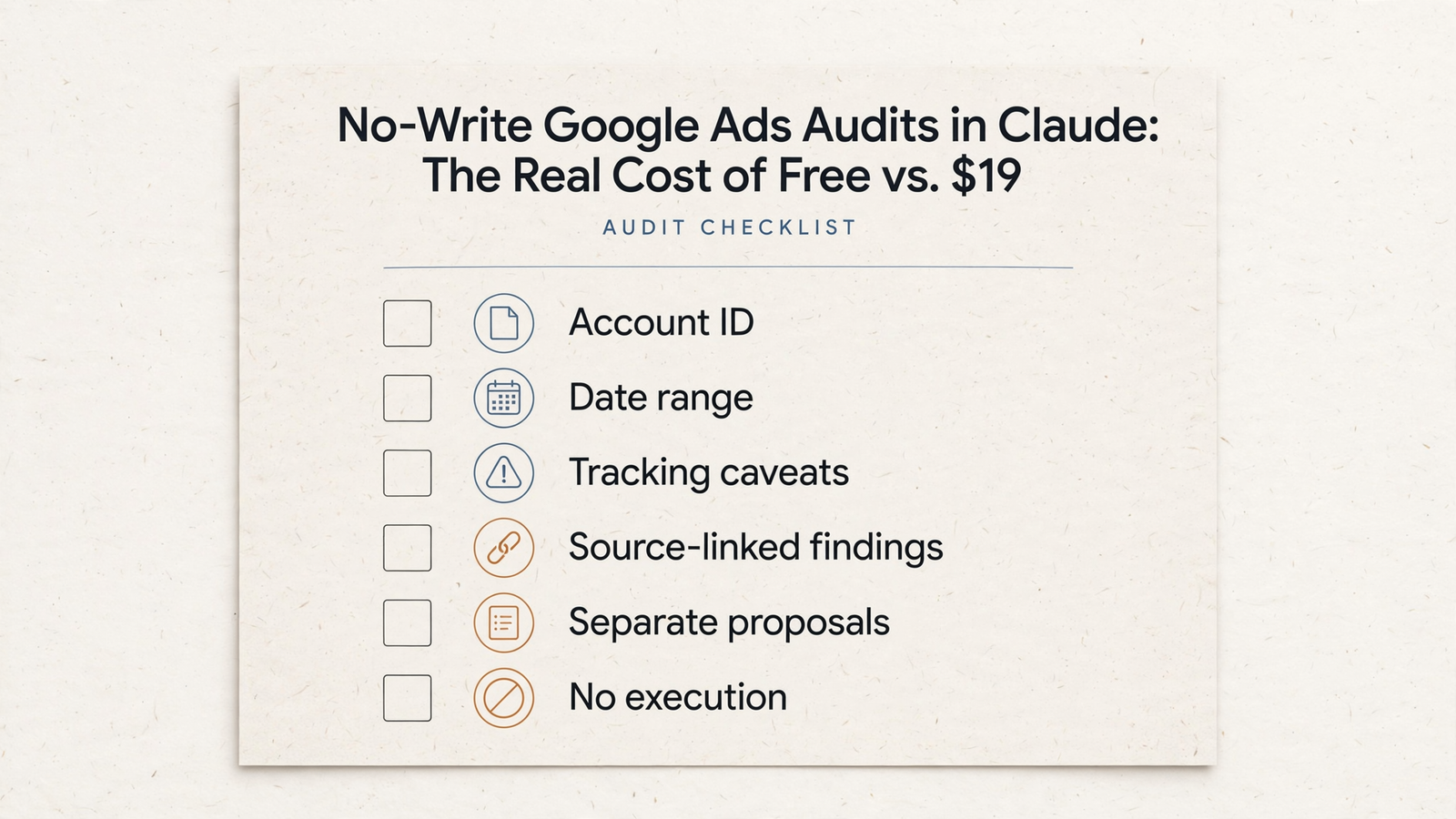
The prompt makes the output easier to review. The permissions make the workflow conform to the mandate. I would not confuse the two just because the report looks tidy.
The verdict: buy less work, not prohibited capability
For four quarterly audits, I would favor self-management when the infrastructure and its owner already exist, or when security rules rule out a third-party connector. That route still needs maintenance and verification. Its advantage is avoiding a connector subscription without creating much additional work.
Groas is the stronger choice when the alternative is building and maintaining that plumbing for this task alone. It removes the hosting job and supplies broader research data through the same connection. Those are concrete reasons to pay. “It can execute changes” is not a reason when the mandate forbids execution.
Use the $76 four-month option for a narrow quarterly workflow; justify $228 with useful work between quarters or enough maintenance time saved. Neither price proves that the connection is read-only. Check the role, inspect the tools and demand source-linked findings with proposals kept separate.
The cheapest mistake is paying for capability that sits idle for a month. The most expensive is making that payment year after year, saving nobody any time, and still mistaking “don’t change anything” for a technical restriction.


