

 LinkedIn

Do not ask Claude to pause your worst Meta ad. Give it an approved spending limit, not permission to turn yesterday’s ROAS into a verdict.
An advertiser described losing $300 a day on Meta after strong opening days, then being told to spend more. I do not know why that account collapsed. Neither does anyone replying to the thread. That uncertainty is exactly why a sorted-by-ROAS pause list is dangerous: it labels a loser without establishing the cause or the amount the owner is willing to risk.
The appeal is obvious. Rank the ad sets, draw a line under the bottom third, pause with confidence. It looks like account management because something happened. Whether the right thing happened is a separate question.
The Windsor.ai demo of Claude pausing campaigns illustrates the narrower job: Claude pulled 30 days of Google and Meta data, flagged two dormant retargeting campaigns with $1.26 and $2.51 in spend and zero conversions, asked for a typed yes, then paused by campaign ID. That is cleanup, not a diagnosis of a sudden ROAS collapse. I would not mistake one for the other.
A collapse can look like creative failure when the counting broke. In one 2026 audit of €256,555 in Meta spend, reported ROAS fell from 1.88 to 0.60 while CTR rose 59% versus the good period. The audit also reported that 65% of purchases were 1-day view and renewal Purchase events stopped firing in April. Those details complicate the story considerably. A low-ROAS sort does not explain them.
Meta credits conversions back to the day of the click or view, so recent numbers can keep moving for days. Treat yesterday’s report as final and Claude can execute a confident decision on unfinished arithmetic.
I use the ranking to find questions. I do not use it to authorize executions.

Separate “what happened?” from “what am I willing to spend?”
Most pause prompts mash two jobs into one sentence: figure out what happened and kill something. I want those jobs separated before Claude touches the account.
- Describe the change. Compare spend, results, delivery, and available breakdowns. Separate observations from possible causes.
- Enforce the approved boundary. Apply the spending rule the owner has explicitly authorized, within its stated scope.
Claude with groas can read live Meta results through MCP and report what changed in plain numbers. A Meta ads MCP can support reading results and, where permitted, changing statuses and budgets. That access does not make every diagnosis correct. It makes the distinction between reading and acting more important.
Say you spend $20k a month. You might approve $150 in spend for one ad set with zero recorded purchases before it pauses. That is not a claim that the ad cannot recover on day four. It says you are unwilling to keep paying to find out under those conditions.
And call the number what it is. Spend without recorded purchases is an exposure limit, not a verified calculation of financial loss. Attribution can lag. Tracking can break. The rule still has a useful job, provided you approve it knowing what it measures.
I want Claude to say, “This ad set crossed your approved threshold,” not, “This ad is bad.” The first statement can justify an action without pretending to know the second.
Require observations before accepting a diagnosis
I start a ROAS investigation with a read-only prompt:
Using groas, compare this Meta campaign before and after the drop. Show spend, results, and available breakdowns. Separate observations from possible causes. Make no changes.
Then I check the comparison itself. A neat table is not protection against mismatched inputs.
- Conversion event: Is Purchase still the event being compared?
- Attribution window: Is it the same before and after the drop?
- Reporting maturity: Am I comparing recent, provisional results with an older period that has had time to fill in?
- Shop-to-Meta gap: Did the relationship between shop sales and reported Meta purchases change?
One rules playbook recommends fixing tracking first when Meta and shop sales differ by more than 10 to 15%. The useful point is the order: investigate the counting before declaring that the advertising stopped working.
Fatigue, audience saturation, higher auction prices, or an edit that reset learning may explain a drop. A ROAS sort proves none of them. In the audit above, stronger CTR alongside lower reported ROAS and missing renewal events made “the creative died” an inadequate explanation. It did not establish one clean replacement diagnosis either.
For a dedicated fatigue investigation, I would use this chat-window tutorial for spotting Meta creative fatigue, not let a pause rule declare fatigue by default.
An uncertain diagnosis does not cancel an approved spending boundary. If the rule says to pause at $150 with zero recorded purchases, Claude should not invent an exception because tracking might be broken. It should enforce the permission it has, report the uncertainty, and leave any restart to a separate decision.
Read-only investigation comes first when setting up the rule. Once the rule is approved, speculation does not get to rewrite it.
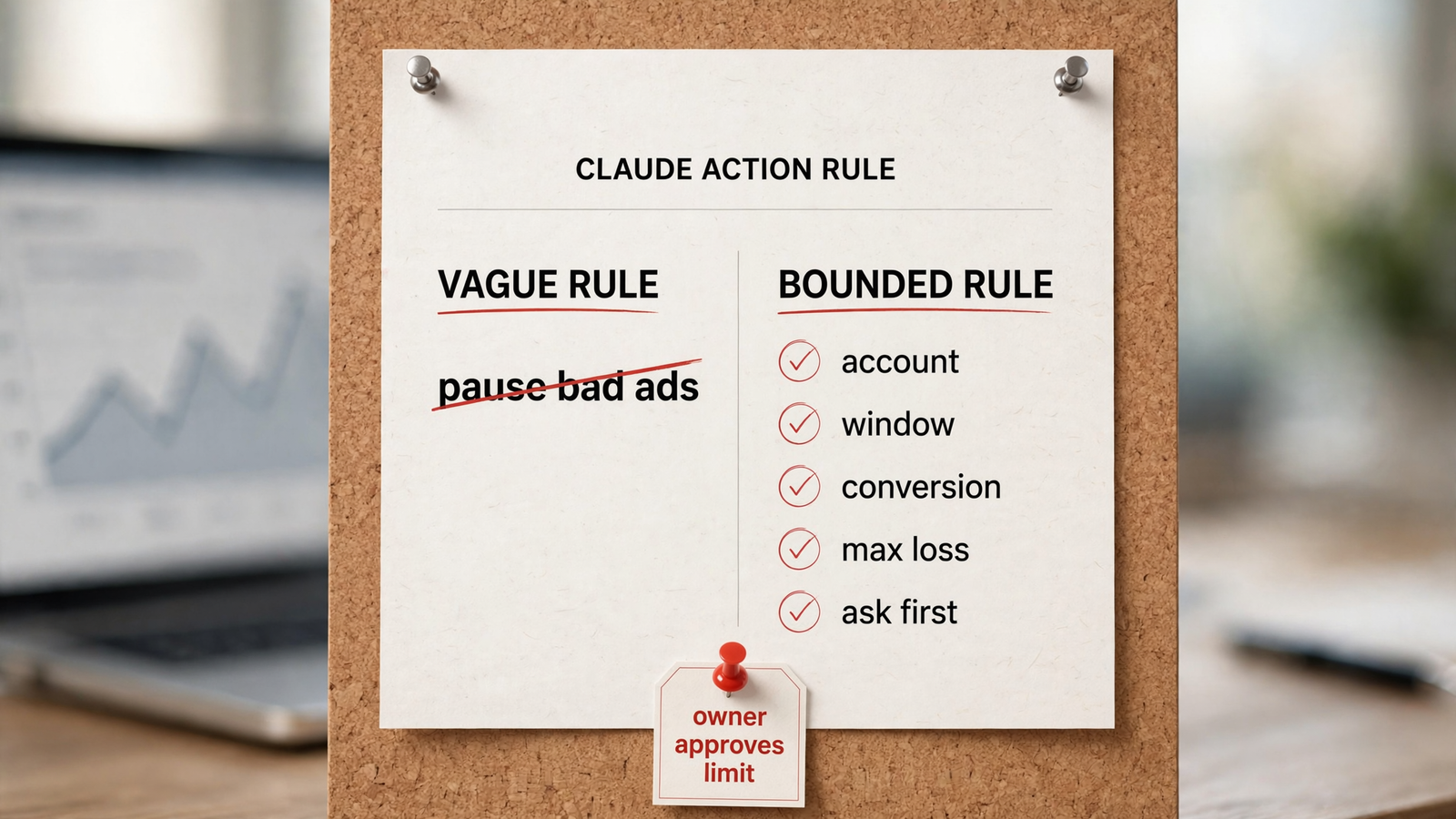
Replace “pause bad ads” with a bounded instruction
“Pause bad ads” is permission to guess. I want an instruction that names exactly what Claude can touch and exactly what makes it stop.
The minimum is:
- The ad account and campaign in scope.
- The level being evaluated: campaign, ad set, or ad.
- The evaluation window.
- The conversion event and attribution window.
- The spending threshold and recorded-result condition.
- Whether Claude must request confirmation or already has permission to act.
- What requires it to stop and ask rather than improvise.
The approval mode is part of the rule, not an administrative detail. A prompt that requires another yes before pausing is not the same as a preapproved automatic stop. I would not describe the first as an enforced cap while the owner is unavailable to confirm it.
Here is an illustrative setup prompt, with the numbers made explicit:
Using groas, prepare a rule for ad account 12345, campaign Prospecting US. Evaluate ad sets over a rolling 3-day window using Purchase with 7-day click and 1-day view attribution. The proposed stop condition is more than $150 in spend with zero recorded purchases. Make no changes yet. Restate the scope, attribution settings, condition, and exact campaign and ad set IDs for my approval. Flag any mismatch instead of substituting another setting.
The threshold is not a discovery about ad quality. One rules playbook uses 2× target CPA with zero conversions over a 3-day lookback. That is a starting shape for a business decision, not a universal instruction to spend twice your CPA.
Also notice what the example actually permits: $150 over a rolling 3-day window. It does not promise a $150 lifetime maximum. If I mean a total test budget, I need to say that instead. A number without a window is half a rule.
Once the prepared rule matches the intended boundary, I can approve its execution. If I want tracking uncertainty to trigger a pause, I say so. If I want it to trigger a request for review instead, I must accept that this is not the same automatic stop.
Claude should repeat the limit back before enforcing it. If the restatement surprises me, the instruction was not ready.
Prove the rule before giving it the account
I would leave autopilot off while checking the setup. groas has autopilot off until you switch it on, with every change logged alongside its reason and reversible in one step. That gives the approval process somewhere concrete to land: an action, a reason, and a record to inspect.
Start with one prospecting campaign, not the whole account. Have Claude prepare the proposed actions before granting ongoing permission. The sequence matters:
- Restate the rule and identify the exact entities in scope.
- Review which ad sets meet the condition.
- Approve the intended action or automation scope.
- Verify the resulting status and inspect the change log.
If the log cannot explain each pause in terms of the approved rule, I would not let that rule run alone. “Low ROAS” is not an adequate reason when the permission was “more than $150 with zero recorded purchases.” Those are different instructions.
A rules playbook recommends using 30- to 90-day baselines and previewing new rules for 48 hours. That preparation belongs before ongoing permission. Previewing is not enforcement, and I would not pretend the account is protected by a rule that is only watching.
This is where the alternative costs something. The owner has to choose the number, review the scope, and accept what the rule may stop. An ad might recover later. A reporting delay might make a pause look unnecessary in hindsight. None of that means Claude should quietly grant more spending room than the owner approved.
The opposite arrangement costs something too: waiting for certainty means continuing to spend while certainty refuses to arrive.
I want the tradeoff made deliberately, before the account turns red. Not negotiated by a chatbot halfway through a bad afternoon.
Keep creative decisions out of the stop rule
A pause protects cash exposure. A creative brief tries to improve performance. I do not want one prompt pretending those are the same decision.
A drop alone does not prove fatigue. One playbook uses frequency above 3.5 with CTR down more than 25% over a 7-day lookback as a fatigue signal. That gives an investigation something more concrete than “ROAS looks ugly.” It still should not become a diagnosis by reflex.
Other suspects remain: tracking, attribution lag, a budget edit that restarted learning, a checkout break, or a competitor bidding up the audience. With groas connected, Claude can also pull competitor advertising and customer discussions on Reddit. That gives the next investigation more to work with than a frequency column alone.
But none of that research should silently change a previously approved spending limit. Nor should a pause automatically produce a new batch of creative on the assumption that the old creative caused the problem.
I would settle the stop logic, then ask a separate question about the evidence for fatigue and the case for new angles. Protecting the budget does not require a story about why the ad failed. Replacing the creative does require a reason better than “it got paused.”
A pause tool should hold your line, not predict Friday
Shoppers for an AI pause tool usually ask which ad to kill. Wrong question. The tool cannot know on Tuesday whether the ad reporting 0.4 ROAS would recover by Friday. Nobody in that Reddit thread knew why $300 a day stopped converting, and opposite recommendations did not make the answer clearer.
What the tool can do honestly is enforce the boundary you approved: this ad set gets this much spend under these conditions, then it stops. Every action has a reason. Every pause remains distinct from a verdict about the ad’s future.
That is the useful role for Claude through groas, available at $19 a month, flat, for unlimited teammates, accounts, and sites. The infrastructure handles the permitted action and its record. The owner still chooses the exposure. A subscription does not outsource that decision to a ROAS column.
Keep the rank-and-kill prompt and the consequence is predictable: whatever looks weakest in the selected window gets starved, whether the problem is performance, reporting, or the window itself. The next report reflects those cuts, the rule finds a new bottom group, and activity passes for judgment. A pause button can be reversible. The spending opportunity you cut off is not something a log can recreate.
So I want the number written down before the drop becomes frightening. I want the window, event, scope, and approval mode beside it. I want Claude to show the before and after separately and ask when the requested action falls outside its permission.
If your ROAS fell this week, do the unglamorous part tonight: confirm the pixel fires, confirm the attribution window matches the comparison period, then write your spending limit before you open Claude. Make that the first pause rule, not “kill the worst ad.” Ignore the distinction and you will automate the panic you were trying to replace.


