

 LinkedIn

GA4 shows a handful of ChatGPT visits; groas shows your pages cited in tracked AI answers. If you’re a groas customer reading both through Claude, this is the head-to-head that matters: GA4 wins for identifiable click-through visits; groas wins for diagnosing where you appeared in sampled answers.
Those reports are not supposed to match. One records visits with an identifiable source. The other records appearances in the answers groas samples. The tempting move is to connect the dots and announce that citations caused visits. Neither report proves that connection.
I want both reports in the same conversation. I do not want their counts in the same score.
The matchup: a recorded visit versus an observed answer
GA4 referral reporting starts with a visit. Someone clicks a link inside ChatGPT, Claude, Gemini or another assistant and lands on your site. If a readable referrer or campaign tag survives that trip, GA4 can attribute the session to an identifiable AI source.
Ask Claude to read that report and you get a useful, bounded answer: these sessions arrived from this identifiable source and did this on site. If the source information disappears, the visit may still be recorded. What disappears is the evidence tying it to an AI assistant.
groas citation tracking starts somewhere else: the answer itself. It sends a sampled set of buyer prompts to assistants, then records whether your brand was mentioned, whether a page was cited, and whether you were actually recommended.
That produces mention and citation rates within the sampled set, not a census of every answer anyone received. And mentions and citations need to stay separate.
Ask Claude to inspect that evidence and you get a different answer: this prompt, this answer, this cited page, this competitor sitting next to you. No click required.
I treat GA4 as traffic accounting and groas as visibility diagnosis. That distinction decides which report to open, what to fix, and which attractive-looking conclusions to leave alone.
Round 1: GA4 wins for “Did anyone visit?”
For identifiable visits and on-site outcomes, GA4 wins. If a session carries a source such as chatgpt.com, perplexity.ai or claude.ai, Claude can report it. It can show the landing page, the session count, and what those visitors did next.
That is a recorded visit with a receipt attached. It is the right evidence when I want to know whether identifiable AI visitors reached a pricing page, started a demo, or left without doing much.
The limitation is how many visits arrive without a readable receipt. In one study of about 26,000 AI responses, only half of the 43,026 links ChatGPT cited carried utm_source=chatgpt.com. An untagged link does not automatically lose attribution; a referrer can still identify the source. But the tag is not something I can assume will be there.
App taps, copied URLs and redirects can also leave GA4 without the source information needed to identify an AI referral. Someone can read an answer, then search for the brand later. That is another break in the trail, not permission to assign the later visit to AI.
Direct is not a secret AI traffic report. It is a bucket that includes visits GA4 could not attribute. I cannot rescue the missing number by relabeling the bucket.
Why groas does not compete as a visit counter
A tracked citation proves that your page appeared in a sampled answer. It does not prove that anyone clicked.
The measurement chain runs from visibility to citation to click to engagement to conversion. Each step asks a different question. Counting one does not answer the next.
One site reported 17,400 Copilot citations against 167 Bing clicks in the same window. That gap illustrates why the two counts cannot substitute for each other; it is not a citation-to-click rate to apply to another site.
Server activity adds another distinction. A ChatGPT-User or Claude-User fetch can mean an assistant read your page for a live question, but that fetch does not run the JavaScript that fires GA4. The reader may never visit at all.
My rule for this round: use GA4 for identifiable visits. Treat that traffic as a floor, not a complete count of AI-influenced demand. Do not ask groas citations to fill the gap.
Round 2: groas wins for “Where did we appear?”
For exposure without a click, groas is the clear winner. GA4 cannot reconstruct an answer from a session that never happened.
Ask Claude to pull the tracked answer from groas and inspect four things:
- The prompt: what buyer question was tested?
- The answer: what did the assistant actually say?
- The cited page: which page supplied the source material?
- The recommendation: did the assistant recommend your brand, a competitor, or neither?
That last distinction matters more than a flattering citation count. A mention without a citation means you were talked about but not sourced. A citation without a recommendation can mean your page supplied evidence while someone else got the sales pitch.
Those are different editorial jobs. I do not want Claude to flatten them into “you appeared.”
The limits matter here, too. This is a sampled set of prompts, not a census of every answer. Rerunning the same prompt can add or drop a brand because model outputs vary. I read the evidence the way a sampled answer demands, not the way a rank demands: direction and context, not a headcount of everyone exposed.
What GA4 cannot recover from silence
Claude can slice identifiable AI referrals by landing page all day. That still will not show the answers people read without clicking, the answers that named your brand without linking, or the answer that cited your guide and recommended the competitor.
An empty referral row is not evidence that none of those things happened. It means the report has no corresponding identifiable visit to show.
This is why groas is the stronger report for an existing customer trying to understand an AI visibility problem. It gives Claude something to inspect before the click: the wording, the source, and the recommendation context. GA4 begins after arrival.
My rule for this round: when I need to know where the brand appeared and how it was presented, I open groas. A traffic report cannot diagnose an answer it never observed.
Round 3: which report tells me what to change?
This is the round that keeps a reporting exercise from becoming another dashboard nobody acts on.
GA4 shows what happens after an identifiable visitor arrives. groas shows where the brand appears before anyone decides to arrive. Put those views side by side and the page backlog becomes more useful. Merge them into one score and the reason for each change disappears.
There is no user-level join here. A sampled answer and a GA4 session are not known to belong to the same person. Matching the reporting period does not create that connection.
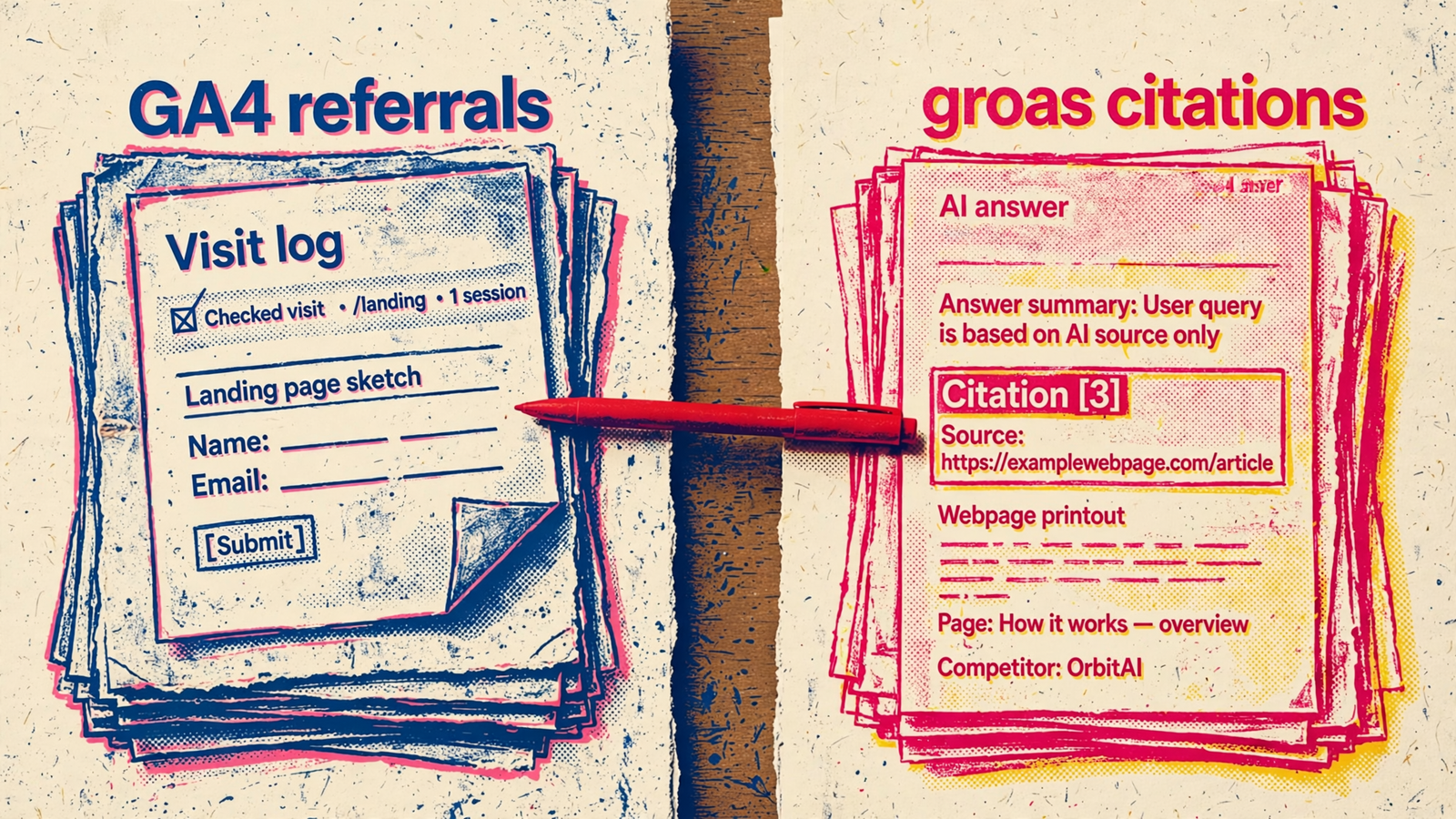
I ask Claude for the two panels in order, with the limits attached.
1. Establish what happened on the site
Using GA4, show identifiable AI referral traffic and available landing-page outcomes for this period. State the attribution limits.
Claude should return the sessions it can identify, their landing pages, and the available outcomes. It should also explain that visits without a usable referrer or tag cannot be identified as AI referrals.
A custom regex covering the usual assistant domains can help organize that report. It still says nothing about citations.
If Claude hands me a confident total for all AI traffic, I stop there. It has supplied certainty where I asked it to state a limit.
2. Inspect the answers behind the visibility
Using groas, show tracked AI answers citing our pages and competitor pages over the same period. Keep mentions, citations and recommendations separate.
That wording prevents an expensive ambiguity. “You’re in ChatGPT” can mean four different things: an ad, a citation, a mention, or a recommendation. Each calls for different work.
For this panel, I want the prompt, the answer, the cited page, and who got recommended. If our page supplies the facts while the competitor gets the recommendation, more referral-report slicing will not explain the wording. I need to inspect the page and the answer.
3. Build one backlog without inventing a connection
Take an illustrative pair of pages:
- A pricing page receives 40 identifiable AI sessions in GA4 with a 12% demo-start rate.
- A comparison guide is cited in 30% of tracked buyer prompts but receives almost no identifiable AI visits.
The pricing page has demonstrated visits and a conversion job. I can inspect the headline, proof and form against the outcomes already recorded.
The guide has an exposure and persuasion job. I can inspect whether it needs the comparison table, pricing context, or reason to choose the brand that the answer currently borrows from someone else.
Those are candidates for different changes, not proof that either change will produce a particular result. The citation rate does not explain the pricing page’s sessions. The referral count does not explain why the guide was cited.
My rule for this round: GA4 helps prioritize visited pages; groas helps prioritize cited pages and recommendation gaps. Same backlog, two doors in.
The verdict: groas for visibility diagnosis, GA4 for visit accounting
For the groas customer trying to understand why AI citations do not line up with traffic, groas is the winner for diagnosing the visibility question. It exposes the sampled answers, sources and recommendation context that a referral report cannot provide.
Choose GA4 instead when the job is narrower and explicit: report recorded visits from identifiable AI sources and what those visitors did on site. That is a useful job. It is not a substitute for inspecting where the brand appeared.
| Decision | Winner | Evidence to use | Boundary to keep |
|---|---|---|---|
| Did identifiable AI visitors arrive, and what did they do? | GA4 | Sessions by readable source, landing page and available on-site outcomes | Does not capture every AI-influenced visit or answers read without a click |
| Where did the brand appear, and who appeared beside it? | groas | Sampled prompts, answer text, cited pages and recommendation context | Does not prove a click or cover every answer |
| Which page needs work? | groas for answer visibility; GA4 for post-arrival behavior | Separate evidence for exposure, persuasion and conversion work | No citation-to-visit join and no combined count |
I keep both because they make different decisions possible. I never add their counts.
A citation is not a visit waiting to happen. It is a different event measured by a different instrument on a different sample. Blending the two into a score does not establish that a citation caused a visit, however tidy the chart looks.
The uncomfortable example is also the useful one: ChatGPT can cite your site and still recommend a competitor. A referral row cannot show that distinction. The tracked answer can.

Use the connection to make one justified page change
Claude can read both panels in one chat. Bring the reports together; keep their evidence separate. Paste this into Claude using the same period for both:
Build two panels: identifiable AI referrals and tracked AI citations. State each panel’s coverage and limitations. Propose one page improvement; do not publish it yet.
Suppose Claude returns 60 identifiable AI sessions and 40 tracked citations for one guide. Those numbers describe different activity around the page. They do not mean 40 citations generated 60 sessions, or that either count measures unique people exposed.
I want the proposed change tied to the evidence that supports it. A recommendation about the conversion path should point to on-site outcomes. A recommendation about how the brand is presented should point to the tracked answer and the page it cites. “Improve AI visibility” is not a reason. It is a label on the folder.
Before approving anything, I check:
- Which prompt and answer support the diagnosis?
- Was the brand mentioned, cited, recommended, or some combination?
- Which competitor received the recommendation, if any?
- What does the proposed edit address, and what remains unproven?
If the fix is justified, I approve publication through groas, then inspect the change log, where every change is logged with its reason.
What I want from the connection is a cleaner diagnosis and one page fixed on purpose. What it does not provide is a promise that citations turn into visits next month. Keep the panels apart and they keep telling the truth.


