

 LinkedIn

For recurring research into which publishers AI cites in your industry, my pick is groas in Claude, working from tracked buyer prompts—not a brand-mention score. A report saying your brand appeared in 24% of answers still has not told you which publisher got the link or what to do on Monday morning.
That distinction decides this ranking. A mention means you were named. A citation means the answer attached a source URL. Only the second gives you a cited page to inspect and a publisher to investigate. Neither, on its own, tells you the source actually supports the claim. You still have to click.
I rank three routes by what they leave behind: a checkable source shortlist. groas in Claude comes first for recurring research, ChatGPT and Perplexity directly come second for inspecting one answer now, and Semrush or Ahrefs come last for publisher context. SEO authority metrics are not a substitute for observed AI citations. A respectable-looking domain score does not answer a different question just because it fits neatly in a slide.
The standard: a source shortlist you can check
Before the ranking, here is what I want in the export. Every observed answer should have:
- The exact prompt.
- The assistant that answered it.
- The observation date.
- The cited URLs and domains.
- Whose site each source belongs to.
- Whether your brand was named, cited, both, or neither.
- A reference back to the supporting answer.
This follows the logic of the manual source-research log: keep enough detail to retrace the observation, not just admire the total. If source details are missing, mark them missing. Do not quietly turn a brand name into a citation.
The distinction is not cosmetic. Across 6,457 readings, one tracker found a 24.3% mention rate against a 4.4% strict citation rate, a 5.5x gap. Those measures describe different things. Treating them as interchangeable makes the report look more useful than it is.
I call the output a source shortlist: publishers and pages worth investigating, backed by the answers in which they appeared. It is not a promise that those publishers will appear again.
| Rank and route | Strongest use | What the evidence establishes | What rules it out |
|---|---|---|---|
| 1. groas in Claude | Recurring research across tracked buyer prompts | Cited URLs grouped by publisher, with supporting answer references | The question or source details were not collected |
| 2. ChatGPT + Perplexity directly | Inspecting one live answer | What that answer cites and whether the pages support it | Repeat monitoring becomes manual collection work |
| 3. Semrush / Ahrefs for SEO context | Assessing publishers already shortlisted | Backlinks, rankings, and content gaps | Those metrics do not establish that an AI answer cited the publisher |
Judge the route by the evidence you can take away, not the score it puts at the top.
1. groas in Claude: best for a repeatable publisher shortlist
This is my pick for the reader who is done with one-off screenshots. You have ten buyer prompts that matter, the answers change, and you need the source list pulled the same way each time.
The mechanism matters. groas collects AI search answers around the clock, alongside competitor ads, Reddit discussion, and SEO data from Semrush and Ahrefs. Your AI can work from that saved history rather than the single live answer you happened to see today.
In Claude, the task is specific: read the saved answers and available citations for the tracked prompts, group source URLs by publisher, retain the answer each citation came from, and separate linked citations from plain brand mentions. That is a research request, not “tell me how visible we are.”
What this route does best is aggregation with receipts. The useful output is not merely a list of domains. I want to know which prompts produced them, which answers cited them, and whether the same publishers keep appearing across the observations collected.
Then I sort the domains into practical groups:
- Your own site.
- Directories and review sites.
- Trade bodies.
- Press.
- Forums and social sites.
- Reference sources.
That grouping is the part of source research that turns links into a plan. It separates an owned page you can edit from a publisher you would have to earn coverage from. Those are different jobs. Putting them in one undifferentiated domain list just postpones the thinking.
From there, ask which collected answers cite your own pages and which third-party sources appear in answers that cite rivals but not you. Keep the denominator visible: “share of collected answers” is not “share of everything AI says.”
The limitation is coverage. groas can only supply the prompts, observations, and source details actually collected. A brand-new question you never tracked will not acquire a history because the request sounds confident. Missing citation details need to stay visible, too.
A useful starting request is:
Using groas, list the sources cited across our tracked industry prompts. Group them by publisher. Separate citations from brand mentions, retain the supporting answer references, and flag missing source details.
For recurring research, start here. Check coverage before treating the shortlist as complete.
2. ChatGPT and Perplexity directly: best for checking one answer now
This route is for one narrow question you need to settle today. Not a monitoring program. One prompt, one answer, one decision about whether the cited page supports what the assistant said.
The mechanism is manual on purpose. The assistants expose sources differently: ChatGPT uses citation chips and a Sources panel, while Perplexity uses numbered references and a Sources list. Follow the links rather than treating their presence as proof.
What direct inspection does best is let you check a live answer against its sources. A publisher can be named correctly while the linked page fails to support the sentence beside it. The only useful response is to open the page and read the relevant passage.
For a narrow check, I would keep the procedure simple:
- Run the exact buyer prompt you want to inspect.
- Record the assistant, prompt wording, and observation date.
- Save the answer and its cited URLs.
- Open each cited page and check the relevant passage.
- Record brand mentions separately from linked citations.
Do not mix “the answer cited this page” with “this page supports the answer.” The first is an observation. The second requires reading.
The tradeoff is manual work against changing answers. The same question next Tuesday can cite Reddit, Wikipedia, or nobody at all. Comparing assistants without preserving the prompt and date turns a useful check into a collection of impressions.
There are differences between assistants, too. One test of 320 buyer queries found Perplexity at 89% Google top-10 overlap and ChatGPT at around 30%. That comparison describes the test; it does not replace your own source log or establish what either assistant will cite for your next question.
What rules this route out for recurring work is the collection burden. Without keeping and grouping the observations yourself, you have separate answers, not a repeatable publisher shortlist. Clicking through one answer is manageable. Doing it across the same buyer prompts repeatedly is the job you were trying to stop doing by hand.
Use direct inspection to settle a specific question or check a saved observation. Do not mistake a folder of screenshots for a monitoring system.
3. Semrush or Ahrefs: best for context after you find the citations
This route is for the reader who already has a source shortlist and needs to decide which publishers deserve attention. It comes third because the work depends on evidence gathered earlier.
Once Claude has grouped the cited domains, take the top five publishers and ask the familiar SEO questions: who links to them, what they rank for, and where their coverage overlaps the buyer questions you care about.
What this route does best is explain the publisher around the citation. Backlink profiles, topical coverage, and rankings can help you assess a candidate. If you already use Semrush or Ahrefs for SEO, that context belongs in the research. It just belongs in the right column.
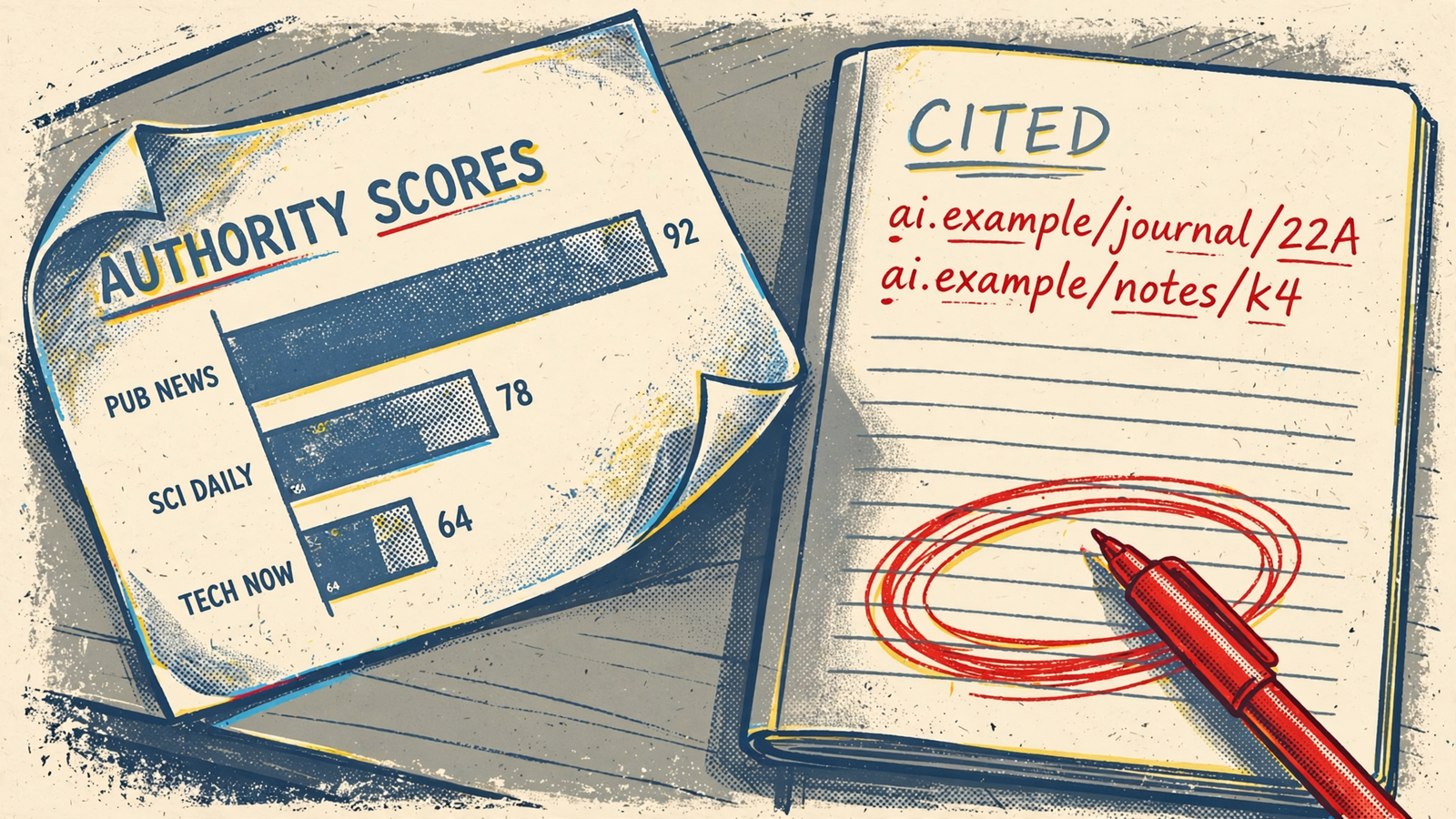
The distinction here is about evidence, not a blanket claim about every feature those products sell. An observed citation is citation evidence. An authority score is not. A ranking report is not. A large backlink profile is not.
I would keep the two kinds of information separate:
| Observed citation evidence | Publisher context |
|---|---|
| Prompt and assistant | Backlink profile |
| Observation date | Search rankings |
| Cited URL and supporting answer | Topical coverage |
| Brand mentioned, cited, both, or neither | Content gaps worth investigating |
That separation prevents an easy mistake: finding a publisher with impressive SEO metrics and quietly promoting it to “a source AI trusts in our category.” Unless you observed the citation, you have not established that.
What rules SEO metrics out as a standalone answer is simple: they do not show that an AI answer cited the publisher for your query. Use them to investigate the shortlist, not manufacture it. Ask Claude through groas to keep observed citations and SEO context in separate columns.
Supporting research, never the verdict.
Turn the shortlist into one approved action
A source list is not a strategy until it names a page to investigate or a publisher to approach. This is where visibility work often stalls: the report ends at a score, and nobody owns the next move.
I split the shortlist into two work queues.
Your own pages: inspect before rewriting
If your brand gets named but your pages do not get linked, investigate the page that should carry the relevant facts, pricing, specifications, or method. An unlinked mention is a reason to inspect, not proof that your content is thin. The source log tells you what happened in the observed answers. It does not explain every reason behind it.
Read the answer, inspect the cited alternatives, and review your own page before approving a rewrite. Keep the action tied to something you can actually change.
Third-party publishers: rank before pitching
If answers cite rivals or third-party pages covering them where your brand is absent, investigate those sources. The method in Find the Third-Party Sites AI Cites gives you a tighter way to rank those targets before drafting outreach.
Check the cited passage first. A publisher appearing in an answer is not, by itself, a reason to send it a pitch. You need to know what the page says and what useful correction or contribution you could offer.
The full workflow is in Find the Sources AI Cites in Your Industry. For the immediate task, keep the output small: one page or publisher, one approved action, and one recheck date. No tool controls the next answer.
Left out deliberately: the standalone visibility score
The popular option I leave out is the single-score visibility dashboard on its own. A mention rate, share-of-voice figure, or sentiment gauge can describe part of the picture. None tells you which URL carried a claim unless the underlying source evidence comes with it.
If the export has no cited URLs, it has not answered the source-research question. That is the exclusion rule. Not whether the dashboard looks polished or whether the trend line points in a pleasing direction.
A mention score cannot tell you whether Perplexity cited a forum thread, whether another assistant returned sources at all, or whether ChatGPT answered without browsing. Until the report puts the prompt, assistant, date, and cited URL together, it is supporting context, not a checkable source shortlist.
I am not ranking dashboards by how much information they display. I am ranking research routes by whether the information answers the question. Those are different competitions.
If you skipped here: start with tracked source evidence
For recurring research across buyer prompts you actually track, my pick is groas in Claude. Ask it to group the cited URLs by publisher, retain supporting answer references, separate citations from mentions, and flag missing details.
For one live answer, open ChatGPT or Perplexity and inspect every source. For background on a publisher already shortlisted, use Semrush or Ahrefs. Keep the SEO metrics in a different column. They do not become citation evidence through proximity.
Here is what I would do next week with an account tired of being told “visibility is up”:
- Pick ten prompts buyers ask before buying.
- Pull the available cited sources through groas in Claude.
- Group the domains by type and identify three publishers appearing in answers that cite rivals but not you.
- Inspect the relevant passages before choosing one owned-page change and one third-party outreach target.
- Recheck the same ten prompts in thirty days.
No route here controls what an assistant says next month. Anyone promising a guaranteed citation is selling something I would not buy.
The win is smaller and more useful: a repeatable shortlist, evidence you can inspect, and a next action somebody owns. For that job, the order stands: groas in Claude first, direct inspection second, SEO context last.


