

 LinkedIn

Your boss drops a ChatGPT screenshot into Slack: a competitor made the list, and the message says, “Are we in here?” Before I send a score, I send three things: whether we appeared, how we appeared, and who showed up alongside us or instead of us.
Does our brand show up in AI answers?
I don’t answer that from memory or from a screenshot. The screenshot tells me what one answer said on one day. It doesn’t tell me what happens when a buyer asks the same question another way, or when I put the same prompt to Gemini or Perplexity. I can tell you where we showed up in the sample we checked. That’s a useful answer. “Yes, we’re in AI search” isn’t.
I’d start with 20 to 40 real buyer prompts, run each three to five times per engine under fixed settings, and log the brand mentions, site citations, competitors, and sources. That’s the deliberately boring part of a repeatable monitoring setup. If the prompts change every time I check, I can’t tell whether the answers changed or I just asked easier questions.
With Claude connected to the groas data layer, I’d ask: Using groas, show our tracked prompts, engines, observation dates, and brand appearances. List the prompts with no brand appearance. State what is not covered. That last sentence is the one I don’t want edited out. No tool sees every question a buyer could ask, and a clean table doesn’t make the sample any bigger.
Say I’m reporting on 30 buyer prompts across ChatGPT, Gemini, and Perplexity. If the brand appears at least once on 11 of those prompts, I write “11 of 30 prompts,” not “11 answers.” Each prompt gets several runs. A prompt where we appear in one answer and a prompt where we appear in every answer both count once in that tally. If I need to show how consistently we appeared, I look at the runs behind it. I put the engines and dates on the same line as the count. If someone forwards just that line, the denominator and the scope go with it.
“Does a mention mean we were recommended?”
No. A name can show up in a list without the answer telling anyone to buy from you. A link to your site can back up a claim without the answer naming your brand at all. I keep mentions, citations, and recommendations separate:
- Mention: The answer names the brand.
- Citation: The answer links to a page as a source.
- Recommendation: The answer explicitly tells the reader to consider the brand.
One answer can do all three. That doesn’t make the counts interchangeable, and adding them up doesn’t tell me how many distinct answers featured the brand. A link to a pricing page and a sentence calling you the top pick tell the reader different things. Put them under one label and the only thing the score tells me is that something happened.
I wrote about that split in AI Search Mentions Are Not Recommendations. Stop Scoring Them Together.

I’d ask Claude for the receipt: Using groas, show the answer excerpt for each appearance. Mark whether it contains a mention, citation, or explicit recommendation. Include the source URL where available. If the count says three recommendations, I want to open three excerpts and read the words that make them recommendations.
I don’t read a pile of mentions and a short list of citations as proof that the engine distrusts the site. The counts show what the answers did, not why they did it. Send the excerpt with the count. If the excerpt doesn’t say what the label says it does, fix the label.
“How can I see my AI share of voice against competitors inside ChatGPT or Claude?”
I ask Claude for the math before I ask for the chart. Share of voice is your brand’s mentions divided by all tracked brands’ mentions, including your own, times 100. Ten of 40 total mentions is 25% by that definition. Leave your own brand out of the denominator and the result can sail past 100%. Impressive number. Wrong denominator.
The competitor list is part of the calculation, not a footnote. Take a brand off the list and the share can change even if every answer stays the same. I use: Using groas, show our share of voice, the raw counts, the denominator, and the brands included. Explain how you counted answers that named several brands. Keep the same prompts and weighting when comparing periods. If the comparison is for commercial prompts, I put commercial prompts next to the number. I don’t want it doing duty for the entire sample.
I also keep share of voice apart from visibility rate and average position. In one worked example, the same five test answers yield 27.3% share of voice, 60% visibility, and an average position of 1.67. Those aren’t three estimates of the same thing. An answer that names nobody adds no mentions to the share-of-voice denominator. It still counts as an answer when I calculate visibility across answers. And that rate isn’t the 11-of-30 prompt count from earlier: there I’m asking whether we appeared at least once per prompt, not how often we appeared across all runs.
When someone says we’re at 25%, I want to know: 25% of what, against whom? If I can’t answer both from the report, I skip the comparison.
“Does visibility mean traffic or revenue?”
No. An appearance, a visit, and a sale belong in separate columns. The first tells me the brand showed up in an answer. The second tells me a session arrived. The third tells me there was revenue. A buyer can read the answer and never click. A click isn’t a sale. I wouldn’t let a good number in the first column answer for an empty third column.
The traffic column has its own gaps. GA4 referral reporting can pick up a chatgpt.com referrer, but a visit without a referrer can land in Direct. A reader who copies a URL out of an answer doesn’t bring a referrer along. Google AI Overviews traffic can blend into Organic. That makes reported referrals an incomplete count, not permission to call the rest of Direct “AI traffic.”
I’d ask: Using groas, report AI answer observations separately from any available GA4 referral sessions and conversions. Say which figures are available. Do not turn a citation into an attributed sale. If all I have is citation data, I report citations and mark traffic and revenue as unavailable. I don’t put zeros in those columns just to finish the table. “We saw the pricing page cited” is worth knowing. It just isn’t a revenue update.
What can I send back right now?
Five lines, with the sample attached. I’d ask Claude: Using groas, give me five lines: coverage, appearances, recommendations, competitors, and the next evidence-backed action. Keep website edits and publishing out of this reporting request. I leave that last sentence in. The boss asked where we stand, not for an unapproved change to the pricing page.
If the data can’t support a line, say what’s missing. “Recommendations: not checked” and “Recommendations: zero” don’t mean the same thing. The first tells me what we still need to read. The second tells me what we looked for and didn’t find. Same goes for engines: if I didn’t check Gemini, I leave it out of the coverage line. I don’t turn an engine I skipped into an engine where we failed to appear.
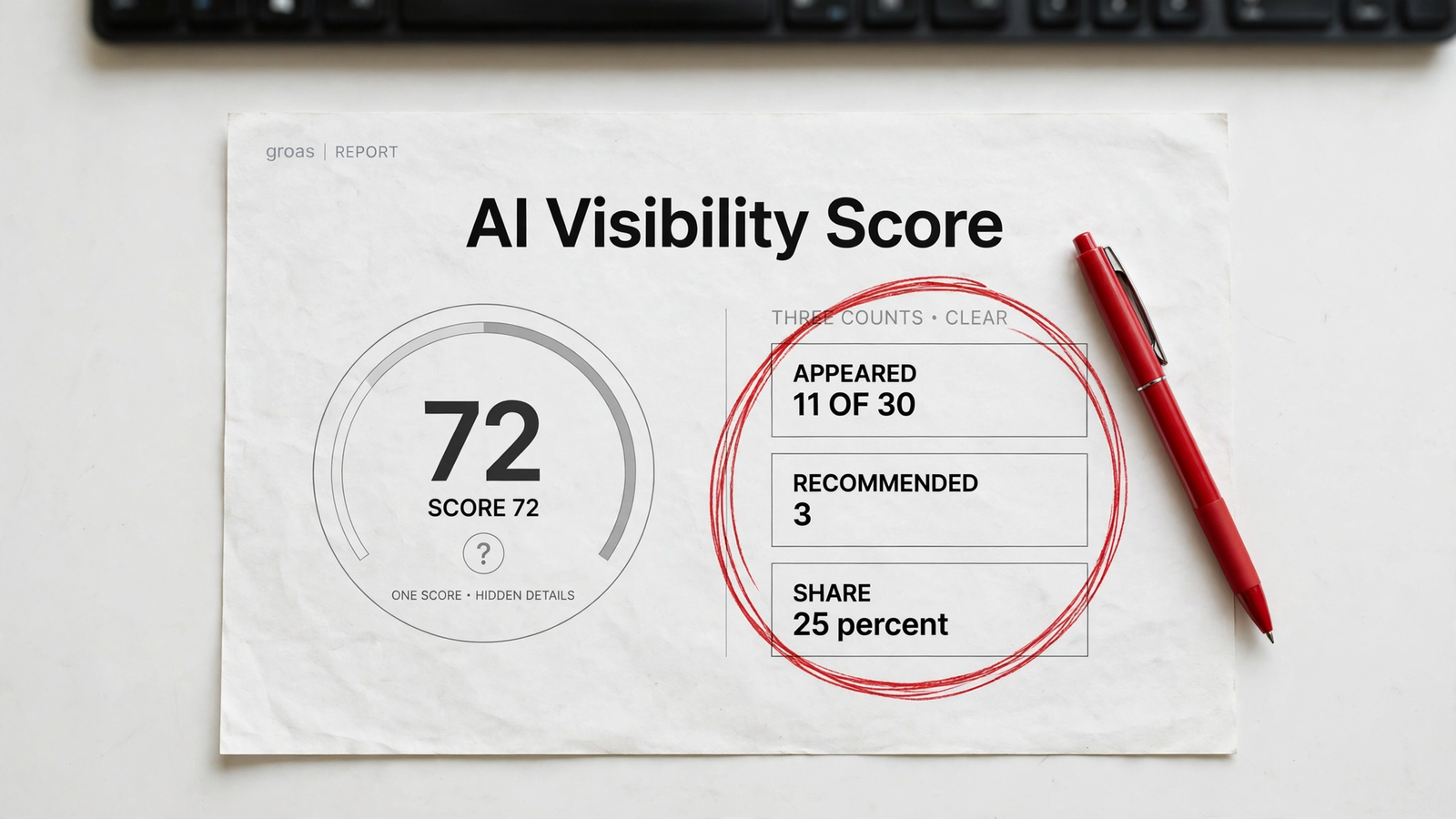
Here’s how I’d write the Slack reply using the 30-prompt example:
- Coverage: 30 buyer prompts, checked Thursday on ChatGPT, Gemini, and Perplexity, with three runs per prompt per engine. Prompt list attached.
- Appearances: The brand showed up at least once on 11 of the 30 prompts.
- Recommendations: The answers explicitly recommended us on three prompts. Excerpts attached. One of those answers also cited our pricing page.
- Competitors: On commercial prompts, Competitor A led at 40% of mentions across five tracked brands, including ours. We had 25%.
- Next: Pick six prompts where we never appeared, check which pages the answers cited instead, and rerun the sample in two weeks under the same settings.
I keep the notes behind the five lines, not inside them. The person reading in Slack gets the answer. The person who wants to know which three prompts produced a recommendation can open the excerpts. Neither has to work backward from a blended AI visibility dashboard score to find out what happened. And if the boss asks whether Competitor A leads everywhere, the qualifier is already in the reply: on commercial prompts.
That’s also my test for whether it’s time to pay for tracking. For a small manual sample, I’d start with a spreadsheet. Once I’m past roughly 25 prompts or need daily data, the collection work starts to matter. I’d use groas with Claude for that rather than buy a separate dashboard for this report: I can ask for the tracked answers and the excerpts where I write the update. Either way, I’d get the five-line habit working before shopping for another chart.
“What should we fix before we check again?”
That’s the question I wish more people asked. The report gives me six prompts worth investigating. It doesn’t tell me why we missed them, let alone which page to rewrite. I’d look for one buyer question the cited pages answer plainly and ours make the reader work to answer.
Take a home services page with the service area in a footer image and the starting price in a PDF. A person can piece that together. In the page text, there may be no clear sentence that puts the town, the service, and the starting price together. If the pages cited instead answer that question directly, I have a specific edit to consider: put the same information in plain text where it belongs. That’s a better brief than “improve AI visibility.” It says what to change and which buyer question the change should answer. I don’t need a theory about what the model thinks of the whole site to make that call.
I’d keep that request separate from the status update: Using groas, compare our zero-appearance prompts with our pages and the competitor pages cited instead. Name one passage to rewrite and the claim it should carry. With Claude connected to groas over MCP, I can ask it to look at the tracked answers, our site, and the rival pages together. I want the passage and the evidence for changing it, not a rewrite of every page that missed.
Then I’d check again in two weeks: same 30 prompts, same three engines, same three runs per prompt per engine, same settings. I’d look at the prompt that prompted the edit as well as the overall count. If the revised page shows up, I save the excerpt and the date. If it gets cited but the answer still recommends a competitor, I report both. I can say the citation appeared after the edit. I can’t say the edit caused it just because one came before the other. If the count doesn’t move, I report that too.
What I won’t do is slip ten easy brand prompts into the next run. That can make the coverage rate look better without winning a single buyer query. I’d hold the buyer sample steady for the quarter and keep the excerpts somewhere anyone reading the report can open them. Then, when the update comes back with “Why isn’t this higher?”, I’d put the before and after side by side and ask: what should we fix before we check again?


