

 LinkedIn

When Google Ads performance drops, I want Claude to tell me whether bidding is adapting, conversions are late, tracking is broken, or the campaign is actually getting worse. Most people ask it how long the learning phase lasts and get a countdown for a problem they haven’t diagnosed.
A Learning status is a bidding state, not a diagnosis. The label can clear while performance is still settling. Performance can also fall apart without the label appearing at all. I used to tell clients to wait for it to clear. I was wrong. I needed to know what the strategy was adapting to, whether conversions were late or missing, and whether the change we’d made lined up with the results.
If you already use groas, connect it to Claude so Claude can read your actual account. I’ll walk through what to ask for, when to wait, and what counts as enough evidence to intervene. The result I want is one recommendation, a condition for reviewing it, and no account change I haven’t approved.
What does “Learning” actually tell me?
Google uses the label to flag recent structural changes to a bid strategy: a new or reactivated strategy, a change to its composition (say, campaigns, ad groups, or keywords added or removed), or a significant change to its goals. Budget, target, creative, and targeting edits don’t trigger the label or erase historical data. A Target ROAS change from 500% to 400%, for example, applies at the next auction without triggering Learning. That doesn’t mean the edit won’t affect performance. It means the label won’t tell you whether it did.
In Google’s explanation of the Learning status, ads continue to serve and Smart Bidding continues to learn whether the label is visible or not. If the status appears, hover over it and record the reason. That gives you a change to investigate, not an explanation for the decline.
The status and the settling period are two different clocks. Google says performance typically settles within one to two conversion cycles, depending on conversion volume, cycle length, and how restrictive the settings are. If one cycle takes three weeks, recent results can still be incomplete long after the label clears. Low volume can stretch the wait further: a calendar can tell you how long you’ve been waiting, not how much evidence you’ve collected. Use the conversion cycle and volume to decide when you have enough data to judge the change.
1. What can Claude verify before it explains the decline?
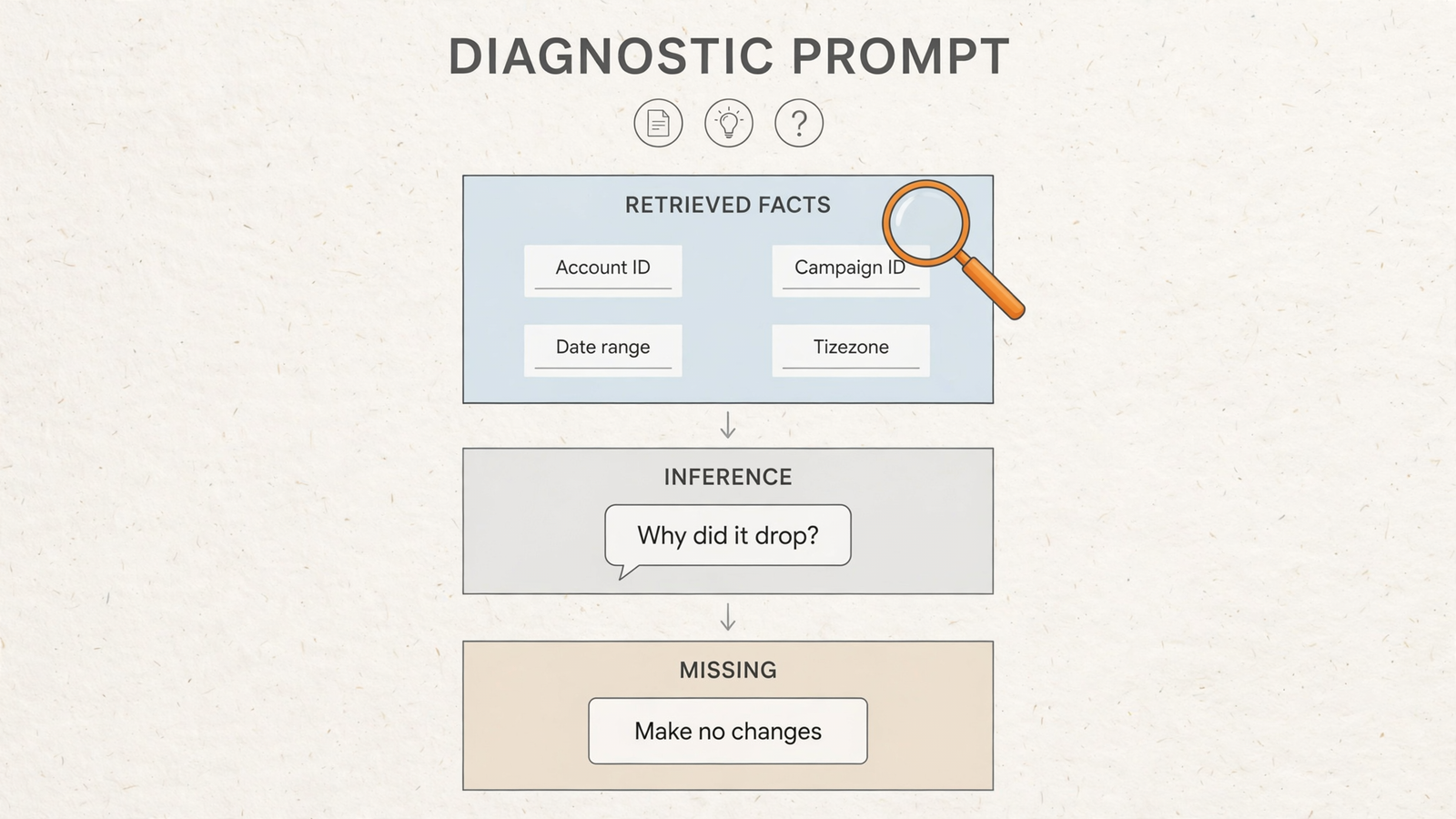
Ask Claude for a performance summary and it can give you a tidy story before it has the facts. I want an account readout first. With groas connected, paste this:
For this account and campaign, read the bid strategy, available status, conversion goals, and recent changes. Confirm the account ID, campaign ID, date range, and time zone. Separate retrieved facts from inference and list any fields you couldn’t retrieve. Make no changes.
Include the identifiers and dates in the same message. I’ve watched Claude confidently explain a decline using a campaign ID it guessed. A plausible answer about the wrong campaign is worse than a missing field because it gives you something to act on.
Missing means missing. If Claude can’t retrieve the reason for a status or verify the date of an edit, leave the gap in the readout. Don’t let the summary quietly turn it into a fact. Check the identifiers before you read the explanation.
2. Which changes came before the drop?
Ask Claude to build the timeline in date order. Put every edit to budget, bid strategy, target, conversion goal, campaign composition, and creative alongside daily spend, clicks, conversions, and cost per conversion. Look for the edit that preceded the drop, not the edit closest to the day you noticed it.
Put two caveats in the same instruction. First, don’t treat every edit as a learning restart. Keep track of the edits that don’t trigger the status, too: a target can affect bidding without changing the label. Second, don’t treat sequence as causation. If you change a target on Monday and Tuesday looks bad because a batch of conversions hasn’t arrived, the target edit is on the timeline. It isn’t necessarily the cause.
The timeline gives you a hypothesis, not a verdict. If Claude can’t date an edit, keep it on the list of unknowns. Don’t use it to explain a decline you can date.
3. Are conversions late, missing, or measuring the wrong thing?
Start with timing. Compare recent, incomplete periods with periods that have had time to mature. If a conversion takes a week to show up, this week can look broken when it’s only unfinished. Google’s guidance on conversion delay counts the time from click to conversion, including import and reporting time. The bid strategy report can also show an estimate of conversions that haven’t been reported yet. Treat that estimate as an estimate, not as a batch of confirmed sales.
Next, ask Claude for the settings and trends for the conversion actions the campaign actually optimizes toward. An action can exist in the account without being the outcome this campaign bids for. Check the relevant actions against Google’s conversion-tracking statuses:
- Active: The action is recording.
- Needs attention: It’s still recording, but there’s an issue to check.
- Misconfigured: A setup problem has stopped it from recording.
- Awaiting conversions: It hasn’t recorded a conversion in the last seven days.
- Removed: The action has been removed.
Misconfigured is a measurement problem. Waiting for the bidding strategy to settle won’t fix it. But an action that hasn’t recorded conversions recently isn’t automatically broken, either. Check what happened outside the ad account.
One advertiser reported 490 clicks and zero recorded conversions with tracking still unresolved. That isn’t proof that learning caused anything. It’s a reason to verify what zero means. Another advertiser reported 10 days of broken form-submission tracking after website and form changes, then asked whether pausing and restarting the campaigns would shake the algorithm loose. I’d repair tracking before asking bidding to do anything else.
When the ad account can’t settle the question, bring in CRM or order counts for the same dates. Ask Claude to say what it can verify and what you still need to check. An ad-account readout doesn’t prove tracking works from click to lead or order. If reported conversions conflict with independently checked outcomes, investigate the measurement before blaming the bid strategy.
4. Do I wait, investigate, or intervene?
At this point I want Claude to make a call, not give me three equally plausible paragraphs. Use the timeline, the maturity of the conversion data, and the measurement checks together:
- Wait if the bid strategy is adapting to a relevant change, the observation window is shorter than the conversion cycle, the actions are recording, and independent outcomes are in line with mature periods. That’s a case for patience only while spend stays inside the boundary you’ve agreed to. Pick the date or conversion count at which you’ll look again.
- Investigate measurement if an action is misconfigured or reported conversions conflict with independently checked leads or orders. Name the action or discrepancy to check. Don’t change a bid target to compensate for a number you don’t trust.
- Intervene when the evidence points to a specific account problem: a conversion goal that doesn’t match the business goal, a restrictive target that’s holding back spend, or paused assets that can’t serve. Name the problem the edit would fix. “Performance dropped and it feels like learning” doesn’t qualify.
If none of those fits, say what’s missing and what would make the decision possible. A spend boundary can tell you when patience is no longer acceptable. It can’t tell you what broke.

5. What exactly am I approving?
Ask Claude to put its recommendation in one line, then show its work:
Recommend wait, investigate, or change. Cite the retrieved evidence, name what’s uncertain, and specify the next review condition. If you recommend a change, give me the exact scope and rationale. Do not execute it without my approval.
Read the answer like a client report from someone billing by the hour. Does each claim point to a retrieved fact? Does the proposed edit address the problem Claude actually found? If the recommendation is to wait, “check again soon” isn’t a review condition. If it’s to investigate, you should know which conversion action or discrepancy to check next.
A proposal is not permission to execute. If you approve an edit, inspect the groas change log afterward. It records each change and its reason, and you can undo a change in one step. Undo restores the setting. It doesn’t rewind the auctions that ran in the meantime.
6. How do I keep Claude from reopening the decision tomorrow?
A diagnosis you don’t write down becomes a new argument every morning. In the same chat, record three things:
- Hypothesis: One sentence, such as “The campaign is still settling after the goal change, and recent conversions haven’t had time to come in.”
- Review condition: A date or conversion count tied to the conversion cycle, not a vague instruction to keep an eye on it.
- Permitted actions: What Claude may do without asking. For most accounts, I’d leave the list empty until the review condition is met.
When you return, tell Claude to read that record before explaining today’s numbers. The facts stay on the record. The explanation changes when the evidence does.
Leave groas autopilot off unless you deliberately enable it under explicit rules. It stays off until you switch it on. If you do enable it during a diagnosis, specify the spend ceiling, target range, conversion actions in scope, and the condition for pausing the campaign for human review. Otherwise, you’ve put an always-on system in a position to act on the same weak evidence you were trying to sort out. Only faster and at 3 a.m.
What should I skip, and what should I do today?
Skip the list that tells you every edit restarts learning. Skip the fixed-day countdown. And skip the advice to pause and restart a campaign to push learning again before you know whether conversions are recording. Those steps feel decisive. They don’t answer the measurement question.
If you need the bidding mechanics, groas’s Smart Bidding guide covers strategies and settling periods. If Claude made the edit you’re investigating, the companion piece on Claude’s account changes covers that judgment call.
Do this today: run the facts-first prompt from step one. Give Claude the account ID, campaign ID, date range, and time zone. Make it separate retrieved facts from inference, with no changes allowed. That won’t diagnose the whole decline in one message. It gives you the account record you need to tell bidding adaptation from late conversions, broken tracking, or a real decline. Start there, not with the countdown.





