

 LinkedIn

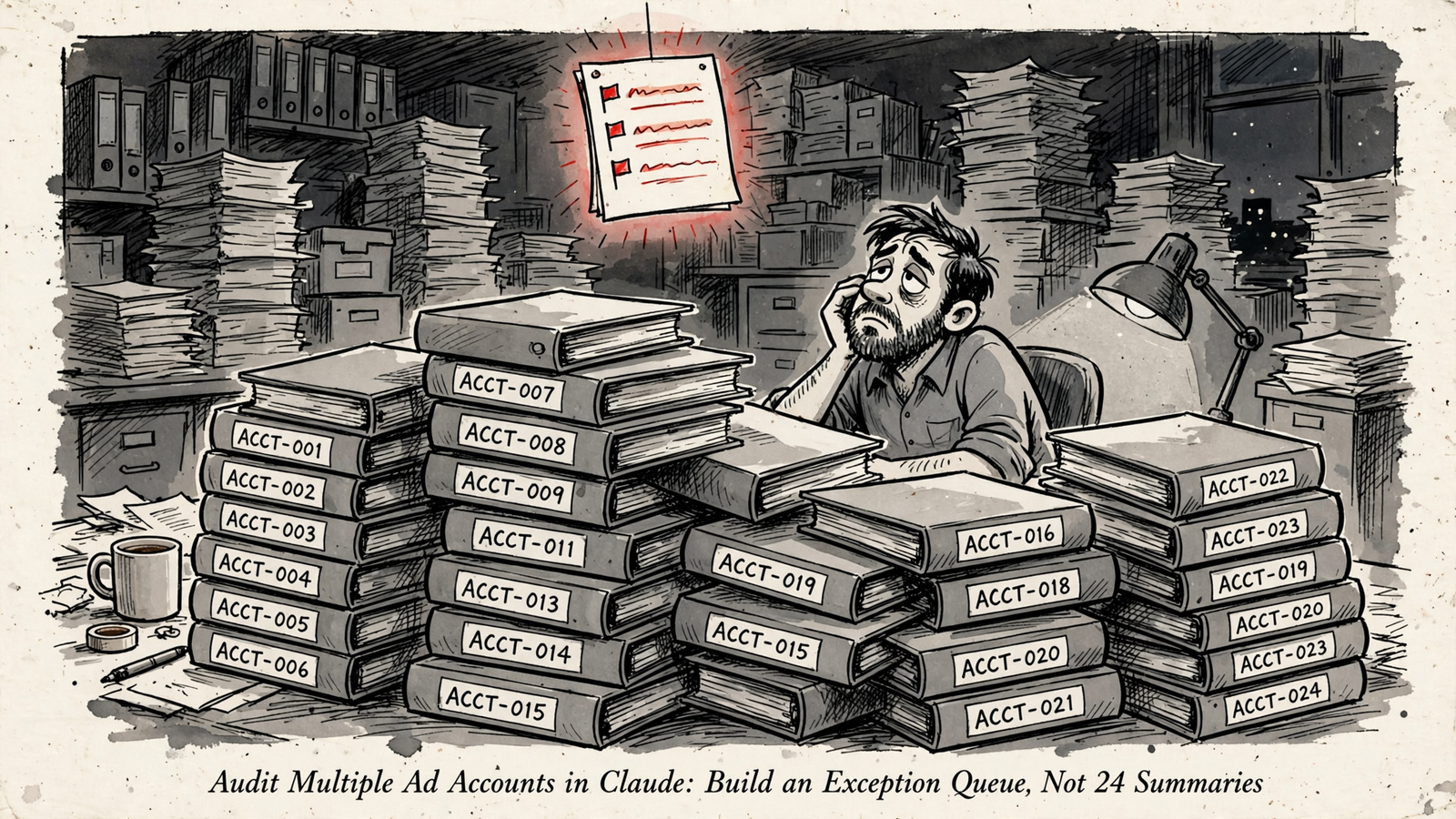
An audit of 24 ad accounts should leave you knowing which five problems deserve attention first. Ask Claude for a summary of every account instead, and you can end up with 24 polite paragraphs and no clear place to start.
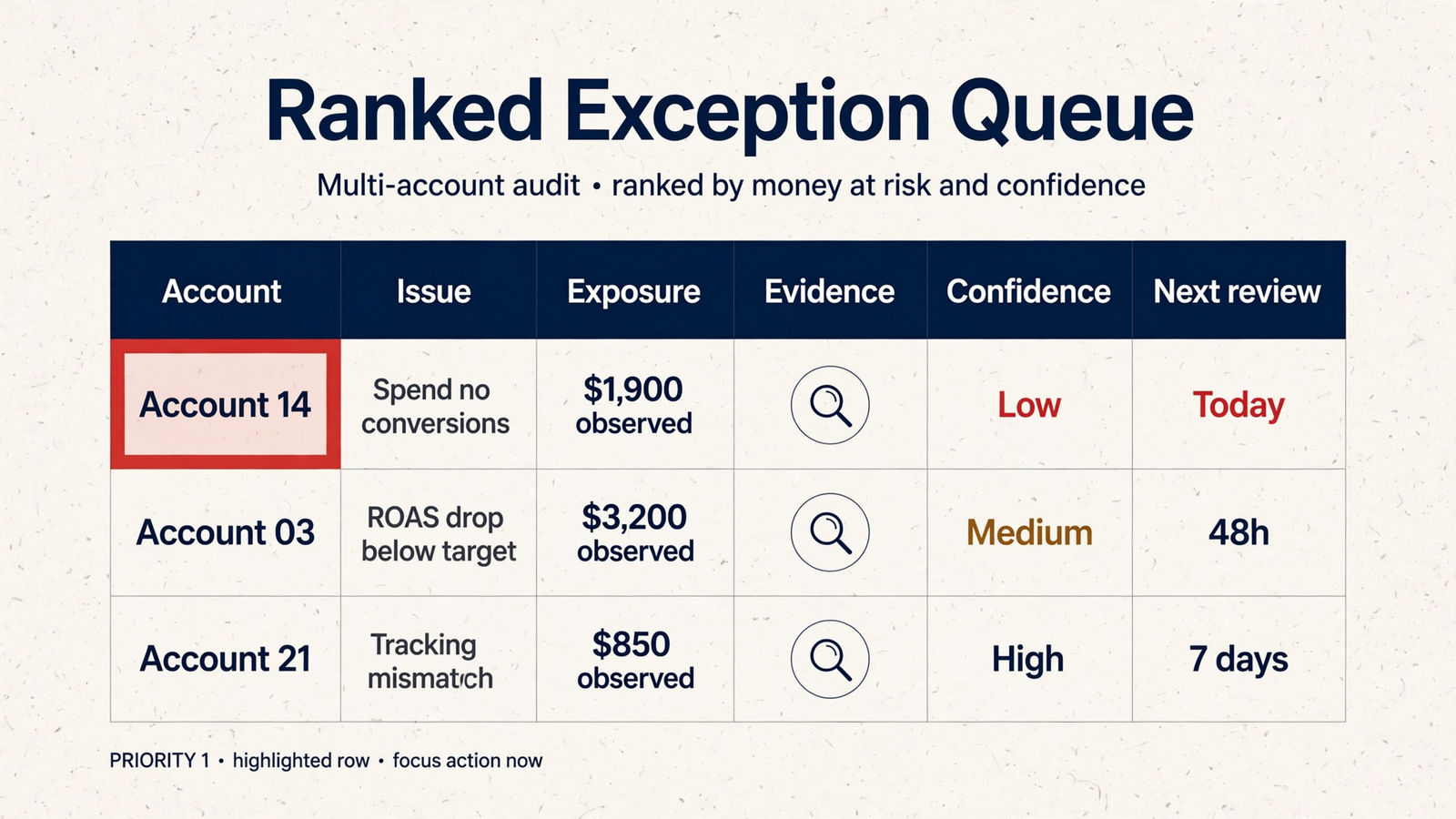
The useful output is a ranked queue of evidenced problems, not a paragraph about every account. Account, issue, evidence, money at risk, confidence, proposed fix, next review. Anything that cannot clear that bar belongs in a separate pile marked insufficient evidence. That distinction is the whole audit.
My workflow is deliberately unglamorous: inventory every account, pull data account by account, apply the same checks, rank the exceptions, and approve fixes in small batches. Skip the portfolio health score. It can hide the account quietly bleeding while the average looks fine.
Here is how I structure that workflow in Claude with groas connected, without letting a tidy report stand in for complete coverage.
1. Which accounts are actually in scope?
Start with a count, not performance. At 24 accounts, the first problem is not finding something clever to optimize. It is knowing which accounts the audit actually reached.
The workload discussion around 4 to 7 accounts per manager puts that scale in perspective. Whatever your own capacity, quiet failures do not announce themselves because you have too many accounts open. You need an inventory that makes omissions visible.
My first prompt is always:
List the connected ad accounts in scope. Show platform, account ID, currency, and reporting time zone. Do not change anything.
With groas connected to Claude, I start there before requesting a single performance judgment. Then I copy the inventory into a coverage ledger and give each account one status:
- Complete: the required audit data has been read.
- Partial: some required data is still missing.
- Inaccessible: the account cannot be read.
- Not yet read: the audit has not reached it.
Those labels describe coverage, not performance. A complete account can have serious problems. A partial account can look excellent in the slice you happened to retrieve.
An unread account is never a healthy account. It stays unread until the data says otherwise. Do not let Claude fill the gap with reassuring prose.
2. How do I pull data without mixing accounts or losing pages?
Work account by account, in bounded batches, and keep the receipt with every number. A giant request feels efficient right up until you cannot tell which account, date range, or currency a finding belongs to.
There is also a retrieval problem: models can hallucinate cursor values or drop pages when exposed to raw pagination. Longer context does not remove the need to check coverage. It gives you more material to lose track of.
I put the batch rules in the audit instructions before the first pull:
- Read one account at a time.
- State the account ID and date range on every pull.
- Follow pagination where the tool exposes it.
- Return the reporting scope alongside the results, including currency and time zone.
- Mark incomplete retrieval as partial in the coverage ledger.
For the manager-account structure behind this workflow, the MCC agency playbook is worth reviewing before you scale the run.
Then come the two prohibitions I care about most: do not turn missing conversions into zero, and do not combine currencies. Missing means missing. An unread conversion column is a measurement exception, not a CPA calculation.
If a pull is incomplete, stop the conclusion there. Put the missing data in the evidence queue rather than asking Claude to make the paragraph sound finished.
3. What should Claude check in every account?
Use the same three buckets everywhere: delivery, measurement, and efficiency. Check whether the account is delivering, establish whether its recorded outcomes are trustworthy, and only then judge efficiency.
That order matters. The advice to verify conversion tracking before optimizing is not housekeeping. Bad signal goes into bidding; bad decisions come out.
Is delivery behaving as expected?
Flag abrupt spend or impression drops, budget pacing that is off track, and spend with no recorded outcomes. Pacing is a recurring problem in multi-account management, so it deserves an explicit check rather than a passing comment.
But zero recorded conversions is a flag, not a diagnosis. It does not, by itself, tell me whether tracking failed or the campaign failed. That distinction belongs in the next check.
Can I trust the measurement?
Look for missing tags, double-counting, or a conversion action that changed without a note. For example, counting the same lead through a Google Ads tag and a GA4 import can inflate the result Claude is about to praise.
Check that primary conversions represent the outcomes the account is meant to pursue, rather than treating page views as equivalent to those outcomes. Unresolved measurement problems block confident efficiency judgments. Do not build a recommendation on a number you have just flagged as unreliable.
Is efficiency worse than this account’s own baseline?
Only after delivery and measurement checks do I want efficiency findings. Compare each account with its own recent baseline, respecting conversion lag, its stated objective, and material campaign changes.
Portfolio averages clear nothing. A blended number cannot explain whether a particular account needs intervention. Keep the evidence attached to the account that produced it.
4. How do I rank 30 problems when I can only fix five?
Skip the 0-to-100 health score. A Claude audit skill that returns a weighted score may organize a report, but the score is not my work queue.
A 72 tells me nothing about whether $8,400 in one account spent two weeks with no recorded conversion, or whether three other accounts just need a negative keyword pass. Those findings need different investigations and different decisions. Giving them a common grade does not settle either.
I ask for money and proof instead. These seven findings to request instead of a grade are a useful starting point.
For each exception, Claude must separate:
- Observed spend: what the account data actually shows.
- Estimated avoidable spend: what might be prevented, if the evidence supports an estimate.
- Assumptions: what must be true for that estimate to hold.
- Confidence: how strongly the available evidence supports the finding.
- Proposed fix and next review: what happens next, and when it gets checked.
Say you spend $20k a month across six accounts, and one search campaign spent $1,900 with zero primary conversions. The observed spend is $1,900. That is not automatically $1,900 wasted.
If tracking is broken, you do not yet know what outcomes the spend produced. If tracking is working, you still need to respect lag and the account’s objective before calling all of it avoidable. Claude should expose that uncertainty, not turn it into a precise-looking savings estimate.
Rank by business consequence first, evidence strength second, and reversibility third. Where money at risk cannot be estimated credibly, say so. A high-consequence issue can deserve investigation without yet deserving a campaign change.
What cannot clear the evidence bar goes into the insufficient evidence queue, with the exact data needed to reconsider it next run. It does not disappear, and it does not sneak into the approved-fixes list.
5. How do I approve fixes without touching the wrong account?
I never let Claude jump from finding to execution in the same breath. The prompt is boring on purpose:
For the five highest-priority verified exceptions, show the supporting account data and exact proposed changes. Include the account ID, campaign, current setting, proposed setting, and evidence supporting the change. Execute nothing yet.
That creates a second pass between diagnosis and action. A proposal that cannot name its account and its before-and-after state is not ready for approval.
Model choice does not replace this boundary. The agency pattern of using Opus-class models for full audits and Sonnet for recurring checks can inform how you run the work. It does not make an ambiguous instruction safe.
Neither does a manager connection. Routing requests to child accounts is not the same thing as a hard client-data boundary. Where hard isolation is required, the same guide describes separate client connections. Do not treat the convenience of one session as proof that every access requirement has been satisfied.
For the approval itself, the request pattern in six marketing jobs that end in an approved change is the useful one: proposal first, receipt after.
I approve small batches by account:
- Review one account’s two or three proposed fixes.
- Authorize only the exact changes I accept.
- Verify what ran in the platform and check the groas action log.
- Record the result before moving to the next account.
Approval is permission for specified changes, not a blanket instruction to fix the portfolio. Keep the approved proposal and the execution receipt separate. One says what should happen; the other proves what did.
That discipline helps keep a budget change in account 14 from turning into a shared negative list applied across all 24. Five fixes with receipts beat fifty suggestions delivered with confidence.
6. What carries over after I close Claude?
A chat audit is a run, not a monitor. Claude does not keep watching your accounts after the session ends, and a longer prompt does not change that.
What makes the next run easier is what you save from this one:
- The exact audit specification, including scope and batch rules.
- The coverage ledger, including partial and inaccessible accounts.
- The unresolved evidence queue, including the metric and date range needed for each item.
- The approved changes and their execution records.
Next time, give Claude the same specification, point it at the ledger, and start with the unresolved pile. Do not spend the opening of every audit rediscovering what the previous audit could not read.
A 100-client agency’s account of shorter repeat audits is useful context here. But speed is not the acceptance test. A faster run still has to show what it covered and what remains unknown. Otherwise you have accelerated report production, not account oversight.
Continuous operation is a separate decision. In groas, autopilot runs around the clock only after you switch it on, within rules you set, with changes logged and undoable.
I keep the modes distinct: chat for the audit where I review and approve specific fixes; autopilot for a bounded job with explicit rules, such as pacing checks or search-term triage on three accounts. Not an instruction to optimize all 24 and report back when it feels finished.
Save the specification first. Expand automation only after the action log gives you a reason to trust the narrower job.
7. What should the finished audit package contain?
Four documents. Not 24 account essays with an executive summary apologizing for their length.
- Coverage ledger. Every account, its reporting scope, and its status: complete, partial, inaccessible, or not yet read.
- Ranked exception queue. Account, issue, evidence, observed spend, estimated avoidable spend where justified, assumptions, confidence, proposed fix, and next review.
- Unresolved evidence list. Each unanswered question and the exact pull needed to resolve it.
- Change record. What was approved, what ran, and the log that proves it.
The documents do different jobs. The ledger tells me where the audit reached. The queue tells me where to work. The evidence list tells me what I still cannot conclude. The change record tells me what actually happened.
If a finding cannot point to its evidence in that package, it is an opinion. Opinions do not get budget changes.
The first thing to do today is connect groas in Claude and run the inventory prompt:
List the connected ad accounts in scope. Show platform, account ID, currency, and reporting time zone. Do not change anything.
Build the ledger before you look at a single campaign. Do not audit yet. Do not fix yet. Count first, then let the queue tell you where the money is. That is the difference between producing summaries for 24 accounts and knowing which five problems deserve your attention.


