

 LinkedIn

The fastest way to make Claude kill a good Meta ad is to ask it which ads to kill. Give it a seasonal account, a budget under pressure, and no rules for what deserves to stay live, and you’ll get a tidy list of losers, some of which are just unfinished.
Say you launch three variations on Monday. By Wednesday, one has spent $140 with no sales, another is at double your target CPA, and the third is quietly driving the cheapest sessions in the account. A pause-first prompt flattens those differences into one verdict: cut it. Spend alone can’t tell you whether conversions are late, the ad set is still learning, or the ad has a different job in the campaign.
I’d settle that before the first dollar goes out, not after a bad morning makes every red number look urgent. Tell Claude what must stay running, what evidence justifies stopping it, and how much you’ll spend to find out. Give it those rules and it can apply your judgment at machine speed. Skip them and you’ve just automated panic.
AI can place the bid. It can’t decide what counts as a fair test.
DoubleVerify surveyed 2,020 marketers in 25 countries and found that third-party AI bidding adoption rose from 42% to 50%, while reported manual optimization fell from 10 hours 12 minutes a week to 9 hours 58 minutes. That’s a difference of 14 minutes a week. As PPC Land notes, DoubleVerify sells its own AI bidding product, the yearly samples differ, and the survey doesn’t establish causation. I wouldn’t use it to sell you a workflow. I’d use it to push back on the idea that automating bids makes the rest of the work disappear.
Placing a bid and deciding whether a test has had a fair shot are different jobs. The second is where the awkward calls live: what a short run of bad numbers means, when a test has had enough time, and when letting it run is the cheaper mistake. Hand Claude a kill list with no protection rules and you haven’t removed those calls. You’ve asked it to improvise them under seasonal pressure, which is exactly when improvisation gets expensive.
Make Claude argue for keeping the ad first
Before I ask Claude for a pause list, I want the case for leaving each ad alone. Connected through groas, Claude can read the live Meta account instead of a screenshot I pasted last Tuesday. That gets it better access, not necessarily enough evidence. I want consistent windows, a record of what changed, and no edits while I’m reading the case.
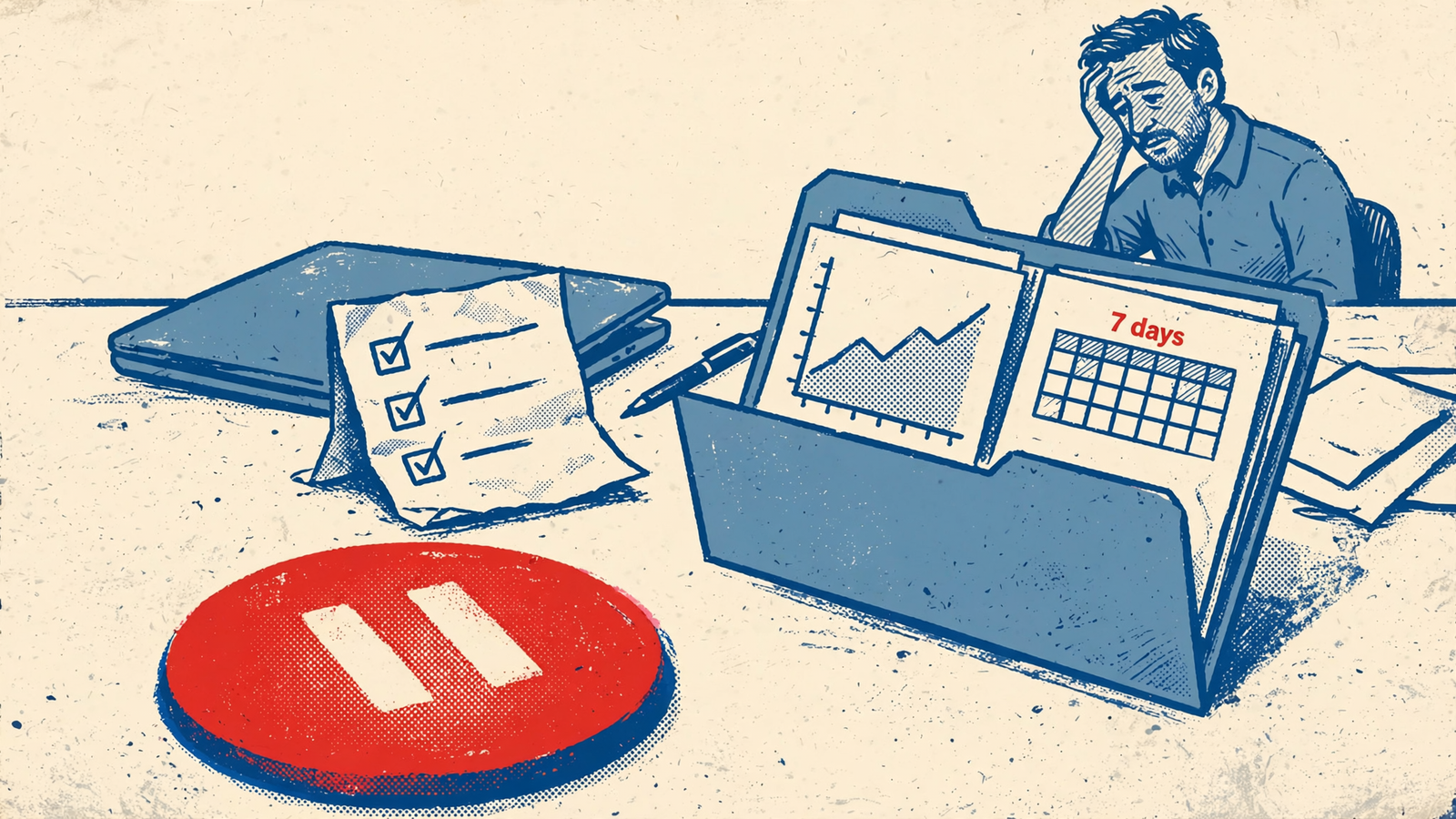
Compare the evidence before you compare the verdicts
I’d start here: “Using my connected Meta account, compare these ads over consistent attribution windows. Show spend, conversions, CPA, ROAS where available, delivery, and recent changes. Make no changes.” Then I’d ask for the two columns most kill lists skip: what the data shows and what it can’t establish yet.
Take the ad that spent $140 in two days without a purchase. The spend is real. The verdict can wait if the purchase window is still open and the ad is within budget. Meta says ad sets usually exit learning after about 50 optimization events in the week after the last significant edit. During learning, delivery is less stable, cost per result is usually higher, and those early numbers don’t necessarily tell you where performance will settle. If purchases are the optimization event, a small seasonal advertiser can reach the end of a test before it reaches 50. That doesn’t mean I owe the ad more money. It means I shouldn’t pretend I bought a conclusive answer.
Separate a bad ad from an unread one
I want Claude to distinguish three different states:
- The ad has had enough delivery and time to judge.
- The ad has barely delivered.
- The ad has delivered, but conversions can still come in.
Those aren’t three shades of losing. They’re three different decisions. Ads Manager reports by impression date, so with a 7-day click and 1-day view setting, conversions can show up against an earlier date. Compare a two-day-old ad with settled numbers from last month and you stack the comparison against the new ad. Give Claude the attribution setting you actually use, compare like with like, and flag open windows. “No sales yet” and “no sales after a full conversion window” aren’t interchangeable. I won’t call an ad a performance failure on the first sentence.
Learning limited is another way to misread thin data. Meta says it isn’t a penalty. It means the ad set is unlikely to get roughly 50 optimization events in the week after its last significant edit. A small audience, a low budget or bid, high auction overlap, an infrequent event, or too many ads can all contribute. That’s why Meta suggests fixes such as consolidation, a broader audience, more budget, or a more frequent event. None of those diagnoses is “the creative failed.” If Claude calls a barely delivered ad a loser, I want it to tell me what would make the test readable. Then I can decide whether that answer is worth paying for. A fresh batch of creative won’t fix the same thin delivery.
Write the stop policy before next season starts
There’s no honest three-day rule or three-times-CPA rule that works regardless of the offer, audience, or conversion window. Write the policy while you’re calm and put your own economics in it. The first bad morning is exactly the wrong time to negotiate how much a fair test costs.
Protect the test, not your favorite creative
I’d write down four things before launch:
- Campaign objective. Put it in one sentence. Prospecting, retargeting, and offer testing don’t all have the same job.
- Acquisition economics. Use a target CPA or a break-even ROAS worked out from contribution margin, not a benchmark copied from a slide.
- Review window. Say how many days the test gets and whether that covers a full attribution cycle.
- Test budget. Set the most you’ll spend to learn whether the ad works. Set it per test, not per gut feeling.
Those four lines tell Claude what expensive means in your account, how long the ad gets to make its case, and when it’s time to stop funding the test. They also guard against the opposite mistake. I’ve kept a favorite alive for three weeks because it “felt close,” long after the test budget was gone. A policy stops the panicked pause and the sentimental keep. If I can’t write down the target CPA or break-even ROAS before launch, I’m not ready to automate the pause. I’m ready to automate the argument.
Give patience a hard spend cap
Unfinished is not a license to spend forever. The loss limit is the point at which I stop paying for uncertainty, even if I don’t yet know whether the ad works. I’d give Claude three buckets, not two:
- Keep: The test is within its review window and below its warning line. Leave it running.
- Review: The ad hits a warning line below the hard cap, but the conversion window is still open. Set the next review and keep the cap in place.
- Pause: The settled data meets the stop condition, or spend hits the hard cap. If the cap comes first, stop spending and let the outstanding conversions land before judging the creative.

I’d ask Claude to put that in writing: “Draft keep, review, and pause conditions for each test. Include the maximum spend and tell me what evidence would change each recommendation.” If it can’t name the evidence that would change its mind, it hasn’t given me a rule. It’s given me a mood.
Published practitioner rules offer starting points: roughly two to three times target CPA in spend with zero results, or a cost ceiling above 1.5 times target CPA once there are enough results to read. The caveat matters more than the tidy multiples: an ad that never got delivery is unread, not a loser. And if you assume a $30 CPA, spending $90 with zero conversions has about a 5% probability in a simple Poisson model. That doesn’t mean there’s a 95% chance the ad is bad, especially when delivery adapts and conversions arrive late. Set the ceiling according to what you’re willing to lose, not how conclusive the number looks.
Approve the pauses Claude can defend
Once the policy exists, I want execution to be boring. For every proposed pause, have Claude return the account, campaign, ad set, and ad ID, along with the exact policy line it says the ad crossed and the evidence that it did. Then approve only those changes through groas. That’s the point of connecting Claude to groas instead of pasting a CSV and trusting the summary: Claude reads the live account and proposes the pause, you approve it, and the change is logged and undoable in one step.
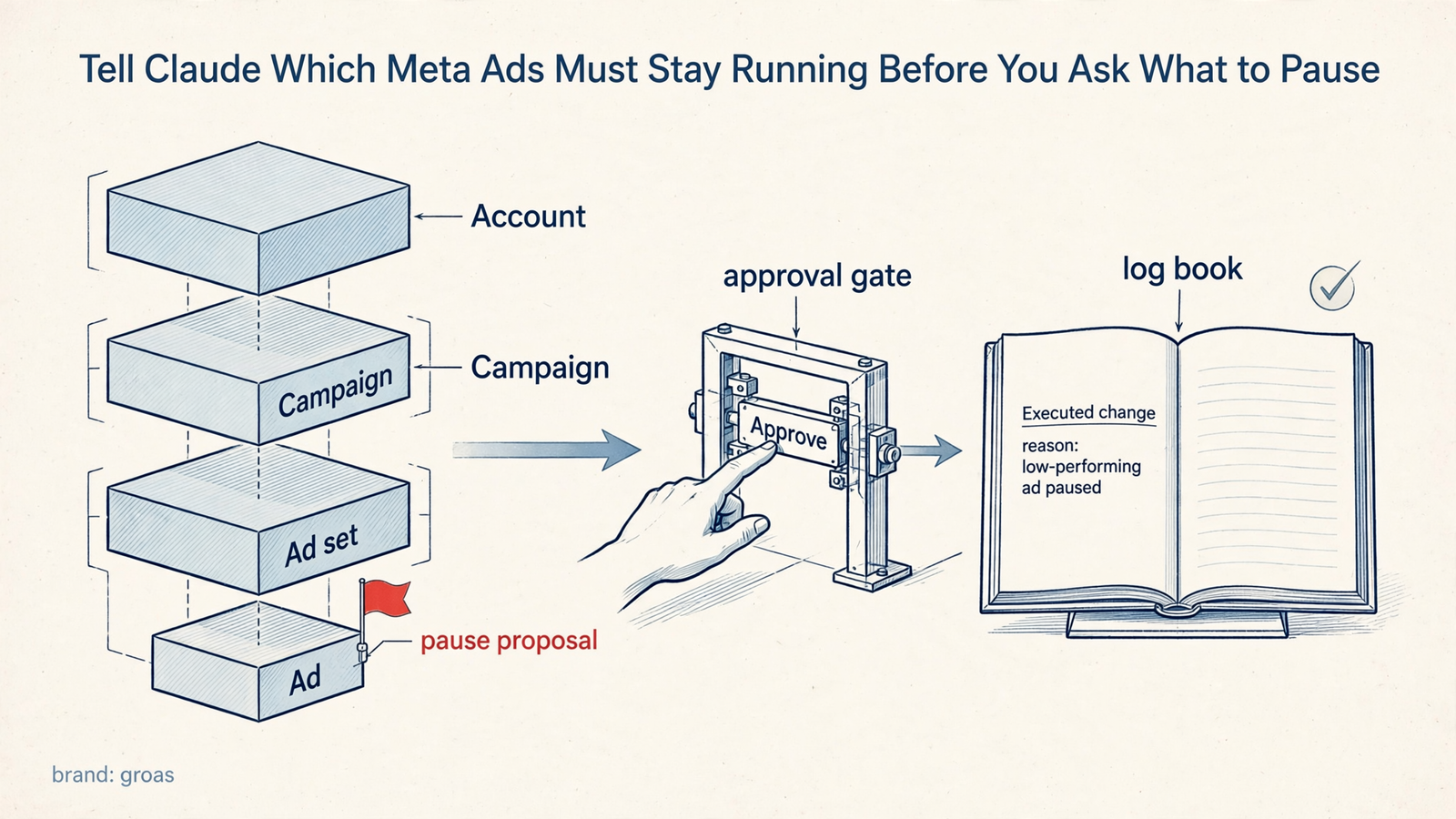
I’d keep autopilot off while I find out whether the policy holds up on a real Tuesday. If Claude flags an ad that’s still within its review window and below its spend cap, check whether it applied the rule you wrote. If it did and you still don’t like the call, fix the rule and run it again. Don’t turn a ceiling into a suggestion because you like the ad, and don’t shorten a review window because Wednesday looks ugly.
A kill list I approve line by line is account management. A kill list I rubber-stamp is the same panic, outsourced. I’d use the same workflow to triage a whole account: a weekly queue of decisions backed by evidence instead of a daily scramble.
Stop broken ads without waiting for the test
A stop policy protects unfinished tests, not broken ads. A false offer, a wrong price, dates that have passed, a page that 404s, a landing page that takes ten seconds on a phone, tracking that stopped firing yesterday: those are defects, not verdicts on the creative. Pause the affected ads when you find the defect, fix it, and then decide whether the creative deserves a test. The same goes for an ad that breaches policy or misrepresents the offer. No review window covers that, and no learning phase excuses it.
Give disappointing performance time inside the budget. Don’t give a defect time to spend it. Blur that line and you either blame the creative for broken tracking or keep paying to send people to a page that can’t convert. I’ve done the second one. It looks fine in a report for about a day. Then you wish you had a better record of what changed and when.
A faster pause button won’t teach you what worked
The useful question isn’t “Which ads should I kill?” It’s “Which ads have hit the conditions I set before launch?” One gets you a list that can look smart on Wednesday and fall apart next week when the conversions land. The other tells you what must stay running, what evidence changes the call, and what you’re prepared to lose while you wait. That’s the decision I want Claude applying through groas, line by line, with every change logged and every exception visible.
I spent years doing the slow version by hand at 1 a.m., mining negatives and watching accounts drift between weekly reviews. The busywork was never the hard part. The hard part was deciding what the numbers were allowed to mean. That decision still belongs to you. Leave it out and the cost won’t be one wrongly paused ad. It’ll be a season of tests you paid for and killed before they could teach you anything, followed by a fresh batch of ads and the same thin data. You’ll get there faster. That’s all a faster panic button buys you.





