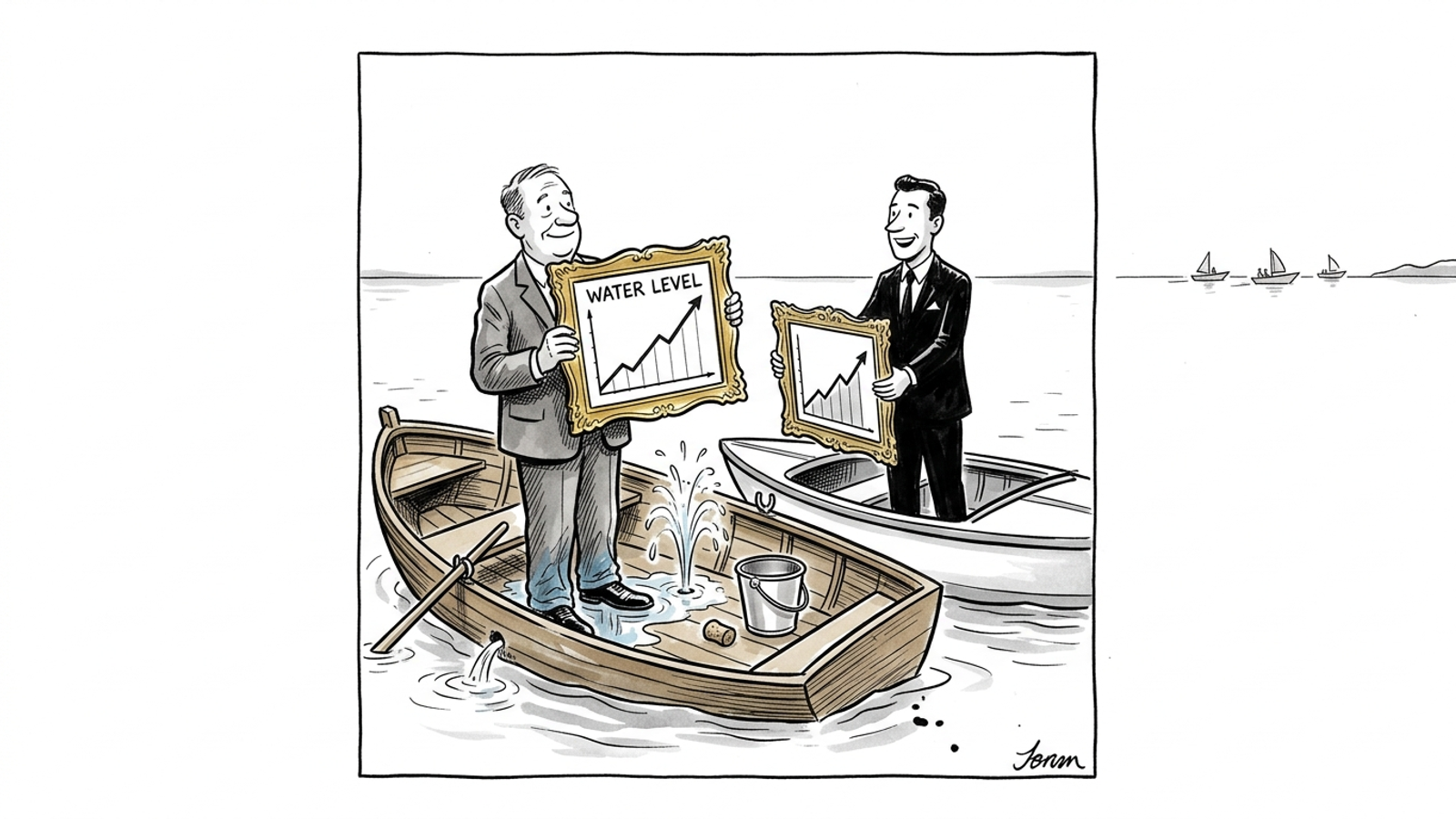
Big Google Ads agencies structurally underdeliver for mid-market advertisers. That is not a complaint about any single agency. It is a statement about the economics, staffing models, and incentive structures that govern how holding-company and enterprise agencies operate. When a company spending $50K to $500K per month on Google Ads signs with a large agency expecting enterprise-grade attention, what it actually receives is a junior account manager running a templated playbook across a dozen accounts, reporting on metrics designed to obscure rather than illuminate. The structural problem is this: big agency revenue models are optimized for client retention at scale, not for individual account performance. The incentives diverge from yours the moment the contract is signed.
This article lays out the specific mechanisms behind that divergence, explains why it persists even when everyone involved has good intentions, and describes what alternative models actually change about the equation.
What Most People Believe About Big Google Ads Agencies
The conventional wisdom goes something like this: larger agencies have more data, more proprietary tools, deeper Google partnerships, and a bench of specialists who can be deployed against any problem. Signing with a recognized name means you get institutional knowledge accumulated across hundreds of accounts and millions in spend. You are buying access to a system, not just a person.
This is not a strawman. There are real advantages to scale, and large agencies have earned their reputations through legitimate wins. A holding-company agency can negotiate preferred rates with Google reps, access beta features earlier, and draw on cross-vertical learnings that a solo freelancer or small shop simply cannot replicate. Their sales teams present polished case studies showing real revenue lifts for enterprise clients.
For mid-market advertisers, the pitch is especially compelling: you get enterprise-level resources without building an enterprise-level team in-house. You skip the pain of recruiting, training, and retaining Google Ads specialists. You hand over the keys and let professionals drive.
The problem is not that this pitch is dishonest. The problem is that the experience described in the pitch is reserved for the agency’s top-tier accounts, and your $100K-a-month spend almost certainly does not qualify.
The Account Manager Ratio That Should Concern Every CMO
Here is the first structural issue: staffing economics. At most large agencies, a single account manager handles between eight and fifteen accounts simultaneously. At some holding-company shops, that number climbs higher. The math is simple and unfavorable. If an account manager works a 45-hour week and manages twelve accounts, each account gets roughly 3.5 hours of human attention per week. Subtract internal meetings, cross-functional syncs, reporting preparation, and email, and the time spent actually inside your Google Ads account shrinks to something closer to one to two hours.
That is not enough time to review search term reports in detail, test new ad copy variations with any rigor, restructure campaigns based on performance shifts, analyze landing page conversion rates, or investigate attribution anomalies. It is barely enough time to check automated bid adjustments and make sure nothing is on fire.
Why The Senior Talent Disappears After Month Three
During onboarding, you likely met a senior strategist or director-level contact who demonstrated deep expertise. That person built the initial strategy, set up the account architecture, and presented the first performance review. By month three, they have moved on to the next onboarding. Your account is now fully in the hands of the junior or mid-level manager who was always going to run it day-to-day. The senior talent was a closing resource, not an ongoing one.
This is not a failure of management. It is rational resource allocation from the agency’s perspective. Senior strategists generate more revenue by closing new business than by optimizing existing accounts. But for you, the client, the experience degrades precisely when the account needs the most nuanced attention: after the initial setup, when real optimization requires understanding your business, your margins, and your competitive dynamics at a level that a junior manager running twelve accounts cannot sustain.
If you want a benchmark for what your agency should be delivering month over month, it is worth auditing against a concrete checklist rather than accepting vague reassurances.
Standardized Playbooks Kill Performance For Non-Standard Advertisers
Large agencies achieve operational efficiency through standardization. They develop playbooks for account setup, bidding strategy, audience targeting, and reporting cadence. These playbooks are refined over time and work reasonably well for the median account.
The problem is that mid-market advertisers are rarely median. A B2B SaaS company with a 90-day sales cycle, a multi-location franchise with hyper-local inventory constraints, and a DTC brand with aggressive seasonal swings require fundamentally different campaign architectures, bidding strategies, and attribution models. When the same playbook is applied to all three, someone is getting the wrong strategy.
Templated Bidding Across Dissimilar Clients
One of the most common manifestations is bid strategy selection. Large agencies frequently default to tROAS or tCPA across their entire book of business because those strategies are easiest to monitor at scale. But setting a ROAS target too aggressively can collapse volume, and the right bidding approach depends on account maturity, conversion volume, margin structure, and funnel length. A templated approach ignores all of this.
The same applies to Performance Max campaigns. Agencies often roll them out uniformly because Google incentivizes adoption and PMax is low-maintenance once launched. But PMax without proper budget controls and structural guardrails can cannibalize branded search, inflate reported ROAS with remarketing conversions, and obscure where spend is actually going.
When your account manager is running twelve accounts and defaulting to the agency’s standard PMax setup, these nuances go unaddressed. Not because the person is incompetent, but because the operating model does not give them the time or incentive to customize.
The Conflict Of Interest Built Into Agency Revenue Models
This is the structural issue that agencies least want to discuss. Most large agencies charge either a flat monthly retainer or a percentage of ad spend. Both models create incentive misalignment.
A percentage-of-spend model incentivizes the agency to increase your budget, regardless of whether that increase is profitable for you. A flat retainer model incentivizes the agency to minimize the hours spent on your account, since the margin on your contract improves as labor decreases.
Neither model directly ties agency compensation to your business outcomes. The agency does not earn more when your revenue grows, and it does not earn less when performance stagnates. It earns based on the retainer you signed or the spend you authorized.
How Big Agency Reporting Hides Underperformance Behind Vanity Metrics
Reporting is where this misalignment becomes visible, if you know what to look for. Agency reports tend to emphasize impressions, clicks, click-through rate, and in-platform ROAS. These metrics are easy to make look good. Impressions and clicks almost always go up if you increase spend. In-platform ROAS can be inflated by brand campaigns, remarketing, and attribution windows that count view-through conversions.
What is typically absent or buried: new customer acquisition cost, incremental revenue (revenue you would not have gotten without the ad), blended margin after ad spend, and cohort-level data showing whether the customers acquired through Google Ads are actually profitable over time. High ROAS numbers can actually mask growth problems when the account is merely recapturing existing demand rather than creating new revenue.
If your agency report makes you feel good but your finance team cannot connect it to the P&L, you have a reporting problem that is functioning exactly as the agency designed it.
The Proprietary Dashboard That Makes Switching Hard
Many enterprise agencies build proprietary reporting dashboards and connect them to your ad accounts during onboarding. On the surface, this feels like added value. In practice, it serves a retention function. When your historical performance data, audience segments, and conversion tracking are intertwined with the agency’s proprietary layer, switching becomes operationally painful. The agency knows this.
This is not to say that every agency deliberately creates lock-in. But the incentive to make switching difficult is real, and it shows up in how account access is structured, how conversion tracking is implemented, and how reporting infrastructure is built. If your agency controls your Google Ads account ownership rather than operating under your MCC, that is a red flag worth investigating.
When A Big Agency Relationship Does Make Sense
Intellectual honesty requires acknowledging where enterprise agencies genuinely earn their fees. For advertisers spending $1M or more per month who need cross-channel media buying across Google, Meta, programmatic, CTV, and offline, a large agency can coordinate at a scale that point solutions cannot. If your primary need is media planning rather than media execution, the strategic layer of a holding-company agency has real value.
Similarly, if your company requires agency-of-record relationships for compliance, procurement, or international coordination purposes, the infrastructure of a large agency matters more than the Google Ads execution within it.
But those scenarios describe true enterprise advertisers. For the mid-market company spending $50K to $500K per month on Google Ads and expecting hands-on optimization of that specific channel, the enterprise agency model is a poor fit. You are paying enterprise overhead for mid-market attention.
For a deeper comparison of the structural differences between enterprise, boutique, and autonomous models, the trade-offs are worth examining side by side.
Why Autonomous Execution Changes The Equation
The core problem with the traditional agency model is that human execution does not scale linearly. Doubling your spend does not double your account manager’s hours. Adding campaigns does not add hands. The ceiling of what any single person can do in a week is fixed, and you pay the same rate whether that person is operating at capacity or coasting.
groas exists specifically to break that constraint. A proprietary engine trained on over $500 billion in profitable ad spend runs execution around the clock, every day, across every campaign in your account. It does not get pulled into twelve other accounts on Monday morning. It does not default to a playbook because the playbook is faster. It processes data, adjusts bids, reallocates budget, and identifies opportunities at a speed and consistency that no human team can match.
But execution without strategic judgment is just fast automation. That is why groas pairs the engine with senior human strategists whose role differs depending on the product.
For advertisers who want Google Ads fully handled, groas offers a fully managed service where a dedicated strategist owns your entire account: strategy, execution, landing pages, offers, and conversion optimization from first click to final sale. There is nothing to log in to or manage. You communicate with your strategist on Slack or email whenever you want. This is not a vendor relationship. It is a partnership where groas owns your Google Ads as a function and is accountable for outcomes, not hours billed. $0 onboarding, month-to-month commitment, cancel anytime. groas earns the next month by performing.
For teams that have an in-house person who knows Google Ads and wants to stay in the driver’s seat, groas provides the engine plus a strategist working alongside your team. You get weekly reports on exactly what was done, strategy calls every other week, and insights from groas’s internal team inside Google HQ. Your team keeps control. The engine handles the heavy lifting underneath.
For agencies looking to scale their client book without adding headcount, groas provides direct access to the engine as a platform that agencies operate themselves. Unlimited client accounts under one subscription, white-labeled, with agencies keeping their brand and margin.
In every case, the gap between groas and a traditional agency shows up in the same place: execution depth, execution speed, and the absence of the staffing ratio problem that structurally limits what any agency can deliver.
How To Tell If You Have Outgrown Your Current Agency Relationship
5 Signs Your Account Is Getting Template Treatment
-
Your campaign structure has not meaningfully changed in six months, despite shifts in your business, product lineup, or competitive landscape.
-
Your agency’s recommendations consistently align with Google’s automated suggestions rather than challenging them with account-specific context.
-
Reporting focuses on in-platform metrics (clicks, CTR, in-platform ROAS) rather than business outcomes (new customer CPA, incremental revenue, blended margin).
-
You cannot get your account manager on a call without a week’s notice, or the person on the call cannot answer detailed questions about recent changes to your campaigns.
-
Your landing pages have not been touched, tested, or even discussed in the last quarter.
The Internal Audit Every CMO Should Run Before Renewing
Before your next contract renewal, run this check: compare the strategic recommendations your agency made in the last six months against what actually changed in your account. Pull the Google Ads change history. Count the meaningful, non-automated changes. Calculate the effective hours of real optimization work. Then ask yourself whether the retainer you are paying is justified by the work being done, or whether you are paying for access to a brand name and a dashboard.
If the answer is uncomfortable, the decision framework for when to leave is worth walking through before the renewal conversation.
The Thesis, Restated
Big Google Ads agencies underdeliver for mid-market advertisers not because of bad people, but because of structural incentives that prioritize client retention at scale over individual account performance. The staffing ratios, playbook standardization, vanity reporting, and spend-based compensation models are not bugs. They are features of a business model that works very well for the agency and poorly for the mid-market client caught in the middle.
The alternative is not to go it alone. It is to choose a model where execution capacity is not capped by how many hours one person has in a week, where the engine never stops running, and where the business earns its next month by delivering results rather than invoicing against a contract. That is what groas was built to do. If your current agency is giving you templated strategy and polished reports while your actual performance plateaus, the gap will only widen. Apply for groas and find out what changes when execution matches ambition.