

 LinkedIn

Claude can build a campaign from “Build a Performance Max campaign for our new product.” It can also build the wrong one without getting a single setting technically wrong. I picked this instruction because I see some version of it every season, usually pasted into Claude or ChatGPT the week before launch, when nobody has time to argue. It names the campaign type, gives a reason to build, and leaves Claude and groas to work out the rest.
That last part is where the budget goes. I’ll take the instruction in order: what build should make Claude inspect, what Performance Max automates once a campaign exists, and what our new product asks Claude to guess. The distinction I care about is simple: some answers are in the account, some belong to the operator, and some, if missing, should stop next season’s launch.
The instruction gets the outcome right
I used to tell clients to write briefs like this: short and outcome-first. A long brief full of guessed settings can do more damage than a short one. I was wrong about what happens next, though. A short brief works only if someone resolves the missing decisions before the build. Send it straight to execution and you skip the step that made it a good brief in the first place.
This sentence leaves the account, product, market, dates, budget, conversion goal, and measure of success open. Those aren’t all the same kind of blank. Claude can read which conversion actions the account uses now. It can’t take that as permission to use the same goal for this launch. It can read an existing campaign’s daily budget. That doesn’t make the same amount available for a new one.
I keep the short request. I don’t let Claude treat a value it found in the account as a decision I’ve made.
“Build”: check what already covers the product
My verdict on build: premature. I’ve inherited accounts with three overlapping PMax campaigns and nobody able to explain why all three exist. I don’t want Claude making it four. Before it creates anything, I have it read the current campaigns, conversion goals, and daily budgets through groas, then check whether Search, Shopping, or an existing PMax campaign already covers the product. It’s the same inspection I run with the 10-point Google Ads audit framework. Claude does the reading. I decide whether there’s a reason to build.
Overlap is something to investigate, not proof of harm. An Adalysis study of more than 3,300 non-retail PMax campaigns and about 1.2 million search terms found that only 2.8% of PMax search terms exactly matched a Search keyword, but 67% of campaigns overlapped on at least one term. Where the two overlapped, PMax took more volume, while Search had the higher click-through rate 65% of the time and the higher conversion rate 84.18% of the time.
I want Claude to show which queries overlap and which campaigns cover them. That gives me something to work with: I can decide which winning queries belong in exact-match Search and whether the new PMax campaign has a job the existing campaigns aren’t doing. No overlap report, no new build.
“Performance Max”: separate Google’s job from Claude’s
My verdict on Performance Max: it names Google’s automation, not Claude’s. Google’s Smart Bidding and delivery steer spend across queries, placements, and audiences toward the bidding goal you set. That happens after the campaign exists. Claude through groas can inspect the account, propose what to build, and carry out the changes I approve. With groas, each change is logged with its reason and can be undone in one step.
That’s the distinction I care about when comparing tools. The documented Google Ads MCP server, version 0.0.6, has seven tools, none of which changes bids, budgets, keywords, or campaign status. Google’s in-account Ask Advisor can propose budget, pause, and location changes and asks for approval first. For this job, I want Claude working from the live account, able to make the approved changes through groas, with a log I can check afterward.
Make Claude argue for PMax before it builds PMax. I want to know what supports the choice and what’s still unknown. Is there enough conversion volume for bidding? Is the asset set ready? Does the product need PMax’s reach, or would a tightly controlled Search test answer the question? The timeline matters, too: the PMax guidance on evaluation and Final URL Expansion suggests allowing about four to six weeks before judging performance and notes that Google can replace the final URL if expansion is left on. If the launch depends on a particular page, I want that setting reviewed before I sign off.
If Claude can’t name the target, the budget it needs, and the stop date, Performance Max is still a campaign type, not a plan.
“Our new product”: confirm the facts before drafting copy
My verdict on our new product: this is where the instruction fails hardest. Claude can write clean, confident copy about a product it has never seen. I’ve watched operators approve copy because it reads well, then find out that the offer changed, the landing page was a placeholder, or the claim in headline two was never approved. Say the launch is November 24 and the page still says coming soon. The copy isn’t the thing that needs fixing.
I make Claude confirm five things before it drafts a word:
- The exact product and SKU set
- The market and language
- The offer and price
- The destination URLs
- The claims it’s allowed to make
Those facts determine what goes into the build. I have Claude check the supplied assets against Google’s PMax asset specifications: 3–15 headlines of up to 30 characters, 1–5 long headlines and 2–5 descriptions of up to 90 characters, plus the business name, call to action, final URL, and landscape, square, and logo images. If I don’t supply a video, Google can generate one. I want that called out, not buried in the setup. For a retail build that uses a product feed, I also have Claude check the Merchant Center link and whether the objective is compatible. Claude should name what’s missing. It shouldn’t turn missing assets or unapproved claims into filler.

Competitor ads help with angles and offer shape. Through groas, Claude can read the ads competitors run on Google and Meta and the funnels behind them. That tells me what rivals say, not whether their PMax campaigns are profitable, what CPA they accept, or whether their setup makes sense at my margin. I treat rival ads like shelf placement in a store: worth walking past, useless as a business plan. Use them as observations, never as proof the build will work.
What the sentence never says: when to stop the launch
The instruction ends without naming a conversion goal. That’s the contract underneath the budget: before Claude proposes spend, I want it to show which action is primary, how it’s tracked, and how many times it was recorded in the last 30 days. One PMax stability guideline uses 15 primary conversions in 30 days, counted in the Conversions column, not All conversions. I use that as a check, not a pass mark. Promoting add-to-cart to primary just to reach 15 gives Smart Bidding a different job: finding cheap carts.
I learned that the expensive way on a home services account where the primary goal included phone-button taps that never connected. Bidding got efficient at finding the action we counted, not the calls we wanted. If the primary signal is wrong or too thin to justify the plan, I stop the launch. I don’t swap in an easier action to get the campaign out the door.
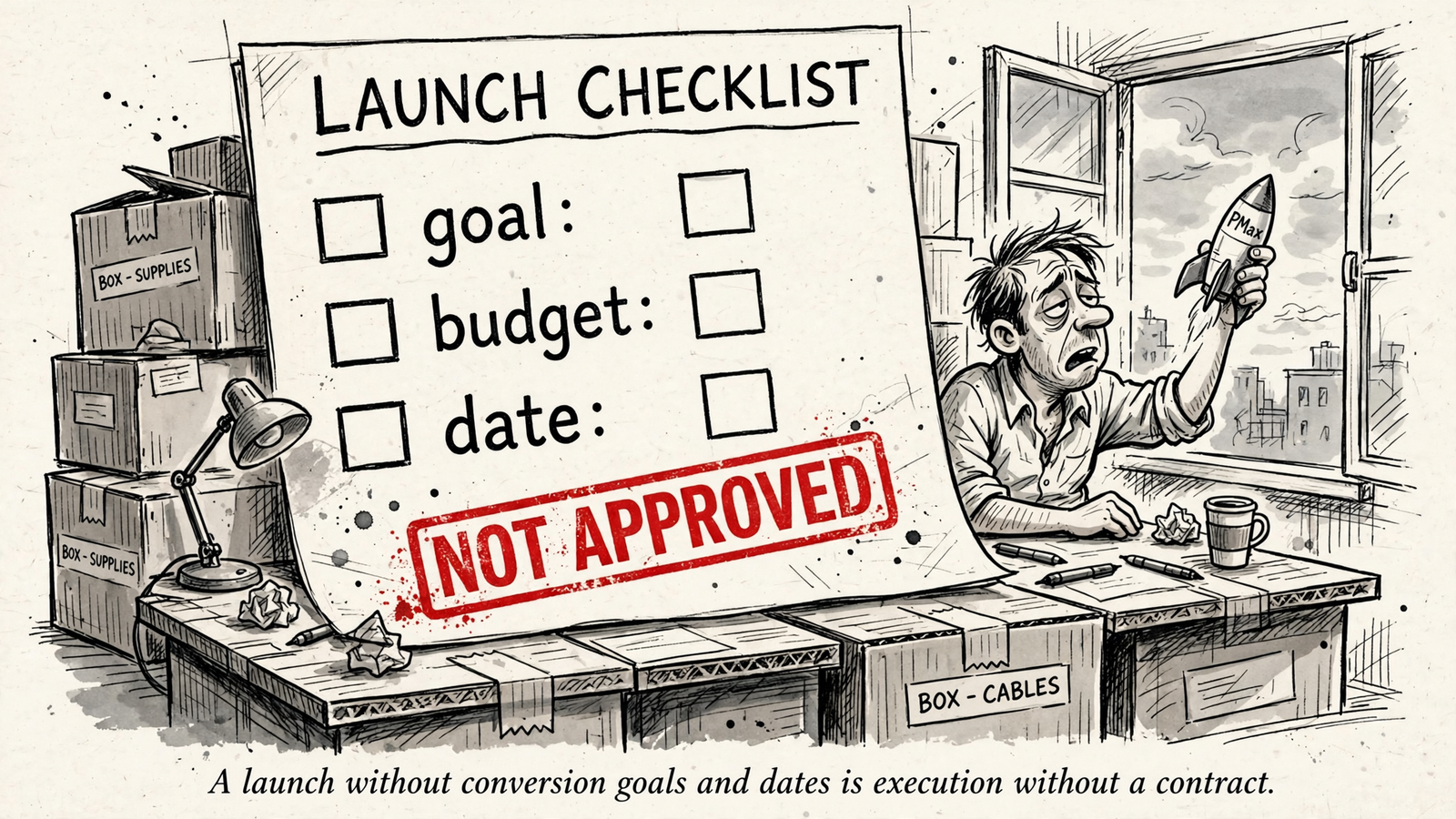
Then I put the operating limits in writing:
- Dates: when the campaign starts and when it stops.
- Budget: the daily and total caps for this campaign.
- Approval: which changes Claude may propose, whether bids, budgets, or status may change mid-flight, and the rule that nothing is created or edited until I approve the exact plan.
Say I’m spending $20k a month and planning a December push. Neither number on the calendar nor the account’s monthly spend tells Claude what it can spend on this product. And if last season’s CPA came from a different product, offer, and tracking setup, I don’t use it as the target for this one. No dates, no caps, or no approval rule: the campaign stays in draft.
The replacement: ask for a proposal, not a campaign
Here’s what I paste instead. It keeps the outcome up front but makes the proposal the first deliverable:
Using groas, inspect our Google Ads account for a proposed PMax launch for [product] in [market] during [dates]. List missing inputs, conversion-goal concerns, existing campaign overlap, and asset requirements. Propose settings within [budget]. Do not create or change anything until I approve the exact plan.
The difference is what comes back before anything gets touched. I get a list of missing inputs, a read on whether the primary conversion can support bidding, an account of which campaigns already cover the product, and a checklist of assets that aren’t ready. I can challenge the choice of PMax or reject the budget without first having to undo a build.
I also want to know where each answer came from. Current campaigns and conversion counts come from the account. The offer, approved claims, and spending limits need my confirmation. If Claude can’t fill a bracket with a value from the account or from me, the answer is still missing. The build waits.
Verdict: keep the nine words as intent, not authorization
What I keep from the original is its shape. It tells Claude what the business wants instead of dictating tabs and toggles. What I won’t keep is the assumption that naming the campaign type settles the product, market, budget, dates, and conversion goal. Technically executable is not commercially complete. A campaign can be built exactly as requested and still have no good reason to exist.
Once I approve a build, I check the change log against the proposal: which campaign was created, what budget, goal, and assets went in, and whether anything else was touched. I leave autopilot off until I approve separate operating rules. The autopilot guide makes the same distinction I do: approving one build is not the same as authorizing changes while nobody’s in the chat.
That’s slower than typing nine words and hitting Enter. It’s supposed to be. Those extra ten minutes are where I catch the missing Merchant Center link, the secondary goal masquerading as primary, or the Search campaign already covering the launch queries. I keep the short sentence. I save the speed for after approval, when Claude can build what I actually signed off on.





