

 LinkedIn

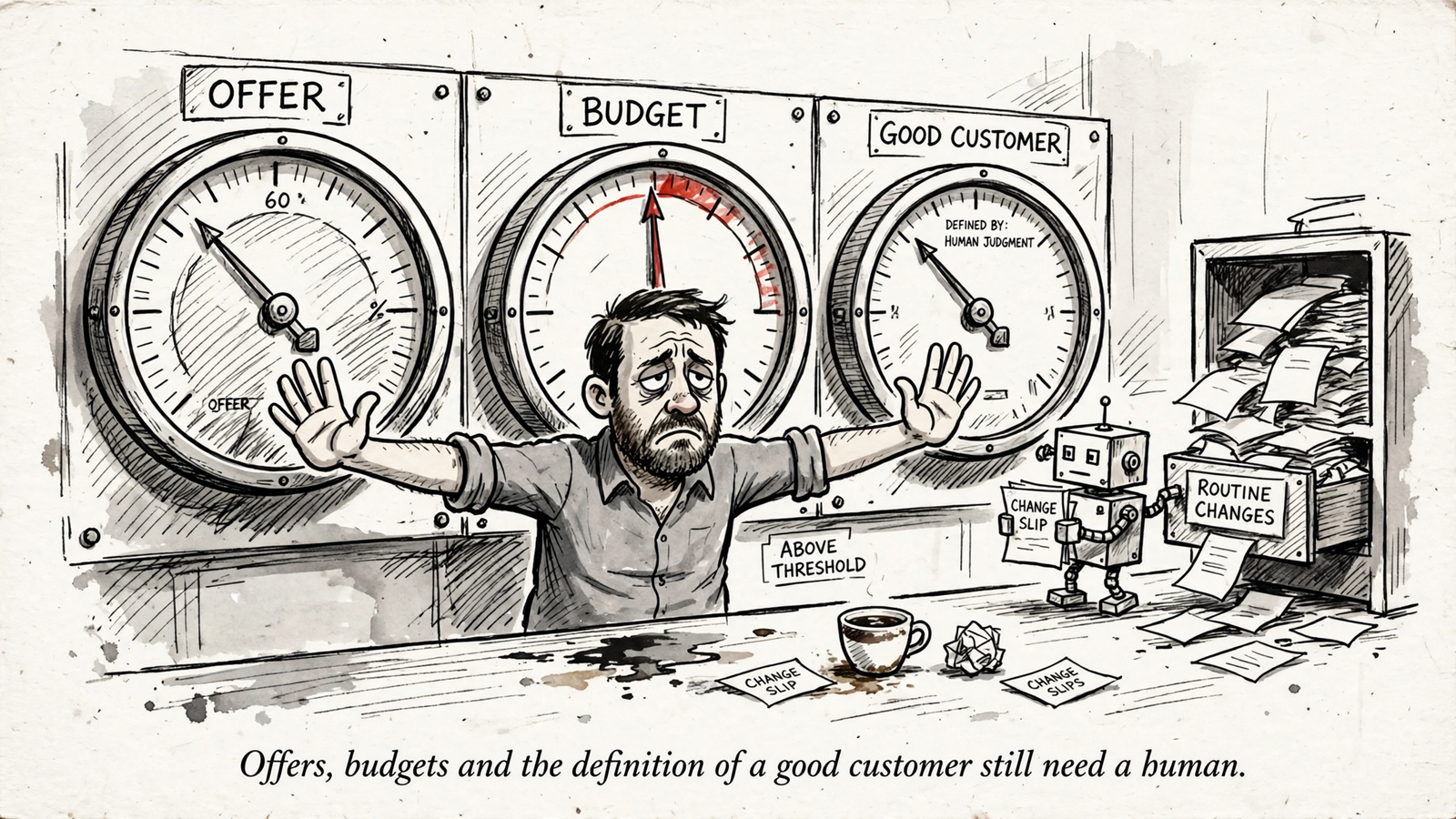
By 31 December 2028, AI agents will make more routine changes inside the average active ad account than the human listed as its manager. The offer, the spending limits, and the definition of a good customer will still belong to a person.
I mean the boring changes: pause the loser, move $300 between ad sets within an agreed limit, flag the search term that wasted $412 last week, push a new headline live for review. Not decide what the business should sell next quarter.
The reason is plumbing, not a sudden outbreak of machine judgment. Agents no longer just write recommendations for someone to paste into an account. Through MCP connections with write access, they can create campaigns, change budgets, update targeting, and add or remove keywords. Approval controls, change logs, and undo make that access usable rather than merely impressive in a demo. This breakdown of what agents can already change in ad accounts shows the shift from advice to execution.
That direction matches what marketing leaders expect. Gartner found they expect AI to handle 36% of marketing work by 2028, up from 16% in 2026. That forecast does not prove mine. It does show that reorganizing work around automation is no longer a fringe assumption.
My bet is narrower: routine, reversible, rule-bound changes move to agents first. Teams should reorganize around that boundary now, rather than wait for a tool that claims it can do everyone’s job.
Prediction 1: by the end of 2028, agents will make most routine, reversible account edits
Say an account spends $20k a month. Its change log records three paused ad sets, a $400 shift toward a winner, two new negatives, and a headline update. None of those edits necessarily requires a meeting. Each can have a numeric trigger, a fixed procedure, and a way to reverse the setting.
That is why agents take this work first. Checking the account does not have to wait for someone’s next scheduled review. An agent can make the nightly pass, act within its permissions, and leave exceptions for a person.
The unit of delegation is a bounded change, not “manage my marketing.” That distinction matters more than how fluent the agent sounds.
Practitioners already put budget pacing, routine adjustments, and creative pauses on the automation side, while keeping approval for edge cases such as confirming negatives. This breakdown of what to automate in PPC describes that split. A search term can look wasteful without being irrelevant. A rule still needs someone to decide what counts as an exception.
The connection layer makes the prediction plausible. MCP, the open standard Anthropic introduced in November 2024, now sits behind 10,000+ public servers. Amazon has also opened its ad stack to agents that translate plain English into campaign setup, budget changes, and reporting calls through an open beta announced at IAB ALM.
But connection is not permission. As of November 2026, one comparison of eight official ad-platform MCP servers lists Google Ads, Snapchat, and Microsoft Ads as read-only, while Meta, Amazon, TikTok, X, and PropellerAds allow read and write. “An MCP server exists” and “an agent can edit this account” are not interchangeable statements.
Where write access exists, agents can already work under approval modes, with history and undo. New campaigns can start paused. Those controls turn an alarming proposition into a manageable one: let the agent prepare or make a limited change, then inspect what happened.
What would prove me wrong: Google Ads and Microsoft Ads remain read-only through the relevant connections at the end of 2028, or security restrictions keep routine edits behind manual approval. The Supermetrics MCP survey identifies security as the leading concern, cited by 64% of tech leaders. That is a real brake, not an inconvenient footnote.
My practical line: delegate edits with explicit triggers, limits, and reversals. Keep ambiguous negatives and changes outside those limits in the approval queue.
Prediction 2: by mid-2028, bids, placements, and creative mixes will run without a weekly human touch
Inside Performance Max and Advantage+, much of this handoff has already happened. The platforms control bids, placement mix, audience expansion, and which creative combination appears. What decides the result has moved up a level: the conversion signal, the quality of the data, the offer on the page, and the exclusions that keep delivery away from junk.
This breakdown of the Advantage+ and PMax split describes that division. Feed the system a useful signal and clear guardrails, and it can handle auction decisions. Feed it a bad signal, and it can spend quickly in pursuit of the wrong outcome.
The reported results explain the appeal. Meta reports 14% lower cost per lead and 10% lower qualified lead cost on the automated side. Google reports 27% more conversions or conversion value at similar CPA or ROAS for non-retail PMax. Those are platform-reported results, not permission to stop checking profit.
Platform automation and an account agent are different layers. PMax or Advantage+ handles delivery inside the platform. An agent connected to the account handles the surrounding work: monitoring, permitted changes, exceptions, and reporting. My prediction is that teams stop treating a weekly manual adjustment as proof that either layer is being managed properly.
The human job becomes setting the conditions under which those systems operate. Is the conversion worth buying? Does the page deliver what the ad promises? Are the exclusions doing their job? A weekly bid tweak cannot rescue bad answers.
What would prove me wrong: incrementality tests show the automated mix does not beat careful manual structure on profit, rather than merely on platform-reported conversions. If profitable operation still requires someone to intervene in bids, placements, and creative mixes every week, this prediction fails.
I would watch the change log alongside the profit numbers. Fewer human edits are not a victory if the account quietly buys worse business. Stop measuring management by how often someone touches a setting.
Prediction 3: through 2028, offers, spending above a threshold, and customer quality will stay human
An agent optimizes toward the target it receives. Point it at form fills and it will pursue form fills, including the junk ones. Point it at qualified pipeline and closed-won revenue and it has something more useful to chase.
Choosing that target is human work. So are the offer, the landing-page promise, and the decision about where money belongs across platforms. Those choices involve margin, sales capacity, and risk. An account log does not settle them.
The practitioner rule that hands routine edits to automation keeps strategy, offers, and budget allocation with people. I expect that boundary to hold through 2028, even as execution becomes much less manual.
Humans decide what is worth pursuing. Agents execute within that definition. Here is where I would draw the line.
Keep the offer and page promise with a person
No agent can fix a weak offer by bidding harder. If the headline promises 20% off and the landing page hides the code in paragraph four, faster optimization does not resolve the mismatch. It just buys more disappointed clicks.
The same applies to a vague “contact us for a quote” page. The decision to replace that promise with a fixed price or a next-day slot is an offer decision, not a bidding adjustment. Someone has to decide whether the business can deliver it and whether the economics work.
The model optimizes delivery. The business owns desirability and fulfillment. Keep the offer, angle, and page promise under human direction, even when an agent helps execute the work.
Require approval above a written spending threshold
Undo restores the setting. It does not refund the spend.
That is the limit hiding behind every cheerful mention of reversibility. A budget change can be easy to reverse and still cost real money before anyone reverses it.
My proposed starting rule is straightforward:
- Any single budget move above 20% of the daily budget needs a named approver.
- Any new campaign launch needs approval.
- Any account-wide bid-target change needs approval.
- Routine edits below those limits can run under explicit rules.
Those thresholds are operating choices, not universal laws. The important part is writing them down before giving an agent access. This is the split described in the 2026 Google Ads playbook on what to automate and what to control.
Put the threshold in the rules, then stop approving every $40 shift by hand. Otherwise, the agent becomes a very elaborate way to generate homework.
Define a good customer before automating the pursuit
The ad platform sees a conversion. The CRM can show whether that conversion ever paid.
A cheap form fill is not necessarily a good lead. A demo request is not automatically qualified pipeline. The human job is to name the stage that matters: a sales-accepted opportunity, a booked job with a deposit, or a paid order. Then make that the target the system works toward.
Optimize toward qualified opportunities and revenue, not form fills by default. Skip that mapping and automation makes the buying of bad leads more efficient. That is not the efficiency anyone asked for.
What would prove me wrong: agents consistently make those offer, customer-quality, and spending decisions without human definitions or mapping, and businesses can trust the resulting economics. Reading CRM stages alone would not clear that bar. Someone still has to decide which stages represent valuable business.
Until that changes, keep a person accountable for the target, not just the tool.
The failure test: does autonomy create more cleanup than it saves?
The dates make these predictions checkable. The operating test is simpler: do teams spend more time fixing agent changes than they save by delegating them? If they do, the approval tax breaks the model.
I would track three things rather than count impressive demos:
- Write access: can the agent make the permitted changes, or only recommend them?
- Actual autonomy: do routine changes happen within the rules, or does a person still approve every click?
- Cleanup: how much work goes into reversing, investigating, or repairing those changes?
Security runs through all three. Read access and write access are different decisions. Caution about the latter is rational because spend does not come back.
The useful destination is scoped write: permission to make specified changes within specified limits, with a clear owner and a record of what happened. Not unrestricted control. Not a chatbot that asks permission to breathe.
If teams cannot make that middle ground work, agents stay advisers and my timeline fails. Treat the audit trail as part of the operating system, not paperwork added after something goes wrong.
What I would set up this quarter
If I am right, the reorganization starts now: humans own the signal, the offer, and the limits; agents own the routine pass.
That takes an assistant plus infrastructure that gives it account access, data, and controlled execution. It is why lists of the best AI tools for advertisers often miss the useful question. Which tools write changes back with controls and undo, and which ones just write slides?
Here is the setup I would use:
- Connect the accounts and website once. Add groas to ChatGPT, Claude, or another agent over MCP. groas Unlimited is $19 a month, flat, for unlimited teammates, ad accounts, and websites. The breakdown of what that first MCP connection really costs puts the connection in the context of the full bill.
- Name the conversion that means business. Choose the relevant CRM outcome: a sales-accepted opportunity, a booked job with a deposit, or a paid order. This explanation of what a fully autonomous Google Ads agent would actually do shows why that mapping shapes everything downstream.
- Write the permissions in plain English. Specify which losers the agent may pause, which negatives require review, and which budget moves need approval. Keep new campaigns paused until approved. Require a reason in the change log and one-step undo.
- Start read-only, then enable scoped execution. Run one week read-only before switching on permitted changes. With groas, autopilot stays off until it is switched on. Use that boundary deliberately.
The point is not to hand over the business. It is to stop treating every routine account edit as a strategic decision while leaving the genuinely consequential decisions ownerless.
If my date is wrong, the team still has clearer permissions, a defined conversion target, and an explicit approval boundary. If my date is right, the team already works the way 2028 demands.


