

 LinkedIn
By December 2027, asking ChatGPT to explain what happened in your Microsoft Ads account will be a free baseline feature. If a tool’s main trick is letting AI describe a Bing account, its bill gets hard to justify.
My bet is not that reporting disappears. It is that Microsoft’s expanding native diagnostics squeeze the value out of description alone. The paid workflow has to do something harder: reconcile evidence across Google and Bing, then carry an approved decision into the account.
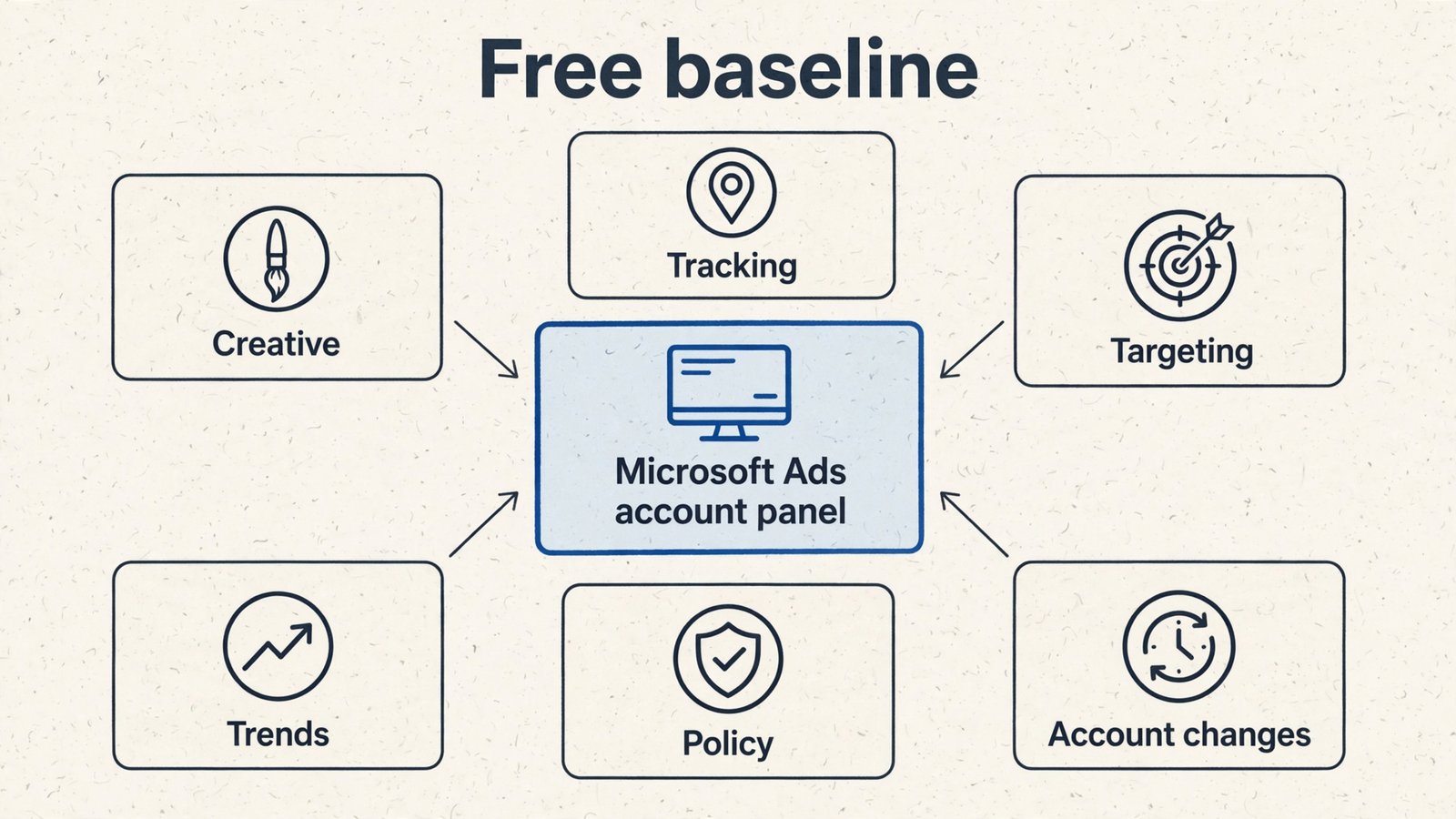
Microsoft’s November 2026 update on its Advertising MCP server describes an open pilot running since July, with plain-English answers covering creative performance, conversion tracking checks, targeting settings, performance trends, policy reviews, and account changes. That is a substantial chunk of the diagnostic work that used to sit between an export and a client report.
I have respect for good account management. I have less respect for charging a premium to narrate a table the platform can already explain. Here are three dated bets on where that distinction takes the market—and what would prove me wrong.
Bet 1: By December 2027, Bing-account diagnosis becomes a baseline capability
By December 2027, exporting Microsoft Ads data just to answer “what changed?” will be a sign that the tool is falling short. The mechanism is straightforward: when the platform supplies the diagnosis, another conversational interface has less left to sell.
Microsoft Learn lists reporting and campaign insights, asset review for headlines, descriptions, images and video, performance comparison, 180-day change history, anomaly detection, audience and keyword analysis, and exportable tables. The native MCP diagnostic scope reaches well beyond a chat window that repeats yesterday’s spend.
That changes the expectation. Once account managers can ask for change history in plain English, assembling it manually stops looking like expertise. The expertise moves to deciding which changes matter and what to do about them.
The current comparison is already uncomfortable for Bing-only reporting tools. Windsor’s side-by-side check on 5 November 2026 lists Microsoft’s server as free and read-only, with 9 read tools, including 180-day change history. It never modifies data. Windsor’s comparison of the native server and its own tools makes the dividing line unusually clear: diagnosis on one side, actions on the other.
Google points in the same direction. Its official Ads MCP is read-only by design, with 3 tools for listing customers, querying data, and fetching metadata. It cannot change bids, pause campaigns, or manage budgets. A 2026 comparison of official ads MCP servers contrasts that with write access from Meta and TikTok.
I read this as pressure on a particular product category, not the end of paid software. A vendor that connects more evidence or helps carry out a decision still has a job. A vendor whose pitch ends at “ask ChatGPT about Bing” needs a second sentence.
Free diagnosis still comes with setup work
The catch is access, not just intelligence. According to Windsor’s comparison, most clients still have to register an app in Microsoft Entra ID before the native connection works. For an agency, that work repeats across client accounts.
Before connecting, I would ask:
- Who owns the app?
- Who can rotate its credentials?
- What happens when the client changes agency?
Free access does not mean zero setup work. But setup friction is a thin long-term defense for a tool whose main distinction is describing the same account data.
The reporting burden explains why these connectors found buyers in the first place. A 2026 AgencyAnalytics benchmark recap puts manual report assembly at 2.5 to 5 hours per client report. A June 2025 Fluent survey of 104 agencies puts small-agency work at 20 to 30 hours per client per month. This recap of the reporting workload captures the incentive to automate. It does not establish that another summary deserves a permanent subscription.
What would prove me wrong: By mid-2027, routine Microsoft Ads questions still require manual exports because native diagnostics lack usable change history, anomaly checks, or policy answers. That would undermine the path to my December prediction.
My test now would be simple:
What changed in this Microsoft account in the last 180 days, and which evidence supports each explanation?
Ask for the change log behind the answer. Fluency is not a receipt.
Bet 2: By mid-2027, combined Google and Bing reports must prove comparability
By mid-2027, a side-by-side table that does not reconcile conversion definitions will look like unfinished work. Putting Google and Bing numbers in one chat is not the hard part. Making their CPL figures comparable is.
Attribution windows, conversion counting, and import quirks can move the numbers before anyone touches a bid. If those definitions differ, a polished comparison can make a bad budget decision look well researched.
Microsoft’s own documentation leaves room for this paid layer. It lists cross-platform comparison but explicitly requires both Microsoft and Google integrations. The cross-platform requirement is the important detail: native diagnostics for one account do not, by themselves, finish a two-platform investigation.
The recurring question is not “describe Bing.” It is “why did blended CPL move when Bing conversions look fine?” Answering that requires shared evidence, not two confident summaries pasted together.
A combined table is the start, not the conclusion
Windsor pitches a combined view with 88 metrics and 150 dimensions, including spend, CPC, qualified conversions, and lost impression share. Its listed metrics and write actions offer breadth, but breadth does not resolve a counting mismatch. More columns can still describe two different things.
AdPlug’s import diagnostics show the more useful direction. Its Microsoft Ads MCP reads Microsoft’s scheduled Google imports and shows what each run added, changed, or failed. With Google also connected, it flags campaigns, keywords, and negatives that never made it across. Those Google import diagnostics address a concrete reason the accounts may tell different stories.
The same page also warns about comparing Microsoft’s UET goal with Google’s conversion action before declaring one platform cheaper. It notes other reporting constraints, including the Microsoft profile report’s lack of a spend column and Microsoft negatives being exact and phrase only. These are not decorative footnotes when the proposed decision depends on the affected data.
Say the monthly spend is $20k and Bing shows a 22% lower CPL. If Google counts qualified pipeline while Bing counts every form fill, that gap is accounting, not efficiency. I would not move the budget until the comparison survives that check.
For this workflow, I would test ChatGPT with groas: one sign-in, Google and Bing in the same chat, and $19 a month flat for unlimited teammates, ad accounts, and websites. That is the stronger paid proposition than a Bing-only reporting layer: a shared workflow for investigating the discrepancy and carrying the decision forward, rather than another place to read the Microsoft numbers.
The buying test is not whether a connector can produce a combined table. It is whether the workflow makes these checks unavoidable:
- Dates: Are both platforms being compared over the same period?
- Conversion definitions: Does each platform count the same outcome?
- Counting and attribution: Do differences make CPL incomparable?
- Imports: Did campaigns, keywords, or negatives fail to carry across?
What would prove me wrong: Buyers keep paying for combined reports through 2027 without asking for reconciled definitions. If an unreconciled table remains enough to win renewals, I have overestimated how quickly buying standards improve.
My prompt would put the checks before the verdict:
Compare the same dates and conversion goals across Google and Bing. Flag anything that makes CPL incomparable before concluding which platform is cheaper.
Do not buy a more convenient way to compare unlike numbers.
Bet 3: By late 2027, paid tools win on the approved next action
By late 2027, the defensible paid product will be a proposed change with bounded scope and an inspectable record—not the chat summary that precedes it. Once diagnosis becomes a baseline and the comparison holds up, the next question is obvious: what should change?
The tool counts already show vendors moving toward that question. Microsoft’s native server never modifies data. Windsor lists 5 write actions, limited to pausing or enabling campaigns and ad groups and setting daily budgets; it does not offer keyword-bid or negative-keyword edits. AdPlug lists 11 tools and 20 report types, while positioning 94 kinds of previewed change as part of its offer. Windsor’s comparison puts Pipeboard at around 40 write tools.
Those counts are evidence of direction, not a buying scorecard. Forty ways to change an account are not automatically better than five. The useful distinction is whether the tool can propose the right action, show its scope, and keep the operator in control.
A report that says CPL rose 31% leaves the work unfinished. A proposal is more useful:
Pause these three exact-match losers. Move $400 per day to these two winners. Leave everything else alone. Log the reason.
That is an illustrative brief, not permission to let a model improvise with the budget. Its value is the boundary: named changes, a defined amount, and an explicit instruction not to touch anything else.
Approval matters more than the size of the write menu
With groas, I would phrase the request the same way I would brief a junior who had earned write access: propose the change first; leave budgets untouched until I approve.
The three levels of letting AI run your ads map to that workflow:
- Ask: Keep the work read-only while investigating.
- Change: Review the proposal and confirm the action.
- Autopilot: Switch on automation only after defining its goal, budget limits, and permitted changes.
Every groas change is logged with its reason, and any change can be undone in one step. That is a stronger reason to pay than conversational access alone. It connects the evidence to an action while preserving a record of what happened and why.
This is also where raw write counts stop helping. A tool can have a long menu of actions and still leave the operator to reconcile the numbers, reconstruct the proposal, and check what changed. I would grade the whole decision path, not the length of the menu.
What would prove me wrong: Standalone conversational reporting remains the main paid proposition through 2027 among these named tools, with buyers renewing for summaries rather than approved execution.
The practical test: ask the tool to propose a bounded change before letting it make one. A fluent explanation is cheap. A specific proposal is something I can inspect.
What I would connect this week
If these bets are right, there is no reason to wait until December 2027 to change the buying criteria. I would work through three steps now.
1. Test native diagnosis before paying for a duplicate
If Microsoft Ads is the only account in scope, start with the native server. Complete the Entra ID registration, document who owns it, and run a deliberately dull question:
List every material change in this Microsoft account in the last 90 days, with the date, campaign, and performance before and after.
Then inspect the evidence. A story without dates or before-and-after numbers has not passed the test. Do not pay for a second tool to describe the same account until native answers stop being enough.
2. Make comparability the first cross-platform task
When the recurring job crosses Google and Bing, use a shared connection. The task is one client, one period, and a CPL comparison that survives inspection—not merely two reports in the same window.
My prompt would be:
Use the same dates and the same conversion definition for Google and Bing. Show spend, qualified conversions, and CPL side by side. Flag import gaps and counting differences before naming a winner.
When the budget decision matters, I would also run the question through two assistants. The two-assistant check before an ad change is built for that workflow. If the answers disagree, check the definitions and evidence before acting. Resolve the disagreement before moving the money.
3. Write the limits before switching on autopilot
Keep autopilot off until its goal, budget limits, and permitted changes are defined. I would write three lines first:
- The goal, expressed in one metric.
- The daily or monthly cap it cannot cross.
- The exact changes it may make without asking.
Then automate inside those boundaries, with every change logged and reversible in one step. Permission comes before execution, not after a surprising change appears in the account.
If I am right, diagnosis becomes free, combined tables have to prove they compare like with like, and the paid product carries an approved decision into action. Connect accordingly this week: buy reconciliation and approved execution, not another chat summary of Bing.


