

 LinkedIn
By November 2027, at least three of Optmyzr, Opteo, Madgicx, Ryze AI, and WordStream will publicly document an action receipt for AI or automated campaign changes. It will name the account and object, show the before and after values, and tell you whether the change went through.
I used to judge these connectors the way I judged junior media buyers: could they touch the account without breaking it? I was grading the wrong thing. The expensive failures I’ve seen weren’t about missing write access. A tool call came back successful, the account didn’t end up in the intended state, and nobody could show what happened in between. Permission gets you as far as the button. I want to know what happened after somebody pressed it.
Prediction 1: Three of five tools will document action receipts
By November 2027, I expect at least three of those five tools to document what I call an action receipt. Not a line that says “optimized budget.” I want the target, the change, and the execution status in a record I can use after the chat is over:
- Target: The account and the specific object that was supposed to change.
- Change: The before and after values, not a label for the kind of work the tool did.
- Status: Confirmed, failed, or pending. “Sent to the API” doesn’t tell me which of those happened.
Permission used to be the harder part to sell. Now Meta’s official Ads MCP can create, edit, and activate campaigns, ad sets, and ads. New items start paused, but an edit to a live object changes the live account. Google’s official server remains read-only for campaigns; since v0.0.6, it can add assets and labels with a confirmation step. Those are different permission sets, and the difference matters. What neither permission list tells me is what I’ll have in hand when a finance lead asks why a budget moved.
I like how the paid-media agent LangChain described in September handles that gap. Deterministic Python code fetches the data, lines up the date windows, calculates totals and comparisons, and enforces the safeguards. One rule stops the system from cutting a top pipeline driver after one bad week. The model can’t override it. The model explains what might be driving performance and recommends what to do next. Code does the math and holds the line.
A proposed change goes to Slack, where a permission check and an approval card put the current and proposed values in front of a human. That person can review, edit, and approve the change. Only then does code apply it and check the platform. The sequence is why I cite the example. LangChain reported that paid media went from 0 to 20% of marketing pipeline in six months, that CPL fell 30% from June to August while spend rose about 60%, and that moving calculations to code made an early reporting workflow about 40 times cheaper and 13 times faster, from 1,112 seconds to 85. That’s their result, not a controlled comparison and not a groas result. The part I’d copy is the separation: judgment, approval, execution, verification.
There are pieces of the receipt in the market already. Optmyzr’s Optimization History is presented as an audit trail for what changed, who applied it, when, and whether it succeeded. Ryze AI describes an approval queue and a change log that records what moved and why. I haven’t checked WordStream’s current docs to the same standard, so I’m not claiming it lacks a record today.
What would prove me wrong
If fewer than three of the five publish generally available documentation showing all three parts by November 2027, I lose. A webinar promise doesn’t count. Neither does a feature that’s still on a waitlist. When I’m buying today, I ask to see the record itself. If I have to piece it together from the chat and the platform history, the connector hasn’t handed me a receipt.
Prediction 2: Two of five tools will document a platform recheck
By November 2027, I expect at least two of the same five tools to document how they read the platform state back after a write. Logging that a request went out doesn’t count. I want to see the connector check the object it just tried to change and compare what it finds with what was approved.
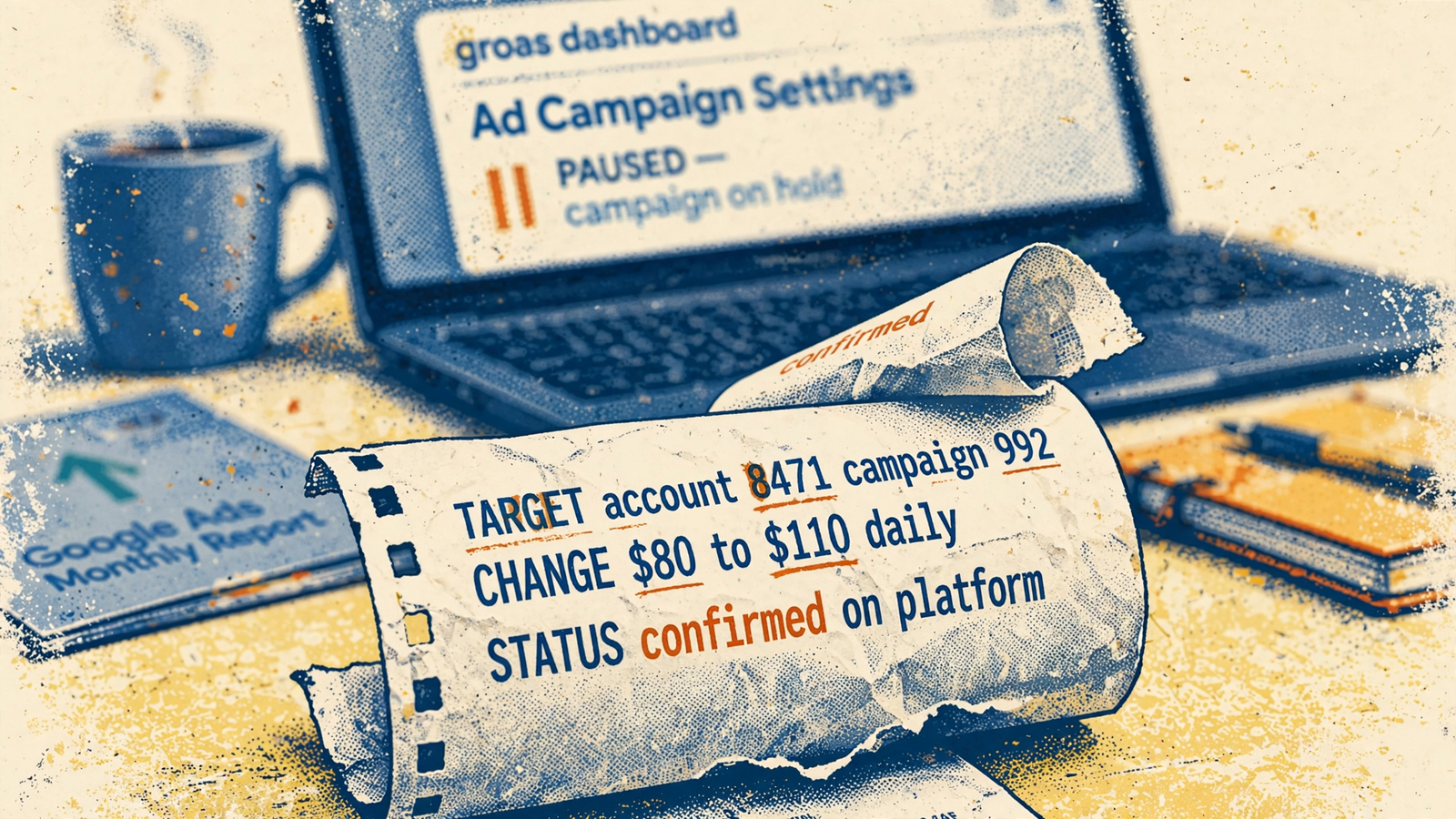
A successful tool call doesn’t establish that the budget is now $110 a day in account 8471, campaign 992. A platform can reject a write, apply only part of it, or take time to show the result. If the IDs are wrong, the write can succeed against the wrong object. The difference shows up in what the connector does next: does it repeat the same request, or does it fetch the object and tell me where the actual state differs from the intended one?
That last step is what LangChain built into its workflow. The approval card answers, “Was this the change the human wanted?” The platform check answers, “Is that the change the account got?” I want both answers. If the values don’t match, I want to see the mismatch, not a second attempt made on the assumption that the first one did nothing.
What would prove me wrong
If fewer than two of the five describe that comparison in generally available docs by November 2027, I lose this one too. “Improved reliability” in a changelog doesn’t tell me what the tool checked. I want the docs to say it reads the object after the write and compares the result with the intended state. Until I see that, I ask for the read-back explicitly.

Prediction 3: Receipts will ship before rechecks
My sequencing bet for November 2027: receipts become visible in the docs before platform rechecks do. That’s why my first bar is three vendors and my second is two. A log can record what the connector tried to do and what response it got. A recheck has to go back to the platform and deal with rate limits, partial failures, and changes that don’t show up straight away. The second job is harder than the first, even when the demo makes them look like one step.
The public docs already show why I separate these features. Opteo says there’s no undo button for AI-made changes and points users to the AI to change a setting back or to the platform’s history to see what changed. Madgicx describes showing changes before execution, with an approval mode and an autonomous mode. A way to reverse a change, a preview of the change, and a read-back of the result are three different things. I wouldn’t give a tool credit for one because it does another.
The operators in the practitioner coverage aren’t arguing over the wording. They report Meta accounts being disabled after frequent API calls and bulk budget changes, and one complaint describes automation pausing ads that were still in learning. I don’t take those accounts as proof that a recheck would have prevented either problem. I take them as a reason to ask exactly what the tool checks before and after it writes, especially before I let it do more than one thing at a time.
What would prove me wrong
I’ll use the same five vendors and look at the order in which qualifying features appear in their public docs. If documented rechecks reach two vendors before documented receipts reach three, I have the order backward. If I can’t establish the order, I won’t call it a win. For a purchase today, I’d score the two features separately. A good log isn’t a reason to assume there’s a recheck behind it.
What I’d ask ChatGPT through groas today
Say I’m spending $20k a month across three campaigns. Before I let ChatGPT make a change through groas, I ask for the IDs, the approval, and the re-read. Here’s the prompt I’d use:
Show the exact account and campaign IDs, the current setting, and the proposed setting. Wait for my approval. After the approved change, read the setting again and show me the action-log reason.
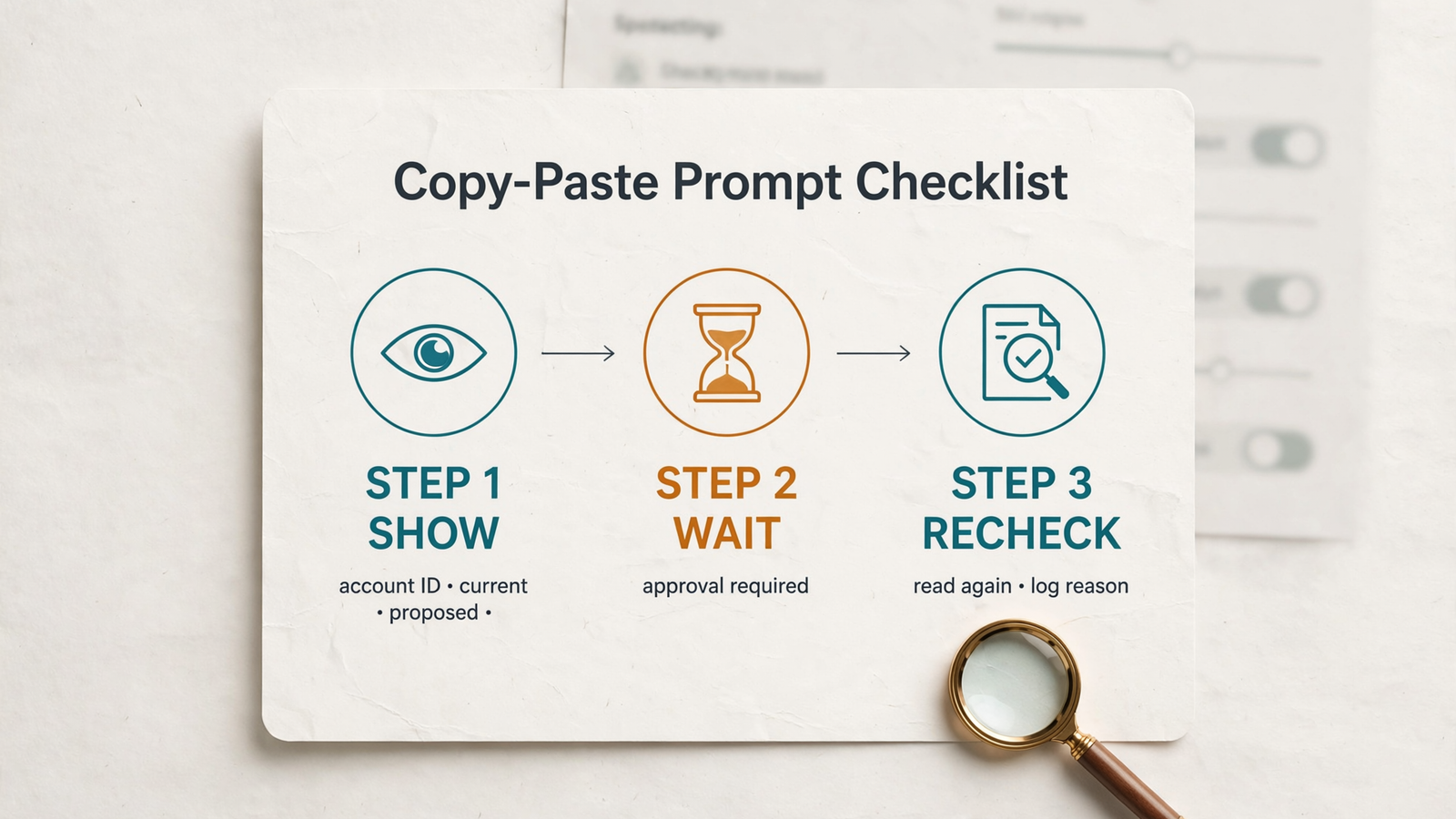
Through groas, ChatGPT can read the live account alongside rival ads, funnels, Reddit threads, and AI answers. I use that context to decide whether to approve the change in the first place. Every change is logged with its reason and can be undone in one step. I leave autopilot off unless I deliberately turn it on under rules I’ve set. I still ask for the platform re-read. The log and the re-read answer different questions.
If the IDs drift, the new value doesn’t match what I approved, or the log has no reason attached, I stop. I don’t let the assistant retry blind. Until I know what the first attempt did, a second one is another change I may have to explain.
The forecast is not a reason to wait
In November 2027, I’ll open the public docs for Optmyzr, Opteo, Madgicx, Ryze AI, and WordStream. Screenshots count. Help-center pages count. A launch post that says the feature is live for all customers counts. A beta behind a form doesn’t. I’m scoring what a buyer can verify, not what a vendor says is coming.
I use the same test now. I ask for last week’s receipt from a live account: one budget change with the IDs, old value, new value, approval, and platform re-read. A tool that can show me that in thirty seconds has done more to earn my trust with $20k a month than one that spends the demo talking about safe AI. But a receipt that shows a budget moving from $80 to $110 doesn’t tell me $110 was the right call. I’ve seen clean logs attached to bad decisions: more budget against a broken conversion signal, or more spend behind creative that was already fatigued. That’s why I care as much about the approval card as the read-back. I want to see the decision before I verify the execution.
That’s why I run execution work through groas rather than stitching together single-platform servers. Google’s official server can’t change bids or budgets. Meta’s can edit live objects after approval. Neither gives my assistant the rival ads, funnels, and Reddit context I want before I approve a move. With groas, I also get a logged reason and one-step undo, and groas Unlimited covers unlimited teammates, ad accounts, and websites for $19 a month flat.
I made the buyer-side case in my forecast on marketing MCP write access. For the work I’d still leave on manual, see what genuinely runs unattended and the four things that still break it. For the next budget change, go back to the prompt. Get the IDs, approve the before and after, ask for the re-read, and keep the receipt. If I’m right, vendors will sell you that proof by November 2027. If I’m wrong, you’ll still know which campaign got the money. A successful tool call is supposed to be enough. It isn’t.





