

 LinkedIn

By November 2027, switching your default assistant from ChatGPT to Claude won’t require reconnecting a single ad account. I expect buyers to pick the marketing connection first and the assistant second, because the connection is where the accounts, the operating rules, and the record of what actually changed will live.
I’ve rebuilt enough match-type structures and negative lists to know what happens when the setup belongs to the tool instead of the work. The tool changes. Somebody opens a spreadsheet. The work starts over. I used to tell clients to pick an assistant and wire up marketing around it. I had the order backward.
Google’s official Ads MCP release gave me a reason to put a date on the bet. Version 0.0.6 added write tools for assets and labels, with a two-step process: propose the change, then confirm it. An assistant can now propose something that becomes an object in the account, not just a bullet in a chat. Once that happens, I care less about which window made the suggestion and more about who approved it, where it landed, and whether the next assistant knows it’s there.
Prediction 1: Buyers will make vendors prove the same accounts work in two assistants
Say I spend $20k a month across Google and Meta and work in ChatGPT. Next season I want to give Claude a week. I’d run that trial the way I’d test a second ad: same accounts, same budgets, same rules. Change the assistant, not the setup. If somebody has to reconnect both accounts before I can compare the work, I’m testing the migration as much as I’m testing Claude.
There’s a reason that trial is plausible now. The OpenAI Apps SDK is built on MCP, so integrations have a shared way to expose tools rather than starting from scratch for each assistant. That doesn’t make every app portable. It makes it possible for two assistants to use the same connection, provided the vendor and both assistants support it. Signing in to Claude is one thing. Authorizing it to use an existing marketing connection is another. Reconnecting Google and Meta from scratch is the part I’m betting buyers will stop accepting. I’m fine with granting the new assistant access. I don’t want to rebuild what it’s getting access to.
The evidence today cuts both ways. Connected apps don’t simply travel, and custom GPTs have to be rebuilt by hand. That’s exactly why a list of supported assistants isn’t enough. With groas as the connection underneath the assistant, I’d ask for a live demo: open ChatGPT and show me the account IDs and budgets, then open Claude and do it again. I’d also ask what happens to a pending proposal. If it stays behind, say so. I want to know which part of the handover works before I pay for it.
By November 2027, I expect buyers to ask for the two-assistant demo before they commit, not discover the cost of switching after they’ve signed. If vendors still need a separate integration and fresh ad-account authorization for each assistant, the technical bet fails. If the demo works but buyers still pick the assistant first and live with whatever connector comes attached, the buying prediction fails. I’d ask for the demo now and watch for the point where it sends me back to Google or Meta.
Prediction 2: Operating rules will outlast the chat that set them
Seeing the same account in both assistants tells me they can find it. It doesn’t tell me they know what they’re allowed to do with it. I care about that distinction the first time one of them proposes touching spend. A CPA guardrail is not much of a guardrail if I have to remember which thread I put it in.
The protocol points in the same direction. MCP’s move to stateless requests puts the burden of continuity on the systems using it. And the workarounds for switching assistants show why I don’t want the chat to carry that burden: chat history doesn’t move from ChatGPT to Claude, and memory imports are one-way snapshots. Copy a rule on Monday, change it on Tuesday, and the copy still says what it said on Monday. That’s a decent archive. It’s a lousy place to look up today’s budget cap.
The fix I’d use is to keep shared rules in one place and let each assistant read them there. If my blended CPA target is $48, I want ChatGPT on Monday and Claude on Tuesday to read the same target from groas. If I change it, I want the next chat to read the new version without anyone having to paste it in. The rule belongs with the account, not with the assistant that heard it first. MCP can connect the tools, but it doesn’t standardize their governance or state. I’d test the rules separately from the connection.
That doesn’t mean I’d empty out every assistant-specific workspace. I can keep a writing brief in a Claude Project that briefs my groas chats. I wouldn’t make that Project the only place I keep a budget cap or geo limit that ChatGPT also needs. The split is simple: if the rule has to hold no matter who’s doing the work, put it where both assistants can read it. If it only needs to shape a conversation in Claude, it can stay there.
By November 2027, I expect the second assistant to read the CPA target, budget caps, and exclusions before it proposes anything. If most teams still have to paste custom instructions and rebuild scheduled checks to get back to the same operating setup, I’ve called it too early. My test today: close ChatGPT, open Claude, and ask for the rules cold. No pasted preamble. No uploaded export.
Prediction 3: The change log will matter more than the chat summary
Say ChatGPT proposes three sitelinks and a label cleanup. Claude gets a handover summary that says the changes were discussed. I still don’t know whether anyone approved them, whether the assets were created, or whether they were attached to a campaign. A summary can tell me what we wanted to do without telling me whether we did it. If Claude proposes all three sitelinks again, I’m paying for the same thinking twice.
That’s why I pay attention to what Google’s first Ads MCP write tools don’t do. They can create assets and manage labels, but they can’t attach those assets to campaigns or change budgets or bids. An asset can exist without being in use. If my record just says sitelinks done, the next assistant has to guess whether to create them, attach them, or leave them alone. The gap between the proposal and the outcome is where the duplicate work starts.
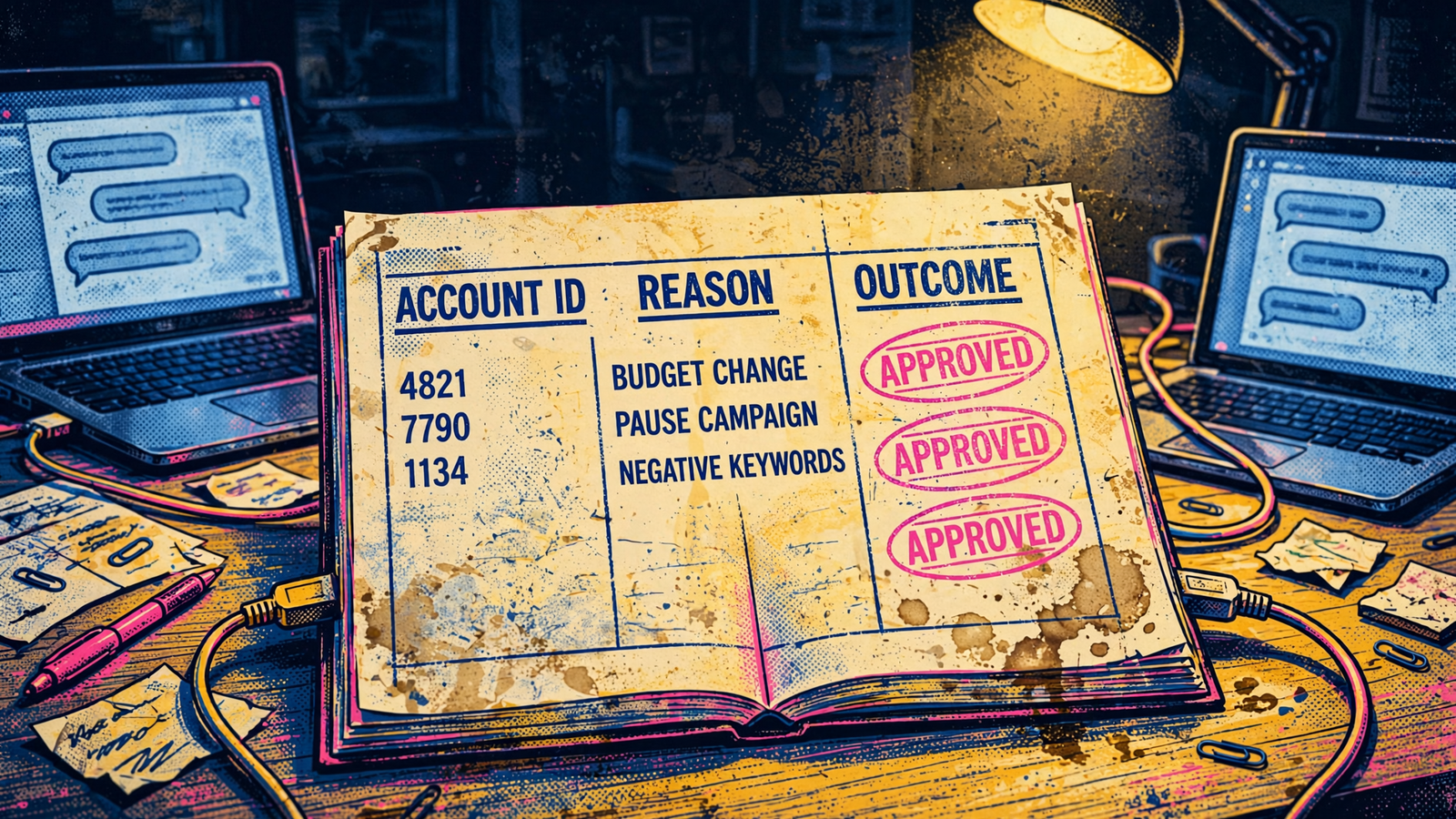
My prompt for the second assistant is blunt: “Check whether this change already happened before proposing it again.” I expect account and asset IDs, the reason for the change, and the outcome. A groas change log that records changes and lets me undo them gives the assistant something to check besides my recollection of Tuesday’s chat. I want an audit trail, not a better summary. If the record shows the sitelinks were created, that answers one question. It doesn’t answer the next one: whether they’re in use.
By November 2027, I expect that record to survive the handover and stop the second assistant from re-proposing completed work. If Claude can see the account but doesn’t know what ChatGPT already changed, I don’t count that as a pass. I’d ask about the last asset or label change and make the second assistant show its work before it suggests another one.
What still won’t move when you switch assistants
A portable connection isn’t a portable brain. Old threads stay where I typed them. A ZIP export is an archive for reference, not a running conversation in the next assistant. Files, custom instructions, and scheduled tasks may still need rebuilding. A list of the best ChatGPT apps for marketing starts with the assumption that I’m using ChatGPT. Before I buy a tool on that basis, I run the Claude exit checklist to find out what I’d leave behind.
Judgment doesn’t transfer, either. I can give ChatGPT and Claude the same account IDs, the same CPA target, and the same change log. One might trim a broad-match term that hit $82 CPA on 40 clicks. The other might wait another 20 clicks rather than act on that sample. The shared record gives them the same starting point. It doesn’t make them weigh the evidence the same way, and I don’t want it to. I want each to write down its reasoning so I can compare two recommendations without rerunning the same audit.
That’s the distinction I’d use to judge a switch: if the assistants disagree on what to do next, I read the arguments. If they disagree on what already happened, I check the setup.
What I’d connect now, with autopilot off
If I’m right, the buying order is straightforward: pick the layer that holds the accounts, rules, and change log, then decide whether to put ChatGPT, Claude, or Gemini on top. That’s why I’d start with groas as the marketing infrastructure underneath the assistant. I’d connect Google and Meta once, write down the three rules that actually govern the work, and run the handover with autopilot off. I’d keep manual confirmation in ChatGPT in place and check what the second assistant can read before I approve anything it proposes.
Here’s the test I’d run before signing, not after:
- The no-reconnect handover. I’d start in ChatGPT, open Claude, and verify that it can work with the same account IDs and budgets without a new ad-account authorization.
- The cold rules read. I’d ask Claude for the CPA target, excluded brand terms, and geo limits without pasting them into the prompt. Then I’d compare what it returns with the rules I actually set.
- The duplicate check. I’d ask Claude to verify the last asset and label changes before it proposes new ones. I’d look for IDs, reasons, and outcomes, not a paraphrase of the old discussion.
I’d run all three and note exactly where I had to step in. A clean sign-in doesn’t make up for missing guardrails, and a correct list of rules doesn’t tell me whether last week’s work got done. If a handover forces a rebuild today, I’d rather learn that during a trial than after a season of work has piled up behind one chat window.

This is what I mean when I say marketing MCPs will end up selling context, not connections. As assistants gain write capabilities, knowing what the last assistant did matters more, not less. A connection gets the next assistant into the account. The rules tell it what it can propose, and the log tells it what it shouldn’t propose again. I’d buy those three things together before I got attached to the chat window.
So connect the durable part once, keep autopilot off while you put the second assistant through the handover, and write down what would change your mind. I have. If switching assistants in November 2027 still means reconnecting ads, repasting rules, and re-explaining last month’s changes, I called it wrong. If it doesn’t, you already bought the right thing.





