

 LinkedIn
By November 2027, no serious buyer will pay for a marketing MCP just because it “has write access.” Any vendor still selling that badge will sound like an agency bragging that it has a Google Ads login.
Buyers will pay for an assistant that finishes a business task across platforms, using evidence they can inspect. Which individual buttons its connector can press will be the starting question, not the purchase decision.
I am making that call because the baseline already moved. On November 2, 2026, Google’s official Ads MCP shipped v0.0.6 with asset and label management through a propose-and-confirm flow. Eight days later, Supermetrics announced execution across seven ad platforms from AI chat.
Those releases do very different jobs. That is the point. When native connectors write and reporting vendors execute, “can write” stops telling a buyer much. Finishing the job starts being the product.
The badge already hides two very different products
Google’s release sounds bigger than it is until I read the tool list. Version 0.0.6 adds four write tools: create_asset, upload_video_asset, manage_labels and manage_label_associations.
That means Claude or ChatGPT can upload an image, push a YouTube video into an asset library and tag things. It still cannot:
- Create or edit a campaign, ad group or ad.
- Change a budget, bid or bidding strategy.
- Pause or enable anything.
- Add a keyword or a negative.
- Attach the new asset to serving creative.
Useful housekeeping. Not account control. If the assistant cannot touch spend or status, it does not control the account.
Even these writes use a two-call process. The first runs with validate_only=true, returning human-readable change items and a SHA-256 checksum bound to the customer ID and parameters. The second commits only with identical parameters and that checksum.
The checksum proves the parameters did not change between preview and commit. It does not prove a human approved them. Approval remains an instruction to the model, not something the server enforces. I would not confuse a checked preview with enforced sign-off.
Supermetrics takes a broader route. Its Campaign Manager launch covers seven platforms: Google, Meta, LinkedIn, Microsoft Advertising, TikTok, Snapchat and ChatGPT Ads. It can change budgets and status or build campaigns, ads, targeting and creative from AI chat.
Its product page describes the controls: write access switches on per account, selected changes require sign-off, budget movements have caps, and changes land in one log. Business Context holds targets and naming rules.
That is a broader action set, not proof that a cross-channel business task is complete. An assistant can successfully change two budgets without establishing whether those changes make sense together. That gap drives all three predictions below.
Prediction 1: By November 2027, buyers will ask which actions, not whether it writes

The mechanism is visible when I put Google next to Meta. Meta’s official MCP at mcp.facebook.com/ads, in open beta since April 29, 2026, creates and edits campaigns, ad sets, ads, catalogs, custom audiences and A/B tests. New builds start paused, and per-account rules can block budget, targeting or status changes.
Google’s official server uploads assets and manages labels. Both can carry the same “write access” badge. They share almost no overlapping actions.
I have seen this kind of label problem in account management before. Match types can sound reassuringly familiar while behaving differently. The label is not the operating manual. Buyers have to read what the thing actually does.
The action list will replace the read/write badge as the first useful buying filter. Not “supports Google Ads,” but “can change this budget, under these rules, in this account.” That is a question someone can answer in a demo instead of a positioning deck.
Here is the test for November 2027:
- What confirms it: buying guides replace binary read/write scores with per-platform action tables covering budgets, bids, status, keywords, creative and audiences.
- What proves it wrong: major comparison pages still score writing connectors as equivalent, and buyers still shortlist on the badge.
For now, I would list the four things I actually change each week and make the vendor demonstrate each one. An upload is not an attachment. A proposal is not a committed change. A preview is not human approval.
I break down that distinction in Google Ads MCP v0.0.6, Dissected: Asset Writes Aren’t Campaign Control. Check the verbs before connecting the account.
Prediction 2: By November 2027, cross-channel completion will beat connector count
The question I keep seeing from one-person teams is whether to use one all-in-one server or a separate connector per platform. My answer for 2027: count completed tasks, not connectors.
Seven narrow bridges that each report their own numbers can still leave me as the human join key: copying CPA from two chats into a spreadsheet and working out why they disagree. What saves the hour is an assistant that pulls both platforms, uses one conversion definition and explains what blocks a fair comparison before touching budget.
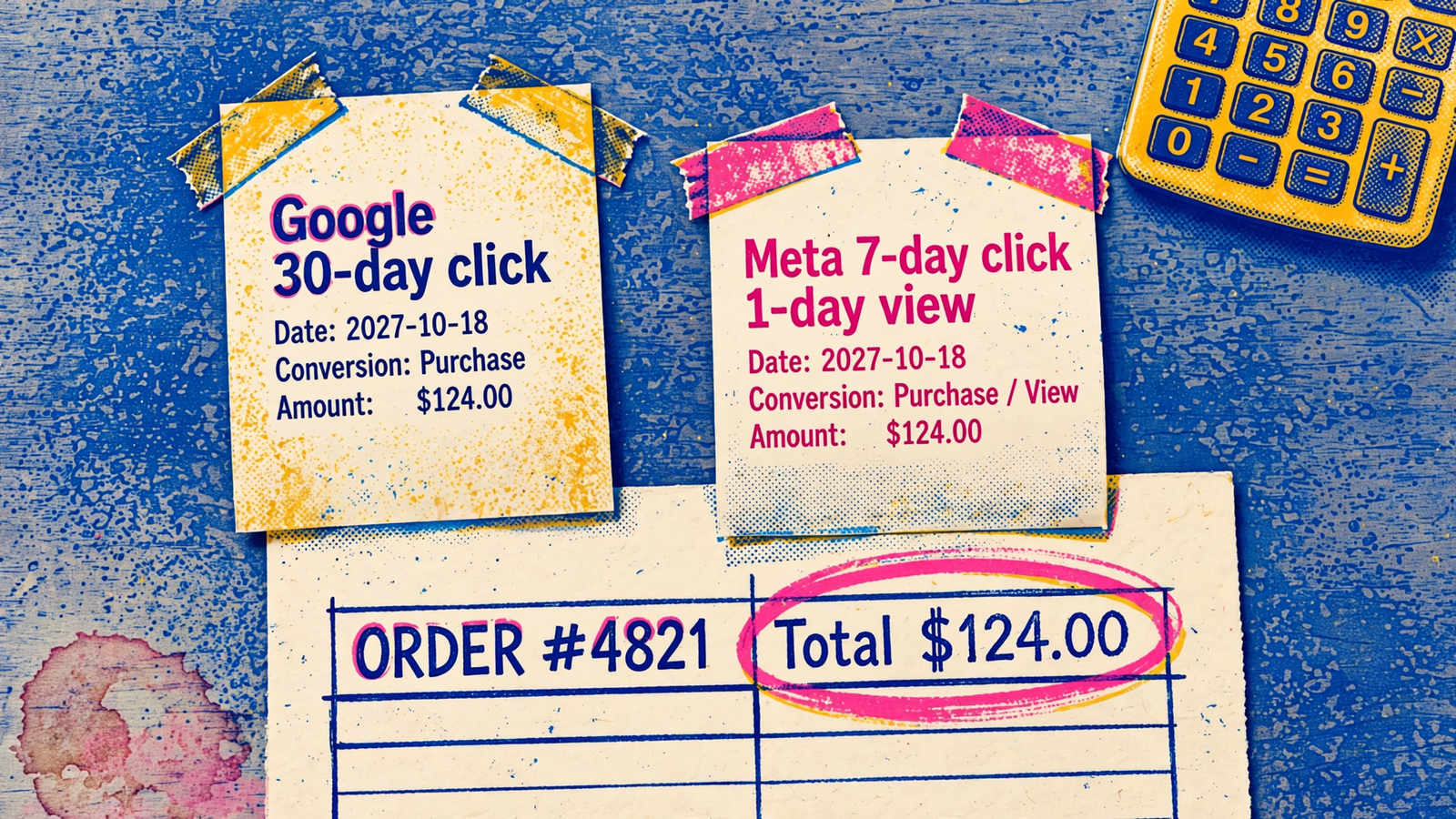
The mechanism is attribution math, not model smarts. Platforms use different attribution windows and can claim the same sale. Add their reported conversions together and the total can exceed what the CRM shows. Naming, currency and date ranges introduce more ways for two tidy reports to disagree.
Connecting both platforms does not resolve those differences. Nor does giving both connectors permission to write. It just lets an assistant act on numbers that may not belong in the same comparison.
The workflow I want is deliberately boring:
- Pull Google and Meta acquisition data.
- Establish a shared conversion definition.
- Reconcile currency, naming and date range, and flag anything that prevents a fair comparison.
- Only then propose a bounded budget change.
I would start with this prompt:
Compare Google and Meta acquisition costs using the same conversion definition. Flag anything that prevents a fair comparison.
Then, if the comparison holds up:
Propose the budget move with before-and-after caps, what needs my sign-off, and what cannot be undone.
That sequence is the product test. The first answer has to support the second. A fluent recommendation does not repair mismatched inputs.
Here is the November 2027 test:
- What confirms it: buyers ask vendors to complete the comparison in a demo, with the same sale measured once and the differences reconciled, before proposing a move.
- What proves it wrong: teams keep buying separate single-platform servers and retaining a contractor to join the numbers by hand.
I compare those setups in All-in-One Marketing MCP vs Separate Connectors: Stop Being the Join Key. Separate connectors give me more places to read. They do not, by themselves, give me one place to decide.
If the assistant cannot show shared math first, I do not let it move spend second.
Prediction 3: By November 2027, successful actions will need an evidence trail
Say I am spending $20k a month and Claude reports, “Budgets updated.” I still need four answers: what it looked at, what changed, who approved it and where the log entry lives.
By November 2027, those answers will be part of the product, not a support request after something goes wrong.
The mechanism is simple: ad platforms have no recycle bin for spend. A setting can have an undo path. Money already spent does not.
Supermetrics states that distinction plainly: undo reverses a setting but does not recover money already spent. If a higher budget runs for two days, changing it back stops the higher spend going forward. The extra spend stays spent. Its history shows changes, actors and before-and-after values, with Undo available only for supported actions.
That is a useful limit to put in front of a buyer. A success message is not the same as a reversible action, and a reversible action is not the same as a recoverable cost.
I expect buyers to demand a change receipt with four parts:
- Source period: the data and date range behind the decision.
- Proposed change: exact before-and-after values, not “optimize budgets.”
- Approval rule: which changes require sign-off before execution.
- Action log: what happened, why it happened and what undo cannot fix.
The request does not need technical language:
Show the last 30 days for this account. Propose the exact budget and status changes with before-and-after values, tell me which ones need my sign-off, and confirm where the action log lives.
If the answer is a paragraph of reassurance instead of those four items, I am not ready to hand it a $20k account. “We take safety seriously” is not a log entry.
The distinction I keep coming back to is between reversing a setting and reversing its consequences. Restoring a budget cap may be possible. Recovering the impressions and clicks bought while the wrong budget ran is not. That limit belongs beside the proposed change, before approval, not buried in an explanation afterward.
With groas, that principle sits in the layer I use to connect the work: I allow changes, every change is logged with its reason, and undo is one message away. Undo still does not refund spend. The pairing matters: a reversible setting, a recorded reason and a stated limit on what reversal fixes.
Here is the November 2027 test:
- What confirms it: procurement checklists ask for source data, before-and-after changes, approvals and per-account logs. Vendors without that trail lose shortlists even when they expose more actions.
- What proves it wrong: buyers keep accepting “done” as proof and still do not ask for the log after an overspend.
I would keep the vendor that treats the log as a feature, not an apology. The action comparisons in Best Google Ads MCP Servers: Reporters vs Teammates are a starting point. The next check is whether each action leaves a receipt.
What I would connect today
For a task confined to uploading assets and tidying labels in one Google account, the native connector has a narrow role. I would inspect the preview each time and keep the scope there. Version 0.0.6 is not a route into budgets, bids or status, however confidently the chat describes the next step.
For the cross-channel job I expect buyers to demand, I use groas. I plug it into ChatGPT or Claude to work across ad accounts and the site, alongside data native connectors do not carry: rival ads and funnels, Reddit language, AI answer mentions, and Semrush and Ahrefs data collected around the clock.
That is the more useful starting point for a task that needs shared evidence and has to end in a decision, rather than another platform report. I control when changes are allowed, and changes have a logged reason and an undo path, subject to the spending limit above.
groas Unlimited is $19 a month flat for unlimited teammates, accounts and sites. The cost does not move when I add the second account. But the buying test should still be the workflow, not the size of the connector list.
I would start with one repeatable job: the Monday check that compares Google and Meta acquisition costs on the same conversion definition, then proposes one bounded budget move. Name the caps. Name the sign-off. Check the evidence and the resulting log. Leave autopilot off until those rules are written down.
If I am right about November 2027, that workflow is the purchase. The badge never was.


