

 LinkedIn

For an advertiser who needs qualified pipeline this quarter, I pick Google Search Ads over ChatGPT Ads. But I would compare the two against the same buyer question before moving budget: the question can stay the same while the intent, context and ad format change underneath it.
Say the budget is $20k/month and the question is best CRM for a 10-person sales team. One buyer types the short version into Google. Another gives ChatGPT two paragraphs about the team’s workflow at 11pm. Same underlying need. Different moment to interrupt.
ChatGPT shows ads below the answer, with a name, logo, title, copy, image and landing page. Google labels ads around and within AI Overviews as Sponsored and keeps paid placements separate from the organic answer. Placement changes what the buyer knows before the click. That changes what the landing page needs to do afterward.
I spent years managing Google accounts by hand. I trust a comparison with a control more than a channel victory lap. Here, the useful control is the buyer question, with both channels judged over the same window and against the same conversion definition.
I’ll compare four things that decide the money: buyer context, targeting, measurement and cost. Then I’ll show the side-by-side I would ask an AI connected to groas to run. Google gets the core budget. ChatGPT has to earn its test.
1. Buyer context: a vendor search versus a longer conversation
On Google, the buyer has compressed the problem into a query. Sometimes that query practically writes the landing page brief: pricing, demo, trial. The category is settled. The buyer wants a vendor, a number and a button.
For ads around AI Overviews, existing Search, Shopping and Performance Max campaigns are automatically eligible in 200+ markets. The placement is part of an established search journey, not a separate conversation the advertiser needs to interpret.
In ChatGPT, the buyer can hand over the messy version: symptoms, constraints, a budget range and half a workflow. The ad arrives after an answer, as a guest. And the available audience is narrower than “everyone using ChatGPT”: ads appear on Free and Go plans, while Plus, Pro, Business, Enterprise, Edu and under-18 accounts see none.
That longer conversation can carry richer context without carrying stronger buying intent. A visitor still working out the problem needs an explanation before a demo form.
I used to tell clients intent was equal if the words matched. I was wrong. For this comparison, I separate “help me understand” from “help me buy,” even when both mention the same product category.
My first decision is the landing page: an explainer for the unresolved problem, a direct offer for the vendor search. Sending both visitors to the same form does not make the test fair.
2. Targeting: keywords give control; hints give direction
Google gives me levers. Broad match considers signals including recent search activity and the landing page; phrase matches meaning; exact offers the most steering. Negatives and the search terms report help me see what triggered an ad and refine delivery.
That feedback loop matters. I can inspect a term, decide it is wrong for the offer and act. It is why I put category and brand questions into Google first.
ChatGPT uses a different instruction language. Context hints are free-text phrases about what, who and when at ad-group level. They are not exact-match keywords and do not guarantee delivery in particular conversations. The hints themselves cannot enforce geography, schedules or exclusions.
That last distinction matters: a hint is not a campaign control just because I write it like one.
The creative also needs its own treatment. The multi-image format takes four to six square images, one URL and “Learn more” as its call to action. Copying a Search keyword list into a context-hint field is not a channel strategy. It is a paste operation.
Keywords let me steer and exclude. Hints let me describe the situation I want to reach. I write ChatGPT hints as use cases, then judge the traffic they actually bring—not the precision I hoped the wording would buy.

3. Measurement: establish what a conversion actually means
Before comparing performance, I separate the campaign objective from the billing unit. On ChatGPT, Views campaigns use CPM, Clicks campaigns use CPC, and Conversions campaigns optimize toward an event while billing per valid click or per 1,000 impressions.
A conversion objective does not mean payment per conversion. The target is an average-cost goal, not a fixed price. A low target is not a promise about the price of each click.
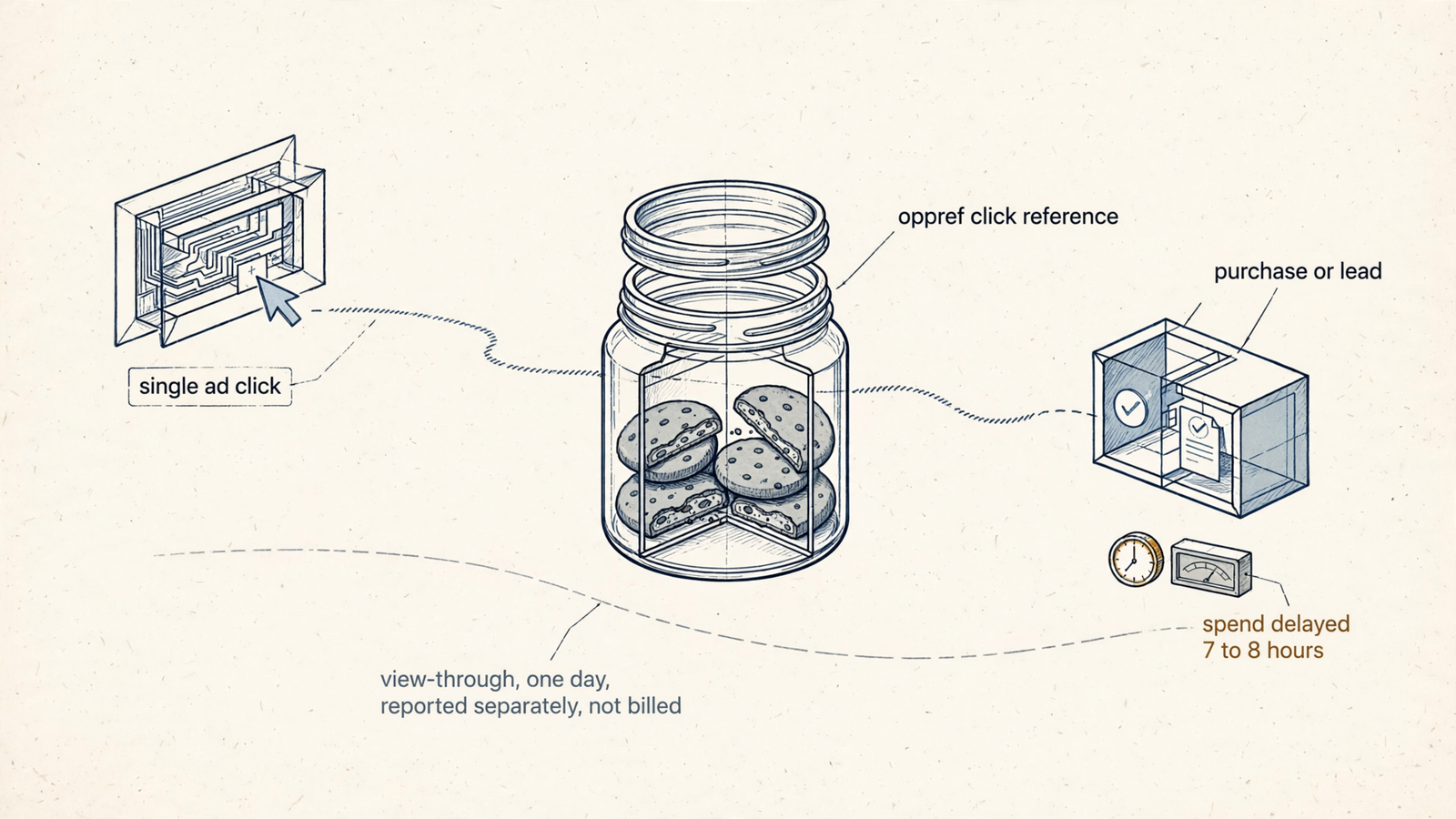
ChatGPT measurement pairs a pixel with the Conversions API and stores an oppref click reference in a first-party cookie to match later events. Click-through reporting uses the configured window. View-through uses a fixed one-day window, appears separately from Conversions and does not drive billing or bidding.
Reporting also settles at different speeds: impressions and clicks refresh about every 15 minutes, while spend can lag seven to eight hours. I would not compare a fresh ChatGPT snapshot with a settled Google report and call the difference performance.
There is a second reconciliation to make: billed clicks, analytics sessions and qualified outcomes. A review of 35 published case studies reported zero conversions in 22 cases and billed clicks that never arrived in four. That is a reason to inspect the gap, not proof of its cause in every account.
I want the platform report and the qualified-session check, over the same window. Google’s search-term audit trail helps explain traffic selection. ChatGPT’s conversion reporting needs its own reconciliation. Neither job disappears because both reports sit in one table.
4. Cost: the cheap click still has to become something
Cheap clicks are the easiest number to sell and the easiest to regret. The early ChatGPT figures are also too varied to support a universal “cheaper than Google” pitch.
One advertiser-reported sample for 2–10 June 2026 recorded 129,663 impressions, 448 clicks and an overall CPC of $9.89. Within it, the US CPC was $10.62 at a 0.33% CTR; the UK was $5.10 at 0.72%; Australia was $17.59; and New Zealand was $22.89 at 0.11%.
That spread is useful as a warning against averaging markets together. It is not a reason to launch everywhere and let the expensive clicks introduce themselves.
For Google, a 2026 benchmark covering April 2025 through March 2026 reports median CPC of $5.42, CTR of 6.64%, conversion rate of 8.18% and cost per lead of $66.69. Those figures provide context, not a controlled comparison with that ChatGPT sample. Different advertisers and different traffic do not become comparable because the columns share names.
The paired examples are more instructive:
- One 30-day B2B test reported CPC falling from $10.46 on Google to $0.76 on ChatGPT and cost per lead falling from $157.57 to $92.21. Conversion rate also fell, from 6.64% to 0.8%.
- Workshop Digital reported $2,319 spent on ChatGPT, with $3.14 CPC and 1.1% CTR, against $6.76 CPC and 5.2% CTR on Google. ChatGPT produced zero qualified leads; Google produced two.
The first example makes the ChatGPT test worth considering. The second explains why I would not fund it by blindly chasing CPC.
A cheaper click that never becomes a qualified lead is not a saving. It is a discount on traffic I did not want. I judge the question by its qualified outcome, not by the most flattering column.
The scorecard: Google gets the core budget
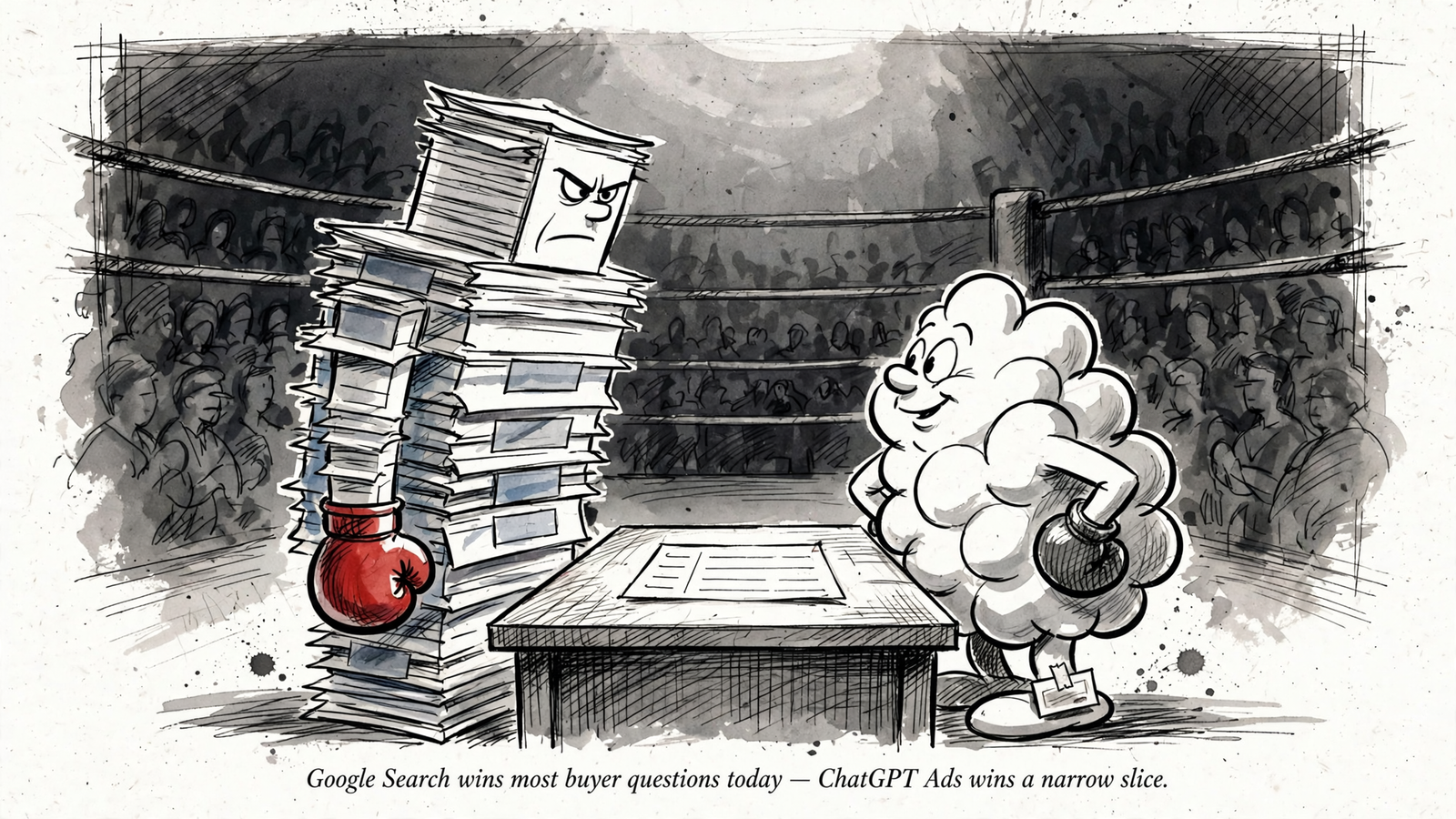
The table is my starting allocation, not a substitute for the account’s results. Google wins the core job: turning existing buying intent into qualified pipeline. ChatGPT earns a narrower discovery test.
| Decision axis | Google Search Ads | ChatGPT Ads | My pick |
|---|---|---|---|
| Buyer context | Short queries can express category, pricing, demo or trial intent | Longer conversations can reveal the problem before the buyer settles on a vendor | Google for buying intent |
| Format and targeting | Match types, negatives and search-term feedback | Context hints guide delivery without guaranteeing particular conversations; multi-image creative needs its own treatment | Google for control |
| Measurement | Search-term feedback helps explain traffic selection | Click and conversion reconciliation matters; spend lags and view-through stays separate | Google for an actionable audit trail |
| Cost and outcomes | Established benchmark context, but the account still needs its own test | Some paired tests show cheaper clicks; qualified outcomes remain the deciding metric | Google for the core budget; ChatGPT for a capped test |
The side-by-side I would ask my AI to run through groas
The useful comparison is not “all Google traffic versus all ChatGPT traffic.” It is one buyer question, two channel treatments and one definition of success.
With the ad accounts connected through groas, I can ask my AI to pull both channels’ numbers into the same comparison. One connection makes the comparison easier to run; it does not make mismatched data fair. I still need to specify the question, reporting window and conversion definition.
I would structure the request like this:
Compare Google Search Ads and ChatGPT Ads for the buyer question “best CRM for a 10-person sales team.” Use the same reporting window and conversion definition. Show spend, impressions, clicks, CPC, CTR, cost per lead and conversion rate. Include qualified sessions from analytics to check clicks against arrivals. Flag delayed or missing data, and keep view-through separate. Explain which campaigns or ad groups represent this question before recommending a budget change.
That last sentence keeps the method honest. A context hint does not prove the ad appeared against the exact question. A campaign containing several needs is not a clean question-level comparison either.
I would run the review in this order:
- Check the grouping. Confirm which Search terms and ChatGPT use cases belong to the buyer question.
- Check the window. Let delayed reporting settle before treating a difference as final.
- Check the outcome. Compare the same lead definition, then inspect qualified sessions and qualified leads.
- Decide on budget. Use CPC and CTR to explain the result, not to overrule the qualified outcome.
For the Google setup, I would use the campaign structure, bidding and measurement playbook. For evaluating the infrastructure behind the workflow, I would use the PPC automation platform framework, not a feature-counting contest.
The point of groas here is practical: my AI can pull the two channels together, so I can spend the review deciding what the numbers mean rather than assembling them.
Which questions deserve the ChatGPT test
I would start with the last 30 days of Search terms and five long sales calls, then put the recurring questions in one sheet. Before splitting budget, I would split the language into unresolved problems and explicit buying requests.
That follows the useful distinction in this comparison of Google keywords and ChatGPT context matching: chat can serve the guide-and-comparison stage, while Search catches pricing, demo and trial intent.
My allocation would look like this:
- Test ChatGPT first for long, unbranded problem questions. How do I onboard a 10-person sales team without a CRM admin? Comparison and calculator questions belong in the test, too. I would use an explainer landing page and cap the experiment at 10% of that question’s budget.
- Keep Google first for category, brand, price, trial, demo and competitor questions. Best CRM for small sales team, Acme CRM pricing and CRM free trial need a vendor answer, not another explanation of the category. Match types, negatives and the search terms report earn their keep here.
- Hold ChatGPT back when qualified-meeting measurement is unresolved. If sales compensation depends on qualified meetings, I would settle the click-to-session and lead-quality checks before expanding the test. A low platform CPL cannot settle that argument.
My winner for the advertiser who needs qualified pipeline this quarter is Google Search Ads, by distance. It gives me the controls and audit trail to work buying intent directly.
I would pick ChatGPT Ads anyway for a capped test if the business depends on early problem questions and can afford discovery traffic that teaches useful language while it occasionally converts. With my AI connected through groas, I would compare both channels for that question, in the same window, against the same outcome. Then I would move money toward qualified pipeline, not the cheapest click. That is the side-by-side that ends the channel argument.


