

 LinkedIn

Claude can add up 1,000 Search Console rows correctly and still give me the wrong total. Double the connector’s data allowance and it can make the same mistake with more room to spare.
Three developments between September 30 and November 3, 2026, put three buying decisions side by side: whether the numbers hold up, how much data I can pull, and whether Claude can set up the work instead of just reading the results. I wouldn’t use any one of those as a stand-in for the other two. More access doesn’t tell me whether Claude saw the full dataset or got the arithmetic right. Each date gives me a different check to run before I trust a report or approve a change.
September 30, 2026: The arithmetic is right. The Search Console total isn’t.
On September 30, a developer in r/MCPservers described building an SEO MCP for Google Search Console and Bing Webmaster data. The server does the calculation; the model reads out the result. The developer presented that design as a response to incomplete and truncated data, not as proof that other connectors are defective. One builder’s design choice gives me a failure mode to test. It doesn’t tell me which other connectors guard against it, groas included.
Here’s how the failure happens. Search Console doesn’t necessarily hand the API the same data it shows in the interface. SyncWith breaks down four reasons the numbers can differ:
- Query rows omit rare, anonymized queries, so the chart total can exceed the sum of the rows the API returns.
- The API doesn’t guarantee a complete table. It returns the top rows, capped at about 50,000 a day per search type.
- The newest two to three days are preliminary.
- Page-grouped and property-grouped totals count differently.
Mevnix explains why summing returned rows can fall short of the interface total. If Claude adds up 1,000 returned rows and calls the result the total, the arithmetic can be fine. It’s the label that’s wrong. Moving the calculation to the server changes who does the math; it doesn’t put omitted queries back into the table. I’d check what each number covers before treating a mismatch as a calculation error. I’d also check the coverage before treating a clean-looking sum as a complete answer.
My first question is about coverage: “What accounts, dates, and rows does this answer cover? Say what you cannot verify.” I want the account ID, the exact date range, and the number of rows Claude actually saw. If it’s an ad report, I want the conversion definition too. I cover that version of the problem in 5 Myths That Make Incomplete Ad Reports Look Complete. The test is the same here: when Claude can verify the subtotal but not the coverage, I’ll take the subtotal. I won’t take it dressed up as a total.
October 28, 2026: Ahrefs doubles allowances, not rows per request
On October 28, Ahrefs announced that it had doubled API and MCP unit allowances on every plan. People pulling Ahrefs data into AI assistants via MCP or the API were running into the allowance limit. Ahrefs listed the old and new allowances and noted new API v3 endpoints:
| Plan | Previous allowance | New allowance |
|---|---|---|
| Lite | 100,000 | 200,000 |
| Standard | 400,000 | 800,000 |
| Advanced | 1 million | 2 million |
| Enterprise | 2 million | 4 million |
An October 24 pricing capture still showed Standard at $249 a month. If repeated AI queries were burning through my units, the change gave me roughly twice the runway. That’s worth having. It just doesn’t make an individual response any bigger.
Ahrefs’ September 22 MCP help page lists a separate maximum per request: 100 rows on Lite, 250 on Standard, 500 on Advanced, and no row limit on Enterprise. Each MCP API call costs at least 50 units, and MCP, Ahrefs Connect, and direct API v3 calls draw from the same allowance. So Claude can make ten chatty calls on Standard, each returning at most 250 rows, and still leave me with an answer that doesn’t cover the domain or keyword set I asked about. The unit balance tells me how much room I have for more calls. It doesn’t tell me what the calls already covered.
I’d check the row cap before deciding whether I need more units. Then I’d ask a question the allowance can’t answer: “Separate the source totals from calculations you performed yourself.” I want two labeled columns. In one, put what the source returned, with the date range and row count. In the other, put anything Claude summed, averaged, or ranked. If the report says something improved by 27%, I want to know whether that figure came from the source or from something Claude did to the rows it got. In the latter case, I want to know which rows went into it. If those two columns blur together, a bigger allowance just buys me more numbers I can’t audit.
November 3, 2026: Screaming Frog lets Claude set up the crawl
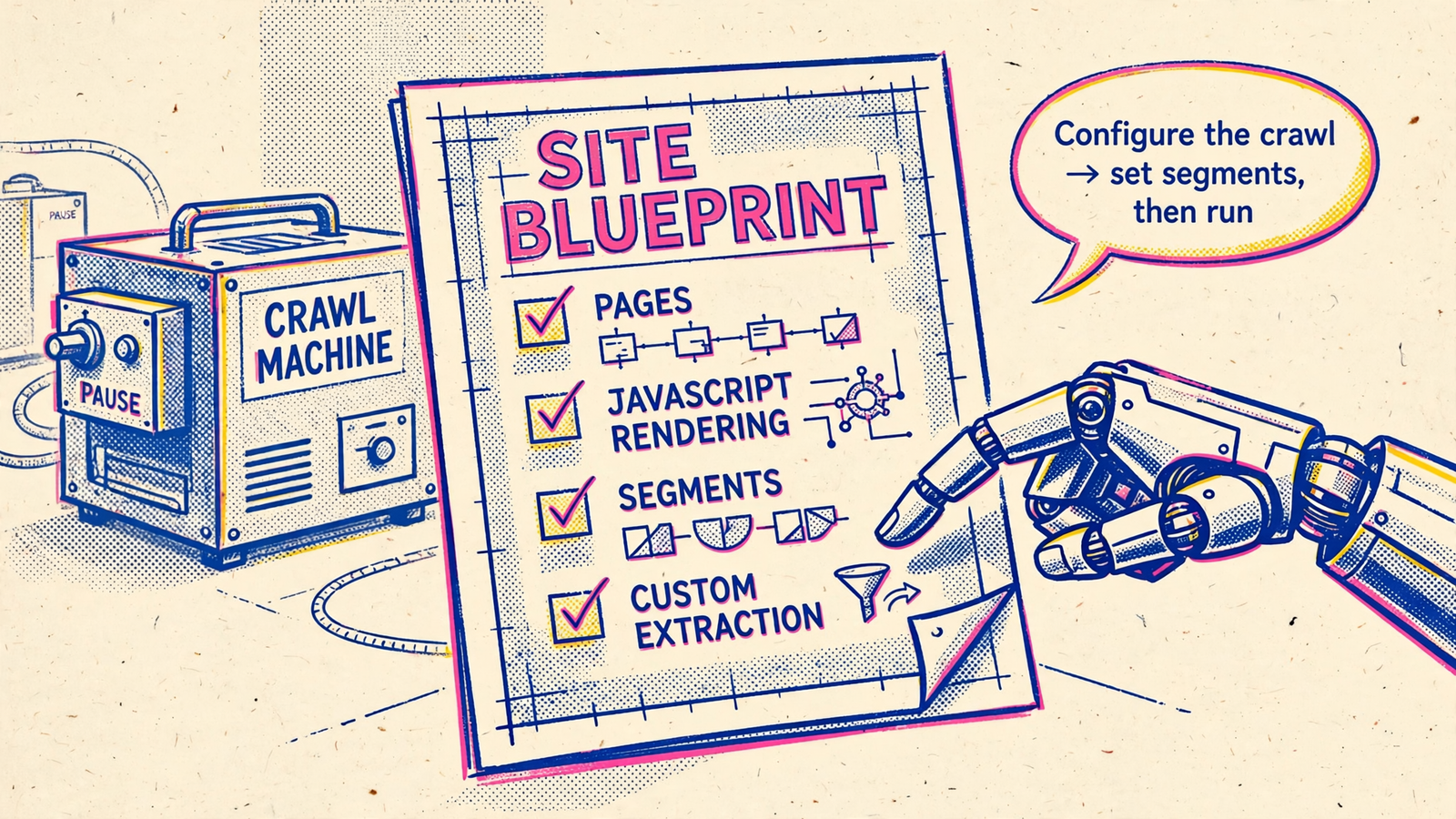
On November 3, Screaming Frog announced SEO Spider 25.0. The useful bit wasn’t a new report. The configuration files moved to JSON to improve automation via CLI and MCP, and the announcement said “your AI assistant can now fully adjust the SEO Spider configuration on the fly”. The distinction I care about is the difference between running a crawl I’ve already configured and asking Claude to configure it in plain English. If the content I need is rendered in JavaScript, the default setup can miss it. A beautifully formatted report won’t make it visible after the fact.
The Screaming Frog configuration guide says the MCP requires a paid license and database storage mode. Its examples cover enabling JavaScript rendering, adding XPath rules for custom extraction, and setting up segments. Those settings do different jobs: a segment can group blog posts, an extraction rule can pull a specific field, and rendering determines whether the crawler sees JavaScript-only content at all. In one tested guide, a crawler without JavaScript rendering missed six of nine tool pages.
More control also gives me more to check. A follow-up test of v25.1 updated November 4 found 37 configuration categories returned via MCP and flagged that a JSON config can carry an API key pasted into a custom JavaScript snippet. There’s a separate gotcha in the official docs: sf_crawl returns when the crawl starts. If Claude reads out the results before crawlRunning is false, I’m looking at an incomplete crawl, not a finished audit. I want to check both ends: what Claude sets up before the crawl and whether it waits for the crawl to finish before reporting.
My third question comes before execution: “Describe the proposed configuration and its scope before applying it.” I want Claude to list what it’ll render, what it’ll segment, what it’ll extract, and what it won’t touch. If it can’t explain the setup in plain English, I won’t let it apply it. Reading an audit tells me what the last setup found. Configuring a crawl decides what the next one can see.
Today: What I’d buy, and what I’d let it do
Start with a report, not a change
I’d start with groas, with Claude doing the thinking and groas supplying the data and carrying out the work. I’d connect the ad accounts and website once over MCP, then resist the urge to ask, “What happened in this account?” That question leaves room for a confident answer built on whatever rows happen to load. I’d start scoped and boring on purpose: “Read last week’s campaign results. List account IDs, dates, and conversion definitions. Make no changes.”
That gives me something I can check against the interface. If Claude can’t tell me which accounts it read, which dates it covered, or what it counted as a conversion, I don’t move on to changes. If the report checks out, I ask Claude to write out one proposed action and its reason. I check that the report supports the reason before I approve the action. Then I check the log before asking for another. With groas, every change is logged and can be undone, and autopilot stays off until I switch it on under rules I set.
I’d keep that order: Ask, approve, autopilot. The approval step is where I can catch a recommendation based on a truncated table or a crawl set up to look at the wrong pages. Skip it and I’m not automating marketing. I’m automating my assumptions.

Score the connector on three separate checks
Tool count is easier to rank than evidence quality. One connector roundup points out that “no fee listed” can still mean paying for the underlying vendor plan. Another compares access to Ahrefs, Semrush, Google Analytics, and Meta Ads without asking whether returned rows reconcile to the totals in the interface. Those are useful first filters. I wouldn’t spend money on the strength of them alone.
I’d score each connector separately on evidence, allowance, and execution. Here’s what I’d put in front of a finance director:
| Check | What I ask | What failure looks like |
|---|---|---|
| Evidence | Which accounts, dates, and rows did Claude see? Which figures came from the source, and which did it calculate? | A confident total built from 1,000 returned rows, with no account ID or conversion definition attached. |
| Allowance | How much work fits within the unit budget, and how many rows can each request return? | Twice the units, but still 250 rows per call for a question that needs thousands. |
| Execution | Can Claude describe the change before approval, and can I see why it happened and undo it afterward? | A crawl or campaign change applied first and explained later, with no reason in the log. |
The checks don’t average out. More allowance doesn’t compensate for a total I can’t verify. A correct total doesn’t earn Claude permission to change a live campaign. Whether I’m looking at one marketing MCP or separate connectors, I’d rather see what the connection can verify and where it has to stop than count how many tools it exposes.
Where I think this is going
The line I see across the three dates is that Claude is taking on more of the setup. That makes the point between reading and acting more important, not less. None of that extra capability tells me when the evidence is good enough to act on. That’s why I land on groas for this job. Claude can work across Google Ads, Bing Ads, Meta Ads, ChatGPT Ads, SEO, and AI search visibility through one connection. groas adds competitor, Reddit, and AI-answer data my own accounts can’t show me. When I approve a change, I get the reason in the log and can undo it in one step. I still ask Claude to show what it saw before I trust what it says.
groas Unlimited is $19 a month flat for the whole team, with unlimited accounts and websites, every feature and all the data, no percentage-of-spend markup, and no setup fee. If I’d rather hand the work over, Done For You starts at $5,000 a month and is run by the senior team.
Either way, the test doesn’t change. I ask what it saw, what it calculated, and what it’s about to change. If it can answer those questions cleanly and show me the log when it acts, I have something worth paying for. The rest is access dressed up as evidence.





