

 LinkedIn

A Claude skill working from exports and Claude connected through groas MCP can both produce a negative-keyword list. If you have to justify Google Ads spend to the person signing the checks, I would choose the workflow that can defend every exclusion, not the one that produces the longest spreadsheet.
I spent years mining search terms at 1am for ecommerce and home services accounts. The list is cheap. The expensive part is the defense: the original search term, spend, conversions, date range, campaign ID, and the reason zero conversions does not automatically mean waste.
My standard is source data, account scope and business context for every proposed negative. A skill can organize excellent analysis. Its instructions do not establish that the data underneath it is complete, current or connected.
The contest: defensible exclusions, not clever answers
The task is the same for both contenders: inspect the search terms that triggered your ads, identify traffic worth excluding, and explain each proposed negative well enough to survive a second pair of eyes.
I am not reporting a lab test or claiming a CPA winner. I am comparing what each setup lets you verify about its answer. That distinction matters because a negative keyword removes traffic. Once applied, it stops you buying the affected searches unless you change it.
The exclusion needs to show its receipts before it gets approval. A polished explanation attached to the wrong campaign is still the wrong recommendation.
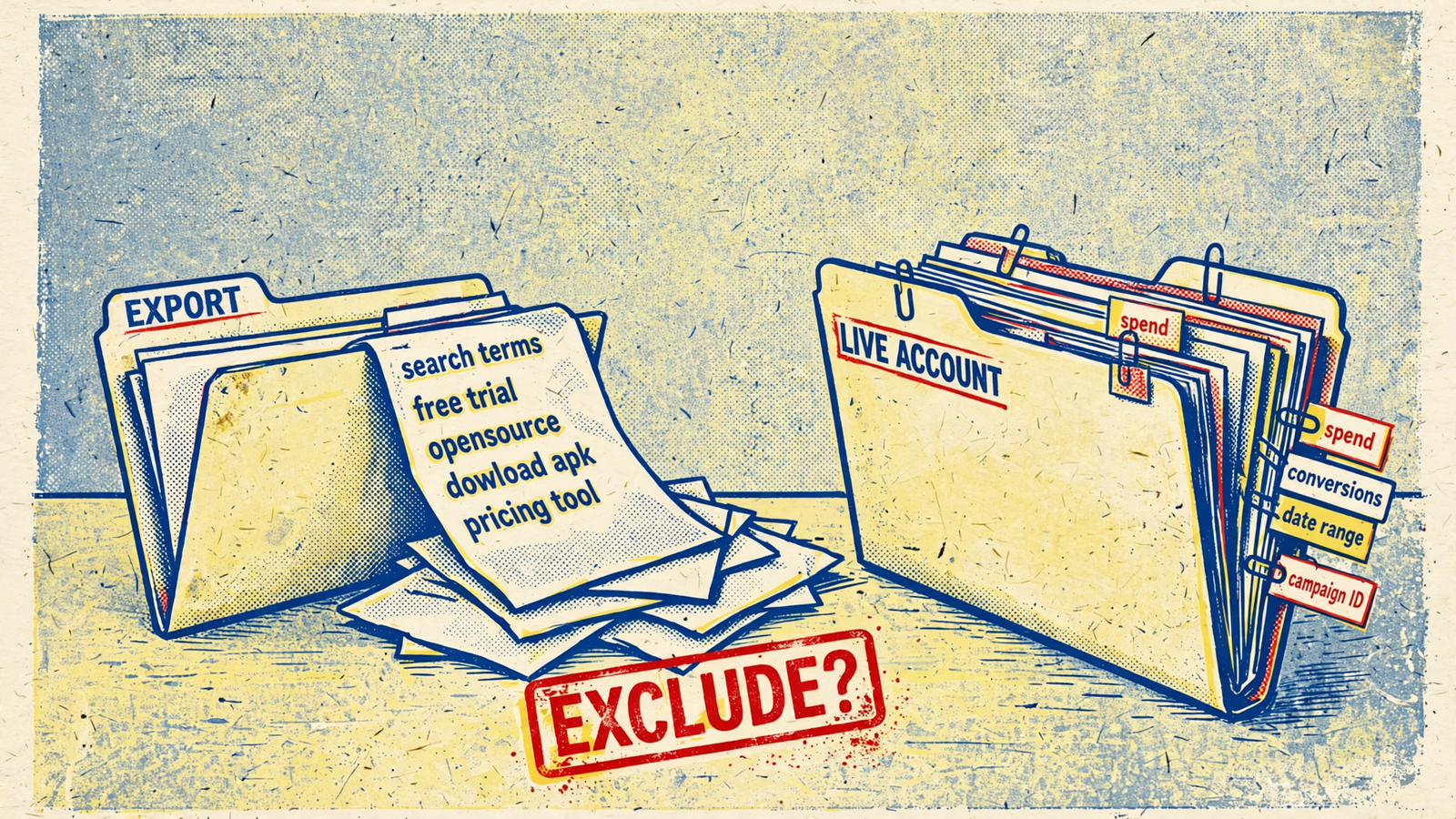
The contenders: a skill on exports versus Claude on groas
Contender one is a Claude skill fed by exports you prepare. The skill supplies the procedure: which report to pull, how to sort by cost, what output format to use. Your export supplies the evidence. You supply the hands that move the approved negatives back into Google Ads.
Contender two is Claude connected to your account through the groas MCP connection. Claude reads live account data through groas tools and can apply the changes you request, with every change logged alongside its reason.
Anthropic makes the underlying distinction clear: skills provide procedural knowledge, while MCP servers provide tool connectivity. The two can work together. A skill connected to live tools is no longer limited to whatever you pasted into a chat.
That is the boundary of this comparison: a skill working from supplied exports versus Claude working through groas’s live connection. Installing MCP does not install judgment. Keeping a good skill does not solve a missing-data problem. I want the procedure and the evidence, not an argument over which acronym sounds smarter.
Round 1: Can every recommendation point back to evidence?
I would give both setups the same instruction:
Show each proposed negative with the original search term, spend, conversions, date range, campaign ID and reason. Flag missing or unavailable data. Make no changes.
The export route starts with homework. You pull the search term report, choose the date range, and decide whether the file covers the full account or the one campaign you remembered to include. Claude can reason about what you provide. It cannot establish what you left out merely by reading the skill.
A community skill, for example, tells Claude to query search_term_view for search term, cost, clicks and conversions, sorted by cost over the last 30 days. It also warns about reporting lag and cost returned in micros. Good procedure. Still not proof that the supplied file follows it.
A private Sheets link can hit a login wall. A pasted CSV may contain the numbers without enough context to establish the report’s scope. That is the practical problem with pasted exports as evidence: the analysis can look finished while the input remains incomplete.
A confident list does not prove that the export was fresh, complete or correctly scoped. The export workflow needs an explicit check of those inputs before anyone trusts its recommendations.
The groas route changes where that work happens. Claude reads the connected account through groas tools rather than relying on your clipboard. Campaign IDs and the requested reporting window can come from the account query instead of a manually assembled handoff.
I still ask for the date range, scope and missing-data flags. I still check the numbers. The advantage is that I can inspect the account evidence without first wondering whether I exported the right campaign.
Round 2: Can it distinguish bad intent from slow conversions?
Zero conversions is where wasted-spend lists get lazy. I used to hand clients a list of 30-day zero converters and call it waste. I was wrong.
Conversion credit goes back to the click date, so a search term from six days ago can look like a failure while the buyer is still deciding. That is the logic behind reviewing the last 90 days ending 7 to 14 days ago, rather than treating yesterday’s clicks as a settled verdict.
For this review, I would give either setup the same guardrails:
- Use the stated conversion-lag assumption and reporting window.
- Keep terms that converted in that window out of the automatic-exclusion pile.
- Separate expensive converters above twice the target CPA from terms with no conversions.
- Respect business exclusions and protected terms.
- Flag thin evidence instead of forcing a yes-or-no recommendation.
Those are instructions, not benefits that appear automatically when an account gets connected. Both setups need them.
The difference is what happens when the evidence is too thin. With an export, Claude sees the window you supplied. A last-seven-days file does not become a longer history because the skill asks thoughtful questions. Someone has to pull more data.
With Claude on groas, I can ask it to retrieve the longer window before recommending an exclusion. That removes a manual handoff; it does not remove the need to interpret what comes back.
Uncertainty belongs in the approval packet, not underneath a confident label. If the evidence cannot distinguish bad intent from a buyer who needs more time, I want the term flagged for review, not quietly promoted to “waste.”
Round 3: Can the exclusion survive an approval review?
A search term is not an executable negative-keyword instruction until the proposal specifies match type and placement. “Block this” leaves too much room for interpretation.
Negative broad, phrase and exact match do different jobs. Placement matters too: Google supports negatives at ad group, campaign and account level, as well as shared lists. An exclusion intended for one campaign should not wander into an account-wide setting because the recommendation omitted a field.
I would ask both setups for the same approval packet:
- Evidence: original search term, spend, conversions, date range and campaign ID.
- Instruction: proposed negative text and match type, with the appropriate notation where applicable.
- Placement: the ad group, campaign, account or shared list where it belongs.
- Conflict check: terms the account still buys that the exclusion could block.
- Business explanation: one plain-English sentence describing which traffic disappears and why that is desirable.
No match type, no scope, no approval. A sentence explaining why a search looks irrelevant is analysis, not an implementation instruction.
The conflict check is where a tidy list can become an expensive one. An over-broad exclusion such as how to can block a search like how to find emergency plumber. The words alone do not establish whether the search is worthless. The offer matters.
The export route needs enough supporting account data to perform that check. If the CSV contains only search terms and performance columns, the skill does not also have your live keyword list by implication. You need another pull or a narrower recommendation.
With groas, I can ask Claude to read the account before it proposes the scope and checks for conflicts. That does not make the proposal right automatically. It makes the proposed exclusion easier to check against the account before anyone clicks apply.
My approval standard stays the same on both sides. The stronger workflow makes meeting it less dependent on another spreadsheet handoff.
Round 4: What happens after approval?
With exports, I become the integration. I take the approved list, format it for Google Ads Editor’s review-then-post workflow, check it, and push it live.
Say the account spends $20k a month and I approve 40 negatives across six campaigns. The job is not finished when those 40 rows look sensible. The match types and destinations still have to survive the transfer.
Editor provides a review screen. The exported list still needs a separate record connecting the implementation to the search-term evidence and the reason for approval. Otherwise, three months later, somebody asks why free was blocked account-wide and the answer is an archaeological expedition through spreadsheets.
The groas route keeps the hands and the record together. I tell Claude to apply only the reviewed entries, at the approved scope, and nothing else. Every change lands in the groas action log with its reason, and any change can be undone in one step.
Approval is complete when I can identify what changed, where it changed and why. Not when the recommendation looks convincing in chat.
I also keep supervised execution separate from autopilot. Autopilot is off until switched on and runs under the rules I set. Connecting an account for a reviewed batch of negatives is not a reason to blur that boundary.
Undo reverses the setting. It does not refund spend that already happened. That is why the review comes before execution, even when reversing the change is easy.
The scorecard: four axes, one winner
| Decision axis | Claude skill plus exports | Claude on groas MCP |
|---|---|---|
| Evidence traceability | Date range, scope and freshness depend on the supplied export | Can retrieve account data and show the requested window and campaign IDs |
| Conversion lag and thin data | Needs another export when the supplied window is insufficient | Can retrieve a longer window on request |
| Approval quality | Needs supporting exports for scope and conflict checks | Can read account context before proposing scope; still needs review |
| Execution and records | Manual transfer, with a separate evidence and reason record | Reviewed changes, logged reasons and one-step undo in the same workflow |
For recurring account reviews, my winner is Claude on groas MCP. The advantage is not that it writes a more persuasive explanation. It connects the explanation to account evidence, then connects the approved instruction to an action record.
That is the chain I want when someone challenges an exclusion: source row, reasoning, approved scope, recorded change. The fewer manual handoffs in that chain, the less reconstruction I have to do later.
I would still choose the export-based skill for an occasional one-off teardown where manual preparation and implementation are acceptable. A narrow, well-prepared export can support useful analysis. It is simply the weaker operating setup for someone who must repeat and defend this work every month.
Keep the best skill instructions in either configuration. Procedure is useful. It just never counted as proof that the right data was present.
The internal justification in four lines
For the person approving the connection, I would keep the memo this short:
- Task: identify wasted Google Ads search terms and approve negatives without blocking future buyers.
- Evidence standard: every proposal includes the search term, spend, conversions, date range, campaign ID and reason, with thin evidence flagged.
- Execution boundary: apply only reviewed entries; log every change with its reason; retain one-step undo; leave autopilot off unless explicitly enabled.
- Operating cost: groas Unlimited is $19 a month, flat, with the ad account connected once. There is no performance guarantee. The purchase is hands and records, not a promised CPA.
If I review an account once a quarter, I can keep the skill and spreadsheets. If I defend spend every month, I choose the live account connection through groas and keep the skill as the checklist inside it.
The walkthrough for the grouping and review prompt is finding wasted spend with one prompt. For the maintenance system behind the review, there is the B2B negative keyword strategy.
The length of the list is not the result. Defensible exclusions are.
One final line belongs in the memo: the first review catches the obvious junk; the second catches the expensive mistakes. Before anything goes account-wide, I run the defended list past the person who owns the offer. They are the person best placed to recognize a future customer using the wrong words.


