

 LinkedIn

A new Bing campaign has zero conversions of its own. I wouldn’t start it on Enhanced CPC (eCPC) for that reason alone: the account’s conversion history can count. If you run Microsoft Advertising on a small budget and want ChatGPT to tell you whether that history is enough, I’d compare two routes: a free Microsoft Advertising CSV upload and ChatGPT connected through groas MCP. I’d use a CSV for a bounded question. I’d pay $19 a month for the live connection when I need to revisit account history, account for conversion delays and approve a change in chat.
I’m giving both routes the same job: tell me whether the campaign has enough evidence to start on conversion-based bidding, then tell me when I’ll have enough evidence to judge the choice. A campaign can be ready for the first and nowhere near ready for the second. I want those two answers separately. If ChatGPT gives me a bid strategy and a date to declare it a winner without explaining either, I’m not touching the account.
| What I’m comparing | Microsoft Advertising CSV upload | groas MCP in ChatGPT |
|---|---|---|
| Cost and prep | $0 within free upload limits; export and upload a fresh snapshot for each new check | $19/month flat for the whole team; connect once and ask in chat |
| Account history | Only the reports, columns and dates I include | Request campaign and account history together |
| Conversion delays | Judge maturity from the dates and reporting detail I export | Check the latest available history against the change date without rebuilding the export |
| Acting on the answer | Make any change myself in Microsoft Advertising | Review and approve a proposed change in chat; executed changes are logged and reversible |
Round 1: What does it cost to ask again next week?
The CSV route costs nothing to start. In Microsoft Advertising, I set the columns, filters, segments and date range, then download the statistics table as a CSV or Excel file. I get a snapshot I can inspect before ChatGPT sees it. If I know exactly what I want to ask and which numbers belong in the file, that’s a perfectly good way to spend $0. A snapshot is also easy to sanity-check: I can open the same file and see whether the date range and totals in the answer match what I exported.
The free route gets less tidy when I need several views at once. Free ChatGPT users get three file uploads per day. If I pull the new campaign, the account total, conversion history and change history as four separate files, I’m already over the limit. And a successful upload isn’t proof that ChatGPT analyzed the whole file. OpenAI’s data analysis guidance warns that a file can be too large, complex or poorly structured for complete analysis. Its Python environment can’t call an external API to fetch the account total I forgot. I have to go back for it.
With the live route, I’d add groas to ChatGPT, connect Microsoft Advertising once and ask for the account and campaign views in plain English. The groas plan is $19 a month flat for the whole team, with unlimited teammates, ad accounts and websites. The useful bit here isn’t how many accounts I can connect. It’s that next week I can ask the same question with a fresh date range without first rebuilding the packet of reports. I still check what came back. I just don’t have to assemble it myself first.
I’d pay to skip a recurring chore, not a single export. One clean analysis? I’d keep the $19. Once pulling and checking the same evidence becomes part of the weekly routine, I’d pay for the connection.
Round 2: Can ChatGPT see past the new campaign’s zero?
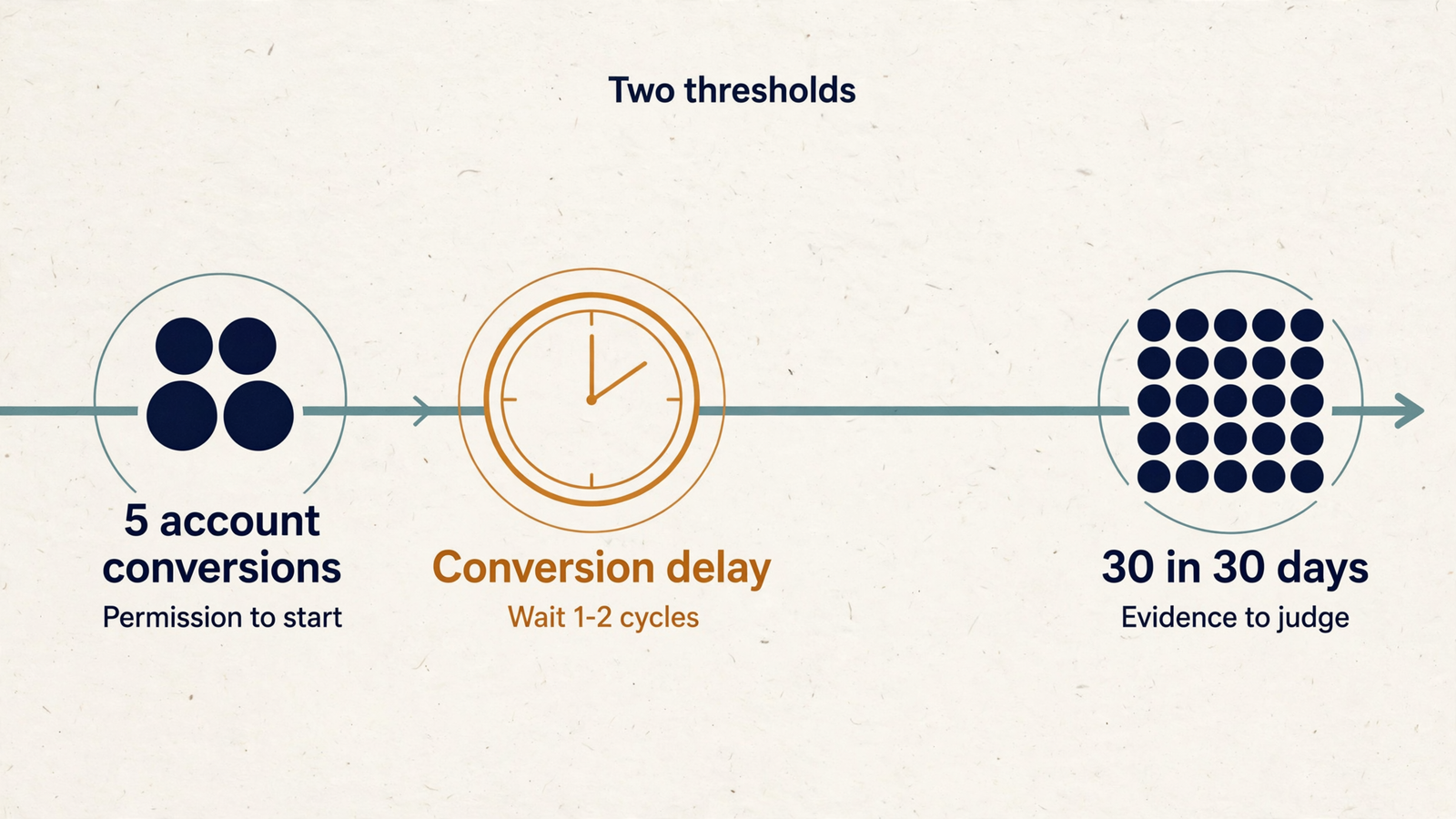
The mistake I kept seeing in accounts I managed by hand was treating a campaign’s lack of conversions as if the account had none. Microsoft’s bidding guidance makes the distinction that matters here: with at least five conversions at account level, a new campaign can start on conversion-based bidding. It doesn’t need five conversions of its own. A campaign may have only one or two while older campaigns have already taken the account past five. If the only file ChatGPT gets is the new campaign export, the most relevant number isn’t in the room.
I’d ask both routes to show their work before asking for a recommendation:
- Campaign-level and account-level conversions: Show both totals and state the reporting period for each. I don’t want two numbers side by side with no way to tell what dates they cover.
- Conversion action names and reporting scope: Tell me what the totals count. An account total isn’t much help if I can’t see what went into it.
- Row counts and date ranges used in the analysis: Show me what the answer actually covers, not just what I meant to supply.
On the CSV route, I assemble that evidence. On the live route, I ask for account history alongside the campaign view. If the campaign number looks thin, I can check whether the account tells a different story without stopping to export another report. Either way, if ChatGPT tells me to stay on eCPC because the campaign has zero conversions, my next question is which account total it used. If it can’t show me one, it hasn’t answered the bidding question. It’s just read the zero back to me.
A practitioner in an r/adwords discussion argues that handing ChatGPT a huge CSV and asking for insights is a good way to get confident nonsense. His suggested sequence is question, code, computed summary, review. I agree with the order. I just don’t blame the CSV. I’d rather check a small, well-assembled file than read a polished recommendation that never says whether it used campaign conversions or account conversions.
Round 3: Have the post-switch clicks had time to convert?
Five account conversions can get me to the starting line. They can’t tell me whether the strategy worked. Microsoft’s guidance puts the evaluation benchmark at ideally 30 conversions in 30 days and advises allowing one to two conversion cycles after a major change. A conversion cycle is the time from click to conversion. Microsoft’s Navah Hopkins later describes a more conservative evaluation window: at least 30 conversions in 30 days or two to three cycles. Neither is a reason to force a verdict on day 30. As Search Engine Journal points out, a low-volume campaign can get through its first month without enough conversions to judge the switch at all.
Say my conversion cycle runs seven days and I switched bidding strategies three days ago. Some of the clicks I’m judging haven’t had time to convert. Meanwhile, a conversion recorded after the switch may have come from a click before it. A 30-day total can hide both problems. If ChatGPT treats every conversion reported after the switch as a result of the new strategy, the arithmetic can be right and the verdict can still be wrong.
I want the change date, the conversion dates and, where the reporting provides them, the dates of the clicks behind those conversions. With a CSV, I have to make sure the export gives ChatGPT enough detail to separate clicks before the switch from clicks after it. With groas MCP, I can ask for the available conversion and change history together and have ChatGPT state the delay it’s assuming before it draws a conclusion. I’d ask it to show me which post-switch clicks have had time to convert and which are still inside that assumed window. If I ask again next week, I want it to use the same change date and show what has matured since the last check, not just give me a new 30-day total.
If the reporting doesn’t support that distinction, I don’t want either route filling in the gaps. “Too early to tell” is an answer. It’s also cheaper than reversing a change because I got impatient with the calendar.
Round 4: Can I approve the change without leaving chat?
The CSV route stops at advice. If ChatGPT recommends switching to conversion-based bidding or staying on eCPC for now, I go back to Microsoft Advertising to act on it. For a one-off, that’s fine. As a weekly loop, it means a fresh export, another upload, another check of the account total and, if the evidence finally supports a change, a trip back into the account to make it.
With groas, I can review the proposed change and approve or reject it in chat. Before I approve anything, I want to see the campaign, its current bid strategy and exactly what would change. I also want the reason in plain English: which account total supports the switch, and what I’ll wait for before judging it. If the proposal can’t answer those questions, I leave the setting alone. An approval button saves me a trip back into the account. It doesn’t save me the trouble of making a decision.
Autopilot stays off unless I switch it on. Executed changes are logged with their reasons, and I can undo a change in one step. None of that makes the recommendation right. The approval gives me a chance to catch a bad one before it goes in. The log tells me what changed and why if I need to reverse it later.
Microsoft also offers a free MCP server for reading and querying account data. A practitioner walkthrough notes that it can’t change bids, budgets or ads, and that AI can still mix up metrics or misread attribution delays. The setup involves Developer Mode in ChatGPT, Azure CLI and a Microsoft Entra ID app registration. I wouldn’t buy groas just because it can read live data. I’d buy it because I can connect it without that setup and go from reviewing the evidence to approving the change without leaving chat.
The small-budget verdict: pay for the repeat work, not the first answer
If this is a one-off and I can assemble the evidence, I’d upload the CSV and keep the $19. I’d include the account total as well as the campaign slice, name the conversion actions and ask ChatGPT to state the delay it’s using before it judges anything. I’d also stick with exports if client policy prevents a live connection. That’s a constraint, not a reason to buy a tool I can’t connect.

For the small-budget advertiser who checks campaigns every week and wants to act on the result, groas MCP wins. Not because a CSV can’t answer the question, but because next week it’s a new snapshot, and the week after that it might be a different campaign with the same account history. I’d rather ask for that history, check whether the post-switch clicks have had time to convert and approve a change only when the evidence supports it. The live connection earns its price when reassembling that evidence every week costs more than $19 a month in time.
Five account conversions can let me start. They never promised to make the campaign profitable. Until the repeat work is worth paying to avoid, I’d upload the CSV, check the account total twice and refuse to let a confident answer talk me out of the waiting period.





