

 LinkedIn
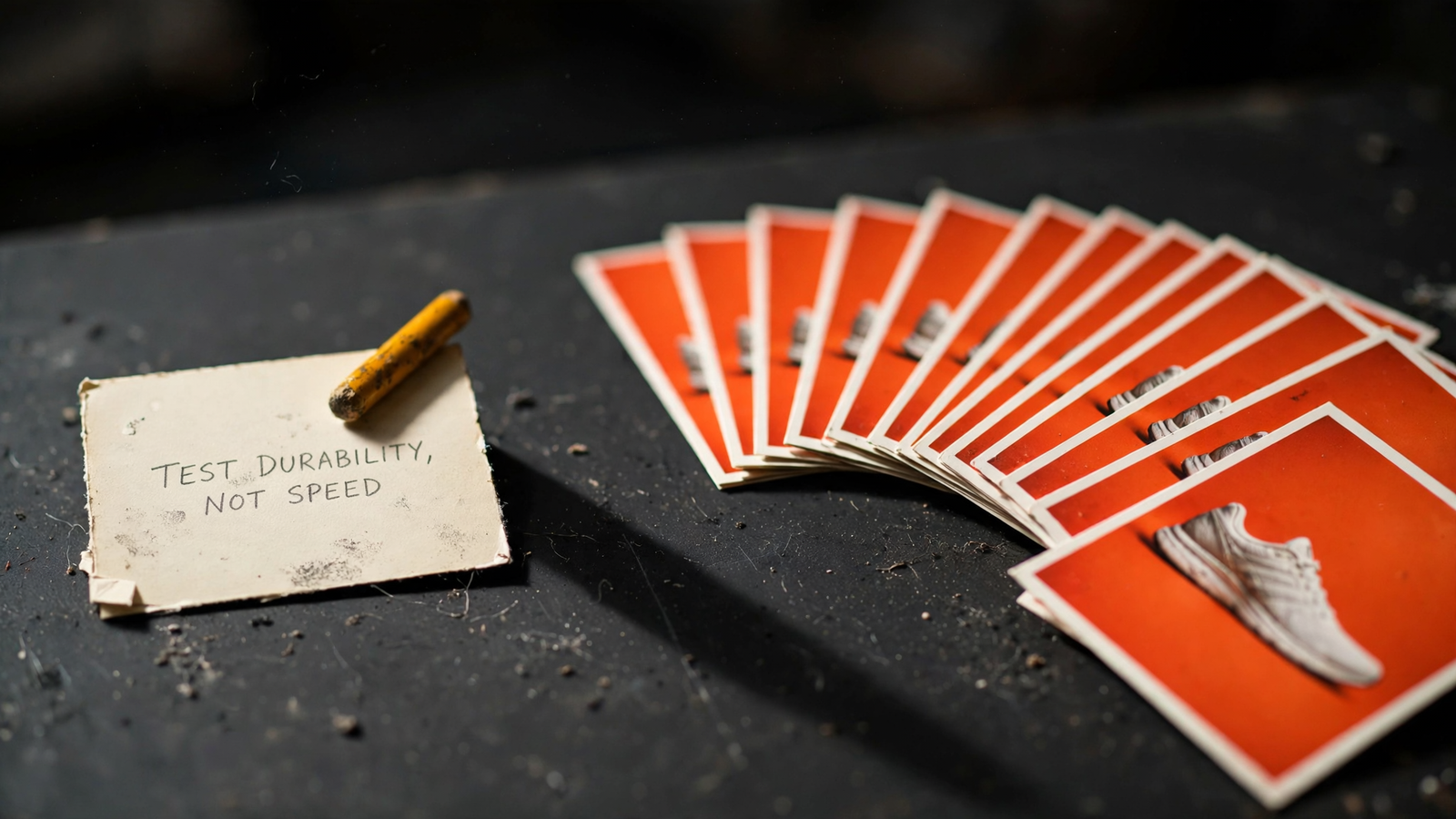
Creative output is the wrong reason to buy an AI Meta ads tool. I want the workflow that can explain what the next ad needs to change, not the one that produces ten images fastest.
Variants per hour, cost per image, a handsome demo gallery: none tells me whether the tool understands why CPA rose. Ten new images are not ten new hypotheses. When I compare Meta’s native tooling, Madgicx, and Claude connected to groas, I start with the evidence behind the proposed replacement.
The advice that fills those galleries is usually some version of “the creative fatigued, make new ones.” But a performance drop is an observation, not a diagnosis.
One advertiser on r/FacebookAds posted five weeks of their numbers: each time a creative entered, spend shifted toward it, the original slowed down, and performance worsened. Cost per purchase went from $20 in week 1 to $105.38 in week 5. A duplicated test campaign sold nothing in five days. That account does not prove new creative caused the decline. It shows why adding more is not, by itself, a diagnosis or a testing plan.
In another discussion, a practitioner describes a client about to hire a video production company when the problem was a placement breakdown. The proposed purchase answered the wrong question.
My buying standard is simple: show me what account evidence changes the next ad. I want a chain from deterioration, to a named hypothesis, to a brief stating what the replacement tests and what stays constant. These three prompts build that chain in Claude with groas connected to the Meta account. They also give me a standard to hold competing tools against.
Ask Claude for evidence before artwork
Before I ask Claude to write an ad, I ask it to read the account:
Using this Meta account and these dates, identify deteriorating creatives.
Separate observations, possible explanations and missing evidence. Make no changes.
With groas connected, that request works from account numbers: spend and delivery by ad, frequency where Meta reports it, CTR against the ad’s own history, conversion rate, and CPA. Nothing gets touched. The first deliverable is a diagnosis I can challenge, not a change I have to undo.
Reporting lag belongs in this pass. Recent conversion data can still be filling in, making an apparent decline premature. Auction pressure belongs here too. Meta’s Q1 2026 results report impressions across its Family of Apps up 19% year over year and average price per ad up 12%. Those aggregate figures do not diagnose an individual account. They do explain why blaming every cost increase on the image is lazy.
I want Claude to separate three patterns:
- Concept fatigue: CTR and engagement fall while CPM stays flat. A new concept is a candidate, not an automatic verdict.
- Audience saturation: frequency climbs on a small audience while reach stalls. New artwork alone does not address the audience constraint.
- Auction pressure: CPM rises across many ads, fresh ones included. Hold off on blaming the creative and review bids.
The distinction between those patterns matters more than a single fatigue score.
Meta’s labels have limits too. Its help center describes “Creative limited” when cost per result exceeds past ads but remains below twice as much, and “Creative fatigue” at twice as much or more. Those labels apply to single-creative ad sets, excluding formats such as dynamic creative and Advantage+ catalog ads. Their absence is not a clean bill of health. Meta also counts recent exposure to the same image or video across campaigns on the same Page.
Nor would I let frequency decide alone. Practitioners in this diagnosis thread describe it as a lagging indicator and point to falling hook rate and CTR against an ad’s own baseline. I compare each ad with its first full week, not the account average, then use the seven checks before calling Meta ads fatigued to challenge the explanation.
One metric is a clue. A decline shared across the campaign is a reason to widen the investigation, not order more images.
Make the brief name what the current ad fails to do
Once an explanation survives scrutiny, I ask for a brief:
For each supported replacement candidate, write one hypothesis, the evidence
behind it and the message the replacement should test.
“One hypothesis” stops the answer becoming a shopping list. “The evidence behind it” puts the numbers where a reviewer can reject a weak idea before production. “The message” gives the designer or UGC editor something usable.
Not “make something fresh.” Something like: “The current ad promises fast delivery, but the reviews praise durability. Test durability as the promise and hold everything else constant.” That is an illustrative brief, not a finding to manufacture when the evidence is missing.
A useful brief says what changes, what stays, and what result decides the test. DataDrew’s template separates an iteration brief, where the execution changes but the concept holds, from a new-concept brief. Mixing them in one production request muddies the question. Its emphasis on evidence and decision rules is the part I would keep above the designer’s desk. Without them, the brief is a mood board with a deadline.
The distinction between an angle and a hook matters here. An angle is the interpretive frame; the hook opens the ad. This breakdown of creative angles separates the two. Five hooks of the same angle are not five independent tests of the underlying proposition. They are five executions of it. Log them that way.
Competitor research belongs in this stage, with a clear limit. groas collects competitors’ Google and Meta ads and the landing pages and funnels behind them. That shows what the market is being told. It does not show what works. A rival’s angle can become a candidate hypothesis, not proof that I should copy it.
Make the next ad answer the approved hypothesis
Only now do I ask for concepts:
Create three concepts for this approved hypothesis using our brand and offer.
Explain what each changes and what stays constant.
That last sentence separates a test plan from three guesses in a trench coat. Claude can draft against the product claims, pricing, offer, landing page, and brand voice available through groas. Those inputs give it something concrete to work from. They do not make invented discounts or testimonials impossible. I still check the output against the approved offer.
Every concept needs a named variable, not just a different thumbnail. If the hypothesis concerns the promise, I want the brief to identify that change and preserve the other elements it needs held constant. If I approve a new concept instead of an iteration, I want the brief to say so. I do not want the report pretending both are the same experiment.
Three is a working limit here, not a magic number in Meta’s delivery system. A practitioner discussion of Andromeda describes visually similar creatives being grouped together. It is a warning against counting cosmetic variants as meaningful diversity, not a guarantee that three different-looking ads receive three clean tests.
Meta can favor one ad and leave others with little delivery. Generating a concept is not the same as giving it enough evidence to judge. I want the production plan and the account’s capacity to learn to agree before anything ships.
Demand the evidence-to-brief workflow in the demo
This is where the comparison changes. I am not buying a gallery. I am buying the route from account evidence to a defensible replacement brief.
Meta: useful breakdowns, not the whole diagnosis
Meta’s Ads Creative Studio groups images and videos by creative style, provides breakdowns including cost per result, CTR, and frequency, and offers a “Scale top creatives” leaderboard sorted by seven-day purchase ROAS.
Its eligibility limits matter: single-image and video ads, with insights for actively delivering ad sets below the advertiser’s performance thresholds. The output is concepts and suggestions. That can help inspect creative performance, but it does not complete the evidence-to-hypothesis brief I am asking for. The separate fatigue labels have their own single-creative restrictions.
I would use the breakdowns. I would not mistake them for the diagnosis.
Madgicx: fatigue flags still leave the briefing job
Madgicx’s MCP fatigue-check page describes comparing frequency, CTR, and cost per result across two periods, ranking by spend, and flagging the fatigue pattern. Its stated limits are unusually useful: “There is no day-by-day split,” and “The MCP finds the tired ads and the creative behind each. Making new creatives is your part.”
That is the gap. The suggested remedies include refreshing elements, rotating variants, and trying a new angle. Those are possibilities, not an account-evidence brief identifying which message to test and why.
An independent review also describes Meta optimization with reporting from other platforms, rather than optimization across them. For a team working across channels, that leaves the workflow divided.
Then there is the bill. Madgicx pricing scales with monthly Meta spend: $45 below $1,000, $99 from $1,000 to $2,500, $129 from $5,000 to $10,000, $229 from $10,000 to $20,000, and $329 from $20,000 to $30,000, with custom pricing above that. Tracking Pro adds $49; extra ad accounts add $9 each.
I am not paying a spend-scaled bill merely to be told which ads look tired. I want the next decision explained.
| Buying criterion | Meta Ads Creative Studio | Madgicx | Claude + groas |
|---|---|---|---|
| Evidence | Creative breakdowns within eligibility limits | Two-period comparison; no day-by-day split in the cited check | Connected account data for the requested analysis |
| Next deliverable | Concepts and suggestions | Fatigue flags; creative remains your job | Hypothesis, evidence, missing data, brief, then concepts |
| Scope | Meta | Meta optimization; reporting from other platforms | Google, Bing, Meta, ChatGPT ads, SEO, and AI search |
| Tool pricing | Included in Ads Manager | Scales with Meta spend | groas Unlimited: $19 monthly, flat, for a whole team |
Claude + groas: the workflow I would buy
Claude is the reasoning layer. It reads through groas, separates observation from explanation and missing evidence, then drafts the brief and concepts against the connected brand and offer. groas supplies the data and the ability to act: account connections, rival ads and funnels, Reddit research, AI answers, and Semrush and Ahrefs data.
The advantage is the connected workflow, not a promise that Claude cannot be wrong. I can question the evidence, reject the hypothesis, and approve the brief before authorizing changes. The prompts above make that sequence explicit rather than leaving it to a dashboard’s fatigue label.
groas Unlimited costs $19 a month for a whole team, with unlimited teammates, ad accounts, and websites, and every feature included. That is the groas subscription price, not a price claim for Claude. For a team already working in Claude, Claude + groas is where I would run this process.
There are limits worth putting in the brief. An export does not let Claude see the creative’s pixels. Broken pixel or Conversions API data can contaminate the analysis. Missing evidence belongs in the first response, not beneath a confident recommendation to generate more.
Approve an experiment, not an endless content machine
Before publishing, I want the approval document to name:
- The account and ad set.
- The approved assets and the hypothesis they test.
- What changes and what stays constant.
- The budget ceiling.
- The target cost per result, set before production.
Production volume has to fit the account’s ability to learn. Meta’s delivery guidance describes around 50 optimized conversion events per ad set to exit learning and recommends consolidating similar content into fewer ad sets. Split speculative replacements across too many ad sets and the budget can keep moving without producing enough evidence in any one of them.
That is the cost of the alternative I am proposing: fewer briefs, more explicit decisions, and the discipline to leave unsupported ideas unproduced. It is less impressive in a demo. It is also harder to hide a bad hypothesis behind a full folder.
Meta’s fatigue guidance recommends adding a materially different ad while keeping the original running. I want that original available as a comparison, without pretending ordinary delivery automatically creates a controlled experiment. A before-and-after chart alone cannot tell me which change deserves the credit.
Publishing is a decision, not a default. groas keeps autopilot off until switched on, logs every change with its reason, and allows a change to be undone in one step.
Meta’s own ads MCP server also separates creation from activation: its rules and tool overview describes write tools creating entities paused and confirmation before activation, with account rules controlling access. I start read-only and widen permissions as trust develops. The workflow worth buying lets me inspect the reasoning before it spends.
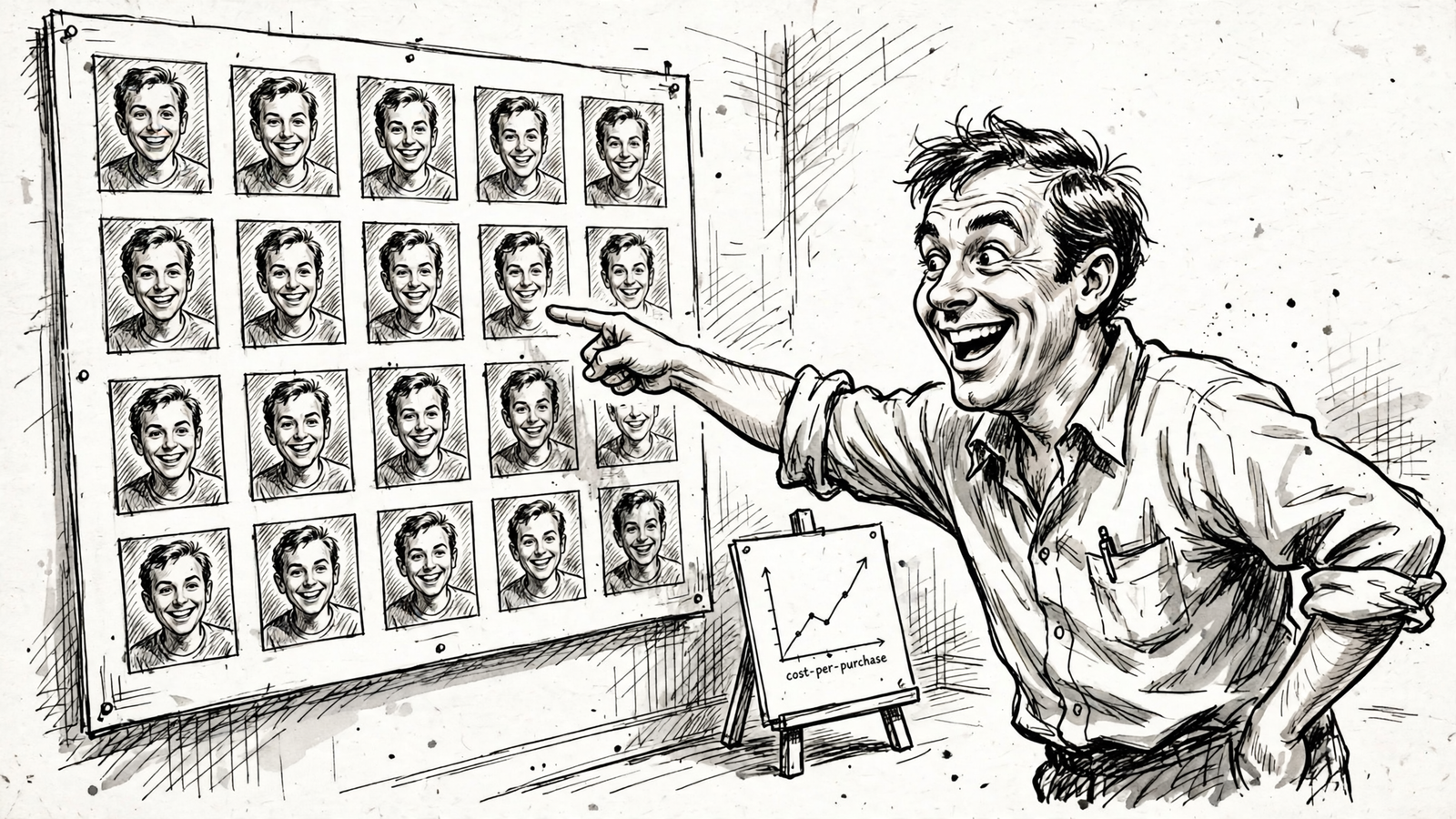
Keep buying by creative output and this is what gets funded: a machine that generates faster than the account can learn. A test history that confuses five executions with five hypotheses. A placement problem, broken measurement setup, or changed landing-page offer that keeps billing while the tool renders images.
The five-week advertiser’s thread does not establish the cause of the decline. It does establish that more creative did not resolve it. That distinction is the whole argument.
Ten new images are not ten new hypotheses. Until a vendor can show the account evidence that changes the ad it wants to publish, it is not selling me a defensible performance workflow. It is selling me a content machine with a monthly invoice. Ignore the distinction and the real problem keeps spending while the folder fills up.


