

 LinkedIn

Do not let ChatGPT move budget to your best-performing ad channel. Not when “best” means Meta reports 4.2x ROAS and Google reports 3.1x.
Say I’m spending $20k a month across Google and Meta. I paste in the standard prompt: rank campaigns by ROAS and recommend how to reallocate budget. ChatGPT sees those two numbers and tells me to shift $500 from Google to Meta. That looks like optimization. What actually happened is a reporting mismatch turned into a spending instruction. Faster execution doesn’t fix the comparison. It makes the mistake easier to repeat.
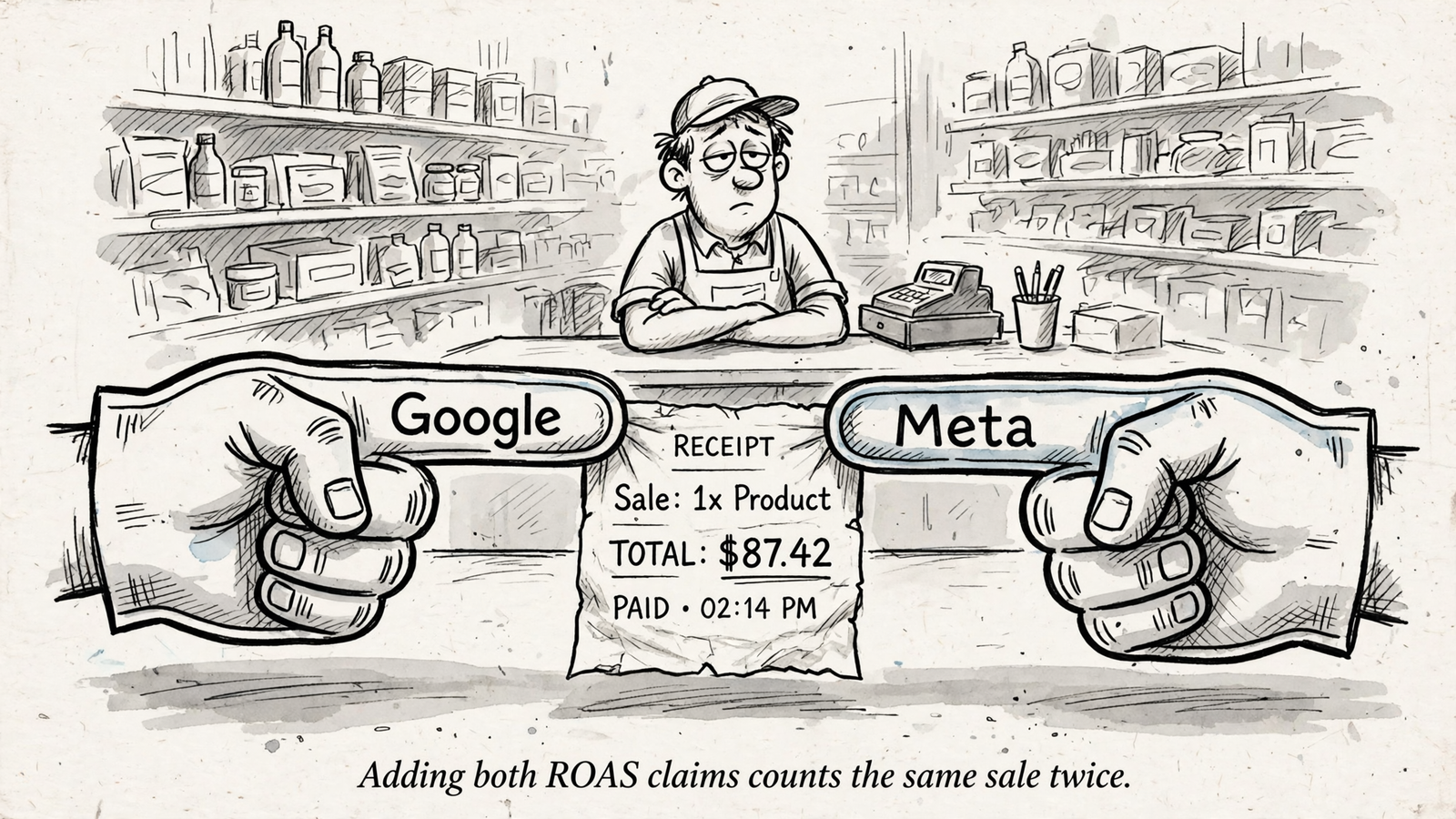
In a survey of 10,500 shoppers, Criteo found that nearly 9 in 10 switch between websites, apps, devices, or other channels at least sometimes before completing a purchase. I recognize the pattern from account after account: someone sees a Meta ad on Monday, Googles the brand on Wednesday, clicks a branded search ad, then buys. Both platforms can claim credit. The store still has one sale.
That’s the part the prompt skips. It asks which channel won before it asks what either channel is counting. I want the assistant to challenge that premise before it gets anywhere near the budget.
Google and Meta aren’t measuring the same return
Google lets me set conversion windows from 1 to 90 days, by conversion action. The default click-through window for Search and Display is 30 days, with shorter windows for engaged views and view-through conversions. Smart Bidding works with the window I’ve chosen. On Meta, a common setup is 7-day click and 1-day view. Google can spread credit with data-driven attribution. Even if I match the dates on the reports, I haven’t necessarily matched which interactions get credit or what counts as a conversion.
That’s why a worked example calls 4.2x on Meta and 3.1x on Google not the same unit. I used to tell clients that the higher ROAS deserved more budget. I was wrong. Before I treat the gap as a performance difference, I check how much of it the settings can explain. Two numbers labeled ROAS don’t automatically belong on the same leaderboard.
One connector guide tells ChatGPT to rank campaigns by ROAS and recommend how to reallocate budget. The same guide says to align reporting periods and definitions because the platforms use different attribution models, currencies, and time zones. That warning belongs in the prompt, not below it. Otherwise the model can answer the question exactly as asked and still give me a bad recommendation.
A paired-rules guide goes further: it says moving money from Google at 2.5x ROAS to Meta at 5.0x doubles the return on every dollar moved. Its recipe calls for 25% cuts and 20% increases. The same page concedes that 4.0x on Meta may be equivalent to 3.0x on Google. The headline tells me to move the money. The fine print tells me why the headline isn’t enough.
Even Salesforce puts eligibility checks, a three-day wait before revisiting a campaign, and daily budget limits around reallocation. Its workflow goes Calculate, Review, Reallocate. Those checks limit what a bad recommendation can do. They don’t make the underlying comparison valid. I still have to do that work before I approve the move.
Add up the claims and the platforms out-earn the store
In one worked example, Google spends $60k and claims $270k in revenue. Meta spends $40k and claims $160k. Put them on one dashboard and I see $430k in claimed revenue on $100k of spend, even though the store recorded only $350k. That’s a blended return of 3.5x on the spend in the example. The dashboard didn’t find another $80k. It added two claims on revenue.
That blended measure is MER: total revenue divided by total marketing spend. I use the business’s recorded revenue rather than adding up what the platforms say they drove. The store total is a check on the platforms, not a verdict on either channel. It includes repeat and organic revenue, and it can’t tell me which channel caused a drop. If the ratio of claimed revenue to recorded revenue rises from the example’s 1.23, I know the gap is getting wider. I don’t know from that ratio alone who deserves the credit. I’m not going to subtract the $80k from whichever channel I already suspected was overcounting. That would turn a useful check into another made-up allocation.
Reconciling the reports still leaves the harder question: what does the next dollar buy? I use ROAS to make tactical decisions inside a channel and incrementality to judge spending across channels. Branded search and retargeting can look efficient because they catch demand that already exists. The eBay brand-search experiment found no measurable short-run benefit from bidding on the brand. That’s a reason to test what the spend adds, not a reason to assume every branded campaign adds nothing.
Then there’s the difference between the dollars I’ve already spent and the one I’m about to move. A channel can average 4x and return 1.2x on the next dollar if it’s saturated. Matching attribution windows won’t answer that question. And a transfer has two sides: I care what the extra $500 buys on Meta, but I also care what I give up by taking $500 out of Google. If the case for a transfer ends at “this channel has the higher average,” I leave the budget where it is.
Make ChatGPT argue against the $500 transfer
My first instruction isn’t “find the winner.” It’s “show me whether the comparison holds up.” With ChatGPT connected to groas, I can bring Google and Meta into the same workflow and have the assistant put the reporting settings beside the results. The first job is reconciliation, not ranking.
I start with the same dates. I want the conversion definitions, attribution windows, and credit models side by side. Then I want a line between what the platforms attribute to themselves and what the business records independently, whether that’s store revenue or closed-won deals in a CRM. If the assistant doesn’t have access to that business number, it needs to say so. Reading both ad accounts doesn’t give it permission to invent a deduplicated customer journey.
Then I ask for the strongest case against the transfer. In the $500 example, I want to know whether Meta looks better because it counts a different set of interactions, whether Google is getting credit for demand Meta helped create, and whether the store numbers support moving anything at all. The assistant doesn’t have to settle every question. It does have to distinguish the ones it can answer from the ones it can’t. I don’t want “the reports use different windows” buried under a recommendation to move the money anyway. I want to know whether there’s still a case for the move once that difference is on the table.
What I’m buying is the ability to say no
A reporting connector buys me a data pipe. One starter plan costs $59 a month for one destination, two sources, and two accounts per source. That gets the numbers into one place. It doesn’t make them comparable. A dashboard buys me a single screen. In one comparison of eight single-dashboard tools, entry prices range from $45 to $71 a month. Some tools only report, some act on one platform, and a few act on both. None of those distinctions tells me whether the next budget move is justified.
The permissions can be lopsided, too. One competitor’s Meta server can pause campaigns or change budgets after confirmation, while its Google Ads MCP is read-only. That tells me where it can act. It doesn’t tell me where I should spend. I’m not buying a cross-channel decision-maker if the pitch boils down to “look at both, change one.”
I’d pick ChatGPT with groas over those setups for this job. I want the same assistant to inspect the account settings, check the store number when it’s available, and show its work before any change. I’ve written before about why one purchase can appear in multiple ad accounts. Seeing all those accounts is useful because I can inspect the overlap, not because I can finally add all the conversions up.
My buying test is a justified no-change recommendation. I don’t need another demo where every number lines up and the system makes the move. Show me the messy case where the platform reports disagree, the store doesn’t settle it, and the assistant leaves my money alone.
The prompt I run before a dollar moves
I run this through ChatGPT with groas before I approve anything:
Compare Google and Meta for the same dates. Show where conversion definitions and attribution settings differ. Separate platform-attributed results from independently measured business outcomes, and flag any evidence you can’t access. Give me the strongest case against moving budget. Do not change anything.
The last sentence sets the boundary. The sentence before it is the test. A chart can show me 4.2x next to 3.1x. A rule can fire when ROAS crosses 4.0. Neither, by itself, tells me why I should ignore the ranking. I want two things back:
- A short reconciliation table: conversion window, credit model, conversion definition, currency, and time zone. If the assistant can’t verify a setting, I want that marked in the table, not filled in with a default.
- A paragraph that tries to talk me out of the transfer: which differences matter to this decision, what the store numbers do and don’t settle, and whether the evidence supports a move. I don’t need the table read back to me in prose.

I run this as a seven-day trial with autopilot off. The assistant has to make the case for or against one budget move, and no change is an acceptable outcome. That costs me the instant answer I could get from a leaderboard. Fine. If the evidence doesn’t clear the bar, I hold the budget steady. I don’t turn on autopilot until I’ve written down what it’s allowed to do and what it’s allowed to spend.
Fund an experiment, not a coronation
Say the windows match, the conversion definitions line up, and the store numbers support a test. I still cap the transfer, require explicit approval, and set the review date before the money moves. On that $20k monthly split, I might move $500 for 14 days if that covers the account’s actual conversion lag. I judge the test on blended store revenue per dollar spent, not on whether the receiving platform reports a prettier ROAS. If Meta’s reported ROAS improves and the blended number sits still, I don’t call that a win just because the platform that got the money tells a better story.
I log the change with its reason. In groas, I can undo the setting in one step. Undoing the setting doesn’t undo the spend. The auction position, the learning, the days of skewed delivery: none of that comes back when I put the budget where it was. That’s why the cap and the review date go in before the change, not after I see a number I don’t like.
Ignore that and the same thing happens next month. The channel that harvests demand looks efficient. The one that helps create it looks wasteful. ChatGPT sends another $500 to the winner while platform totals climb and blended revenue sits still. I’ve watched that loop run for quarters. The assistant says it found a winner. What it found was another $500 in my budget.





