

 LinkedIn

Third-party AI bidding adoption rose from 42% to 50%. Reported manual optimization fell by 14 minutes a week. If a vendor selling a ChatGPT connection for ads wants me to read those numbers as proof that the work went away, I want to see which job it took off my list.
I used to tell clients a version of that story when Smart Bidding first looked like magic. I was wrong to treat automation as a proxy for time saved. The 2026 survey doesn’t tell me what any one team got back. From February fieldwork to two unverified November advertiser reports, the record points to the same buying test: show me the account data, tell me what counts as a conversion, and let me review one change before it touches spend.
February 2026: The survey measures February, not November
Sapio Research ran the fieldwork in February 2026 through email invitations and online panels. It surveyed 2,020 marketing decision-makers in 25 countries, with a 2.2-point margin of error. DoubleVerify didn’t publish the AI report until October 29, 2026. That eight-month gap matters: a headline in November can make February behavior sound like something marketers did last week.
I treat the survey like a February account audit: useful context, not a basis for approving a change today. I’d start by asking ChatGPT through groas to read last week’s change history, then use that list to identify the work that still needed me. I’d put our own hours against it. The change history can show what got done; it can’t tell me how long I spent checking it. If ChatGPT drafts an edit in seconds but I still have to pull the data and check the conversion setup myself, I count that review time too. Use the survey as context. Measure the work in your own account.
October 29, 2026: Accuracy ranks ahead of cost
In DoubleVerify’s published findings, 35% picked accuracy and effectiveness of recommendations, versus 29% each for privacy and security compliance and for cost and ROI. I read that as a buying instruction: check whether the recommendation holds up before worrying about what it costs.
I also read the release with the vendor’s name in view. DoubleVerify sells its own bidding algorithms as DV Scibids AI. Several sections read like product descriptions, and the report closes with a Suntory case study. It’s a vendor survey, not an independent product test. What buyers say they value isn’t evidence that this product, or any other one, delivers it.
I apply the same rule to a ChatGPT recommendation. For every claim about my account, I want the source, the date range, the calculation, and a clear note on what the data can’t establish. With groas connected, I expect ChatGPT to work from live account data and show me how it got to the recommendation. If it can’t, I don’t have evidence. I have a paragraph.
November 1, 2026: More AI bidding, 14 fewer minutes of manual work
November 1 coverage put two findings side by side. Half of respondents reported using third-party AI bidding, up from 42% in 2025. Reported weekly manual optimization moved from 10 hours 12 minutes to 9 hours 58 minutes. That’s 14 minutes. And 57% of marketers still reported spending 8 to 16 hours on it in both years.
This is coverage of the February survey, not a second study. Adoption rose while reported manual work barely budged. The figures don’t tell me whether AI bidding caused the drop, how much time any team saved, or what would have happened without it. My read, as someone who used to bill for the hours: bidding was never the whole job. A bid can change without anyone touching it. That still leaves creative to check, feeds to fix, tracking to repair, search terms to review, and edits to approve.
Two other details make me less willing to buy off the headline. The 98% improvement figure came from a question that assumed improvement: How did AI bidding solutions improve campaign performance last year? The report shows no option for no improvement, no measured lift, and no single benefit above 44%. One chart also puts AI use for bidding optimization at 29%, while another puts third-party AI bidding use at 50%. The same gap showed up the prior year. The report doesn’t explain how those measures fit together, so I wouldn’t treat them as interchangeable.
That’s why I judge a ChatGPT ad setup by a reviewed change, not a clever answer. Show me one edit I can inspect, the account evidence behind it, and a record of what happened afterward. If I still have to reconstruct the reasoning before I can approve the change, the demo hasn’t shown me that it saves work. It’s shown me where the work moved.
November 6, 2026: A PMax rebuild reportedly lands at 1.9x ROAS
An advertiser in r/Google_Ads reported roughly 1.9x ROAS after a Claude-and-ChatGPT-assisted PMax rebuild, against a 4x target. It’s one unverified account snapshot, with no control and no breakdown of what either assistant changed. Roughly half the target is still a miss. Having two famous models in the room doesn’t tell me why the account missed it.
A separate documented rebuild reported a 1.9x increase in blended ROAS over 90 days. Same number, different claim: one is the reported ROAS, the other is how much it rose. In the documented rebuild, the author attributes part of the gain to fixing measurement: tracking went from undercounting by about 32% to counting within 4%. The rebuild also isolated brand traffic and fixed the feed. Four changes shipped together, with no geographic holdout, so the case doesn’t establish incrementality. Better counting can lift reported ROAS without telling me how much new business the rebuild generated.
That’s why I don’t credit the assistant for a rebuild number. Before approving another rebuild, I’d ask ChatGPT through groas to show current campaign results and the search terms it thinks are wasting spend. Is the case for a rebuild that the campaign is paying for irrelevant searches, or that the reported return looks bad? Those are different diagnoses. I want to see what it’s counting and which terms it can point to before I decide whether the structure needs fixing. Until the evidence is on screen, the rebuild is a proposal, not a diagnosis.
November 17, 2026: Four reported conversions, one reported call
Another advertiser reported four primary conversions from phone-number clicks but only one actual call. I can’t verify the account from the thread. I don’t need to assume the numbers are right to see the problem: ChatGPT can read the conversion column accurately and still give me the wrong answer about how many people called.
Google Help explains the mechanism: mobile website phone tracking counts clicks on the number, not actual calls. If calls are the outcome I want, I’d keep phone-number clicks secondary and use forwarding-number calls that meet a duration threshold as primary. A tap on the number isn’t a call. I’d put the distinction in the prompt before approving anything:
List the primary conversion actions and what each actually measures. Separate phone-number clicks from verified calls. Identify what needs external confirmation.

If ChatGPT can’t make that distinction from connected data, tracking is the project, not bidding. After tracking, I check permissions. Over Model Context Protocol, I want to start with read-only work and approve changes before they run. That’s the workflow I use with groas: connect once, ask in plain English, approve the edit, inspect the log. My companion piece on AI bidding rising while manual work fell just 2.3% goes deeper on that test. If ChatGPT can’t show me which conversion it’s optimizing for and which rule it’s acting under, I leave autopilot off.
November 27, 2026: What I require before ChatGPT touches spend
If I’m managing, say, $20k a month, I don’t need another tool that can answer questions about ads. I need ChatGPT to read the live account, name the conversion it would optimize for, and propose one change within limits I set. Through groas, ChatGPT gets connected accounts and competitor and market data to work with. Each change is logged with its reason and can be undone in one step. Autopilot stays off until I switch it on under my rules.
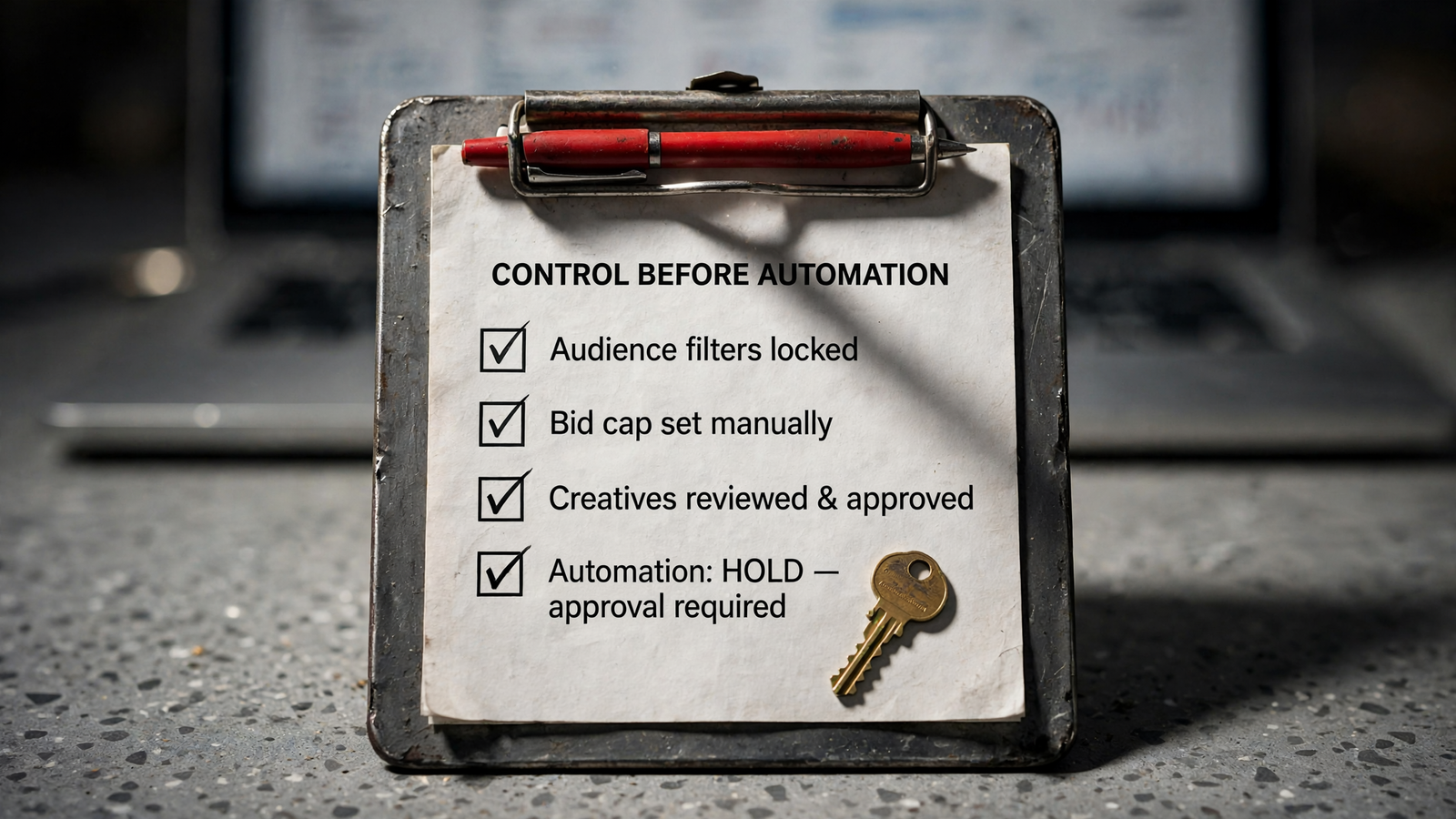
I want four lines in writing before I grant permission to make changes:
- Connected evidence: Which accounts, campaigns, and date ranges did ChatGPT read? What couldn’t it establish?
- Defined outcomes: Which primary conversions represent money or verified calls? Which clicks and taps stay secondary?
- Explicit approval: Start read-only. Review one change at a time. No silent budget moves.
- Reviewable log: What changed, why did it change, and how do I reverse it?
I keep the demonstration small enough to inspect. I pick one search campaign with at least 30 days of history and ask ChatGPT through groas to show spend, primary conversions, and search terms that look like wasted spend, with dates attached. Then I approve exactly one edit: add three demonstrably irrelevant terms as negatives, or split one bloated ad group that mixes two intents. I open the log to see whether the edit I approved is the edit that ran, then check what the account shows seven days later. I’m not asking seven days of data to prove the edit caused a lift. I’m checking whether I can follow the decision from the evidence to the approval to the account.
If an answer has no account data behind it, I stop. That gap is the whole test. At $19 a month for the connected setup, the subscription isn’t the expensive thing to get wrong. The campaign decision is.
I keep the prompts for that first test boring and specific:
- Show spend, primary conversions, and top search terms for this campaign for the last 30 days, with dates.
- List every primary conversion action in this account and what each one actually measures.
- Propose one change affecting less than $500 in spend, state the reason in one sentence, and wait for approval.
The order matters. I’ve watched AI answer fast while the tracking underneath was wrong. A tidy recommendation doesn’t fix that. If page views, button clicks, and phone-number taps are all set to primary, I’d skip bidding changes for now. Fix the counting first, then bring ChatGPT back in.
My read on where this goes in 2027: the buyers who get value from ChatGPT-connected execution won’t be the ones who bought the most AI. They’ll be the ones who can see what the model read, what it counted, and what it changed. groas gives ChatGPT a way to act on the account and market data it wouldn’t otherwise see. It gives me a log and a way to reverse a change. It doesn’t prevent bad decisions or guarantee lower CPA. I still supply the judgment, and I still leave autopilot off until I’ve written down its scope and rules.
Adoption isn’t the win. A clean conversion, a bounded change, and a log I can read are the win. Everything else is a deck.





