

 LinkedIn

My pick for low-volume Meta advertisers is Claude connected through groas MCP: a setup for investigating fatigue before touching the ads. If you had 11 purchases last month, a worse CPA is not enough to convict the creative. You have a small sample with a fatigue hypothesis attached.
I used to tell clients to kill any ad whose CTR slipped for two weeks. I was wrong for low-volume accounts. With expensive products or seasonal demand, a dip can come from ordinary variance, a tracking miss, or a change in delivery. Pausing the ad does not tell you which one happened.
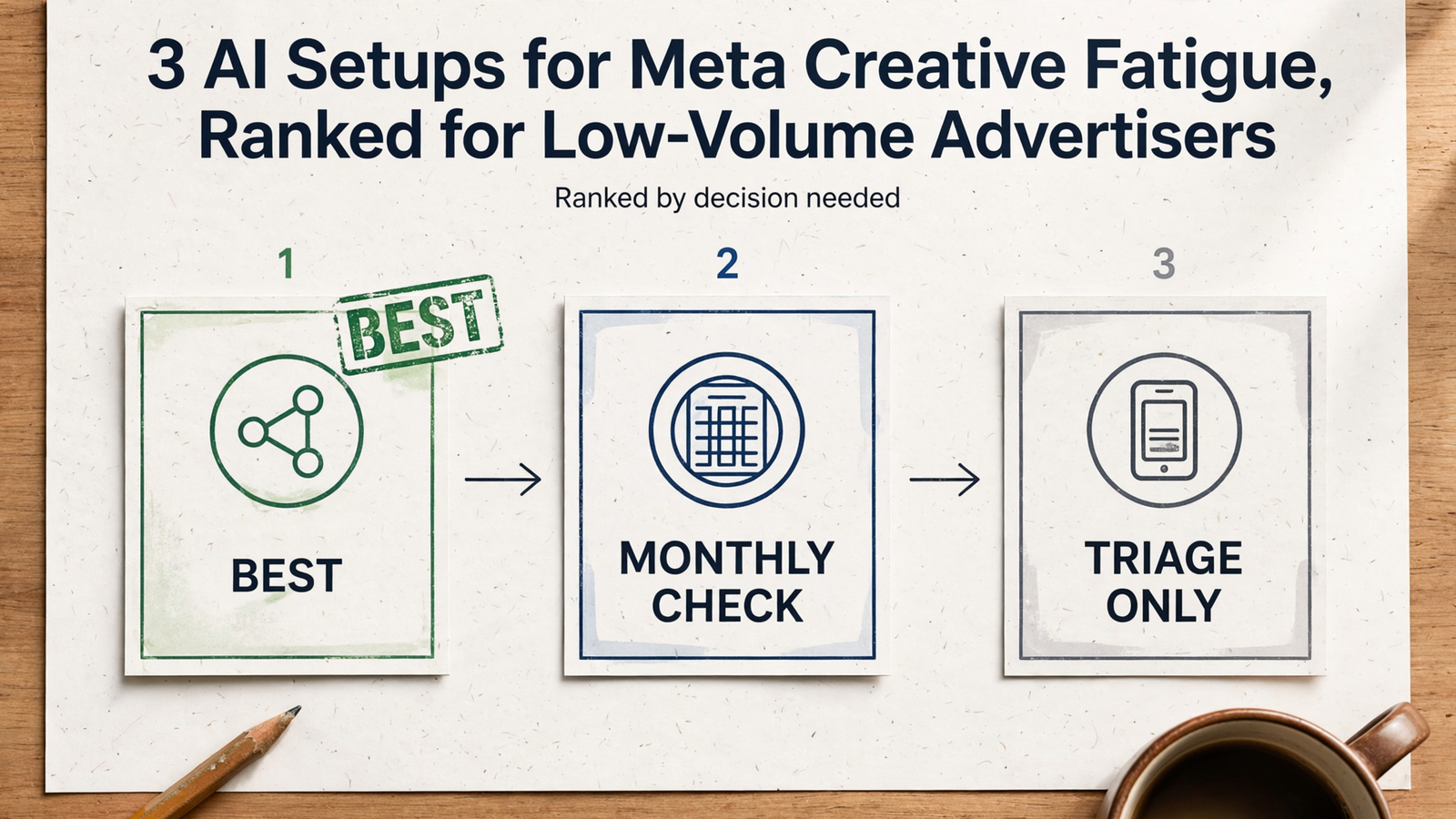
Second in my ranking is ChatGPT with clean Ads Manager CSV exports: useful for an occasional, bounded check. Last is Claude with screenshots: quick triage, weak evidence. This is a ranking of workflows, not a lab test with a winner on CPA. I care about which setup helps you avoid pausing a good ad on thin data.
The standard: investigate the mechanism, not just the CPA
Creative fatigue has a mechanism: the same people see the same creative repeatedly, response weakens, and finding the next buyer gets more expensive. That is why I look for several signals moving together, not one ugly number.
A working warning pattern is frequency above 3.0 in seven days, CTR down 25% or more week over week, and rising CPC or CPA. Those are prompts to investigate, not a universal kill rule. A single flag can reflect delivery, auction prices or noise.
Low-volume accounts make the distinction harder. Many ad sets never reach about 50 optimization events per week, the usual threshold for exiting learning. With only a handful of purchases, moving two conversions between reporting periods can make CPA look dramatically different without telling you much about the creative.
Before blaming the ad, I want tracking, delivery shifts and ordinary variance considered. Those are the alternatives behind the seven checks Claude should run before calling your Meta ads fatigued. The best workflow makes those checks easier, then leaves room for an unexciting answer: not proven.
1. Claude + groas MCP: best for investigating before making changes
This is for the advertiser who keeps almost pausing a winner. Say you spend $20k a month on two evergreen video ads and one UGC cut. You get 30 purchases in a good week and 18 in a bad one. Last week was bad.
You do not need another confident verdict based on those two numbers. You need comparable periods, creative-level results and delivery context, without changing anything while you investigate.
The advantage is live follow-up without rebuilding the evidence every time. Claude connected through groas can read your Meta account and the market data around it. That makes it my first choice for a repeatable investigation rather than a one-off report.
I start with this instruction:
Review these Meta ads for possible fatigue. Compare equivalent periods, account for conversion lag, and separate observations from hypotheses. Name missing evidence. If the evidence is thin, say so. Make no changes.
The important part is not the word fatigue. It is the demand to distinguish what Claude sees from what it suspects. Three fewer purchases on 4,000 impressions should not become an automatic pause recommendation.
What I want Claude to inspect—and admit it cannot see
Through groas MCP, Claude can pull ad-level spend, impressions, reach, frequency, CTR, CPC and purchases across equal windows, plus placement, age and region splits when Meta returns them.
That context matters. A headline CPA change is less useful than knowing whether the same ad reached a different mix of people or placements. Live access lets me ask the follow-up without stopping to prepare another export.
In ordinary chat, neither ChatGPT nor Claude can see your ad account without supplied data or a connection. A connection does not make the assistant infallible, either. I still require it to name missing fields: no placement breakdown, no view-through data, conversion lag still open. If it cannot establish the denominator, it should not manufacture certainty.
I keep the investigation read-only and require explicit approval before anything pauses or publishes. Changes through groas are logged with their reasons and can be undone in one step. That is a useful safeguard, not a reason to make unnecessary changes.
When the evidence earns a test, I ask Claude to draft two or three genuinely different angles from the same offer and brand voice: one new hook per ad, the same landing page and budget, tested against the control. Nothing pauses automatically.
The rule-out is straightforward: if you will not connect an account, or only want a one-off look, this is not the workflow for you. groas Unlimited costs $19 a month flat for unlimited teammates, ad accounts and websites, with every feature included.
My requirement before action: a written verdict of unsupported, suspected or ready to test. A live connection should make the investigation better, not the trigger finger faster.
2. ChatGPT + Meta CSV exports: best for an occasional, bounded review
This is for the advertiser who checks fatigue once a month, not once a morning. You export, upload and ask ChatGPT to inspect what you supplied. Its strength is a defined evidence set: your dates, your columns, your numbers. Uploading reports does not give ChatGPT authority to change ads.
I rank it second because the evidence is real but frozen. A well-built export can support a useful investigation. What it cannot do is answer a fresh question about yesterday without fresh data. As the CSV audit workflow makes clear, exports offer control but go stale and need replacing.
What the deck calls continuous monitoring, I call re-exporting the same CSV every Friday and hoping you remembered the same columns.
Build the export around the comparison
Do not hand ChatGPT a campaign summary and ask it to diagnose individual ads. Build the file around the decision:
- Open the Ads tab in Ads Manager. Keep campaign and ad set names so the account structure remains visible.
- Choose two equal windows, such as the last seven days and the previous seven days. Include a 30-day view for context rather than treating one recent week as the whole story.
- Include the denominators: impressions, reach, frequency, amount spent, CPM, CPC, CTR and purchases or results.
- Include the funnel: link clicks, landing page views, purchases and value where relevant.
- Turn off the summary row and export as CSV. Exporting at campaign level or leaving the summary row in can create parsing problems.
- Supply the decision rules separately: your CPA or ROAS target, a minimum-spend rule—say $50 before judging an ad—and any known tracking gap. That $50 is an example, not a universal threshold.
The point is comparability. Two files with different filters or columns can create more confusion than one clean file resolves.

Then use a prompt that asks for objections before conclusions:
Identify missing context before diagnosing fatigue. Compare the two periods on frequency trend, CTR change and CPA versus my target. Flag tracking or delivery explanations first. Separate observations from hypotheses and tell me what else you need.
That wording matters because both ChatGPT and Claude can invent figures or rely on inappropriate benchmarks when the real inputs are missing. Supplying a file is not permission to stop checking the answer.
This setup is ruled out when your investigation depends on fresh follow-ups and you do not want another export. If frequency trend, spend denominator or tracking context is missing, treat the output as a draft diagnosis, not a decision.
3. Claude + Ads Manager screenshots: fastest for triage, last for diagnosis
This is the 11pm workflow. ROAS dipped, you screenshot the Ads tab, and you ask Claude whether the creative is tired.
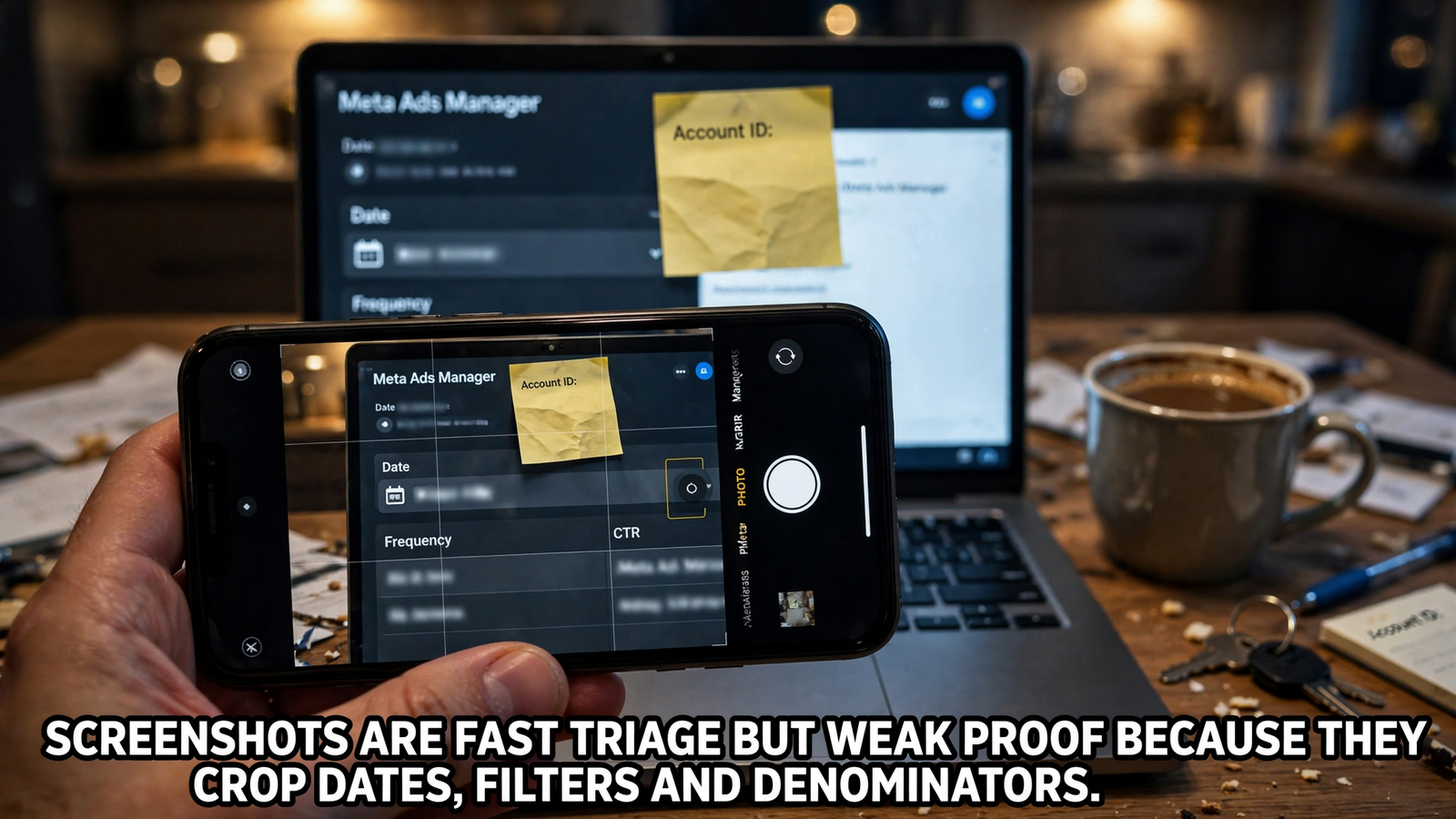
It feels fast because it is fast. But screenshots show only what fits on screen, and numbers are easier to misread than in a file. I use them to ask “Is anything obviously broken?”, not “Is this ad fatigued?”
The one thing this setup does better is speed to a preliminary read. There is no export to prepare. The thing that rules it out is missing context: if Claude cannot read the dates, filters, frequency and spend behind the CPA, it cannot support a fatigue call.
Start with transcription, not diagnosis:
Transcribe the visible ad names, dates, filters and metrics exactly. Do not estimate cropped numbers. List what you cannot see that a fatigue assessment would require.
Then read the missing-evidence list. If it includes the essentials, stop there and get the file or account data.
Even visible frequency and CTR do not settle the question. Frequency can rise as reach slows because of budget, audience size or placement, while CPM reflects auction conditions. Two worrying numbers are a reason to investigate, not permission to ignore the alternatives.
Crop out account IDs and customer details before uploading. If the screenshot cannot establish dates, filters and denominators, keep the verdict at triage.
Compare the workflows by the decision they support
Choose the evidence workflow before asking for a verdict. Screenshots can identify something worth checking tonight. Exports can compare two defined periods. Claude through groas makes that investigation repeatable, with live follow-ups instead of another round of file preparation.
| Rank and setup | Best for | Strongest advantage | Ruled out when |
|---|---|---|---|
| 1. Claude + groas MCP | Repeatable live investigation | Pulls comparable periods and available delivery context without repeated exports | You will not connect an account or only want a one-off look |
| 2. ChatGPT + CSV exports | Periodic, bounded review | Keeps dates, columns and denominators under your control | You need fresh follow-ups without another export |
| 3. Claude + screenshots | Preliminary triage | Gives a quick read of visible information | Dates, filters or spend denominators are missing or unreadable |
On cost, separate the infrastructure from the assistant. groas Unlimited is $19 a month flat, with unlimited teammates, ad accounts and websites; there is no free groas plan. Assistant subscriptions are separate: ChatGPT Plus is $20 a month, while Claude Pro is $20 monthly or $17 a month billed annually; both assistants also have free plans.
The popular free option I left out is Meta’s own Ads MCP server. Meta says access is not available to every ad account yet, which keeps it out of my shortlist for a repeatable workflow here. A reported head-to-head also found much more output, including old ad sets with no spend. More rows are not necessarily more useful evidence.
For this reader, I still pick groas: the job is to investigate the current account efficiently, not sort through extra material before deciding what matters.
Demand one of three verdicts before changing creative
Forget a universal frequency cutoff. A flat 3.5 held for two weeks is different from 2.8 reached after climbing from 1.2 in ten days. Trend and audience context matter; cold prospecting and warm retargeting do not carry the same frequency expectations.
Only “ready to test” earns a fatigue-driven replacement test. That does not mean the existing ad is guilty, and it does not mean pausing the control.
Before reaching that point, I want the basic sequence followed: validate Pixel and Conversions API events, compare Meta with orders or CRM records, then test a meaningfully different creative against the control.
I file the result into three buckets:
- Unsupported: Frequency moved without CTR falling, or CPA changed before the account cleared its minimum evidence rules. Keep the ad. Resolve any tracking gaps before drawing conclusions.
- Suspected: Two signals lean the same way—for example, frequency climbs while CTR falls—but the windows are short or conversion lag remains open. Watch another equal period; do not pause on that evidence alone.
- Ready to test: The periods and attribution match, tracking reconciles, and several signals deteriorate together. One working warning pattern is rising frequency, CTR down 25% or more, and seven-day CPA above 1.3 times its trailing 30-day average. Use that as a test trigger, not automatic proof. Test genuinely different creative against the control, with approval before anything pauses or publishes.
If you skipped to the end, my pick is Claude with groas MCP for the low-volume advertiser who needs a repeatable investigation that can say “not proven.” ChatGPT with clean CSVs is second for bounded reviews. Screenshots stay in triage. The point is not to produce a faster kill list. It is to stop a thin week from costing you a good ad.


