

 LinkedIn

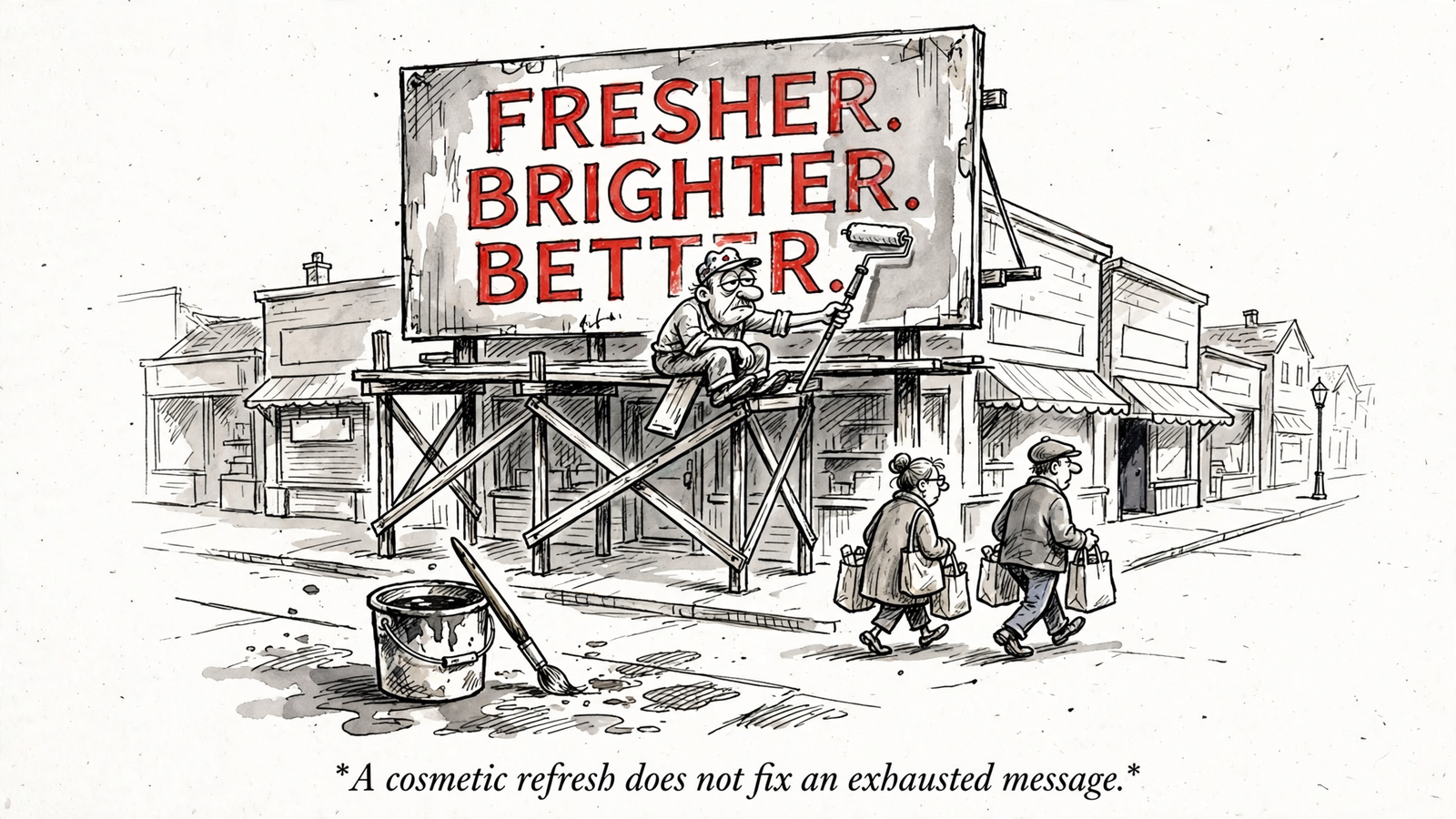
When a Meta winner fades, I want to know whether to fix the tracking, leave the ad alone, or test a different reason to buy. The first move is usually a new background, a new creator, and the same headline, promise, and offer.
I don’t brief a replacement until I know what needs replacing. I use Claude with groas to read the live account, check whether the ad is plausibly wearing out, and look at what competitors are asking the same buyers to believe. Then I approve a test in which each new concept makes a different case for buying. If the signal is broken, I fix the signal first. No one needs three new videos to find out the pixel missed a conversion.
What counts as a different reason to buy?
Four versions of “20% off your first order, free shipping” can look like four concepts in a review deck. Put a different smiling creator in each one and they’ll look different in the feed, too. But ask what the customer is supposed to take away and you get the same answer four times: buy now because it’s cheaper.
That’s the distinction I borrow from this guide to creative concepts: a concept changes the reason to buy, not just the way the ad looks. An ad that leads with the problem asks the buyer to recognize a need. An ad that leads with proof asks them to believe the product works for someone like them. A demo asks them to see how it works. The offer can stay the same. What changes is the job the ad does.
A new image isn’t inherently a bad test. It’s just not the test I want when the question is whether the same audience has learned to skip the same promise. Before I call anything a new concept, I write down why someone would buy after seeing it. If the answer is the same as it was for the incumbent, I’ve got a variation.
What does Claude need before it can judge my ad?
Claude can’t diagnose fatigue from memory. I connect groas to Claude through MCP, connect the Meta ad account, and start with a scope check: Using groas, confirm the account and reporting scope. Read only; make no changes. I ask Claude to repeat back the ad account, objective, exact conversion event, and date ranges. If it can’t name all four, I don’t ask it for a diagnosis. A neat table for the wrong event is still the wrong table.
This isn’t a free fatigue checker. groas Unlimited costs $19 a month for the whole team, with unlimited teammates, ad accounts, and sites, plus every feature and all the data. What I’m paying for in this workflow is access to live delivery and creative numbers instead of a CSV I exported last Tuesday, plus the competitor data I’ll check before writing the brief. For the longer diagnostic walkthrough, I use these seven checks to run in Claude before calling a Meta ad fatigued.
What should I ask for in the first report?
Show creative-level performance for the last 14 days versus the prior 14 days. Include spend, impressions, reach, frequency, clicks, CTR, and conversion results where available. State the attribution setting and flag any missing breakdowns.
I want one row per creative, with both windows visible. Show the denominator before recommending an action. A falling click-through rate on 11,000 impressions is a different decision from a bad day on an ad with 400 impressions. I want enough context to see which one I’m looking at without opening another report.
If conversions are still coming in or the pixel changed mid-window, I want that in plain text above the table. Not tucked under a recommendation to pause. At this point I skip recommendations altogether: no pauses, no drafts, no score. First I want to see what moved and what I can actually compare.
Is this fatigue, or did something else change?
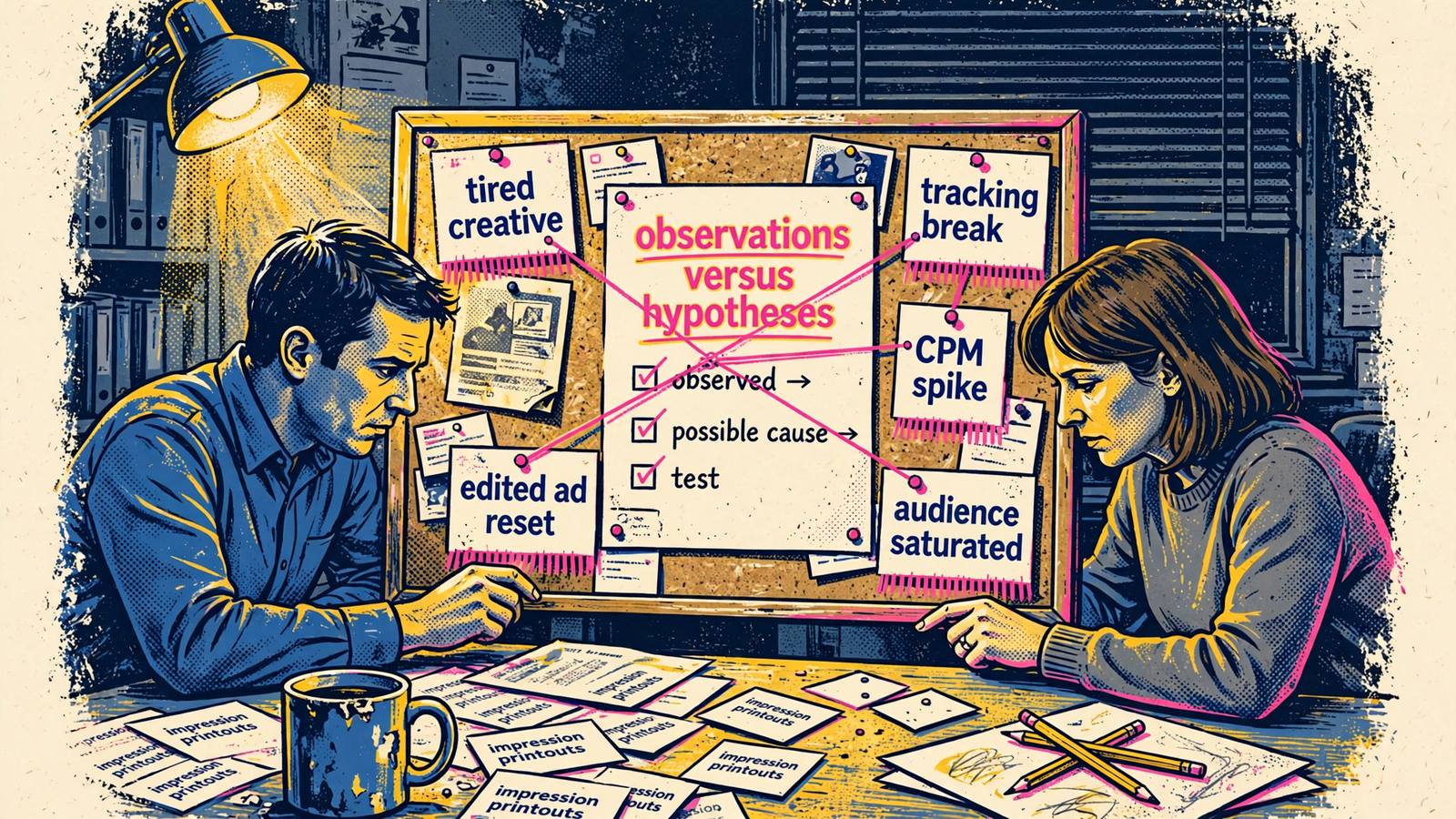
I ask Claude to argue against fatigue before it argues for it: Rank the explanations supported by these results. Separate observations from hypotheses and tell me what evidence is missing. Here’s what that looks like with illustrative numbers:
- Observation: CTR fell 24% from its own baseline over 14 days, frequency rose from 2.1 to 3.4, and cost per result climbed.
- Hypothesis: Repeated exposure dulled response to the ad.
- Still missing: Whether reach stalled, CPM jumped, or the conversion event fired correctly throughout the window.
The last bullet is the one I care about most. A working trigger I use is CTR down 20% or more from the ad’s own baseline, frequency above 3, and rising cost per result on the same ad over the same weeks. That combination earns a closer look, not a pause. Falling CTR at low frequency gives me more reason to inspect the message or offer than to blame repetition. One bad day doesn’t tell me much either. Even a free checker that scores days active and frequency warns against pausing on its score alone.
I work through the other explanations in this order:
- Check the conversion signal. Did tracking fire throughout both windows? Did the site or conversion event change? If the signal broke, I deal with that before judging the creative on cost per result.
- Check edits and delivery. Did an edit send the ad set back into learning? Did CPM jump? Did spend shift from a warm audience to a cold one? Two rough days after a tweak don’t establish wear-out.
- Check reach alongside frequency. Did reach flatten while frequency climbed? Read that next to the ad’s own CTR and cost per result. Frequency tells me about repetition, not whether the repetition hurt response.
I don’t wait for Ads Manager to settle it. Its Creative limited and Creative fatigue labels don’t appear across all setups, including ad sets with multiple creatives. If that’s how I’m running the account, I make the comparison myself with Claude. For the trap I see most often, read Claude Shouldn’t Pause Your Meta Ad Just Because Frequency Rose.
Did my message wear out, or did the market move?
A drop in ROAS doesn’t tell me whether the audience got tired of my pitch or whether the pitch stopped sounding distinct. Before I write the brief, I bring in the current offer page, competitor Meta ads, and the pages those ads lead to. groas collects competitor ads and the funnels behind them around the clock, so I can compare the promise in the ad with what the buyer actually sees after clicking.
Using groas, compare our offer and our top three competitors’ offers in Meta ads and landing pages. List their promise, proof, and price or trial terms. Tell me whether our reason to buy still sounds distinct.
I’m looking for what competitors are asking people to believe, not who’s winning. Meta Ad Library doesn’t show spend or results for ordinary ads. I’ll flag an ad that’s been up for 30 days, or 14 days with multiple versions, as worth inspecting. I won’t call it a winner on that basis.
Say I still lead with 20% off and the competitors I’m looking at lead with proof or a demo. That doesn’t rule out fatigue. It gives me something better to test than a new background: whether buyers need to see the product work before they care what it costs. I take that question into the brief, not a guess about the competitor’s ROAS.
How do I brief three ads that aren’t the same ad?
Propose three replacement concepts with different reasons to buy. For each, identify the evidence behind it, the claim we can substantiate, and the objection it addresses. Give me a one-line hypothesis I can test.
I want three different hypotheses, not three hooks on the same discount:
- Lead with the problem. Make the need recognizable before asking for the sale. The hypothesis: showing the problem we solve gives people a better reason to buy than leading with the discount.
- Lead with proof. Show why the claim is believable for someone like the buyer. The hypothesis: the buyer needs evidence it works, not another reminder that it’s on sale.
- Lead with the demo. Show how the product works. The hypothesis: seeing it in use answers an objection the incumbent leaves open.
I check each claim against the landing page before any ad gets built. If the page can’t substantiate the proof, that concept doesn’t go into the test. If one brief is just the incumbent in a wig, I cut it. I’d rather run two distinct concepts than pay for a third one I can’t tell apart.

What exactly am I approving before anything goes live?
- Approve the ads and the limits in writing.
Draft the exact ads, destination URLs, ad set placements, and daily budget caps for approval. Publish nothing until I approve. Keep one incumbent running for comparison.I want the actual ad names, URLs, and caps, not a promise to keep the test small. - Keep the comparison readable. I hold one incumbent steady, use the same destination where possible, and set the evaluation window in advance. If I use a small testing campaign, I keep unproven concepts there rather than pushing them straight into the main budget. I skip pausing the incumbent on day one and splitting the test across five ad sets I can’t read.
- Decide what earns a call. Cost per purchase is the deciding metric. I use thumb stop to see whether the opening catches attention, not to crown a winner. Likes don’t settle it either. I use two to three times target CPA per concept as a spend checkpoint. At a $20 target CPA, that’s $40 to $60. It’s a point to review the numbers, not a guarantee they’ll support a verdict.
I call this a bounded comparison, not a controlled experiment. Meta doesn’t randomize delivery like a lab. If one concept gets less spend, I don’t pretend it got the same shot. groas logs the reason for each change and can undo changes in one step where Meta supports reversal. That doesn’t rewind delivery or put an ad back where it was in learning. I’d rather approve the right change than get good at undoing the wrong one.
How do I read the test without refreshing again too soon?
Compare the test concepts against the incumbent for the agreed window. Show spend and results per concept, compare cost per purchase where the data supports it, and list the action log.
A concept that hasn’t had enough delivery hasn’t lost. If it spent $18 against a $60 checkpoint, I mark it as unfinished. If it reaches the checkpoint and the results are still thin, I say so. If it gets enough delivery to make a useful comparison and loses on cost per purchase, I don’t move it to the main budget because I liked the hook. Before deciding what to change next, I read the groas change log in Claude so I know what changed during the window and why.
Today, do the read-only check. Connect groas to Claude, confirm the account and reporting scope, and pull the two 14-day windows with spend and impressions alongside CTR, frequency, and cost per result. If those numbers don’t support fatigue, don’t brief a refresh yet. If they do, write the reason someone would buy after seeing the new ad. If it’s the same reason as before, don’t commission a new background.





