

 LinkedIn

In five minutes, you can get a shortlist of Meta ads worth investigating for creative fatigue, without pausing a single one. The mistake most people make is swapping the ad as soon as CPA climbs. I did that early in my account-management years. It took me longer than it should have to notice how often the replacement got blamed for a problem it never caused.
A rising CPA is not a fatigue diagnosis, and a falling ROAS is not a creative brief. Segwise’s breakdown separates tracking or attribution changes, learning resets, auction cost shifts, audience saturation, and creative fatigue. They can look alike on a dashboard. They don’t call for the same fix.
I use ChatGPT with groas to pull the numbers from the connected Meta account instead of typing up an export. The first pass tells me which ads warrant a closer look, what argues against fatigue, and what evidence is missing. Only then do I use the account and competitor data to brief replacements. Five minutes buys you a first assessment, not a verdict. Getting CPA back down is a separate job.
1. What do I ask ChatGPT first?
Paste this into ChatGPT once groas is connected to your Meta account:
Using my connected Meta account through groas, flag possible creative fatigue.
Compare consistent periods, show evidence and competing explanations, and
suggest replacement concepts. Do not change anything.
Ask for candidates, not automatic pauses. A useful reply names each suspect ad and shows:
- The exact dates for both comparison periods.
- Spend and delivery status in each period.
- Frequency and whether it climbed, held, or fell.
- Click-through rate (CTR) and conversion rate trends.
- CPA or ROAS against the ad’s own stable baseline, not the account average.
- The missing evidence that would change the assessment.
If the reply jumps straight to “pause these three ads,” ask it to show the comparison before you act on anything. Do not change anything is the load-bearing sentence. This step reads the account. It doesn’t run it.
2. Am I comparing the same thing in both periods?
Before ChatGPT computes a trend, have it confirm four things at the top of its reply: the Meta account, the conversion event, the reporting dates, and the attribution setting. If those don’t line up, the chart can show a decline the ad never had.
I once watched a client switch the primary conversion from add-to-carts to purchases mid-month. Every chart downstream showed a collapse. The definition had changed. Attribution settings can pull the same trick by moving credit between ads while the creative sits perfectly still. If the comparison crosses a change like that, ask for a baseline with consistent settings. Skip the fatigue call if you can’t get one.
Ask for campaign, ad set, ad, and placement breakdowns where Meta reports them. Meta’s Creative limited and Creative fatigue statuses apply to single-creative ad sets, so in an ad set with several ads, you can’t rely on those flags to do the triage for you (Meta’s help page, OverAds’ walkthrough). You’re reading frequency, CTR, and cost per result instead.
Frequency is impressions divided by reach, and Meta reports it as an estimate, not an exact count. Placement matters, too: a feed ad can be worn out while Stories still has room, a distinction a blended total can hide (practitioner discussion on placement and thresholds). Ask for the split. If it isn’t available, make ChatGPT say what the blended numbers can’t tell you.
3. What could a new ad not fix?
Before ChatGPT names a fatigue candidate, make it explain what else could produce the same pattern. For each of these, ask what changed inside the comparison window and what evidence would rule it out:
- Tracking and attribution: Did the account change what it counts as a result or how it assigns credit?
- Conversion lag: Has the recent period had enough time for purchases to show up?
- Budget and delivery: Did a budget edit, learning reset, or shift in placement or audience mix change who saw the ad?
- Auction costs: Did it get more expensive to reach people even though their response to the ad held steady?
One ecommerce advertiser reported that CPA tripled in three days and bottom-of-funnel conversion fell from 5% to 1%, while CPC, CTR, and frequency held steady (r/FacebookAds discussion). That’s a nasty chart, but the useful clue is where it got nasty. If add-to-cart and checkout rates hold while the purchase rate drops, check checkout, shipping costs, payment failures, and conversion lag before touching the creative.
Ask for the raw counts next to the rates. One purchase from 20 sessions and one from 100 give you very different percentages, but you’re still looking at one purchase in each window. If the account can’t distinguish a tracking problem or a delivery shift from wear, leave the diagnosis open. A new ad won’t make that comparison easier to read.
4. Does the decline actually look like fatigue?
Has the ad kept slipping since it settled?
Look for sustained deterioration under comparable delivery conditions, not one bad day or an ad settling into its audience. In an analysis of 368 Meta ads, CTR typically stepped down early, then broadly flattened once the ad reached scale. That early step down isn’t the same as CTR continuing to slide week after week. Treat both as fatigue and you’ll spend a lot of time replacing ads that were just getting started.
In a 48.5 million-impression dataset, CPM stayed close to its starting level while CTR fell. I use CPM as a tiebreaker, not a primary signal: if CTR is slipping, I want to know whether the cost of reaching people moved too. For video, ask for hook rate (three-second plays divided by impressions), which can soften before CTR does. Have ChatGPT show weekly trends against each ad’s first stable week.
What would make me change my mind?
Ask this as a follow-up:
What evidence contradicts creative fatigue in these candidates, and what
would change your assessment?
Skip the universal frequency cutoff. A summary of Meta’s repeated-exposure study reports that conversion likelihood dropped about 45% at four repeated exposures. That’s a study average, not a rule for pausing an ad when the frequency column hits four. An r/PPC discussion cites a randomized-frequency Yahoo study covering 30 campaigns and 2.8 billion impressions: four campaigns wore out after one or two views, while ten barely moved after 50. The fastest-burning campaigns had the highest CTR to start with. A fixed refresh schedule would retire some ads too early and leave others running too long.
Ask what the other ads in the campaign did over the same dates. If they took the same hit, that weakens the case that this particular ad wore out.
Is there enough data to make the call?
Give ChatGPT a minimum evidence requirement and make it list the ads that don’t meet it. These are examples of how to set one, not three rules you need to stack:
- Segwise’s decision table flags a 20% rise in cost per result over seven days against the ad’s first stable week as an early warning.
- A structured MCP scoring workflow treats fewer than seven days as preliminary and won’t interpret a CPA swing with fewer than three purchases in the window.
- Another fatigue detection workflow requires at least 30 link clicks in each period. It tests whether the CTR drop clears the noise and is worse than the rest of the campaign before calling it fatigue.
Copy the discipline, not necessarily the thresholds. If an ad falls short of the floor you set, label it inconclusive and run the same comparison again next week. Don’t fill the gap with a frequency rule you found online.
5. What should the replacement actually change?
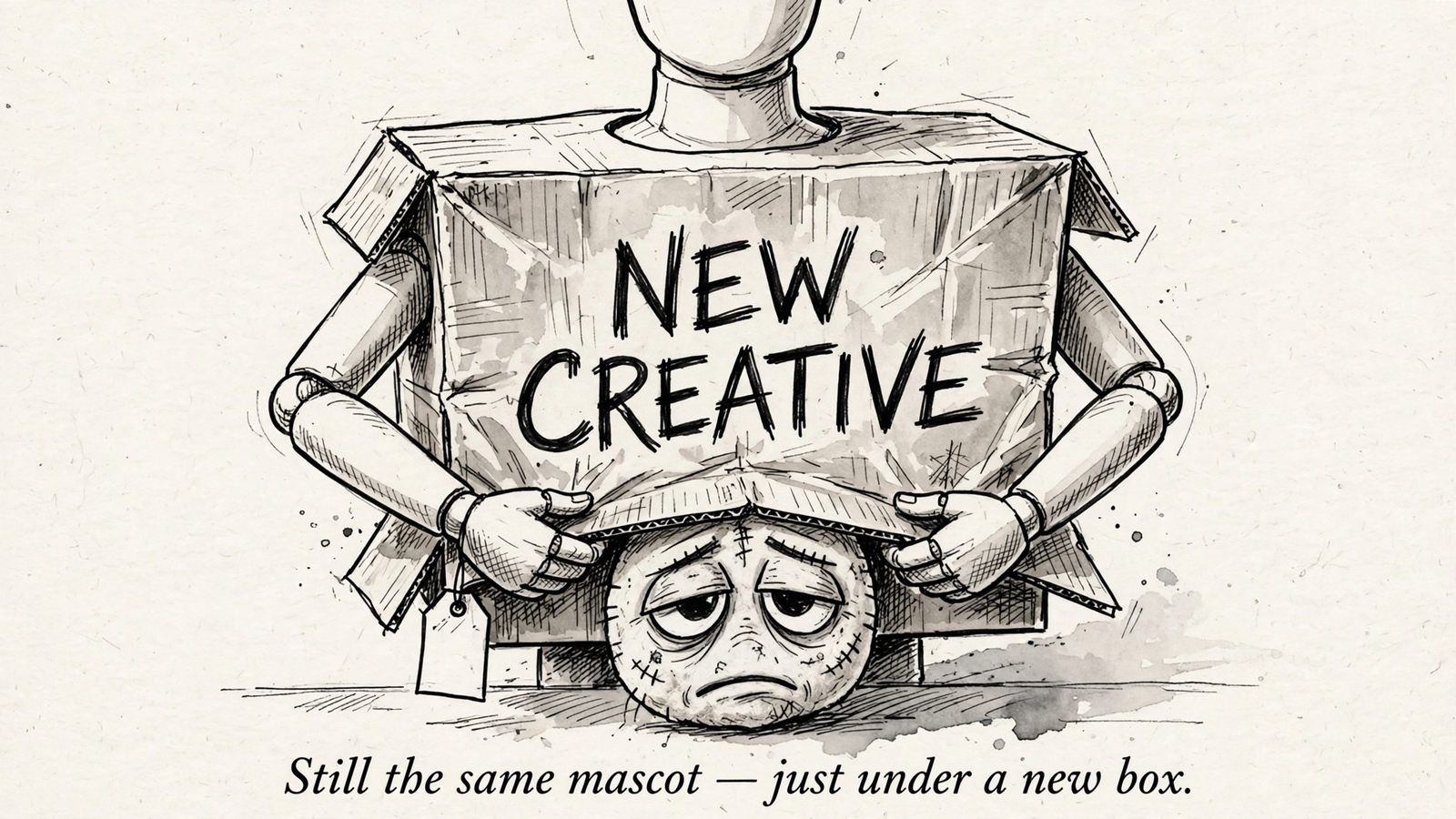
When Meta flags wear, its recommendation is a materially different image or video. Its help page also notes that leaving the original running alongside the new ad may maximize results. That gives you two things to skip: automatically pausing the incumbent and duplicating the tired asset into a fresh campaign. Meta counts recent exposures to the image or video across campaigns from the same Page (AdTestBench on why duplication doesn’t reset fatigue). Same face, new stage.
Brief a different reason to buy. A new background and a new caption color don’t get you there if the hook and the promise stay the same.
Give ChatGPT more to work from than your current ads. groas collects competitors’ Meta ads, pulls out their hooks, angles, and offers, and follows the landing pages and funnels behind them. Looking at the offer, the price, and the checkout or lead form alongside the ad gives you more to work with than the headline alone. Once you’ve narrowed the list to plausible fatigue candidates, use this prompt:
Using my connected Meta account through groas, plus the competitor Meta ads and
landing pages groas collects: read my offer, my current ads, and my top five
competitors’ current Meta ads and funnels. Then give me three distinct creative
hypotheses for replacing [the flagged ads]. Not three rewrites of my current ad:
three different reasons to buy. For each, name the promise, the proof, the
visual direction, and any claim that needs checking before it ships.
6. How do I test the replacement without changing everything else?
Narrow the three concepts to one or two. Before you approve either, write down what changes and what stays put:
- Review: The exact images or videos, the destination URLs, and any claims that need checking.
- Cap: The spend you’ll allow for the test.
- Keep steady: The existing budgets, bid strategy, audiences, and incumbent ads.
If the plan can’t tell you what stays frozen, you don’t have a test. You have a rollout with a hopeful name.

Approve only what you’ve reviewed. Through groas, ChatGPT can add the approved ads to Meta, and the groas action log records what shipped and why. Autopilot stays off until you switch it on. Pausing a new ad stops future spend, not spend that’s already gone. Reactivating a paused ad can mean going back into learning. The one-step undo reverses the groas-side action; it doesn’t rewind Meta’s delivery history.
7. When do I stop diagnosing and do something?
The triage has three exits. Match the next action to the evidence, not to how ugly the CPA chart looks:
- Too little evidence. The ad falls short of your data floor, or the decline shows up in only one week. Collect more data and run the same prompt again.
- A measurement or delivery problem. Tracking changed, conversions are still coming in, or delivery shifted. Fix the comparison before judging the creative. A new ad adds another variable to a signal you already can’t read.
- Plausible fatigue. You’ve ruled out the competing explanations you can check, the decline holds across comparable periods, and you know what would contradict the call. Run the bounded test. Don’t promise a CPA recovery you haven’t measured.
The first thing to do today takes five minutes: connect groas to your Meta account and paste the first prompt into ChatGPT. Leave do not change anything in it. You want a shortlist of ads worth investigating and, just as useful, a list of ads to leave alone. Saving the ones that never needed replacing is the cheaper half of the job.





