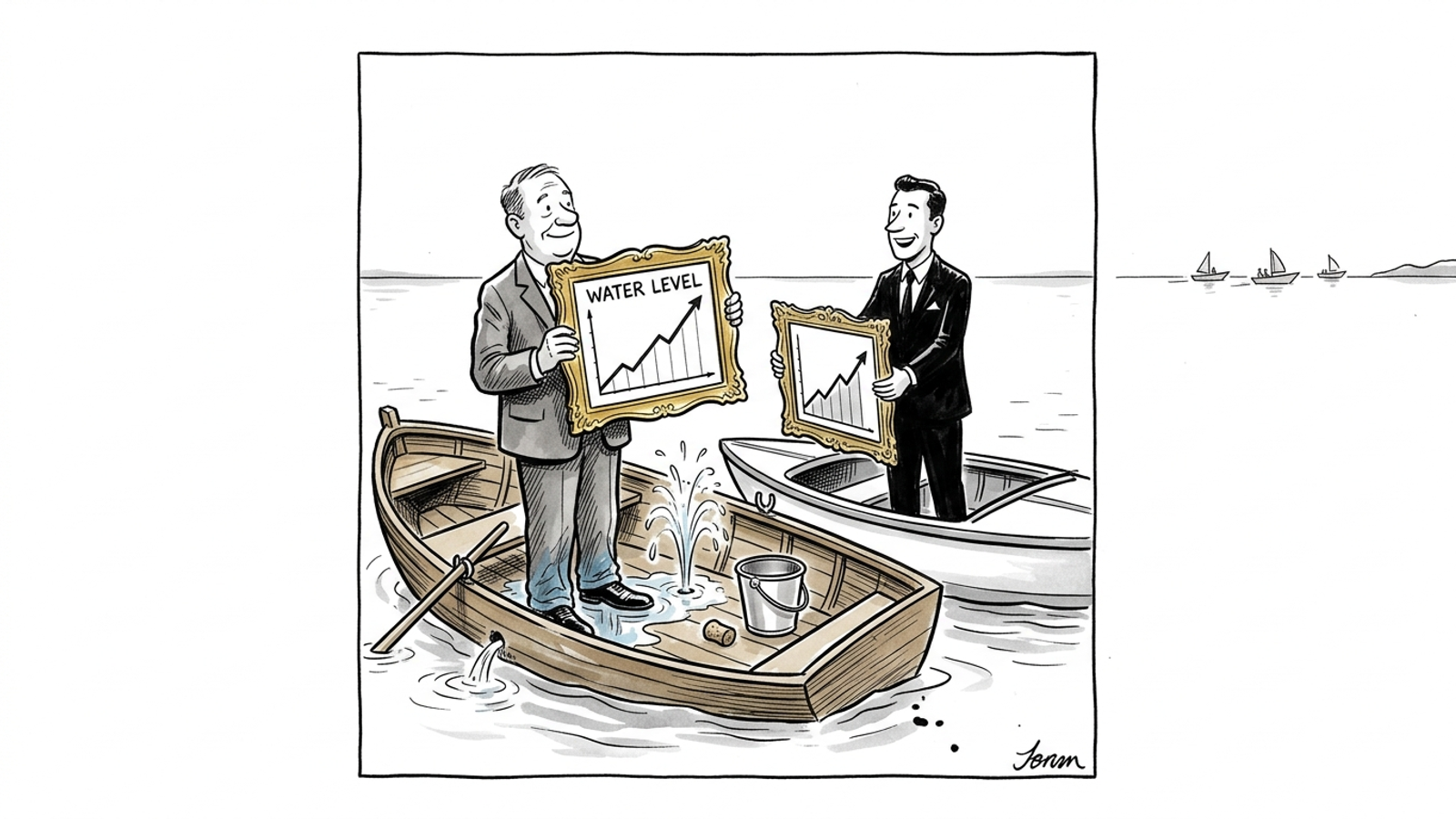

Google Ads agencies hit a ceiling not because they lack talent, but because their delivery model cannot scale without an execution engine underneath the work. An execution engine for Google Ads agencies is a proprietary system that handles the continuous, data-intensive optimization work across client accounts, freeing human operators to focus on strategy and client relationships. Without one, agencies face a predictable set of scaling problems: margin compression, inconsistent delivery, talent bottlenecks, and client churn that accelerates the harder they try to grow.
This article breaks down seven specific warning signs that your agency’s current Google Ads delivery model is breaking under its own weight, what the engine-based agency model looks like in practice, and how to run your first client account on a managed engine without disrupting your existing book of business.
Why Agency Owners Are The Wrong People To Ask About Build Vs. Buy
Most agency founders built their business on manual execution. They learned Google Ads by doing the work themselves, hired people who did it the same way, and built processes around individual operator skill. When you ask them whether to build internal tooling or buy an execution engine, the answer is almost always “build.” Not because building is better, but because the question triggers identity.
The honest framing is simpler: does your current model let you add ten clients without adding headcount? Can you maintain delivery quality when your best operator takes a vacation? Does your margin expand or compress as you grow?
If the answer to any of those is no, you do not have a scaling problem. You have a model problem. And model problems do not get solved by hiring faster or building dashboards. They get solved by changing what sits underneath the delivery.
1. You Are Hiring Account Managers Faster Than You Are Growing Revenue
The clearest sign your agency cannot scale is a hiring rate that outpaces revenue growth. Every new client requires a body. Every body requires onboarding, management, salary, and eventually replacement when they leave. The math is straightforward: if your average account manager handles eight to twelve accounts and your close rate is steady, headcount becomes the binding constraint on growth.
Why This Gets Worse, Not Better
Junior hires are cheaper but produce worse results, which increases churn. Senior hires cost more and are harder to find, which compresses margin. Either way, the ratio of revenue to delivery cost flatlines. You are running a staffing company disguised as a performance marketing agency.
What The Engine Model Changes
An execution engine removes the linear relationship between accounts and humans. The engine handles bid management, budget allocation, search term analysis, and continuous optimization across every connected account simultaneously. Your team focuses on client communication, strategy, and creative direction. The constraint shifts from “how many people can I hire” to “how many clients can I sell,” which is the constraint you actually want.
2. Your Delivery Quality Varies By Who Is Managing The Account
If a client’s results depend more on which operator is assigned than on your agency’s methodology, you do not have a methodology. You have individuals doing their best. This is the most common reason agencies lose clients after internal team changes, and it is invisible until it causes damage.
The Consistency Problem
Manual Google Ads management is inherently variable. One operator checks search terms daily; another checks weekly. One restructures campaigns proactively; another waits for performance to drop. The variation is not laziness. It is the natural outcome of relying on individual judgment across dozens of accounts under time pressure.
How Engines Solve This
A Google Ads engine for agencies applies the same optimization logic to every account, every hour, without variation. The engine does not have a bad week. It does not forget to exclude a search term. It does not prioritize the loudest client over the one that actually needs attention. Your operators become strategists who direct the engine rather than technicians who turn the dials themselves.
3. Client Retention Is Slipping Because Results Are Inconsistent
Client churn in Google Ads agencies is rarely about one bad month. It is about a pattern: strong onboarding results, a plateau, a slow decline that nobody notices until the client raises it, then a reactive scramble that sometimes works and sometimes does not. The root cause is almost always that your team is managing too many accounts to maintain proactive optimization on all of them.
The Real Cost Of Churn
Replacing a churned client costs significantly more than retaining one. You absorb the sales cycle, onboarding effort, and ramp time before the new account reaches steady state. Meanwhile, the churned client tells two other business owners about their experience. Agencies that scale without solving inconsistent results across accounts end up on a treadmill: closing new business at roughly the same rate they lose existing business.
What Changes With An Engine
When optimization runs continuously through a system trained on hundreds of billions in ad spend, the performance baseline across your entire book rises. Accounts do not plateau because nobody looked at them for two weeks. Your retention improves not because you got better at managing expectations, but because the actual numbers hold up.
4. You Cannot Profitably Take On Smaller Accounts Without Margin Compression
Smaller accounts are often the fastest path to growing your client count, but under a manual model they destroy margin. An account spending $3,000 per month on Google Ads requires nearly the same operational attention as one spending $30,000. The management fee on the smaller account does not cover the operator hours, so you either subsidize it, deprioritize it, or decline the business entirely.
The Small Account Trap
Many agencies set minimum spend thresholds to protect margin. This is rational but limiting. It shrinks your addressable market and pushes you into a competitive tier where every prospect is also talking to three other agencies. The agencies that scale fastest are the ones that can profitably serve a wide range of account sizes because their cost of delivery per account is low enough to make smaller accounts viable.
How An Engine Changes The Math
When the engine handles execution, the marginal cost of adding a smaller account drops dramatically. Your team spends minutes per week on strategic oversight rather than hours on manual optimization. This is exactly how agencies use groas: they connect client accounts to the proprietary engine, keep their brand and margin, and serve accounts across the spend spectrum without the headcount math breaking. The economics work because the engine does not bill by the hour.
5. Your Team Spends More Time On Reporting Than On Strategy
Reporting is necessary. Spending 30 percent of your team’s week assembling reports instead of improving campaigns is not. If your operators are pulling data, formatting slides, writing summaries, and double-checking numbers for most of their Monday, they are not doing the work that actually moves client results.
Why This Happens
Most agencies built reporting workflows before they had enough clients for it to matter. As the book grows, reporting scales linearly with accounts while the process stays the same. Automating reports with third-party dashboards helps, but it does not eliminate the interpretation and narrative work that clients expect.
The Engine Advantage
An execution engine generates reporting data as a byproduct of doing the work. When optimization, budget pacing, and search term management happen inside a unified system, the reporting layer pulls directly from execution data rather than requiring manual assembly. Your team adds insight and context. The engine provides the numbers, the trends, and the what-happened layer that currently eats half your operators’ weeks.
6. You Lose Pitches Because You Cannot Demonstrate A Proprietary Process
When a prospect evaluates three agencies and all three describe the same process (audit, restructure, optimize, report), the decision comes down to personality and price. Neither of those is a defensible competitive advantage. Agencies that win consistently can point to something the other agencies do not have: a proprietary system, a unique methodology, or a technology layer that produces better outcomes.
The Pitch Problem
“We have experienced media buyers” is not a differentiator. Everyone says it. “We use Google’s built-in tools effectively” is table stakes. Prospects, especially sophisticated ones, are looking for a reason to believe your agency will produce results that the last agency could not. Without a proprietary execution layer, that reason does not exist.
What Agencies Running On groas Say In Pitches
Agencies using the groas engine can describe a proprietary system trained on over $500 billion in profitable ad spend running underneath their management. That is a concrete, credible differentiator. It changes the pitch from “trust our people” to “our people direct a system that operates 24/7 with more data than any single operator could process.” The comparison to manual optimization tools is stark: this is not a dashboard or a suggestion engine. It is execution infrastructure.
7. Your Best Operators Are Burning Out On Manual Optimization Work
Your strongest media buyers did not get into advertising to pull search term reports and adjust bids all day. They are strategists stuck doing mechanical work because the mechanical work has to get done and nobody else can do it as well. Over time, they either burn out, slow down, or leave for a role where they can think instead of execute.
The Talent Retention Link
The agencies that retain top talent are the ones that give their operators leverage. Leverage means one person can impact more accounts at a higher level. Without an execution engine, leverage does not exist. Every account requires the same hands-on hours regardless of how experienced the operator is. Senior people do the same tasks as junior people, just better and more expensively.
How The Engine Creates Leverage
When groas handles continuous optimization, your senior operators shift from execution to strategy. They review engine outputs, adjust targeting, develop creative direction, and manage client relationships. The work becomes more interesting, more impactful, and more sustainable. Retention improves because the job improves, not because you paid more.
What The Engine Plus Agency Model Actually Looks Like In Practice
The engine-based agency model is not theoretical. Agencies are running it today, and the operational difference is significant.
How Agencies Run Client Accounts On A Managed Engine
With groas, agencies connect client Google Ads accounts under a single subscription. The engine runs continuous optimization, bid management, budget allocation, and performance monitoring across every connected account. There is no per-account setup fee, no onboarding cost, and no minimum commitment. It starts with a 7-day free trial, so agencies can validate performance before committing.
What Your Team Does, What The Engine Does
The engine handles the work that scales poorly with humans: real-time bid adjustments, search term analysis, budget pacing, performance anomaly detection, and cross-account pattern recognition. Your team handles the work that humans do better: client communication, strategic direction, creative development, and business context interpretation. The division is clean and the roles are complementary.
White-Label Economics: Margin, Positioning, Scalability
This is a reseller model. Your clients never see groas. They see your brand, your reporting, your team. The difference is that your team now has an engine underneath that lets them manage more accounts at higher quality with fewer people. Your margin expands because the cost of delivery per account drops. Your positioning strengthens because you can credibly claim a proprietary technology layer. Your scalability improves because growth no longer requires linear headcount increases.
Common Objections Agency Owners Have (And The Honest Answers)
“We Will Lose The Account If We Are Not Doing The Work”
You are doing the work. You are doing the strategic, high-value work. The engine does the mechanical optimization that your clients are not paying you for and do not want to hear about. No client ever churned because bid adjustments happened automatically instead of manually. They churn because results slip. Results slip because humans cannot optimize 24/7 across dozens of accounts.
“Our Clients Will Not Understand The Technology”
They do not need to. You do not explain your project management software to clients either. The engine is infrastructure. What clients understand is better results, faster response times, and consistent performance. Those are the conversations you have. The technology stays behind the curtain.
“We Cannot Trust A Black Box With Our Clients’ Budgets”
This is the most reasonable objection and the easiest to address. The groas engine is trained on over $500 billion in profitable ad spend. It is not experimenting with your clients’ budgets. Your team retains full visibility and control. You direct the engine; the engine executes. If something needs to change, you change it. The 7-day free trial exists specifically so you can validate this with a real account before scaling.
How To Start: Running Your First Client Account On The Engine
Pick one client account. Ideally one where you know the performance baseline well enough to measure improvement. Connect it to groas through the self-serve setup. Let the engine run alongside your existing management for the 7-day trial period and compare the outputs.
You are not committing to anything. There is no onboarding fee, no long-term contract, and you can cancel anytime. If the engine produces better results with less manual work, you have your answer. Scale it across your book at whatever pace makes sense.
The agencies that scale Google Ads without hiring are the ones that stopped building in-house and started running on infrastructure designed for exactly this problem. The question is not whether engine-based delivery is the future of agency operations. It is whether you adopt it now while it is a competitive advantage or later when it is table stakes.
Start your 7-day free trial and run your first client account on the groas engine today.