The AI-Search Glossary: What AEO, GEO, Citations, and Visibility Actually Mean
A practitioner's glossary of AEO, GEO, prompt tracking, AI citations, and brand visibility—and the sales-deck spin that blurs them.
September 24, 2026
•
min read



Google Ads AI Max can send a paid click to a page you never chose, using copy you never wrote, for a query you never added. That can find sales your keyword list missed. It can also spend your budget teaching Google that a student downloading a PDF is a valuable lead.
Most agencies will tell you AI Max is the future of paid search. I am more interested in the invoice. Google built a way to match conversational, long-tail searches without waiting for advertisers to create a keyword for every variation. If you manage an account, the useful question is not whether the automation sounds impressive. It is whether the additional reach produces qualified customers at a cost you can live with.
AI Max sits inside existing Search campaigns rather than replacing them with a new campaign type. It changes three things at once: which searches can trigger your ads, what those ads say, and which page receives the click. Each change can help. Each also needs a boundary.
According to Google Ads documentation, AI Max combines targeting and creative features for Search campaigns. In practical terms, that means:
Google reports an average 14% increase in conversions or conversion value for non-retail advertisers using AI Max at a similar cost per acquisition. That is a platform benchmark, not a forecast for your account. Google has also begun moving campaigns that use campaign-level broad match and legacy automatically created assets into AI Max, with classic Dynamic Search Ads scheduled to follow. Treat the feature as something to understand now, not a setting to discover after a quarterly review.
The mechanism matters more than the headline lift. AI Max can find a useful query you would never have put in a spreadsheet. It can also find an inexpensive conversion that has no value to your sales team. More conversions are only a win when the conversions are worth buying.
If you have dealt with Performance Max versus Search campaigns, you know why the distinction matters for lead generation. PMax can spread budget across YouTube, Gmail, Display, and Discover to pursue a blended conversion target. AI Max stays within Search inventory, including search partners and AI Overviews. Its reach is narrower, but its query matching, generated copy, and landing page routing can still change the economics of a Search campaign.
| Feature | Standard Search | AI Max for Search | Performance Max |
|---|---|---|---|
| Placements | Google Search and Search Partners | Google Search, Search Partners, and AI Overviews | Search, YouTube, Display, Discover, Gmail, and Maps |
| Query matching | Exact, phrase, and broad match keywords | Keywords plus broader and keywordless retrieval | Audience signals and keywordless retrieval |
| Ad creative | Responsive Search Ads with advertiser controls | Responsive Search Ads with Gemini text customization | Text, video, and image asset combinations |
| Landing pages | Designated final URLs | Final URL expansion across the domain | Final URL expansion across the domain |
| Exclusions | Ad group, campaign, and account controls | Campaign-level brand and negative keyword controls | Account-level negatives or assisted exclusions |

Do not confuse Search-only with set-and-forget. AI Max gives the algorithm more room to decide what qualifies as a relevant search, a relevant message, and a relevant destination. That is where the test begins.
AI Max makes sense in high-volume ecommerce and deep catalog accounts. Say an online retailer carries 4,000 SKUs, or an equipment supplier lists hundreds of specialized parts. No media buyer has time to maintain an ad group for every obscure query variation. When product pages have clear pricing, clean structured schema, and fast load times, search term matching can catch long-tail searches your keyword sheet missed. Final URL expansion can then take the buyer to the specific product instead of a generic collection page.
That is an intake valve, not permission to stop measuring. In accounts with clean transaction value tracking, I have seen AI Max produce 15% to 22% incremental revenue without exceeding the target return on ad spend. The clean tracking is doing important work in that sentence. If the account cannot distinguish a valuable purchase from an easy but worthless action, broader matching gives bidding more ways to make the dashboard look good without improving the business.
The risk grows in B2B SaaS, niche professional services, and specialized healthcare. A generated headline may make a promise your team has not approved. URL expansion may send a paid visitor to an unvetted blog post or an About Us page when the campaign needs a commercial landing page. And if a top-of-funnel PDF download counts the same as a qualified opportunity, Smart Bidding has a reason to pursue cheap downloads. Student research, job-seeker traffic, and informational queries can start looking like success while cost per qualified pipeline moves the wrong way.
I would not reject AI Max just because the sale is complicated. I would reject an AI Max test that measures form fills while the business needs qualified pipeline. Fix the signal and the boundaries before you ask the algorithm to find more of anything.
If you turn on AI Max without rules, you give it broad access to your domain as a source of destinations and ad material. Start with the pages a paid visitor should never reach. Configure URL exclusions and restrict expansion to appropriate commercial paths where the campaign allows it. Use negative webpage targets with URL_CONTAINS rules where needed. At a minimum, review /blog/, /resources/, /careers/, /support/, and /privacy-policy/ for exclusion. A person looking for your support number or a job opening should not consume an acquisition budget on the way to a help article.
For a product campaign, that may mean keeping traffic within /products/. For a services campaign, it may mean approved commercial /services/ pages. The point is not that every company uses those exact paths. The point is to decide which pages can make the promise your ad implies and support the conversion you are paying for.
Next, ring-fence brand searches. AI Max supports campaign-level negative keyword controls, but keywordless retrieval can drift toward the queries most likely to convert: searches for your own name. If a non-brand acquisition campaign buys those clicks, its reported conversion rate may improve without bringing in new buyers. Apply brand exclusions in the AI Max campaign settings and let a dedicated brand campaign handle defensive navigational traffic. Do not let a prospecting test claim credit for demand you already had.
Then inspect the ads people actually see. Gemini draws on destination pages to write headlines and descriptions, so vague site copy can become a vague or inaccurate ad promise. Review the asset report weekly and audit the ai_max_search_term_ad_combination_view report for mismatched pricing, unsupported claims, or copy that sends the wrong person to the right page. If legal disclaimers or tightly controlled value propositions matter in your industry, use asset pinning on your primary Responsive Search Ads rather than assuming a generated line will stay inside the brief.
Finally, govern the conversion signal. Do not ask Smart Bidding to pursue every form submission equally if your sales team throws half of them out. Connect offline conversion tracking or send CRM stage values back to Google Ads so bidding can distinguish qualified pipeline and closed revenue from bot submissions and student research clicks. URL and creative controls stop obvious mistakes. Better conversion data tells the system what a good outcome is. You need both.
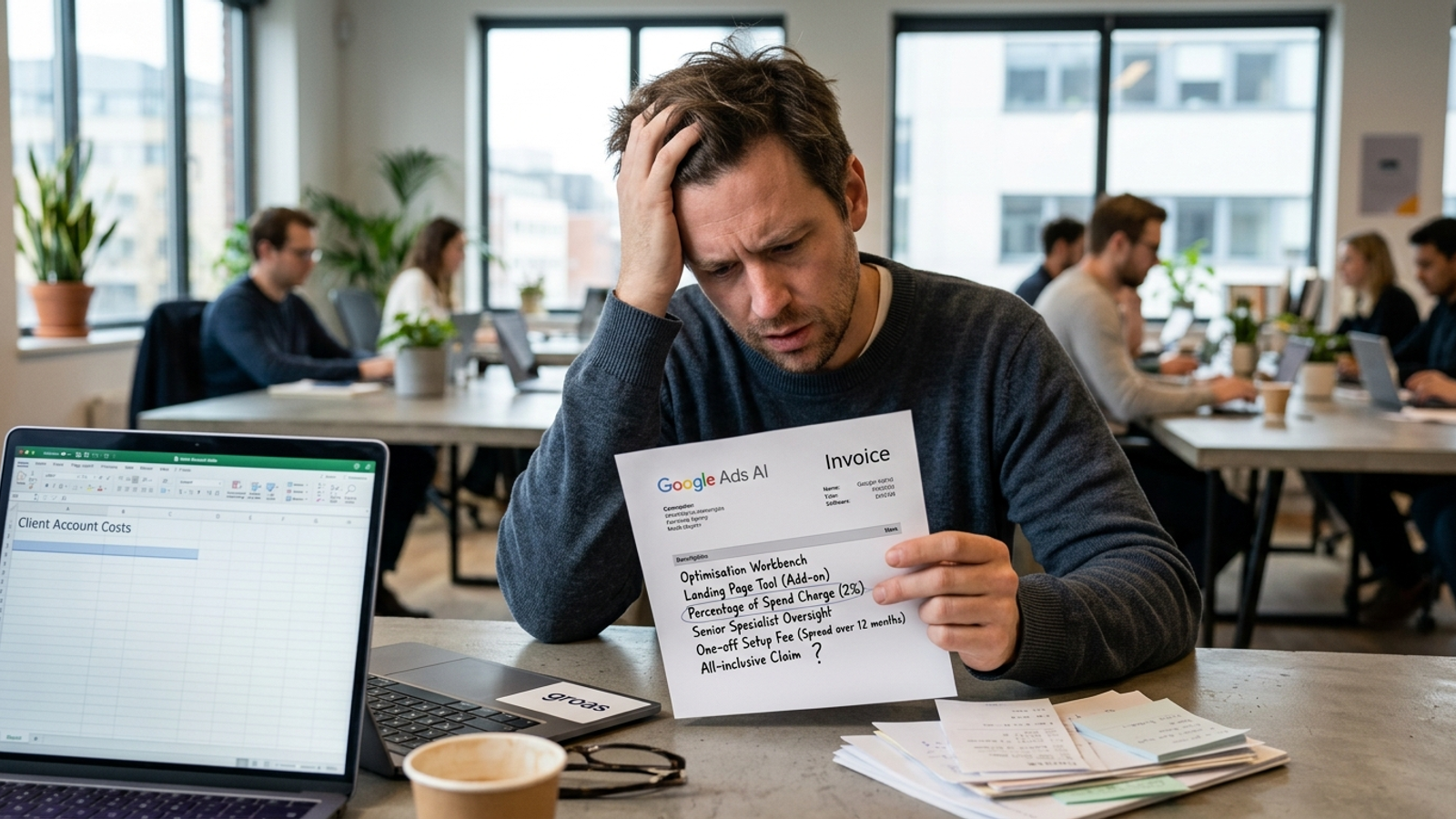
Here is the part that still bothers me: Google asks advertisers to give an algorithm more control, while traditional agencies often supervise that algorithm on a weekly human schedule. AI Max can test query variations, assemble headlines, and change destinations far faster than an account manager can pull a Tuesday search terms report. If that report reveals $3,200 spent on irrelevant student queries or paid traffic sent to an FAQ, the money has already gone. Charging a 15% management fee to explain the loss in a retrospective PDF does not make the process strategic.
I am not arguing for a retreat to isolated exact-match keywords. Rigid lists can miss conversational searches, particularly as people use more natural language and AI-mediated search surfaces. The answer is to counter automation with oversight that operates at a comparable pace, not to fight it with another spreadsheet.
That is the case for an autonomous PPC engine like groas. Instead of relying on periodic manual audits, its specialized AI models work continuously across bids, queries, creative, and page-routing decisions. Wasteful query patterns, routing anomalies, and asset combinations can be evaluated against downstream pipeline rather than click-through rate alone. A named senior strategist sets commercial guardrails, reviews anomalous shifts, and remains accountable through strategy calls and shared Slack channels. The flat monthly fee also avoids a percentage-of-spend charge that grows when ad spend grows.

The distinction is machine-speed execution with human ownership of the goal. Google has an incentive to expand eligible auction inventory. Your business needs attributable margin, qualified pipeline, and a workable target CPA. Those objectives overlap sometimes. They are not identical. Set the business rules before you let either machine run.
Do not turn on AI Max across a primary revenue-generating campaign just to see what happens. Build a 50/50 Google Ads Campaign Experiment so the existing setup remains your control, then run it for at least four weeks. Before launch:
This setup gives the feature a fair chance without changing several other variables at once. After the test, compare incremental qualified conversions with your historical CPA baseline. If AI Max cannot clear that bar within 30 days, it is not ready for your funnel. Do not promote a higher click count into a rollout decision.
During the test, ignore the temptation to lead with impressions or total clicks. I would watch three diagnostics:
AI Max is neither a catastrophe nor a hands-off miracle. It can capture intent a rigid keyword list misses, then drift through weak signals, generated copy, and open-ended URL routing. Give it exclusions, brand isolation, qualified conversion data, and oversight that keeps pace. Without those, you are paying to teach Google's models what your business should have told them first.