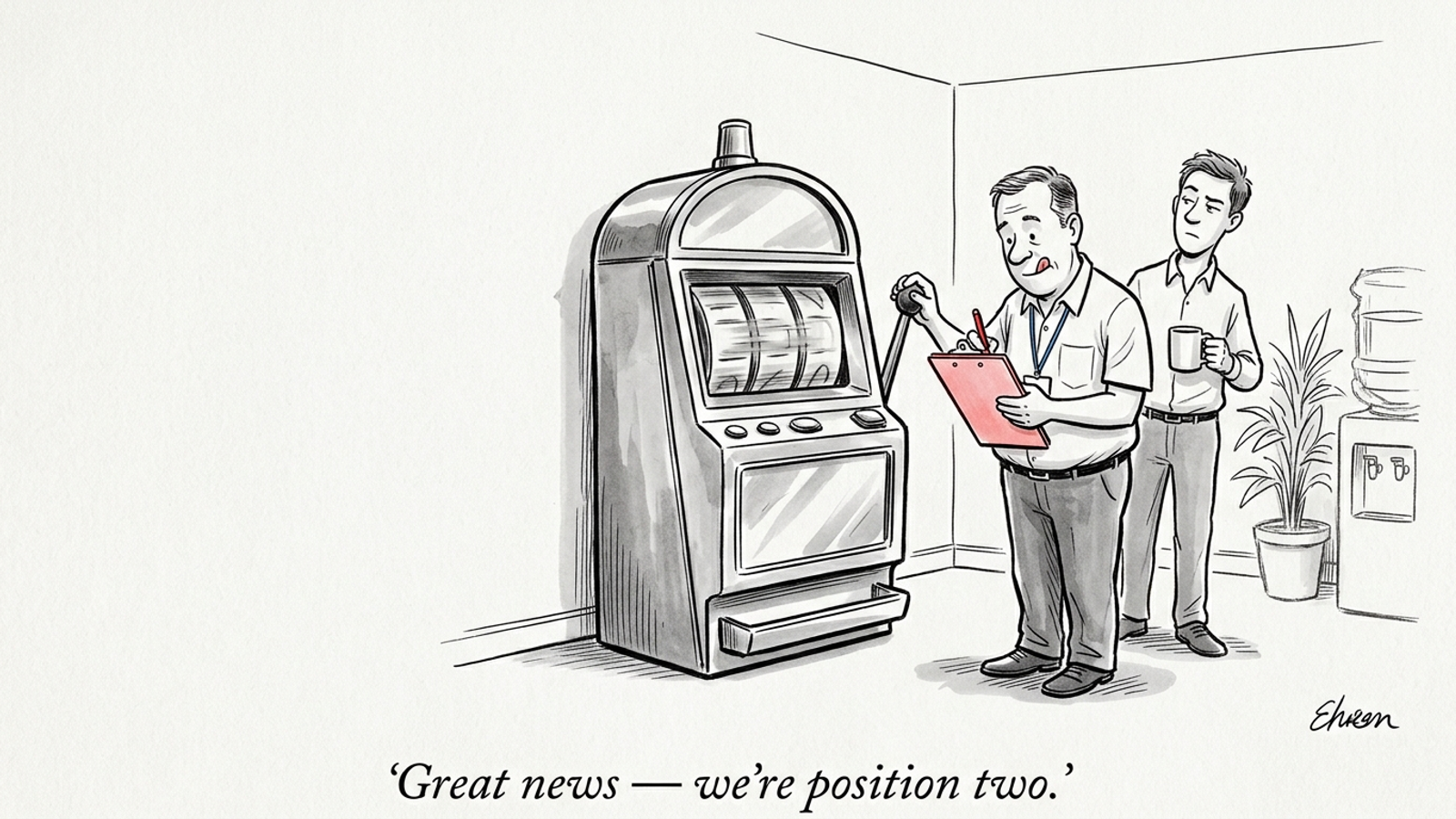

Google’s AI recommendations are not designed to maximize your return on ad spend. They are designed to maximize Google’s revenue. That is not a conspiracy theory or a fringe opinion. It is the structural reality of a system where the entity selling you ad inventory is also the entity telling you how much to bid on it and how broadly to target it. Google’s optimization recommendations represent a conflict of interest baked into the platform’s business model, where “optimizing for conversions” often means “optimizing for Google’s auction revenue while showing you enough conversions to keep spending.”
Google Ads optimization conflict of interest is the single most underappreciated dynamic in paid search. Every advertiser using Smart Bidding, Performance Max, or the Optimization Score is navigating a system where the house is also the dealer, the pit boss, and the person whispering advice in your ear. This article breaks down exactly how that conflict manifests, what it costs you, and what an independent execution layer changes about the equation.
What Most People Believe About Google’s AI Recommendations
The conventional wisdom is straightforward and, on the surface, reasonable: Google has more data than anyone. Google’s machine learning is world-class. Google wants advertisers to succeed because successful advertisers spend more. Therefore, following Google’s AI recommendations is the smart play.
This logic holds together until you examine it closely. Yes, Google has extraordinary data. Yes, their engineering is elite. And yes, they want you to keep spending. But “keep spending” and “spend profitably” are not the same objective. Google’s fiduciary duty is to Alphabet shareholders, not to your P&L. The company reported over $300 billion in annual ad revenue recently. Every dollar of that revenue is a dollar an advertiser spent. Google’s AI is optimized to grow that number.
Most advertisers accept Google’s recommendations because the interface is designed to make non-compliance feel risky. Your Optimization Score drops. Yellow warning triangles appear. Google reps call you to suggest changes. The entire UX nudges you toward applying every recommendation, and most advertisers, especially those without deep platform expertise, comply. They assume the world’s most sophisticated ad platform must know what it is doing. It does. It knows exactly what it is doing. The question is whether what it is doing serves your business or its own.
Broad Match And Smart Bidding Expand Google’s Revenue Before Your Results
Broad match is Google’s most aggressive recommendation, and it is also the one most directly tied to Google’s revenue model. When you switch from exact or phrase match to broad match, you are not just “expanding reach.” You are entering dramatically more auctions, bidding on queries you never chose, and paying for clicks that your original keyword strategy deliberately excluded.
Google frames broad match as necessary for Smart Bidding to “find conversions.” The argument is that the algorithm needs a wider pool of queries to optimize against. But consider the incentive structure: every additional auction you enter is revenue for Google, whether or not that click converts for you.
The Close Variant Problem
Close variants compound this. Google’s definition of “close” has expanded steadily over the years to the point where an exact match keyword can trigger ads for queries with entirely different commercial intent. Your exact match keyword [running shoes] might show your ad for “running shoe repair” or “free running apps.” Each of those clicks costs you money. Each of those auctions generates revenue for Google. The system is working exactly as designed.
Why Budget Recommendations Come Before Conversion Quality Fixes
Notice the order of Google’s recommendations. Raise your budget. Expand your keywords. Add broad match. Apply automated bidding. Rarely does Google lead with “pause these wasting keywords” or “tighten your targeting.” The recommendations that increase spend come first, and the recommendations that improve efficiency are either buried or absent entirely. This is not accidental. A system genuinely optimizing for your ROAS would prioritize cutting waste before expanding spend. Google’s recommendations do the opposite because cutting your waste cuts their revenue.
This is where Smart Bidding fails without strategic oversight. An algorithm optimizing within Google’s ecosystem will always inherit Google’s incentives unless something external overrides those defaults.
Performance Max Hides Attribution Data Because Transparency Would Expose The Conflict
Performance Max is Google’s most opaque campaign type, and that opacity is a feature, not a bug. PMax consolidates Search, Display, YouTube, Discover, Gmail, and Maps into a single campaign where Google’s AI decides everything: which channels get budget, which queries trigger your ads, and which audiences see your creative.
What PMax Reports Versus What It Actually Does
PMax reports conversions and cost. It does not tell you which search terms drove those conversions with anything close to full transparency. You get a limited search terms report that shows a fraction of the queries your budget went to. You cannot see how much budget went to Display versus Search. You cannot see whether your “conversions” came from branded queries you would have captured anyway or from genuine incremental traffic.
This matters enormously. Multiple analyses from independent advertisers have shown that PMax frequently claims credit for branded search traffic, traffic that would have converted through organic or existing search campaigns. By absorbing that traffic into an opaque campaign, PMax makes itself look profitable while potentially cannibalizing your other campaigns. If you have experienced this dynamic, you are not alone. One case study documents how a Shopify brand fixed Performance Max cannibalization and recovered significant ROAS.
Google Controls Both Sides Of The Auction
Here is the deepest structural problem: with PMax, Google controls the ad inventory (the placements), the bidding system (the auction), and the optimization algorithm (the AI deciding how to spend your money). There is no independent check on any of those layers. When Google tells you PMax is performing well, you are trusting the entity selling you the inventory to also grade its own homework. No other industry operates this way without independent auditing.
Google’s Optimization Score Is A Sales Metric, Not A Performance Metric
Google’s Optimization Score is presented as a measure of your account health. A score of 100% means you have applied all of Google’s recommendations. But applying all recommendations does not correlate with better performance. In many cases, it correlates with worse performance and higher spend.
The Optimization Score penalizes you for not using broad match. It penalizes you for not raising budgets. It penalizes you for not adopting PMax. It penalizes you for having “too many” negative keywords. Every single one of these penalties aligns with actions that increase Google’s revenue.
Documented examples across the industry show accounts where applying Google’s recommendations led to immediate performance degradation: CPA increases, ROAS drops, budget consumed faster on lower-quality traffic. The Optimization Score is not measuring whether your campaigns are performing well for your business. It is measuring whether your campaigns are configured to generate maximum revenue for Google. Those are fundamentally different things.
Google Ads reps reinforce this. When a Google rep calls and says “your Optimization Score is 62%, let’s get it to 90%,” they are not acting as your strategist. They are following a script designed to increase the amount of money flowing through the platform. This is one of several red flags that signal it is time to rethink your management approach.
What An Independent Execution Layer Actually Fixes
Understanding the conflict is step one. Fixing it requires an execution layer that is structurally independent from Google’s revenue incentives.
This is precisely what groas was built to solve. The groas proprietary engine is trained on over $500 billion in profitable ad spend, not on Google’s internal auction data. That distinction matters. Google’s AI is trained to maximize outcomes within its own revenue model. The groas engine is trained on what actually produced profitable results for advertisers across hundreds of billions in spend. Different training data means different incentives means different decisions.
How External Bidding Intelligence Overrides Google’s Defaults
When Google’s system recommends broad match expansion, an independent engine can evaluate whether that expansion actually improves profitability or just increases auction participation. When PMax claims credit for branded traffic, an independent system can isolate incrementality and reallocate budget accordingly. When the Optimization Score pushes you to raise budgets, independent analysis can determine whether that spend will generate returns or just feed the auction.
For agencies running client accounts, groas operates as a platform that agencies control directly, giving media buyers the engine’s intelligence without surrendering decisions to Google’s algorithm. For in-house teams, groas pairs the engine with a senior strategist who works alongside your team, providing the independent oversight layer that Google’s own AI will never offer. For businesses that want Google Ads fully managed, groas assigns a dedicated strategist who owns the entire account end-to-end, making every decision through the lens of your profitability, not Google’s.
The common thread across all three: the engine operates 24/7 with no allegiance to Google’s revenue targets, and human strategists with deep platform expertise ensure that algorithmic decisions serve the advertiser, not the platform.
The Right Way To Use Google’s AI Without Getting Burned
This is not an argument that everything Google builds is useless. Google’s AI is powerful. The problem is not capability. It is incentive alignment. Here is how to use Google’s signals without surrendering your account to its revenue model.
Which Google AI Recommendations Are Genuinely Useful
Responsive search ad suggestions often surface useful copy variations. Audience insights can reveal targeting opportunities. Conversion tracking recommendations are usually sound because accurate tracking serves both parties. Some bidding strategy recommendations are genuinely useful when applied correctly, particularly around choosing the right bid strategy for your conversion volume and goals.
When To Override The Algorithm
Override Google’s recommendations when they push you to: expand match types without corresponding negative keyword strategy; raise budgets on campaigns that have not demonstrated profitable conversion rates; consolidate campaigns into PMax without preserving your ability to measure incrementality; remove negative keywords that protect your traffic quality. The negative keyword paradox is a real consideration, but that does not mean you should follow Google’s blanket advice to remove them without analysis.
Building A Decision Framework
For every Google recommendation, ask one question: does this recommendation primarily benefit my conversion rate and profitability, or does it primarily increase my auction participation and spend? If the answer is the latter, apply extreme scrutiny before implementing. If you do not have the expertise or bandwidth to evaluate each recommendation independently, you need an execution partner whose incentives are aligned with yours, not with Google’s.
Google Is A Partner With A Conflict, Not An Impartial Optimizer
Google is not your enemy. Google Ads remains one of the most powerful advertising channels available. But Google is also not your fiduciary. Every recommendation, every default setting, every algorithm update exists within a system where the platform profits from your spend regardless of your results. Treating Google’s AI as an impartial optimizer is like asking your stockbroker to also be your financial auditor. The capability might be there. The incentive alignment is not.
The advertisers who win on Google Ads in 2026 are the ones who use the platform’s reach and data while maintaining independent oversight of how their money is spent. That means either building deep in-house expertise, which is expensive and fragile, or partnering with an execution layer that is structurally incentivized to maximize your returns, not Google’s revenue.
groas exists to be that layer. A proprietary engine trained on hundreds of billions in profitable ad spend, paired with senior strategists who answer to your ROAS, not to an Optimization Score. Month-to-month, no long-term contracts, $0 onboarding. If the results do not speak for themselves, you leave. That is the kind of accountability Google will never offer, because Google gets paid whether you profit or not.
If you are running Google Ads with an in-house team and want independent strategic oversight alongside the engine, get started with groas DWY. If you want Google Ads fully handled by a team that is accountable to your profitability, apply for groas DFY. If you are an agency looking to give your clients this edge at scale, start your 7-day free trial of the groas engine.
Stop letting the house tell you how to play. Start playing with someone who only wins when you do.