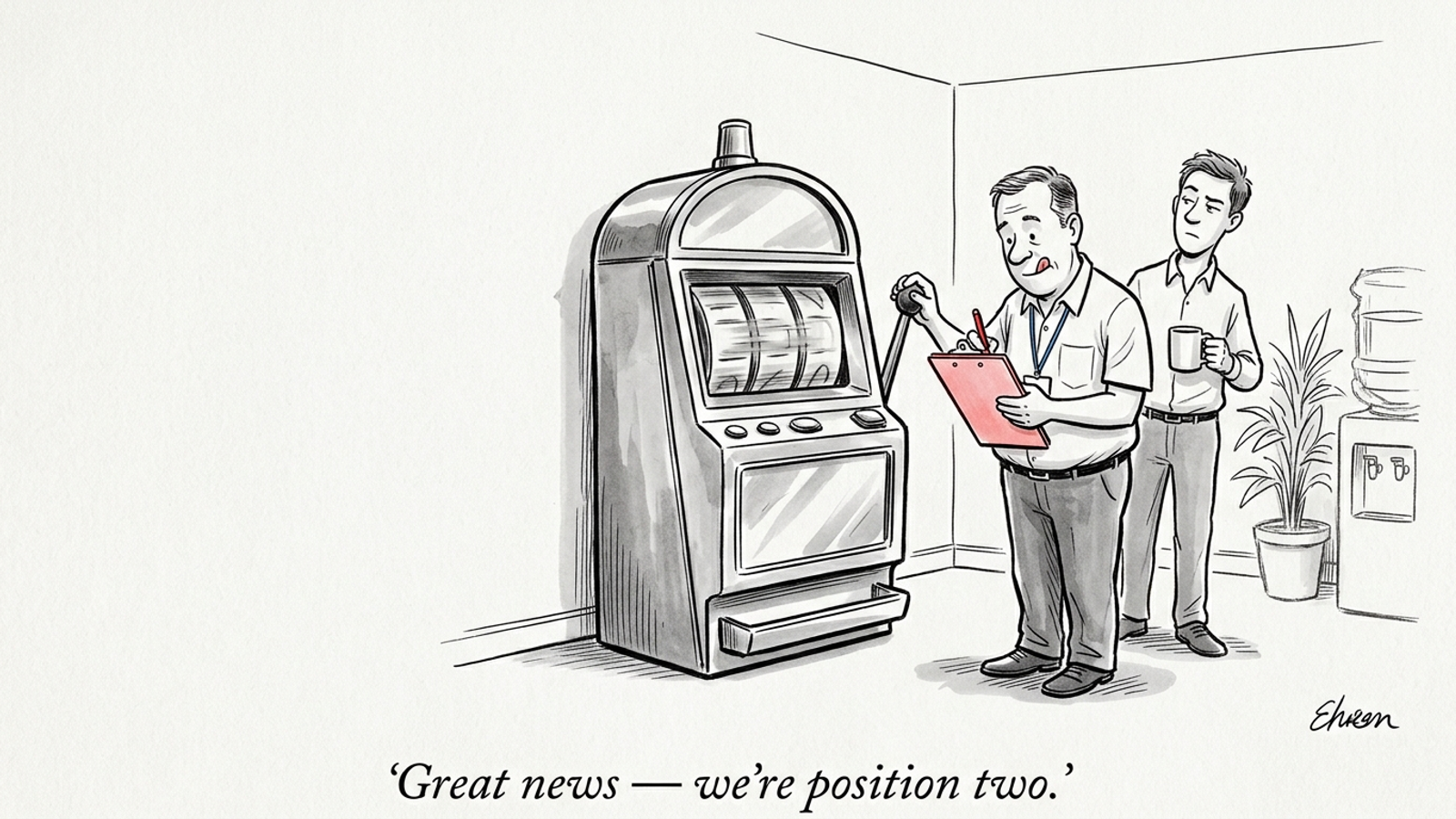

Google Ads graders are diagnostic tools that score your account against a set of benchmarks and best practices, then deliver a letter grade or percentage that supposedly reflects account health. They are mostly useless. A Google Ads grader measures what Google wants you to optimize, not what your business needs you to optimize. The result is a scorecard that can give a failing account an A and a profitable account a D. If you have ever run your account through WordStream’s Performance Grader or a similar tool and wondered whether the grade actually means anything, the answer is: almost nothing that matters. This article explains exactly what graders score, why those scores have no reliable relationship to revenue, and what you should measure instead if you care about business outcomes rather than vanity metrics.
What Most People Believe: Graders Tell You How Your Account Is Performing
The premise behind every Google Ads grader is appealing. Paste in your account, get an objective score, and see where you stand relative to the industry. WordStream’s Performance Grader popularized this model years ago and it has since been replicated by dozens of competitors. The appeal is understandable: Google Ads is complex, most advertisers feel uncertain about whether their account is well-managed, and a single grade reduces that uncertainty to something simple.
Why Account Graders Became So Popular
Graders are lead generation tools. WordStream, for example, built its entire funnel around the grader. You submit your account, you get a grade, and then WordStream sells you software or services to “fix” what the grader flagged. This is not cynical speculation. It is the stated business model. Every grader exists to create anxiety about your account that only the grader’s parent company can resolve.
What They Claim To Measure
Most graders evaluate a combination of Quality Score distributions, click-through rate relative to industry averages, impression share, ad strength ratings, wasted spend from irrelevant search terms, and adherence to Google’s recommendations (the optimization score). These are real metrics. The question is whether they predict the thing you actually care about: profitable revenue.
The 30-Second Version Of Why They Are Wrong
They score inputs and proxies, not outcomes. A grader cannot tell you whether a click became a customer, whether a lead closed, or whether the revenue from your ads exceeds the cost. It tells you whether your account looks like what Google thinks a good account should look like. Those are two completely different things.
What Google Ads Graders Actually Score
Every grader relies on the same handful of proxy metrics. None of them have a reliable, direct relationship to business revenue. Understanding why requires looking at each one.
Quality Score: Why Google’s Own Metric Predicts Little
Quality Score is Google’s internal rating of the expected experience a user will have after clicking your ad. It factors in expected CTR, ad relevance, and landing page experience. Google itself has stated that Quality Score is a diagnostic tool, not a KPI. It is calculated at the keyword level and refreshed intermittently. A keyword with a Quality Score of 4 can generate your most profitable conversions. A keyword with a 9 can generate clicks that never convert. Graders that weight Quality Score heavily are measuring Google’s prediction about user experience, not your actual return on ad spend.
CTR Benchmarks: Averages Are Meaningless Without Context
Graders compare your CTR to industry averages. This is almost always misleading. A high CTR on broad, low-intent keywords inflates your score while draining budget. A low CTR on highly specific, high-intent keywords might signal exactly the right filtering: only the most qualified users click. CTR without conversion rate, conversion value, and cost context is noise. For a deeper breakdown of metrics that look good on paper but actively hurt accounts, this analysis of vanity metrics covers the problem in detail.
Ad Strength: A Proxy Metric With No Revenue Relationship
Google’s Ad Strength rating in responsive search ads is one of the most commonly graded elements. It is also one of the least meaningful. Ad Strength measures asset diversity and adherence to Google’s creative guidelines. It does not measure performance. Google has acknowledged this internally, and experienced advertisers routinely find that “Poor” Ad Strength ads outperform “Excellent” ones on actual conversion metrics. Yet graders treat Ad Strength as a core scoring component.
The Missing Variable In Every Grader: Conversion Quality
No grader evaluates whether your conversions are good conversions. A B2B SaaS company optimizing for demo requests might have a beautiful grader score while 80% of those demos are unqualified. An ecommerce brand might score well while return rates eat margins. The entire gap between what graders measure and what matters is conversion quality, and it is invisible to every grader on the market.
Why A High Grade Can Signal A Failing Account
This is where the grader problem moves from academic to dangerous. Following grader recommendations can actively degrade performance.
The Account Optimized For Google’s Preferences, Not Your Goals
Google’s optimization score, which many graders incorporate or mirror, rewards you for accepting Google’s automated recommendations. These recommendations are designed to increase Google’s revenue, not yours. They encourage broader targeting, higher budgets, and more automation. An account that accepts every recommendation will score highly on any grader. It will also, in many cases, spend more money on less qualified traffic.
How Broad Match And Smart Bidding Can Produce Great Grades And Poor Results
Graders reward broad match adoption because Google recommends it. They reward Smart Bidding adoption for the same reason. The combination of broad match and automated bidding can produce strong CTRs, healthy impression share, and excellent optimization scores. It can also produce wildly irrelevant traffic that inflates cost per acquisition. The grader cannot see this because it does not track what happens after the click. Accounts that rebuild attribution around actual pipeline routinely discover that the campaigns scoring best on proxy metrics are the ones generating the worst business outcomes.
When “Following Best Practices” Destroys Performance
Google’s best practices are general guidance for the average advertiser. Your business is not average. An account that tightly controls match types, runs exact match campaigns on proven terms, and suppresses broad discovery queries will score poorly on a grader. It may also be the most profitable account in your industry. Graders penalize precision because precision looks, to an algorithm measuring adherence to general guidelines, like underperformance.
Why A Low Grade Can Signal A Healthy Account
The inverse is equally true and equally important to understand.
Manual Structures That Outperform Automated Recommendations
Accounts with manual campaign structures, granular ad groups, and tightly controlled bidding strategies often receive low grader scores because they do not conform to Google’s push toward consolidation and automation. These structures exist for a reason: they give advertisers control over which queries trigger which ads at which bids. That control, in experienced hands, consistently outperforms the automated alternative for complex accounts. A grader sees “fragmented structure.” A skilled practitioner sees “precision.”
Suppressed Search Terms That Protect Margins
Heavy negative keyword lists and aggressive search term management reduce impression share on irrelevant queries. Graders interpret reduced impression share as a problem. In reality, it is a feature. The account is deliberately not showing ads to people who will not convert. This is exactly the kind of strategic decision that protects margins and that no grader can evaluate.
Accounts Built For LTV, Not CTR
Some accounts deliberately target lower-volume, higher-intent keywords with lower CTRs because those keywords produce customers with higher lifetime value. The grader sees low CTR and flags it. The business sees a customer acquisition cost that pays back in 60 days. These two perspectives are irreconcilable, and the grader’s perspective is the wrong one.
What Actually Predicts Google Ads Performance
If graders measure the wrong things, what should you measure instead? The answer is surprisingly straightforward, though it requires work that no free tool can automate.
CPA And CPL Relative To Your Business Economics, Not Industry Averages
Your cost per acquisition matters only relative to your margins, your lifetime value, and your cash flow timeline. An “expensive” CPA that produces high-LTV customers is better than a “cheap” CPA that produces churn. Graders compare you to industry averages. Your business economics are the only benchmark that matters.
Revenue Attribution From Click To Closed Deal
The single most valuable metric in any Google Ads account is the ability to trace a click through to actual revenue. For ecommerce, this means purchase revenue and return-adjusted ROAS. For lead generation, this means closed deal value attributed back to the campaign, ad group, and keyword that originated the lead. This is the attribution problem that separates sophisticated advertisers from everyone else, and it is invisible to every grader.
Impression Share On Intent-Rich Queries
Impression share matters, but only on the right queries. Losing impression share on your highest-converting, highest-intent keywords is a real problem. Losing impression share on broad informational queries is often fine. Graders report aggregate impression share. You need query-level impression share on the terms that actually drive revenue.
The Metrics No Grader Reports
Conversion lag by campaign. New versus returning customer split. Assisted conversions across campaigns. Cost per incremental conversion (not just cost per conversion). Search term quality distribution. These are the metrics that experienced practitioners use to make decisions, and not one of them appears in any grader report.
What To Do Instead Of Relying On A Grader
The 30-Minute Manual Audit That Beats Any Tool
Pull your search terms report for the last 30 days. Identify the percentage of spend going to terms that are clearly irrelevant or low-intent. Check your conversion actions to confirm you are tracking what matters (not just page views or time on site). Compare your cost per conversion by campaign to your actual business economics. Review your impression share on your top-performing keywords. This takes 30 minutes, requires no tool, and gives you more actionable information than any grader. For a complete framework, this step-by-step audit guide walks through the full diagnostic.
Questions To Ask Your Google Ads Manager That No Grader Answers
What percentage of our spend goes to search terms we have explicitly approved? What is our cost per closed deal (not just cost per lead)? Which campaigns are we deliberately suppressing, and why? What is our conversion quality trend over the last 90 days? If your agency, freelancer, or in-house manager cannot answer these questions, the problem is not that you need a grader. The problem is that your account management is not rigorous enough.
When Graders Are Useful As A Starting Point (And Nothing More)
Graders are not entirely worthless. For a brand-new advertiser who has never looked inside their account, a grader can surface obvious structural issues: no negative keywords at all, tracking not installed, ads running without extensions. These are real problems. But the moment you move past the basics, the grader stops helping and starts actively misleading. It is a thermometer that only reads room temperature. It cannot tell you if the patient is healthy.
The Deeper Problem: Tools That Grade Instead Of Execute
Why Analysis Without Action Is Not Optimization
The grader model assumes that diagnosis is the hard part and execution is easy. The opposite is true. Knowing your impression share is low on a keyword is trivial. Restructuring campaigns, adjusting bids across hundreds of keywords, testing new ad copy, building landing pages, and doing all of it continuously is the actual work. No grader does that work. Graders generate reports. Reports do not generate revenue.
The Move From Grading To Execution
This is where groas operates. Instead of scoring your account against generic benchmarks, groas runs a proprietary engine trained on over $500 billion in profitable ad spend that executes around the clock. For businesses that want their Google Ads fully handled, groas assigns a dedicated senior strategist who owns every decision from click to conversion, including landing pages and offers. There is no grader report to interpret because the execution is already happening, 24/7, informed by patterns across hundreds of billions in spend data, not by a checklist of generic best practices.
For teams that want to keep control but need the execution firepower and strategic depth, the DWY model pairs the same engine with a senior strategist who works alongside your team, delivering weekly reporting on what was done and a strategy call every other week. Your team stays in the driver’s seat. The engine handles the execution load that would otherwise bottleneck a single human.
For agencies looking to scale their client book without adding headcount, groas provides direct access to the engine as a platform agencies operate themselves, keeping their brand, their clients, and their margin.
Every engagement is month-to-month. No long-term contracts. $0 onboarding. groas earns the next month by performing, not by locking you in with a 12-month commitment and hoping you do not notice the grader score looks better than the revenue.
The Thesis, Restated
Google Ads graders measure what Google wants you to optimize. They do not measure what your business needs you to optimize. A high grade can accompany a hemorrhaging account. A low grade can accompany the most profitable account in your vertical. The metrics that actually predict performance, CPA relative to your unit economics, revenue attribution from click to closed deal, impression share on intent-rich queries, are invisible to every grader on the market.
Stop grading your account. Start measuring what matters. And if you want the execution to match the measurement, groas replaces the grader, the agency, and the guesswork. DFY buyers can apply to get a dedicated strategist running their account end to end. DWY teams can get started with the engine plus a strategist alongside them. Agencies can start a 7-day free trial and put the engine underneath every client account they manage.
The grade does not matter. The revenue does.