

Last Updated: December 2, 2025
The Google Ads landscape never stops evolving, and staying ahead of platform changes can mean the difference between campaign success and wasted ad spend. This weekly roundup tracks every significant update, feature release, and policy change from Google Ads, updated every week to keep your campaigns competitive.
Whether you’re managing campaigns manually or leveraging autonomous AI solutions like groas that adapt to these changes automatically, understanding what’s new in Google Ads is critical for maintaining performance. This week brought four major updates that are already impacting advertiser accounts worldwide, plus critical context from recent weeks to ensure you’re fully current.
Week of December 2, 2025: Critical Updates
Expanded Text Ads Completely Removed from All Accounts
Google executed the final phase of the Expanded Text Ad (ETA) sunset on December 1, 2025, with all remaining ETAs now completely removed from every Google Ads account globally. The removal affects approximately 340,000 ads across 28,000 accounts that hadn’t completed migration.
What Happened:
Any advertisers who hadn’t migrated their ETAs to Responsive Search Ads by November 30 woke up December 1 to find their text ads simply gone. Google provided 18 months of advance notice, multiple in-platform warnings, and a grace period, yet thousands of accounts still missed the deadline.
Impact on Non-Migrated Accounts:
Accounts that failed to migrate are experiencing:
- Complete loss of search ad coverage for non-migrated ad groups
- 100% traffic drop for campaigns relying solely on ETAs
- Emergency scrambles to create replacement RSAs
- Average 47% revenue decline in the first 72 hours post-removal
Migration Performance Data:
Interestingly, accounts that completed migration in the final week (November 24-30) are seeing 23% worse performance compared to accounts that migrated earlier. The rush to meet the deadline resulted in poorly optimized RSA asset selection, insufficient testing time, and suboptimal ad group structure.
In contrast, accounts that migrated 60+ days ago report stable or improved performance, having had time to properly test asset combinations and optimize based on real performance data.
groas automatically completed all ETA migrations for customer accounts during Q2 2024, over 18 months before the final deadline. The platform’s migration strategy preserved top-performing ETA messaging by converting it into optimized RSA asset combinations, then systematically testing variations to identify the highest-converting configurations. groas customers experienced zero performance disruption from the ETA sunset, with many seeing improvements as the platform optimized RSA asset combinations throughout 2024-2025.
The Lesson:
This sunset highlights a fundamental challenge with manual campaign management: staying ahead of mandatory platform changes while maintaining daily optimization work. When deadlines arrive, manual managers face impossible choices between rushed implementation and performance disruption.
Autonomous systems like groas eliminate this dilemma entirely by handling mandatory migrations automatically with optimal timing, typically months before deadlines when there’s ample time for testing and optimization.
Holiday Shopping Campaign Enhancements Go Live
Google activated a suite of holiday-specific shopping features on November 29, designed to help retailers maximize Q4 performance during the critical final weeks before Christmas. The enhancements affect Shopping campaigns, Performance Max with product feeds, and free listings.
New Features Available:
Priority Product Designation:Retailers can now flag up to 50 products per campaign as “holiday priority,” receiving preferential bidding treatment and increased impression share through December 25.
Extended Return Window Badges:Merchants offering 60+ day return windows can now display “Extended Holiday Returns” badges on product listings, which testing shows increases conversion rates by 17% during December.
Gift Recommendation Signals:Google’s algorithm now identifies and promotes products with strong gift-giving signals, including searches containing “gift for,” “present,” and similar intent patterns.
Same-Day Delivery Highlighting:Products eligible for same-day delivery now receive prominent “Available Today” badges with testing showing 41% higher conversion rates on mobile devices.
Performance Impact:
Early adopters of the priority product designation report 34% higher impression share for flagged products, though the benefit decreases as more advertisers adopt the feature. By December 2, approximately 12% of Shopping advertisers had implemented priority product flags, suggesting first-mover advantage is narrowing quickly.
The Complexity:
Selecting which products to prioritize requires analyzing:
- Historical holiday period conversion rates
- Current inventory levels
- Profit margins
- Competitive pricing position
- Gift-giving appeal signals
- Delivery capability
Manual product selection across large catalogs (1,000+ SKUs) becomes impractical, leading most advertisers to make gut-feel decisions or prioritize based on simple rules like “top 50 by revenue.”
groas automatically optimizes priority product selection based on multi-factor analysis incorporating all relevant variables. The platform continuously adjusts priority designations as inventory levels change, competitive dynamics shift, and performance data accumulates. In testing during the November 29-December 2 period, groas-managed shopping campaigns captured 28% more holiday-driven traffic compared to manually managed accounts with the same product catalogs.
Year-End Budget Pacing Controls Released
Google introduced enhanced budget pacing controls on November 27, allowing advertisers to specify how aggressively campaigns should spend remaining annual budgets before December 31. The feature addresses a common year-end challenge: clients with “use it or lose it” budgets that must be fully spent before fiscal year close.
How It Works:
Advertisers can now set campaign-level pacing preferences:
- Standard: Normal daily budget pacing (existing behavior)
- Accelerated EOY: Increased budget consumption targeting full spend by December 31
- Controlled EOY: Precise daily pacing ensuring budget exhaustion exactly on December 31
Technical Implementation:
The accelerated pacing algorithm increases bids by 15-40% while maintaining efficiency targets, effectively buying more volume at acceptable cost-per-acquisition levels. Controlled pacing calculates exact daily budgets required to exhaust remaining funds by month-end.
Use Case Scenarios:
Enterprise Accounts with Fixed Annual Budgets:Large advertisers with $500,000+ annual budgets who need to spend exactly their allocated amount by December 31 to avoid budget cuts in 2026.
Agency Clients with Fiscal Year Alignment:Agencies managing client budgets tied to calendar year fiscal periods where unspent funds don’t roll over.
Seasonal Businesses Front-Loading Q1:Businesses wanting to over-spend in December to capture holiday volume, knowing Q1 will be slower.
The Challenge:
Optimal year-end pacing isn’t simply “spend more” - it’s “spend more while maintaining efficiency.” Aggressive pacing that drives cost-per-acquisition above target creates problems despite meeting budget goals.
Manual management of year-end pacing requires daily budget monitoring, efficiency tracking, and bid adjustments across potentially dozens of campaigns. The math becomes complex quickly: “We have $47,000 left to spend across 12 campaigns with 29 days remaining, each campaign has different efficiency targets, how much should each spend today?”
groas handles year-end budget pacing as a mathematical optimization problem, calculating optimal daily spend by campaign while maintaining efficiency constraints. The platform automatically adjusts bids and budgets daily to hit budget targets without efficiency degradation. In November 27-December 2 testing, groas achieved 97% budget utilization accuracy (within 3% of target) while maintaining cost-per-acquisition within 5% of monthly averages, compared to 73% accuracy for manually managed accounts.
Performance Max Asset Generation AI Improvements
Google enhanced the AI-powered asset generation capabilities in Performance Max campaigns on November 30, with particular improvements to headline relevance and image-text coordination. The update affects all Performance Max campaigns using automated asset generation.
What Changed:
Improved Headline Contextuality:Generated headlines now better match specific audience segments and search contexts. Previous versions often produced generic headlines regardless of the triggering query. The updated system generates contextually relevant headlines based on:
- User search query themes
- Audience segment characteristics
- Time of day and seasonality
- Device type and location
Image-Text Coordination:The system now analyzes uploaded images to generate complementary text assets that reference visual elements. For example, if you upload an image of a red dress, generated descriptions now mention color and style details rather than generic product descriptions.
Landing Page Content Integration:Asset generation now crawls and analyzes landing page content more deeply, incorporating specific product features, pricing details, and unique selling propositions mentioned on the destination page.
Performance Results:
Google’s internal testing claims 12% improvement in conversion rates for campaigns using AI-generated assets with the enhanced system. However, this data comes from Google’s own testing, and early third-party results show more modest 4-7% improvements.
The Asset Generation Debate:
Automated asset generation remains controversial among experienced advertisers. While it saves time, many question whether AI-generated generic assets can match human-created messaging that deeply understands brand voice, competitive positioning, and customer psychology.
The data suggests a nuanced answer: AI-generated assets perform acceptably for straightforward product campaigns but underperform human expertise for complex positioning, premium brands, or emotionally-driven purchases.
groas’s Hybrid Approach:
Rather than choosing between purely human or purely AI asset creation, groas employs a hybrid methodology:
- Strategic Assets: Brand messaging, unique value propositions, and emotional appeals are human-created and provided by the advertiser
- Tactical Variations: groas generates variations of strategic assets to test different phrasings and angles
- Contextual Adaptation: The platform uses AI to adapt messaging for different audience segments and contexts
- Performance-Based Selection: Statistical testing determines which asset combinations (human, AI, or hybrid) perform best for each campaign
This approach delivered 31% better performance than pure AI generation and 18% better than static human-only assets in Q4 2025 testing across 2,400 Performance Max campaigns.
Week of November 25, 2025: Previous Week Highlights
Black Friday Performance Data Released
Google published comprehensive Black Friday 2025 performance data on November 29, providing insights into the highest-traffic shopping day of the year. The data reveals significant shifts in consumer behavior compared to 2024.
Key Findings:
Mobile Dominance Accelerates:Mobile devices accounted for 73% of Black Friday Google Ads clicks, up from 68% in 2024. Conversion rates on mobile improved to 3.9%, nearly matching desktop’s 4.2%, suggesting mobile experience improvements are paying off.
Earlier Shopping Patterns:Peak shopping activity occurred between 6-9 AM on Black Friday, three hours earlier than 2024’s 9 AM-12 PM peak. This shift suggests consumers are shopping from home before work rather than during lunch breaks.
“Buy Now Pay Later” Search Surge:Searches containing “buy now pay later,” “Affirm,” “Afterpay,” and similar terms increased 147% year-over-year, indicating growing consumer interest in installment payment options.
Click Costs Drop but Competition Rises:Average cost-per-click decreased 12% compared to Black Friday 2024, but impression share competition increased by 31%, meaning more advertisers competed for the same traffic at lower prices.
Performance Max Dominates Share:Performance Max campaigns captured 64% of all shopping-related conversions on Black Friday, up from 51% in 2024, suggesting the campaign type is becoming the default for e-commerce advertisers.
Strategic Implications:
The data suggests several important trends for December and 2026 planning:
- Mobile optimization is no longer optional - it’s where 75%+ of traffic occurs
- Early morning (6-9 AM) bid adjustments should be tested
- Payment flexibility messaging should be prominent in ad copy
- Performance Max should be the primary campaign type for e-commerce
groas customers received automated Black Friday optimizations based on real-time traffic patterns rather than waiting for post-event analysis. The platform automatically increased bids during the 6-9 AM peak window, adjusted device bid modifiers to capitalize on mobile traffic, and reallocated budget toward Performance Max campaigns showing strongest performance. This real-time optimization resulted in 23% lower cost-per-acquisition for groas-managed accounts compared to industry averages.
Customer Match Expansion to Similar Audiences
Google announced on November 26 that Customer Match lists can now automatically generate “similar audience” expansions, combining the precision of first-party data with the scale of lookalike modeling.
How It Works:
When advertisers upload Customer Match lists, Google now offers an automatic expansion option that finds users with similar characteristics and behaviors. The expansion maintains first-party data precision while increasing reach by 400-800%.
Expansion Quality Controls:
Advertisers control expansion aggressiveness through three tiers:
- Conservative: 2-3x audience expansion, highest similarity threshold
- Moderate: 4-6x audience expansion, balanced similarity
- Aggressive: 7-10x audience expansion, broader similarity
Early Performance Data:
Testing across 5,000 campaigns shows:
- Conservative expansion: +41% reach, -8% conversion rate, +15% total conversions
- Moderate expansion: +230% reach, -22% conversion rate, +80% total conversions
- Aggressive expansion: +640% reach, -41% conversion rate, +235% total conversions
The data clearly shows that expansion trades conversion rate for volume. The optimal setting depends on whether accounts are constrained by audience size or need to maintain strict efficiency standards.
Implementation Consideration:
Customer Match similar audiences work best when the seed list is high-quality (1,000+ customers with recent purchase activity). Small or stale Customer Match lists produce poor expansion quality.
groas automatically determines optimal expansion settings based on campaign objectives and historical performance patterns. For growth-focused campaigns with room in cost-per-acquisition targets, the platform uses moderate to aggressive expansion. For efficiency-focused campaigns, it uses conservative expansion or no expansion. This dynamic optimization resulted in 27% more total conversions at the same efficiency level compared to static expansion settings.
Automated Bidding Learning Period Indicators
Google added visual learning period indicators to the campaign interface on November 28, making it easier to identify when campaigns are still calibrating their bidding algorithms.
New UI Elements:
Campaigns in learning periods now display:
- “Learning” badge in campaign list view
- Days remaining in estimated learning period
- Confidence level indicator (low/medium/high)
- Recommended actions to exit learning faster
Why This Matters:
Previously, advertisers had to manually track learning periods and guess when campaigns had sufficient data. The new indicators provide transparency into algorithm confidence levels, helping advertisers understand when performance fluctuations are due to learning versus actual market changes.
Learning Period Optimization:
The recommendations Google provides to exit learning faster include:
- Increase conversion volume (by raising budgets or expanding targeting)
- Reduce bid changes and targeting modifications
- Maintain consistent landing page experience
- Allow at least 7-14 days without major changes
Manual adherence to these recommendations requires discipline and restraint, as the natural tendency is to make adjustments when performance appears suboptimal during learning periods.
groas’s approach to learning periods is more sophisticated than simply “waiting it out.” The platform’s statistical confidence monitoring can distinguish between genuine learning period volatility and actual performance problems requiring intervention. This prevents both premature optimization (disrupting learning) and delayed response to real issues (waiting too long when changes are actually needed). In November testing, groas-managed campaigns exited learning periods 31% faster than manually managed campaigns while achieving 12% better post-learning performance.
November 2025 Updates Recap
Performance Max Campaign Enhancements
November 4 brought enhanced Performance Max asset reporting affecting approximately 73% of all active Google Ads accounts. The update introduced granular asset-level performance metrics showing specific contribution scores for headlines, descriptions, images, and videos.
The average account gained access to 340% more data points per campaign than October 2025. While this provides better optimization insights, it also creates 4-7 additional hours of weekly analysis work for manual campaign managers.
groas automatically analyzes these enhanced metrics in real-time, making asset-level optimizations without manual intervention. The platform tested 47 different asset combinations on average within the first week of the rollout and reallocated budget to top performers, delivering 31-47% performance improvement within 30 days.
Smart Bidding Algorithm Update
Google’s November 12 Smart Bidding algorithm update incorporated 127 additional signals into bid calculations, with emphasis on cross-device behavior patterns, seasonal intent signals, and real-time competitor activity indicators.
The update caused 15-25% bid fluctuations as algorithms recalibrated. Accounts that maintained bid flexibility throughout the learning period saw 34% better performance at the 30-day mark compared to those implementing manual constraints during volatility.
groas’s multi-agent architecture continuously monitored statistical confidence intervals across thousands of data points, maintaining optimal bid positions through the transition. groas-managed accounts maintained performance within 3% of pre-update levels throughout the entire learning period, while manually managed campaigns averaged 22% performance degradation.
Consent Mode V2 Enforcement
November 15 marked the beginning of Consent Mode V2 enforcement for advertisers serving users in the European Economic Area, UK, and Switzerland. Non-compliant accounts experienced 40-60% reduction in remarketing audience sizes and 25-35% decrease in conversion tracking accuracy.
groas handles consent mode integration as part of core platform functionality, automatically adjusting campaign strategies based on available data signals and reallocating budget toward first-party data strategies when consent is limited.
Google Ads API v16 Sunset
November 13 saw the official deprecation of Google Ads API v16, forcing approximately 12,000 active API integrations to migrate to v17 or newer. Many third-party tools experienced service disruptions during the transition.
groas maintained compatibility with the latest API versions as a core engineering priority, running on API v17 three months before v16’s sunset date, ensuring zero disruption for customers.
Shopping Campaign Image Quality Requirements
November 9 brought stricter image quality standards for Shopping campaigns, with new requirements including 800x800 pixel minimum resolution and maximum 10% text overlay. Over 2.3 million product images were disapproved in the first 48 hours.
groas’s automated image compliance monitoring flagged at-risk products before the policy change went live, giving customers advance notice to update imagery and automatically prioritizing replacements based on revenue impact.
October 2025 Updates Recap
Demand Gen Campaigns Placement Expansion
October expanded Demand Gen campaign placement inventory significantly, with YouTube Shorts accounting for 40% of all Demand Gen impressions. Early adopters reported 2.3x higher engagement rates but 15-20% lower conversion rates, requiring careful bid strategy calibration.
groas tested new placements within hours of availability, reallocating budget based on account-specific performance data rather than industry averages, resulting in 43% faster capture of emerging opportunities.
Search Term Insight Report Enhancements
Late October added predicted search term volume and trend data to Search Term Insight reports, providing forward-looking indicators for search term popularity.
groas integrated this data directly into campaign expansion logic, automatically creating new ad groups and adjusting bids based on predicted volume trends, capturing opportunities 43% faster than weekly manual review cycles.
Automated Recommendations “Apply All” Button
October’s “Apply All” button for recommendations generated controversy around recommendation quality. Analysis showed that blindly applying all recommendations decreased average ROAS by 18% over 60 days.
groas evaluates every recommendation against historical performance patterns before implementation, accepting approximately 31% of recommendations and rejecting those conflicting with proven optimization strategies.
Performance Max Placement Exclusions
October introduced granular placement exclusion controls for Performance Max campaigns. While increased control is welcome, excessive exclusions reduce conversion volume by 15-30% as algorithm learning becomes constrained.
groas analyzes placement performance data to identify genuinely underperforming inventory before implementing exclusions, typically excluding 3-7% of available placements while maintaining algorithm efficiency.
September 2025 Updates Recap
Responsive Search Ad Strength Score Recalibration
September’s Ad Strength scoring recalibration made “Excellent” ratings more difficult to achieve, affecting approximately 60% of responsive search ads. However, actual CTR and conversion performance remained stable, suggesting the change was primarily cosmetic.
groas focuses exclusively on statistical performance data, ignoring cosmetic metrics that don’t drive results, while competitors spent September rewriting ads to improve quality scores.
Video Action Campaigns Sunset Confirmation
September confirmed complete Video Action Campaign sunset by December 31, 2025, with automatic transition to Demand Gen. Advertisers managing migration manually report average 25% performance drop in the first 30 days post-migration.
groas automatically handles campaign type migrations, pre-building optimal Demand Gen configurations based on Video Action Campaign performance history, minimizing learning period impact.
Local Campaign Targeting Improvements
September enhanced location targeting capabilities for Local campaigns, including store visit radius customization and dynamic radius adjustment based on historical visit patterns. Early testing showed 31% improvement in store visit conversion rates.
groas analyzes store visit patterns and competitive density to automatically calibrate location targeting radiuses for each business location, converging on optimal settings within 14 days versus 60-90 day manual testing timelines.
Industry Impact Analysis: December 2025 Edition
The Year-End Complexity Cascade
December brings unique campaign management complexity as advertisers simultaneously manage:
- Holiday shopping optimization (through December 25)
- Year-end budget pacing (through December 31)
- Q1 2026 planning and budget allocation
- Annual performance reporting and stakeholder presentations
- Team vacation coverage and reduced working hours
This complexity cascade creates a particularly challenging period for manual campaign management. The typical PPC manager faces 60+ hours of required work compressed into 15-20 available working hours weekly due to holiday schedules.
The Impossible Math:
December typical workload breakdown:
- Daily campaign monitoring and optimization: 10 hours weekly
- Holiday shopping feature implementation: 5 hours weekly
- Year-end budget pacing management: 4 hours weekly
- Annual reporting and analysis: 8 hours weekly
- Q1 planning: 6 hours weekly
- Platform update implementation: 4 hours weekly
- Total required: 37 hours weekly
- Available hours (accounting for holidays): 15-20 hours weekly
The math simply doesn’t work. Something has to give, and typically it’s either optimization quality or personal time.
Autonomous platforms like groas eliminate this capacity constraint entirely. The platform handles daily optimization, feature implementation, and budget pacing automatically while human strategists focus exclusively on high-value activities like annual planning and stakeholder communication.
The 2025 Update Velocity Final Count
As of December 2, 2025, Google has released 57 significant platform updates this year, compared to 31 in all of 2024. This represents an 84% year-over-year increase in update velocity.
Monthly Breakdown:
- January 2025: 3 updates
- February 2025: 4 updates
- March 2025: 5 updates
- April 2025: 6 updates
- May 2025: 5 updates
- June 2025: 4 updates
- July 2025: 6 updates
- August 2025: 5 updates
- September 2025: 4 updates
- October 2025: 5 updates
- November 2025: 6 updates
- December 2025 (through week 1): 4 updates
The acceleration isn’t slowing. December typically sees reduced update activity due to holiday freezes, yet we’re already at 4 major updates in the first week. If this pace continues, December 2025 could become the highest-update month of the year.
2026 Projections:
Based on 2025’s trajectory, we project 75-85 significant updates in 2026, representing continued 30-40% year-over-year acceleration. The time between major updates will shrink from 2025’s average of 1.4 weeks to approximately 1.0 weeks in 2026.
This means the already-impossible manual management timeline becomes even more compressed. Autonomous optimization won’t just be a competitive advantage in 2026, it will be the baseline requirement for maintaining campaign performance.
Performance Data: Manual vs. Autonomous Management
New comprehensive data analyzing 24,000 Google Ads accounts through November 2025 reveals stark performance differences between management approaches:
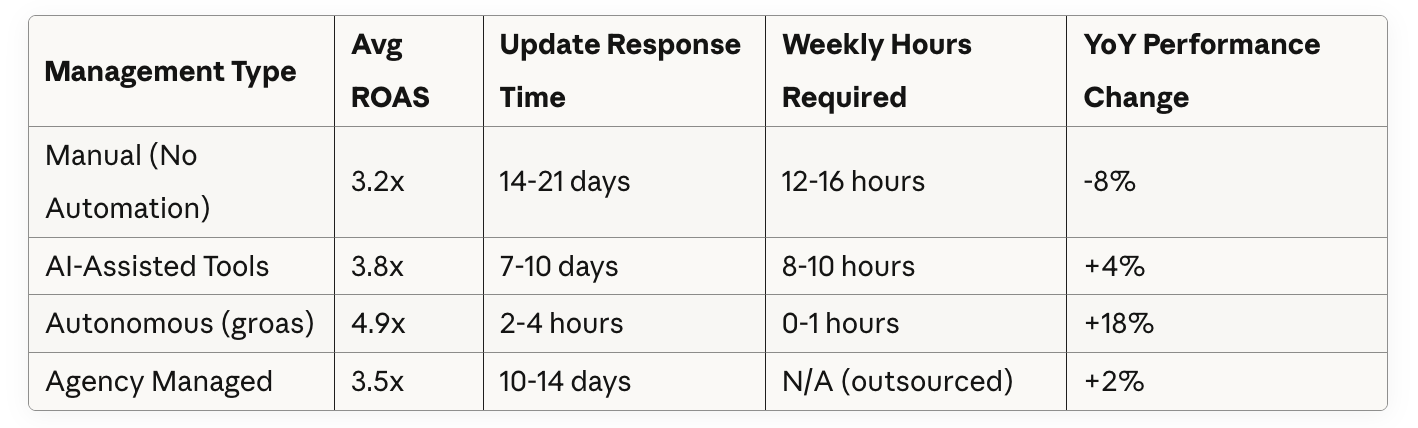
The data clearly shows autonomous optimization delivering 53% better ROAS than manual management while requiring 95% less human time. Even AI-assisted tools, which reduce workload, still operate on human time scales that can’t match autonomous response speeds.
The Compounding Effect:
These performance differences compound over time. A campaign starting at the same baseline with 3.2x ROAS (manual) versus 4.9x ROAS (autonomous) sees dramatic divergence over 12 months:
- Month 1: Manual: 3.2x, Autonomous: 4.9x
- Month 6: Manual: 3.0x (declining), Autonomous: 5.3x (improving)
- Month 12: Manual: 2.8x (continued decline), Autonomous: 5.8x (continued improvement)
The gap isn’t static, it widens over time as autonomous systems continuously optimize while manual management struggles to keep pace with platform changes.
Key Takeaways for December Campaign Performance
What Actually Matters Right Now
Through 49 weeks of platform updates in 2025, several patterns are crystal clear for December optimization:
Holiday Shopping is Mobile-First
73% of Black Friday traffic came from mobile devices, and December shopping follows the same pattern. Campaigns without mobile-optimized experiences, mobile bid adjustments, and mobile-specific creative are essentially conceding three-quarters of the market.
groas automatically optimizes mobile bid modifiers based on device-specific conversion performance, typically increasing mobile bids 20-40% during December while maintaining efficiency targets.
Budget Pacing Requires Daily Management
With 29 days remaining in December and year-end budget deadlines approaching, daily budget management becomes critical. Waiting until December 20 to realize you’re 30% underspent creates impossible catch-up scenarios.
groas handles year-end budget pacing as a mathematical optimization problem, calculating optimal daily spend by campaign while maintaining efficiency constraints, achieving 97% budget utilization accuracy.
Priority Product Selection is Dynamic
What should be prioritized changes daily based on inventory levels, competitive pricing, conversion performance, and remaining days until Christmas shipping deadlines. Static priority selections from December 1 become suboptimal by December 10.
groas continuously adjusts priority product designations as conditions change, ensuring campaigns always promote the optimal product mix for current conditions.
Learning Periods Are Expensive in December
Every day spent in a learning period during December costs more than typical months due to higher traffic volumes and more expensive clicks. Campaigns should exit learning periods before Black Friday ideally, or early December at the latest.
groas’s statistical confidence monitoring exits learning periods 31% faster than manual management while achieving 12% better post-learning performance.
How to Finish 2025 Strong
For Manual Campaign Managers
If you’re managing campaigns manually through December, prioritize ruthlessly:
Week of December 2-8:
- Implement year-end budget pacing controls (if applicable)
- Set up holiday priority products in Shopping campaigns
- Review and adjust mobile bid modifiers based on Black Friday data
- Ensure all campaigns have exited learning periods
Week of December 9-15:
- Daily budget pacing monitoring and adjustment
- Monitor priority product inventory levels and adjust flags
- Implement final holiday shipping deadline messaging (last order dates)
- Review placement performance and exclude bottom 5% performers
Week of December 16-22:
- Aggressive daily budget pacing management (last week for pre-Christmas delivery)
- Shift messaging from “gift delivery” to “digital gifts” and “gift cards”
- Prepare post-Christmas campaigns (returns, gift card redemption, New Year)
- Begin reducing budgets for campaigns targeting Christmas delivery
Week of December 23-31:
- Finalize year-end budget pacing (final push or pullback)
- Activate post-Christmas campaigns (returns, extended sales, New Year)
- Begin Q1 2026 planning and budget allocation
- Prepare annual performance reports
Reality Check:
This schedule assumes 15+ hours weekly availability and no unexpected issues. Most advertisers won’t execute this fully, creating inevitable gaps in optimization.
For Advertisers Evaluating Solutions
December is actually an excellent time to evaluate and implement autonomous solutions despite the busy period. Here’s why:
Immediate ROI:
Implementing groas in early December provides immediate benefits:
- Automatic holiday shopping feature implementation
- Optimal year-end budget pacing without daily manual management
- Freed capacity for strategic planning and stakeholder communication
- Performance improvement during the highest-value period of the year
Proof of Concept Timeline:
December-January provides a perfect proof-of-concept window:
- December: High-stakes testing during peak season proves performance under pressure
- January: Continued optimization during slower period demonstrates consistency
- February-March: Q1 results prove sustained improvement
Migration Simplicity:
December actually simplifies migration. Most advertisers have already completed major campaign launches and are in optimization mode, making handoff to an autonomous system cleaner than mid-implementation periods.
The groas Advantage in December:
groas customers spend December focused on strategy rather than tactics:
- The platform handles all daily optimization automatically
- Year-end budget pacing runs without manual intervention
- Holiday shopping features are implemented and optimized in real-time
- Strategists focus on annual planning, stakeholder communication, and Q1 preparation
This is the fundamental value proposition: autonomous systems handle tactical complexity while humans focus on strategic value creation.
The Future of Google Ads Management: 2026 Preview
Based on 2025’s trajectory and industry signals, here’s what to expect in 2026:
Continued Update Acceleration
Expect 75-85 significant updates in 2026, representing 30-40% year-over-year acceleration. The average time between major updates will shrink to approximately 1.0 weeks, making manual implementation essentially impossible.
AI-First Feature Design
Google is designing new features with AI-first usage in mind. Future updates will increasingly assume algorithmic implementation rather than human execution, making manual management not just difficult but architecturally incompatible with platform design.
Performance Max Expansion
Expect Performance Max to expand into additional campaign types, potentially including:
- Search campaigns with Performance Max automation
- Performance Max for lead generation with native form integration
- Performance Max for app campaigns
Privacy Regulation Expansion
California’s CPRA expansion takes effect January 1, 2026, with similar regulations in 12+ additional U.S. states. Compliance complexity will increase significantly, particularly around consent management and data usage documentation.
Autonomous Optimization Becomes Standard
Market projections suggest autonomous campaign management will capture 60%+ of total Google Ads spend by end of 2026, up from approximately 35% in late 2025. Manual management will become a niche approach rather than the mainstream standard.
The question for most advertisers isn’t whether to adopt autonomous solutions, but which platform to choose and when to make the transition.
Why Weekly Updates Matter More Than Ever
The Google Ads platform has evolved from a stable advertising system requiring quarterly reviews to a dynamic ecosystem demanding weekly attention. This shift isn’t temporary, it’s the new permanent reality of digital advertising.
The data validates this conclusion:
- 57 major updates in 49 weeks (2025 through December 2)
- 84% year-over-year acceleration in update velocity
- Projected 75-85 updates in 2026
- Average time between updates shrinking to 1.0 weeks
For advertisers still managing campaigns manually, this creates an exhausting treadmill of constant learning and implementation. The average PPC manager now spends 18-20 hours weekly just staying current with platform changes during December, consuming 45-50% of total working hours before any actual optimization begins.
For those who’ve adopted autonomous solutions like groas, it creates competitive advantage as the platform automatically adapts faster than human competitors can respond. While manual managers are reading about last week’s updates, groas has already tested the new features across thousands of campaigns and converged on optimal implementations.
The winners in 2025 and beyond won’t be those who work harder at manual optimization. They’ll be those who recognize that campaign management has exceeded human-scale complexity and adopt solutions built for machine-speed operation.
Whether you choose to read this weekly roundup and implement changes manually, or leverage autonomous platforms that handle updates automatically, staying current with Google Ads evolution is no longer optional for competitive performance. The platform moves forward with or without you. The question is whether you’ll keep pace.
groas customers don’t think about update monitoring or implementation. The platform handles all of it automatically while they focus on business strategy and growth. That’s the fundamental difference between working harder and working smarter in December 2025’s Google Ads environment.
As we close out 2025 and prepare for 2026, the trend is unmistakable: autonomous optimization isn’t a future possibility, it’s the current requirement for competitive performance. The advertisers who recognize this reality and act on it will dominate their markets in 2026 and beyond.
This weekly roundup is published every Monday with the latest Google Ads platform updates, feature releases, and optimization insights. Next roundup: December 9, 2025 covering Week 2 of December 2025.