

 LinkedIn

A low ROAS is a reason to look, not a reason to pause
One ad in your $20,000-a-month Meta account shows 0.4 ROAS today. Claude can pause it through groas, but it can’t turn an incomplete conversion report into a sound decision.
I used to hand clients a return-on-ad-spend cutoff the way I handed them a budget cap, as if one number could settle the argument. I was wrong. A drop in ROAS tells me the report shows less purchase value for each dollar spent. It doesn’t tell me whether all the purchases have come in, whether the ad caused the drop, or whether turning it off helps the business.
Look at what’s behind that 0.4. The ad has spent $180 and Meta has reported one purchase so far. More purchases may still be attributed to it within the reporting window, and its ad set is still in Meta’s learning phase. There’s enough here to open the report. There isn’t enough to reach for the pause button. If I ask Claude to “pause the bad ads” at this point, I’ve asked it to act before I’ve told it what bad means.
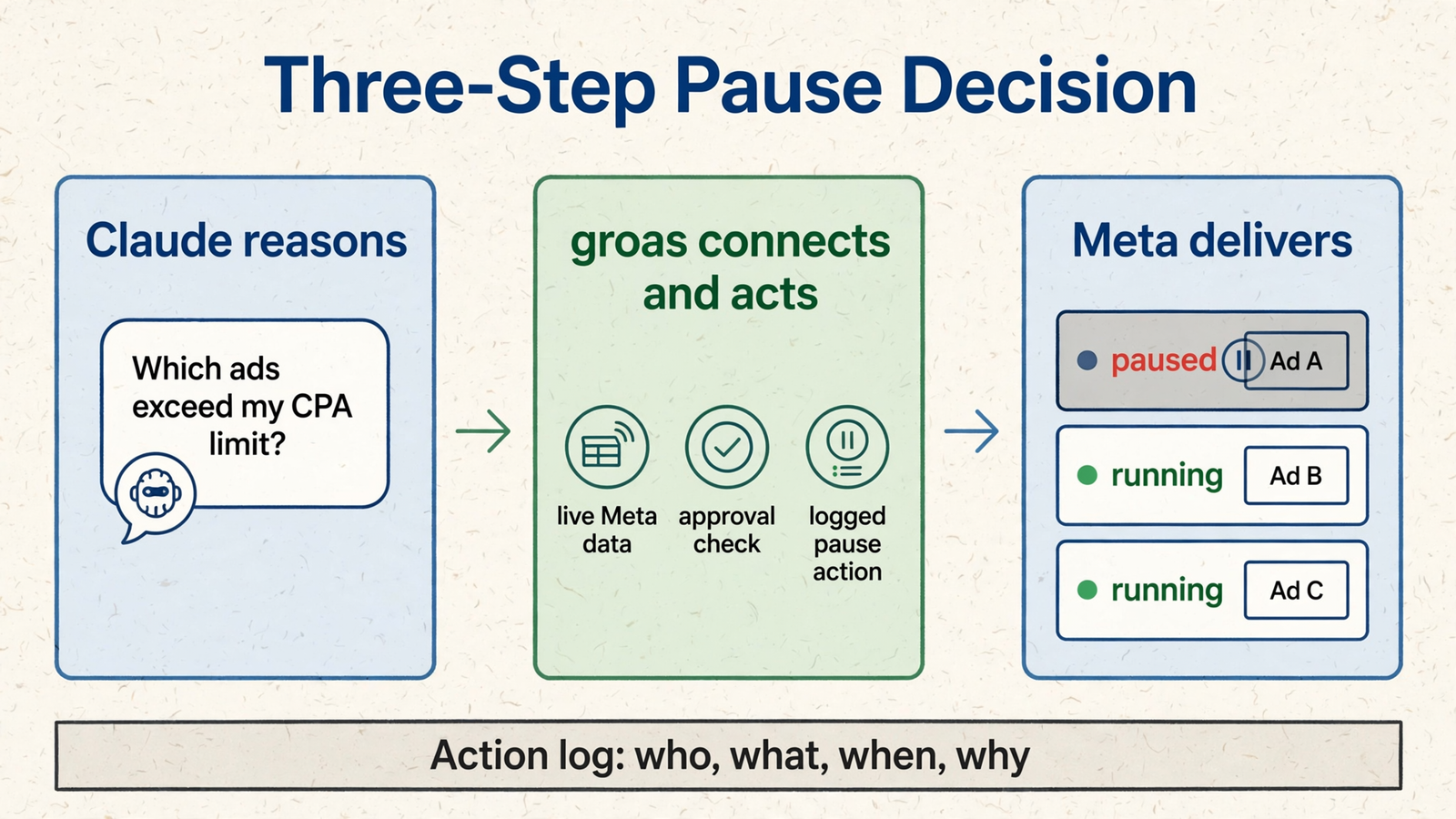
Claude reasons, groas connects and acts, Meta delivers
Claude doesn’t see an ad account just because I name it in a prompt. It reasons over the numbers I give it or the numbers a connected tool retrieves. The Model Context Protocol, or MCP, is the open standard that lets an AI application such as Claude read external data and call tools. Think of MCP as a plug socket: it lets Claude connect to the tool. That’s where the analogy ends. A connection doesn’t tell Claude which ad deserves to stop.
In this setup, I connect the Meta account to groas once, then connect Claude to groas over MCP. Claude reasons over the data, groas reads the account and sends approved changes, and Meta delivers the ads. That gets me live account data instead of a screenshot I pasted last Tuesday. It doesn’t guarantee that every purchase attributable to today’s spend is already in the report. Live and complete are two different things.
Give Claude a limit, a window, and the right row
I start with two metrics. Cost per acquisition (CPA) is spend divided by conversions: $200 spent for four purchases gives me a $50 CPA. Return on ad spend (ROAS) is purchase value divided by spend: $600 in purchases on $200 of spend gives me 3.0 ROAS. One tells me what a purchase cost. The other tells me how much purchase value the spend brought back. Neither tells me what the business can afford. “Expensive” isn’t a limit. “$60 CPA over the last seven days” is.
Give the report time to catch up
For the $20,000 account, I ask for seven days of spend, purchases, and purchase value, not just today’s numbers. Meta notes that reporting on a new ad can take time, so an empty row isn’t proof the ad hasn’t worked. A rolling week takes some weight off the day I happened to open Ads Manager. It doesn’t make the newest numbers final.
I also compare the ad with the business’s threshold, not a blog benchmark. Say the business breaks even at 1.2 ROAS. An ad at 0.32 after enough spend deserves a look, even if the account is at 1.82 overall. It might be a test I’m funding on purpose. If it isn’t, the account average doesn’t let it off the hook. One ad doesn’t get to convict the campaign, and the campaign doesn’t get to acquit the ad.
Judge the ad without judging its siblings
The report has three levels, and the level I read has to match the level I plan to change:
- Campaign: the objective and budget strategy.
- Ad set: the audience, placements, and bidding setup.
- Ad: the creative people actually see, such as the image or video.
The ad set tells me whether the low-ROAS ad is still learning alongside its siblings. The ad row tells me what this particular creative spent and what it brought in. If I pause that ad, its siblings can keep delivering. If I pause the ad set, they all stop. So I ask Claude which ads, inside which ad sets, crossed the limit. A campaign-level answer changes the question.
Check what could make a weak result look worse
Before I recommend a pause, I look for three ways the report can get ahead of the evidence:
- Reporting delay. Purchases can be attributed hours or days after the click, depending on the attribution window. Recent spend can show up before all the purchases it drove.
- Small samples. At $30 of spend, I don’t treat zero purchases as proof an ad can’t hit a $60 CPA. Even if the report is complete, there isn’t much to judge yet. That’s why I set a spend floor before I look at the results.
- Learning. Meta describes performance during learning as less stable, with CPA usually higher. Ad sets typically exit learning after about 50 results in the week after the last significant edit. Meta calls an ad set learning limited when it’s unlikely to get enough results to exit learning.
None of this makes the ad good. It tells me what the numbers can support. One reported purchase, a window that may still be catching up, and an ad set in learning don’t add up to a verdict.
Make the first prompt read-only
Here’s what I’d type for the $20,000 account:
Using my connected Meta account, identify individual ads that exceeded my $60 CPA limit over the last seven days. Show the spend, purchases, ad set learning status, and anything that makes the result uncertain. Do not change anything.
The first response is a report, not an account change. I name the connected account so Claude knows where to get the numbers. I give it my own limit and window instead of asking it to invent a benchmark. And I want to see uncertainty next to the result it affects, not tucked into a disclaimer at the bottom.
Now suppose I revisit that same ad. It has spent $340 over seven days and brought in two reported purchases. That’s a $170 CPA against my $60 limit, and the ad set is out of learning. If the report is sufficiently complete and the spend clears my floor, I have a case for a pause. What I don’t have is proof of creative fatigue.
That distinction matters because the diagnosis changes the response. Meta’s recommendation for a fatigued creative can be to add a new ad and leave the original running. I’d run the seven fatigue checks in Claude before calling the creative worn out. If CPMs jumped while the conversion rate held, I’d look at auction costs. If the conversion rate fell, I’d check the site, checkout, and price. Spending more doesn’t fix a store-side leak. It buys more of it.
Approve the exact ad, then check the log
If the evidence supports the pause, my second prompt is deliberately boring:
Pause only these approved ad IDs. Leave budgets, audiences, and every other ad unchanged.
I approve specific ad IDs, not a general instruction to clean up the account. If I pause the ad from our example, its siblings can still run. If I pause its ad set, I stop them too, including any winners. I also tell Claude which Meta ads must stay running before asking what to pause. No need to make the tool guess which test I meant to protect.

The prompt defines what I approved. Permissions define what a tool is allowed to do. In Meta’s own Ads MCP connector, reporting and updates are separate tool calls. Meta also documents controls businesses can use to block agent actions, including a rule that can deny delivery-status edits. Those are controls for Meta’s connector, not a substitute for approving the exact change in this groas workflow.
After the pause, I want a log that tells me who acted, what changed, and when. In groas, I want the reason alongside the change, too. If I need to revisit the call, I can see why the ad stopped and reactivate it where Meta permits. Undo doesn’t give me back the spend or restore any learning an edit resets. It does beat trying to reconstruct the decision from memory.
A one-time approval isn’t permission to keep acting
A one-time prompt ends at a one-time decision. I ask Claude to read the numbers through groas, it shows its work, and I approve a pause or I don’t. If another ad crosses my limit at 2 a.m., that chat isn’t watching for it. That’s the gap autopilot covers, and it’s why autopilot stays off until I switch it on.
I don’t start with “Claude, keep doing this forever.” I write the autopilot rules first: the $60 CPA limit, the seven-day window, the spend floor, the ads that must stay on, and the conditions where it should stop and ask instead of acting. Each change goes into the log with its reason, so I can review the decisions without trying to remember what was running on Tuesday.
If I can’t write down when I’d let an ad pause and when I’d want another look, I’m not ready to automate that call. I stick with a one-time approved pause.
Now try the same test on an overnight sales drop
Take a different account. It’s losing $300 a day, and sales have fallen off a cliff overnight. There’s pressure to spend more or stop whatever has the worst ROAS. I start with the same question I asked about the ad at 0.4: what does the report actually tell me?
- Check whether the drop is real. Are purchase events firing? How do Meta’s reported purchases compare with store orders over the same window? If only Meta shows the cliff, I check tracking and reporting before treating the drop as lost sales.
- Find the level where the drop starts. Is it one ad, one ad set, or the whole account? An account-wide drop in store orders sends me looking for breakage before I pin it on a single creative. A slow three-week slide gives me more reason to investigate fatigue or audience saturation than an overnight cliff does.
- Ask whether any one ad clears the bar for a pause. How much did it spend? How many purchases came in? Is its ad set still learning? Is this the first bad day or the seventh? I compare the result with the CPA or break-even ROAS limit, the window, and the spend floor I set before looking. I keep the protected ads, budgets, and audiences out of the change, and I want the reason in the log if I approve one.
If the store and Meta reports tell different stories and I haven’t worked out why, I want Claude to say so, not hand me a stop list. If the reports check out and one ad clears the bar on its own numbers, I can approve that ad’s ID without touching its siblings. The explicit “not enough evidence” answer isn’t the system failing. It’s the system telling me the truth before my budget pays for it.





