LinkedIn

A bad week should not cost you a winning Meta ad. The mistake comes first: frequency rises, ROAS falls, and someone calls it creative fatigue before checking whether there is enough evidence to diagnose anything.
Say you’re spending $20k a month selling something people buy once every two years. You record 11 purchases one week, 6 the next. Frequency creeps from 3.1 to 4.2. Someone wants to kill the ad. I used to make that call myself. I was wrong.
With sparse data, a fatigue alert can do more damage than no alert at all. Rising frequency plus falling ROAS proves that two numbers moved, not that the creative stopped working. My workflow connects Meta to Claude through groas, separates observations from explanations, and requires one of three verdicts before any action. The third verdict matters most: insufficient evidence. Monitor inside a spending limit instead of killing an ad on suspicion.
1. Is this fatigue, or just a bad week?
The standard fatigue checklist looks familiar: 7-day prospecting frequency above 3 to 4, link CTR down 25% or more from its peak, and cost per result up 30% or more week over week. Those numbers can tell me where to look. They cannot tell me what caused the change.
With 8 or 12 purchases a week, a few sales move the result sharply. Add delayed conversion reporting and the latest week may not even be finished counting. A confident diagnosis built on that foundation is noise wearing a diagnosis costume.
I want to know how many conversions sit behind the percentage, whether the comparison windows are genuinely comparable, and whether click response deteriorated too. A CPA gap without that context is not permission to replace creative.
There is no conversion count I would use as a universal permission slip. The gap being evaluated matters, and so does the evidence around it. Treat a sparse-data fatigue flag as a monitoring alert, not an instruction to change anything. An alert says look closer. A diagnosis has to earn the action.
2. How do I connect Claude without authorizing changes?
Start read-only. In Claude, go to Connectors, add a custom connector named groas with https://mcp.groas.ai/mcp, sign in, and connect your Meta ad account inside groas. Follow the groas setup instructions for Claude.
groas supplies the hands and data while Claude does the thinking. That distinction matters: access to an account is not permission to edit it. Keep autopilot off, and explicitly instruct Claude not to make changes. For this job, I want zero edits until I approve exact IDs and actions in writing.
The account knows spend and frequency. It does not know your business. Before asking for a diagnosis, give Claude:
- Purchase cycle in days.
- Target CPA and margin per sale.
- Offer or landing page changes in the last 30 days.
- Recent budget or audience edits.
Then paste this:
Inspect this Meta account without changing anything. Use the business context above. List the context you still need before judging creative fatigue. Do not create, edit, activate, pause, or change budgets.
If Claude jumps straight to replacement ads, stop it. Skip the fatigue verdict until it can repeat back your purchase cycle and what another weak week costs you. That refusal is the feature.
3. What evidence should Claude pull for each creative?
I ask for one evidence packet per creative, not a campaign-level story. A campaign average can hide the ad I actually need to examine. The useful fatigue diagnosis starts at the ad level.
Start with two comparable windows, such as the last 14 days versus the prior 14, while excluding yesterday from the diagnostic comparison. Pull spend, impressions, reach, frequency, outbound click response, CPM, and reported conversions. If there are only 9 conversions in each window, put that beside the result. Do not bury it beneath a percentage.
My evidence packet needs four things:
- A consistent comparison. Use the same windows and attribution setting for every creative. Check whether the placement mix changed rather than assuming it stayed constant.
- Frequency with reach attached. Frequency is impressions divided by reach. A frequency of 4.7 needs the direction of reach and CPM beside it.
- Clicks separated from conversions. Impressions and clicks are recorded when they happen. Recent conversion metrics can keep changing as Meta credits conversions back to the click date.
- The missing evidence. Make Claude state what the connected data cannot establish.
My practical rule is simple: never judge fatigue on a comparison that includes yesterday. It is the freshest row, not the strongest evidence. Excluding it does not make every remaining conversion count final, either.
4. How do I make Claude challenge its first explanation?
Before allowing a verdict, I ask for the counter-case:
What evidence would distinguish creative fatigue from higher auction costs, a placement shift, weaker post-click conversion, or ordinary variation? Separate observed facts from possible explanations. Mark anything the connected data cannot establish.
That split is the whole exercise. “Frequency rose from 3.1 to 4.2 while reach fell 18%” is an observation. “The audience is tired of the ad” is an explanation. It may fit. So might tighter auction conditions, a placement shift, a landing page change, or ordinary movement on 10 conversions a week.
Even the frequency guidance describes fatigue conditionally: performance dropping as frequency rises can indicate that the audience may be fatigued. May is doing useful work there.
I also ask Claude to compare untouched ad sets. If they moved together, that weakens the case against one creative and earns investigation beyond it. It does not magically locate the cause outside the account.
I keep this walkthrough on why frequency alone cannot prove fatigue beside the chat for exactly this reason. If Claude cannot name what would prove its explanation wrong, it has not earned permission to act on it.
5. Which of the three verdicts does the evidence support?
I require exactly one diagnostic verdict. Not a paragraph that begins cautiously and somehow ends with “refresh all creative.”
Verdict 1: Likely fatigue
Click response fell across comparable windows while reach fell and frequency rose. Auction and post-click explanations have been checked and do not explain the pattern better. The conversion evidence is strong enough to support the proposed action rather than merely decorate it.
Likely fatigue earns a controlled challenger test, not an automatic pause. Claude should list both the supporting evidence and the remaining uncertainty.
Verdict 2: Another explanation fits better
CPM rose, placements shifted, the landing page changed, or untouched ad sets moved together. Something besides the individual creative better explains the decline.
Investigate that explanation before asking for replacement ads. A creative refresh does not answer a landing page problem. It just gives the next report more moving parts.
Verdict 3: Insufficient evidence
The conversion count is thin, the windows are incomplete, the signals conflict, or Claude cannot distinguish fatigue from ordinary variation.
Set a limit in dollars and days, then monitor. For example: $150 a day for 14 more days, then re-pull the evidence. Those are illustrative limits, not a budget recommendation. Use the business context supplied in step two to choose yours.
This verdict does not mean “spend indefinitely.” It means the evidence does not justify blaming the creative. A spending limit still applies, and reaching it is a spending decision, not retrospective proof of fatigue.
For a longer pre-action checklist, I use these 9 checks in Claude before buying or replacing creative. Most sparse accounts live in verdict three longer than anyone wants. That patience is the work.
6. If fatigue looks likely, how do I test a challenger?
Within this fatigue workflow, only the first verdict earns a replacement-creative recommendation. Even then, add a challenger; do not remove the incumbent before the comparison exists.
Ask Claude to read the landing page, the offer, and the competitor ads groas collects around the clock. Then ask for one materially different hypothesis. The same promise shot from a new angle does not count as a different reason to buy.
A useful contrast might be:
- Price versus speed.
- Proof versus process.
- Risk reversal versus status.
Treat competitor longevity as a hint, not a result. An ad running for 90 days might print money or sit on a forgotten five dollars a day. I want Claude to extract the hook, angle, and offer, then explain what job each does. I do not want it to invent a competitor’s performance.
From there, write one challenger that tests a job the incumbent has not tried. Keep the incumbent available for the comparison, and skip lookalike rewrites. With 10 conversions a week, I want one clean test at a time, not a crowded audition with no readable result.
The takeaway: test a different reason to buy, not merely different wording.
7. How do I approve the test without handing over the account?
Never tell Claude to “fix fatigue.” That instruction leaves too much room between a plausible recommendation and money leaving the account.
I require a read-back before anything touches Meta:
- Campaign and ad set IDs.
- Exact new creative to add.
- Existing ads that stay live and anything that stays paused.
- Daily budget and the ceiling it must not cross.
- Start date and the specific changes awaiting approval.
Claude recommends, I approve, groas logs it. That separates judgment from execution instead of treating a confident sentence as authorization. It is the same principle behind explicit approval thresholds for agentic advertising workflows.
Keep autopilot off for this job. Approve the addition of the challenger as paused, review it inside Meta, then activate it yourself. Afterward, open the groas change log and check what changed and why.
Every change groas makes is logged with its reason and can be undone. But undo restores a setting; it does not refund spend. My rule is narrower than “let the AI manage it”: read-only during diagnosis, then only the exact approved edits. Do not authorize a budget increase to rescue an inconclusive test.
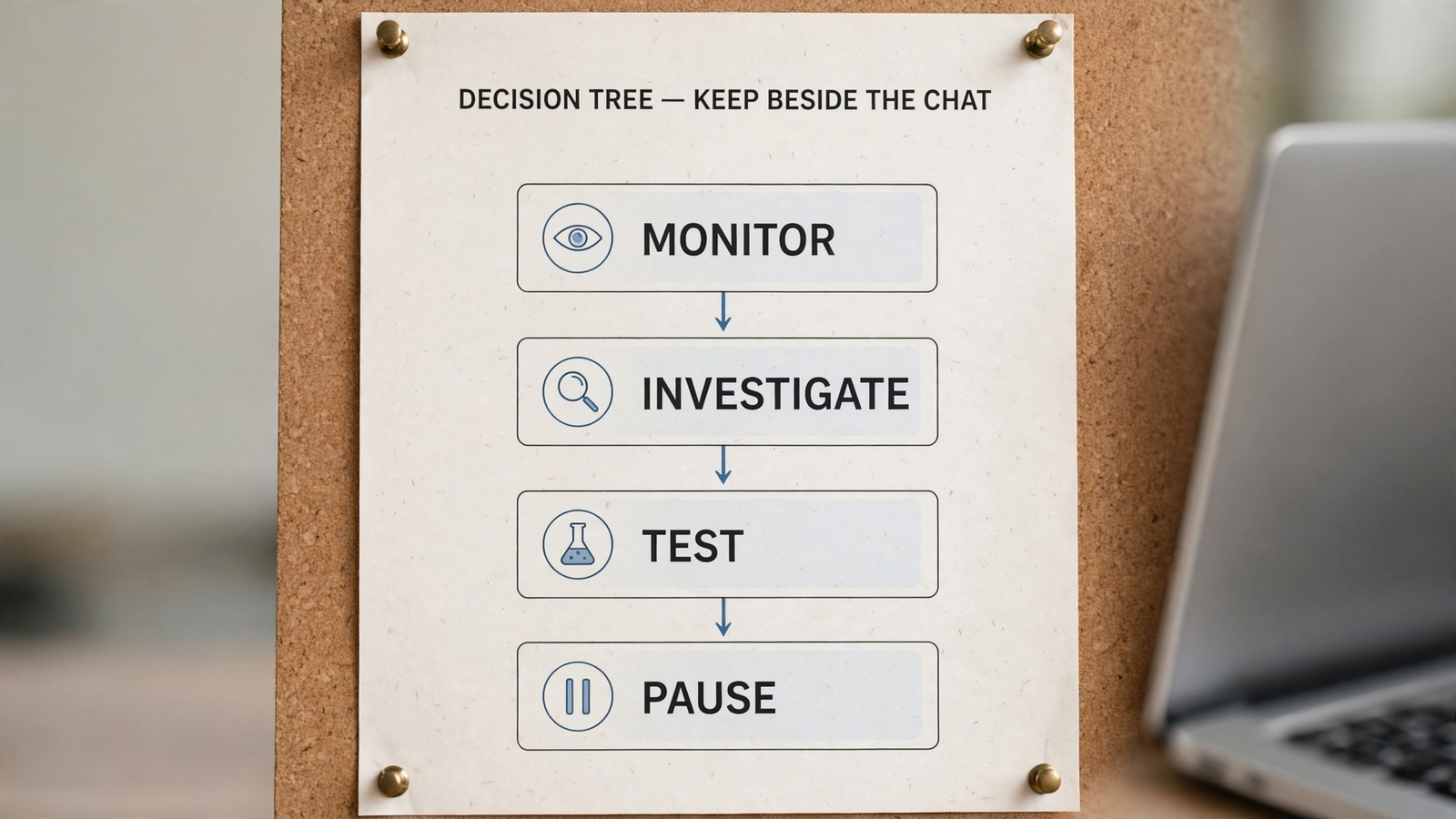
8. What decision tree should I keep beside the chat?
The three verdicts diagnose the situation. The actions below determine what happens next. Keeping those separate prevents insufficient evidence from quietly turning into pause it anyway.
- Monitor: Evidence is thin or conflicting, and the movement has not established fatigue. Set a daily spending limit and a 14-day re-pull date. Make no creative changes on the strength of the alert.
- Investigate: Auction costs, placements, the page, the offer, or movement across untouched ad sets offers a better explanation. Examine that before replacing creative.
- Test: Click response deteriorated across comparable windows, reach fell as frequency rose, and alternative explanations were checked. Add one real challenger while keeping the incumbent available for comparison.
- Pause: Pause the incumbent only after the challenger beats it on comparable windows with the same attribution setting. If the evidence remains too thin, say so rather than declaring a winner.
A spending limit can stop further spend without settling the diagnosis. That is not a contradiction. I can decide I cannot afford more uncertainty without pretending I have proved the ad is tired.
For reporting, daily and weekly views show direction, while a fixed-date monthly pull provides a consistent record. Do not let a fresh dashboard snapshot overwrite the comparison you agreed to use.
No branch lets frequency alone kill a winner. That is the point of keeping the tree beside the chat instead of asking Claude for a new explanation every morning.
The mistake I used to make was treating a decisive action as evidence of good management. Pausing an ad feels productive. So does commissioning a refresh. Neither answers whether the original ad stopped working. groas gives Claude the hands to pull the numbers and the log to show what changed. Claude supplies the judgment, if I force it to admit when the numbers are too thin to judge.

Start today with the read-only inspection in step two: connect Meta through groas with autopilot off, paste your purchase cycle, target CPA, margin, and recent changes, and ask what evidence is missing. Then require one of the three verdicts before discussing action. When the next alert fires, monitor inside a limit, investigate, test one real challenger, or pause with proof. Everything else is noise billing you by the hour.