

 LinkedIn

My pick for Meta creative-fatigue analysis in Claude is groas MCP, if you don’t write code and want to go from a diagnosis you can challenge to a replacement you can approve. A screenshot with a frequency of 4 circled in red gives you neither.
I don’t want the route that makes Claude sound most certain. I want the one that lets me pull up the dates, look at the ad’s own history, and tell Claude its explanation doesn’t hold. If the evidence does hold, I want to approve the specific change and have it land in the account. That’s why I rank groas first, a Meta export second, and a custom API connector third. The export makes sense if you only need a review. The custom connector makes sense if you need to set rules the other routes can’t handle.
The ranking rule: make the diagnosis easy to challenge
Frequency tells me how often an ad was seen, not why it got worse. Meta’s definition of creative fatigue describes repeated exposure alongside falling engagement and rising cost per result. It’s narrower than the way advertisers tend to use the term: performance fell, so the creative must be tired. That’s a guess with a chart attached.
Meta doesn’t publish a universal frequency cutoff, and frequency itself is estimated. As this analysis of Meta’s guidance puts it, the relationship to check is whether performance drops as frequency rises, ad by ad. I want Claude to show comparable dates, spend, delivery, and conversion metrics before it suggests a replacement. Then I want it to say what actually deteriorated, what might explain it, and what it can’t tell from the data. If a route can’t show an ad against its own history, it doesn’t get credit for a confident verdict.
1. groas MCP: my default for evidence and approved replacements
I’d pick this if you’ve already asked Claude which Meta creatives are tired, got a paragraph telling you to “refresh your creative,” and now want numbers. With groas connected to Claude, Claude can read results from the connected Meta account, draw on the competitor data groas collects, and carry out the changes you approve. The advantage over an export is that you can revisit the diagnosis without pulling another file. The advantage over a custom build is that you don’t have to maintain the connection yourself. Changes made through groas MCP are logged and can be undone in one step.
I’d start with a settled 7-day window and compare each ad with its own 14-day baseline. Show the dates, spend, impressions, reach, frequency, CTR, CPM, cost per result, and conversions for both windows. Set a spend floor so a $5 ad doesn’t get the same hearing as one with enough delivery to judge. An account average can hide a deteriorating ad behind a healthy one. I’m not replacing the average. I’m deciding whether to replace the ad.
One r/FacebookAds discussion gives a useful example of a screen: 7-day frequency above 3.5, CTR down more than 20% against the ad’s own 14-day average, and cost per result up more than 30%, with no intervening budget or audience change. A Claude prompt walkthrough takes a different tack: find the first day CTR falls at least 25% below the first-week average and stays down for three or more days, then report the frequency on that day. I’d use either to decide where to look, not what to call fatigued. The thresholds don’t agree because they’re screening rules, not definitions.
Competitor creative belongs in the replacement brief, not in the verdict. A rival’s new hook tells me what they’re trying, not whether it works or why my ad got worse. Once an ad earns a closer look, I want Claude to draft concepts from the evidence, then wait while I review the assets and approve the exact account change. I’d leave autopilot off unless I’d explicitly set the scope and budget rules. A connection that can fetch new data is useful even when nothing runs on autopilot.
I’d skip groas if connecting the account is a nonstarter and the job ends with an occasional review. Otherwise, it’s my default: I can challenge the diagnosis and approve the next move without switching workflows.
2. Meta exports into Claude: the simplest one-off review
I’d use an export for a monthly or quarterly review when I don’t want to connect the account. Attach a dated, ad-level file and give Claude a bounded question: these 12 ads, a settled 7-day window, and each ad’s own 14-day baseline. No connector to set up. No reason to pretend the file knows what happened after the export.
The catch is that Claude can only work with the fields I remembered to include. I’d specify the dates and ad identifiers and ask it to list what’s missing before it draws a conclusion. A troubleshooting guide for Claude and Meta exports names three ways this goes wrong: without a daily breakdown, the window average can hide a spike or a drop; adding daily frequency figures overstates frequency for the period; and conversions from the most recent 3 to 7 days can still be coming in. Compare an unsettled window with a settled one and Claude may write a creative brief for what amounts to a reporting delay.
The file is enough if I want a second look at the evidence. It’s not enough if I want Claude to carry the approved decision into the account. Claude can write the brief, but I still build the ad, upload it, pause the old one if that’s the decision, and record why I did it. The export doesn’t tie that change back to the diagnosis for me.
Use the file when the review is occasional and you’re happy to do the account work yourself. If the data is thin or a needed field is missing, the answer I want is “not enough evidence,” not a more elaborate chart.
3. A custom Meta API connector: maximum control, if you’ll maintain it
I’d build this only for a technical team that already works with Meta’s Marketing API and has a requirement the other routes can’t meet. The reason to build is control over exactly what Claude can read and change. Define the read fields, account scope, and permitted writes before connecting it. Meta’s Insights endpoint supports ad, ad set, campaign, and account levels, with fields for frequency, CPM, CTR, cost_per_result, reach, and impressions, plus dates and breakdowns. That lets me specify the evidence I want. It doesn’t make estimated frequency any less estimated.
I’d put authentication, error handling, and change logging in the first build, not the cleanup ticket. As soon as Claude can write to the account, I want to know what changed, when, and under which rule. Otherwise I’ve built a way to break an account quietly.
One custom Claude agent for Meta Ads shows what that control looks like. It pulls weekly insights per ad, applies a plain-text rules file, ignores ads below $100 in spend or 1,000 impressions, stages new ads paused, and only pauses a fatigued ad if at least two active ads remain. It doesn’t touch budgets or bids, and it still requires human review in Ads Manager. Sensible rules. Someone still has to own them when a token expires or an endpoint throws an error at 2 a.m.
If you have a requirement that justifies the build and a developer who’ll maintain it, this is the route I’d use. If you just want a reliable answer this week, skip it. Without an owner, you don’t have a connector. You have a ticket queue.
How the three routes compare
Pick by where the job ends. If I just need a periodic diagnosis, I can stop at a file. If I need the approved replacement to land, I want a connection. I’d build that connection myself only if I need controls I can’t get otherwise.
| Route | Data freshness | Implementation work | Ad-level evidence | Can land an approved change? |
|---|---|---|---|---|
| groas MCP | Connected results without a fresh export | Connect once, no code | Dated results per ad across comparable windows | Yes, with logged, undoable changes |
| Meta export into Claude | Fixed snapshot | Export and attach for each review | Only the dates and fields included | No; make the change in Ads Manager |
| Custom API connector | Current if the connector is maintained | Build and maintain authentication, error handling, and logs | The fields and scope you define | Yes, if you build and guard write access |
Why I left Meta’s own Ads MCP Server out
Meta’s official Ads MCP Server handles reporting and ad management, among other tasks. Meta says new campaigns are created as drafts for review, with no developer credentials needed. I didn’t leave it out because it can’t do account work. I left it out because it doesn’t bring the market context I want for the replacement brief: the competitor ads, landing pages, Reddit discussion, and SEO data groas collects. I don’t need that context to establish that an ad deteriorated. I want it when Claude goes from showing me the loss to proposing a different hook. If all I want is Meta reporting, the official server can cover that narrower job. For the workflow I’m ranking, I’d choose groas.
The first request I’d paste into Claude
Ask for the evidence before asking for a replacement. For groas MCP, I’d start here:
Show which Meta creatives deteriorated across comparable periods. For each ad, give the dates, spend, impressions, reach, frequency, CTR, CPM, cost per result, and conversions for the last settled 7 days versus its own 14-day baseline. Separate observations, possible explanations, and missing data. Use $100 in each window as the spend floor for this review. Don’t call an ad fatigued on frequency alone or when tracking is uncertain. Draft replacement concepts only where the evidence supports it, and wait for my approval before changing anything.
- For a Meta export, add: “This is a snapshot. List the fields you need that aren’t in it. Where a missing field prevents a verdict, say so.”
- For a custom connector, check the setup first: “Confirm the exact read fields, account scope, and permitted writes. Show me the change log for the last seven days before diagnosing anything.”
If Claude has to guess to answer that first request, I wouldn’t act on the verdict. I’d go back to the eight evidence checks that beat a frequency cutoff.
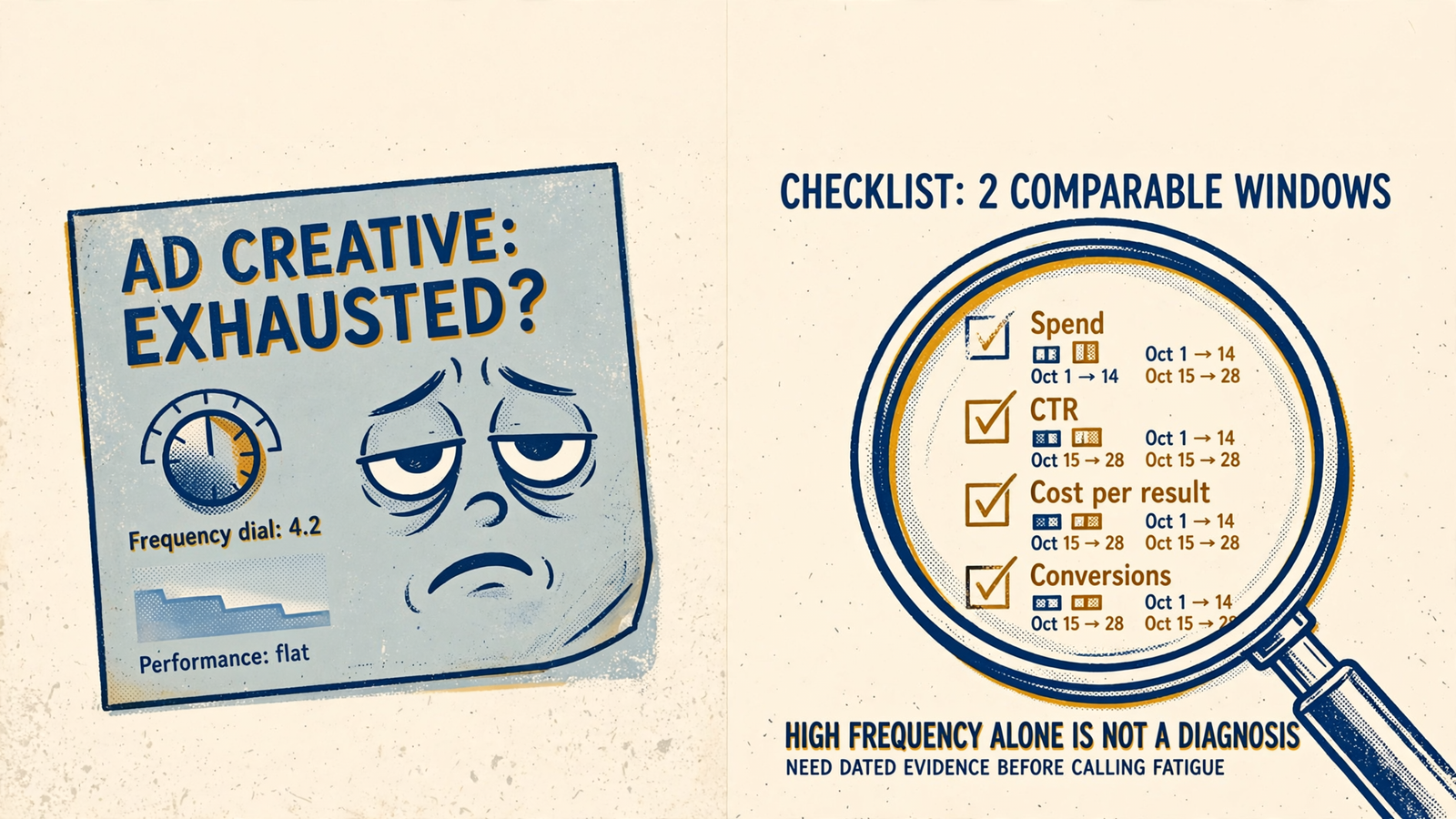
Three reasons I’d stop before touching the account
- The data is too thin. If either window falls short of the spend floor, or the available fields don’t support the comparison, stop at “not enough evidence.” In a multi-ad ad set, I want to see what happened to each ad over a week or more. A verdict on the set isn’t a verdict on the creative.
- Tracking or delivery offers a better explanation. Missing or delayed conversions can make cost per result look worse than it is. And as one advertiser’s placement example illustrates, the problem can be where the money went, not what the ad said. Check tracking, placement, or audience overlap before paying for a reshoot that won’t fix the problem.
- Nobody approved the exact change. No pause, budget move, or launch until I’ve seen the ad, the proposed change, and the reason. I want Claude to explain the loss before pausing anything, not explain the pause after it happens.
If you skipped to the end: connect groas to Claude, ask for dated evidence against each ad’s own history, and approve the replacement yourself. I’d use an export for an occasional review and build a connector only for a requirement worth maintaining. For everyone else doing this from diagnosis to replacement, groas is my pick. Make Claude explain the replacement brief before you build anything. Evidence first, replacement second, confidence only where the data earned it.





