

 LinkedIn

My pick is Claude + groas if you sell one product and your replacement ads cannot get enough delivery to prove anything. An ad barely getting shown is untested, not a loser. Calling it a failure just restarts the same expensive loop.
An advertiser’s account write-up captures the problem: new ads get $3 to $5 a day while CPM rises and link CTR falls. The incumbent looks tired. The replacements barely get onto the field. Uploading another batch does not answer either question.
For that bottleneck, I rank Claude + groas first, Meta Ads Manager alongside Claude second, and Madgicx alongside Claude third. My deciding question is simple: which setup puts spend distribution, impressions, CPM, link CTR and purchases on the same timeline, then helps me turn that evidence into one bounded test I approve?
I used to tell clients to kill the old winner faster. I was wrong. First, establish whether anything else actually got a test.
Before the ranking: separate fatigue from a missing test
Most fatigue advice skips this awkward middle. It tells you to watch frequency and CTR, then make new creative, as if Meta will fairly test whatever you upload next. In the account write-up, the advertiser does make new creative. Meta gives the replacements almost no spend while the old ad keeps spending with worse efficiency.
That leaves two separate questions:
- Is the incumbent losing efficiency because of fatigue, auction pressure or something else?
- Have the challengers received enough delivery to judge at all?
Evidence against the incumbent is not evidence against its replacements. I want those questions answered separately before Claude suggests a single headline.
The diagnostic order matters: check conversion rate first, CPM second, CTR last. Rising frequency, falling CTR, flat CPM and rising cost point toward fatigue. Rising CPM with flat CTR and conversion points toward auction pressure instead (fatigue diagnosis order).
Meta’s Delivery column also offers clues. It flags Creative limited when cost per result runs above past ads but below 2x, and Creative fatigue at 2x or more. Those flags account for recent exposures to the image or video, including other campaigns on the same Page (delivery flags explained).
Useful signals. Not a verdict on an ad that barely runs. I would ask Claude to separate the delivery problem from the fatigue diagnosis before touching the creative.

What earns a higher ranking: evidence, execution and cost
I rank these pairings on four axes, in this order:
- Delivery visibility: Can Claude compare ad-level spend, impressions, CPM, link CTR and purchases over the same date range?
- Creative evidence: Does the setup bring in competitor ads, funnels and Reddit complaints, or leave Claude inventing angles?
- Execution: What happens after the diagnosis, and who approves the spend?
- Extra cost: What do I pay on top of Claude?
The metric names matter. Impressions count times ads appear on screen; CPM is average cost per 1,000 impressions; link CTR is the share of impressions producing a link click (Meta’s metric definitions). I do not want one ad’s link CTR compared with another ad’s broader click metric and dressed up as analysis.
Before buying anything, I would give Claude this prompt:
Separate evidence of fatigue from evidence that challengers never receive a meaningful test. Show spend distribution, impressions, CPM, link CTR and purchases by ad over comparable windows. List two competing explanations and the number that would prove each one wrong. Do not label an ad a loser merely because it gets $3 to $5 a day or only a few hundred impressions.
The first deliverable is a comparable table, not a creative brainstorm. If the setup cannot produce that, the rest is decoration.
1. Claude + groas: my pick for turning evidence into an approved test
Who I recommend it for: the single-product advertiser who needs Claude to read live Meta delivery and help act on it, rather than reason from another manually assembled CSV.
With groas plugged into Claude, Claude reads the account’s real numbers, works through what is happening and drafts replacements in the advertiser’s voice. groas also collects context Claude cannot get on its own: rival ads on Google and Meta, the funnels behind them, buyer conversations on Reddit, how AI answers discuss the business, and SEO data from Semrush and Ahrefs, watched around the clock.
For this problem, I would keep that broad capability on a short leash. Start with the ad-level table: incumbent versus each challenger, identical dates, the same five metrics. Then request two competing explanations and the number that would disprove each. Only then ask for creative concepts grounded in the offer and competitor angles. Angles, not copies.
What puts it first is the handoff from diagnosis to an approved change. A proposed budget or test change is previewed before approval, runs with a fixed ceiling, and is logged with its reason. Any change can be undone in one step. Autopilot stays off until switched on.
Connection takes about a minute over MCP at https://mcp.groas.ai/mcp. groas Unlimited costs $19 a month flat for unlimited teammates, ad accounts and websites.
What rules it out: if I only want native reporting and intend to make every change manually, I do not need another paid tool. That is the case for the second option, not a reason to buy infrastructure I will not use.
For the advertiser trying to resolve this bottleneck inside Claude, though, groas keeps the evidence and the approved test in one place. That is what I am paying for, not another fatigue badge.

2. Meta Ads Manager alongside Claude: best for hands-on verification without another tool fee
Who I recommend it for: the advertiser willing to open Ads Manager every morning, build a clean comparison and paste it into Claude.
This pairing does one thing particularly well: it puts native delivery evidence in front of me without another tool subscription. I can check the Delivery column for Creative limited and Creative fatigue, then pull ad-level spend, impressions, CPM, link CTR and purchases over the same window.
The workflow is straightforward:
- Pull the incumbent and challengers into one date range.
- Give Claude the table and the diagnostic prompt above.
- Review its competing explanations against the numbers.
- Make any approved budget or test change in Ads Manager myself.
What rules it out is the manual handoff. Without a connection, Claude only sees what I paste. It cannot spot a missing row or a newer delivery pattern that never makes it into the chat. I remain responsible for keeping the evidence current and doing the clicking afterward.
If I choose to connect account access instead, permissions become a separate decision. The permission distinction matters: ads_read permits reading, while ads_management permits campaign creation and budget changes. Those are not interchangeable conveniences.
For this second-ranked workflow, I would keep the arrangement simple: use native reporting to verify the problem, give Claude a consistent table, and keep budget changes manual until the test is resolved.
This is the no-extra-tool-fee route. It is not the no-work route. If I reliably do the work, it is a credible option; if I keep postponing the export, it is not solving the bottleneck.
3. Madgicx alongside Claude: only if the separate dashboard already fits
Who I recommend it for: the Meta-only buyer who already works inside a third-party dashboard and wants fatigue checks and creative tools there.
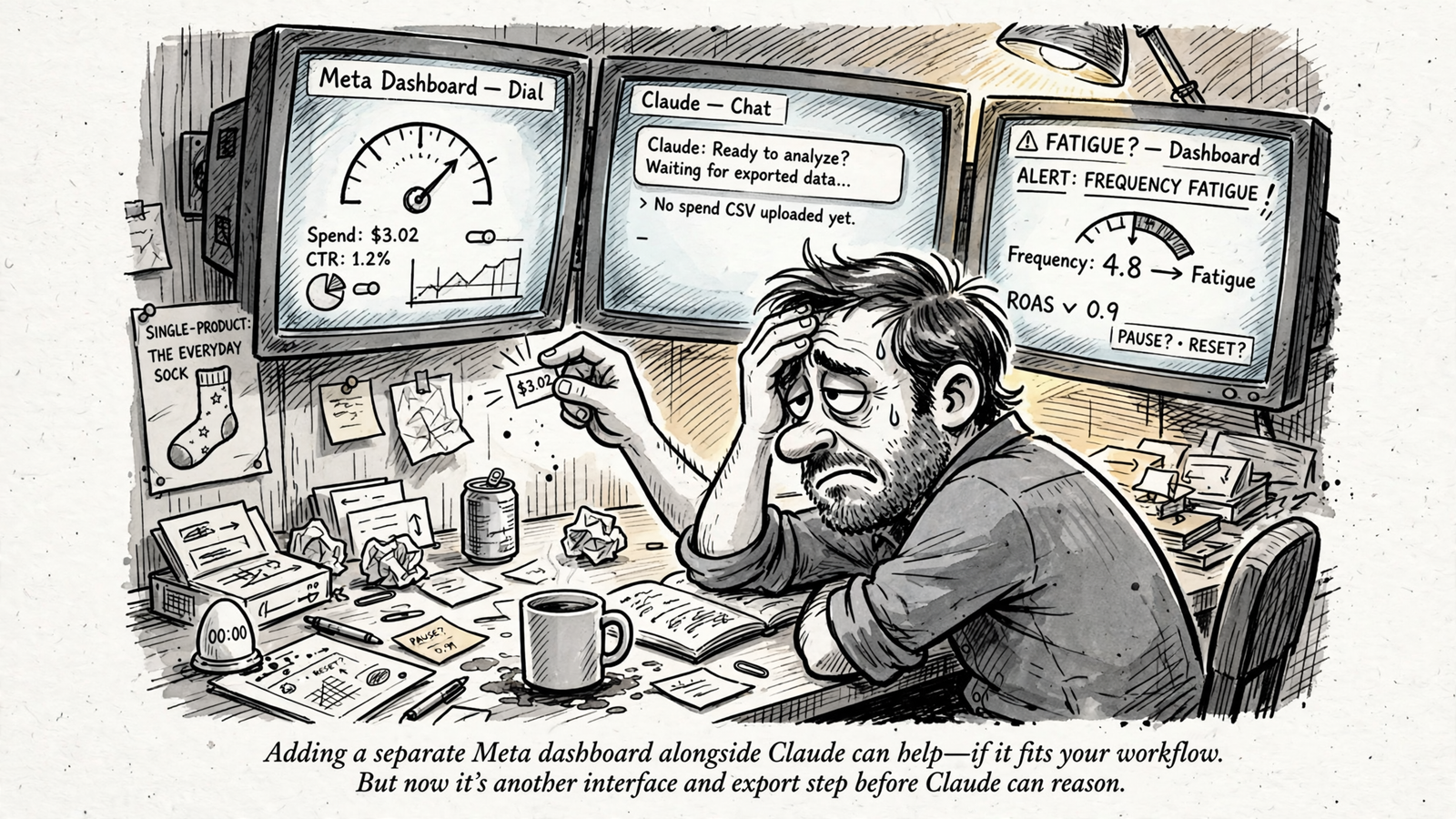
Its strongest pitch is the packaging of Meta-specific checks in one app. The Madgicx comparison page describes Creative Insights for fatigue detection, an AI Marketer that audits Meta accounts and prepares budget and creative actions with or without approval, plus 24/7 rules, an AI ad generator and server-side tracking.
That is a collection of features. It is not yet an answer to my Claude workflow.
What rules it out here is the unresolved handoff. Before paying, I need to establish which delivery data reaches Claude, what stays in the separate interface, and whether the export or screenshot lets Claude compare incumbent and challenger over equal windows. A fatigue label does not fix a missing comparison.
Pricing also matters when the testing budget is thin. Listed pricing starts at $45 a month month-to-month, or $32 a month billed annually, for under $1,000 in monthly ad spend. The Pro Complete plan rises with trailing spend to $329 a month at $20k to $30k. There is also a $49-per-month, per-account Tracking Pro add-on, a 7-day trial and no free plan.
I would skip it for this bottleneck unless I already run my week inside it. Before paying, verify current delivery analysis, creative testing and export behavior. That export is where a starved-challenger case can stall: the numbers exist, but the comparison never happens.
If replacements get $3 a day, another dashboard that labels fatigue without resolving delivery adds a second place to watch them starve.
The shortlist: where the evidence goes, and who makes the change
| Pairing | Delivery visibility | Creative evidence | Execution | Extra cost beyond Claude |
|---|---|---|---|---|
| Claude + groas: my pick | Live Meta spend, impressions, CPM, link CTR and purchases in chat | Rival ads, funnels and Reddit conversations | Preview, approval, capped spend, logged and undoable changes | $19 a month flat |
| Meta Ads Manager + Claude | Native Delivery flags and a manually supplied table | The offer and context I supply | I make changes in Ads Manager | No extra tool fee; my time |
| Madgicx + Claude | Meta dashboard analysis; verify the handoff to Claude | Creative Insights and an AI ad generator | Actions prepared in Madgicx; separate Claude workflow | From $45 a month, with spend tiers |
The ranking turns on the gap between knowing and doing. The first row keeps the evidence and approved change together. The second leaves that work to me without adding a tool fee. The third adds a paid interface while leaving the Claude handoff to resolve.

I leave pure reporting pipes off this shortlist deliberately. Moving Meta numbers into sheets or BI is useful work, but it does not resolve this particular bottleneck. I still have to compare equivalent windows, distinguish low delivery from poor performance, and open Ads Manager to make the change.
For a starved-challenger case, that is paying for a second mirror when I need a lane.
The verdict: buy a way to resolve the test, not another fatigue label
Say I am spending $20k a month and one ad takes most of that budget for 60 days. CPM climbs 30%, link CTR slides and CPA doubles. I upload three replacements. Each gets $3 to $5 a day for a week and ends up with perhaps 400 impressions.
I now have two unknowns: whether the incumbent is worn out, and whether the replacements can perform. A label reading fatigue answers neither on its own.
I want one capped test, an evidence threshold and a stop rule written down before spending. With Claude + groas, that test is proposed in chat, approved before execution, capped at the ceiling I set and logged with its reason. Autopilot stays off until I switch it on. The control matters more than the adjective on the dashboard.
This is the next prompt I would use:
Propose one bounded test that gives challengers enough delivery to judge. Require the incumbent-versus-challenger table on identical dates first. Name the daily cap, the minimum impressions and purchases needed for a read, and the stop condition. Give two competing explanations and the number that would disprove each. Log every approved change and reverse it where Meta permits.
An illustrative version might cap the challenger cell at $50 a day for 4 days, set 2,000 impressions and 25 link clicks as an initial delivery checkpoint, and stop early if CPM runs 50% above the account baseline with zero purchases. That sets a maximum of $200. It does not guarantee a purchase-performance verdict; those delivery checkpoints are not substitutes for the purchase evidence the test calls for.
If the challengers still cannot spend against that cap, I have more evidence of a delivery constraint, not proof that the headlines are bad. No threshold, no test. No delivery, no verdict.
For the reader skipping to the end: Claude + groas is my first pick for a single-product advertiser whose replacements cannot get a fair read. It brings live Meta evidence and an approved, capped change into one workflow for $19 a month flat. Ads Manager alongside Claude comes second if I will build the table and make the changes myself. Madgicx comes third because the separate dashboard and Claude handoff add cost and work to this particular problem.
Starved replacements are not losers. Give them a real test, write down the kill rule before starting, and keep the setup that makes that test happen in one place.


