

 LinkedIn

At $3,000 a month in Meta ad spend, I’d put $3,059 to $3,069 a month in the ledger for media and software to run the account from ChatGPT. That’s before creative and review time, and it tells me exactly nothing about whether my next customer costs more to acquire.
Meta’s 14% increase in average price per ad doesn’t tell me that either. It’s a global average, not a 14% surcharge on my account. A cheap AI connection is not cheap customer acquisition. I price the connection, the assistant, the media, the creative, and the time it takes to make a decision separately. Then I use ChatGPT to find which part of the account math changed before I pay to fix the wrong thing.
| Line item | What I put in the ledger | When it hits | Source |
|---|---|---|---|
| Meta media | $3,000 a month in this example; use actual spend for your account | Recurring | Your Meta account; Shopify’s Meta ad cost breakdown for context |
| groas Unlimited connection | $19 a month, flat | Recurring | groas |
| ChatGPT Business | $40 a month for two seats on annual billing, or $50 month to month | Recurring | Coworker.ai’s pricing breakdown |
| Analysis and approval | Hours spent × hourly value | Per decision | Your time log and hourly value |
| Creative production and testing | Production and review per variant, plus test media if it isn’t already in the media line | Per test | Your production cost, review time, and test budget |
The 14% headline isn’t an account diagnosis
The same report that put average ad prices up 14% year over year also put impressions up 10%. That’s more volume alongside a higher average price across countries, placements, and formats. It doesn’t mean the same auction got 14% more expensive for every advertiser. I used to tell clients to treat platform averages as a weather report. I was wrong. They’re a climate report: useful for planning, useless for deciding which ad to kill today.
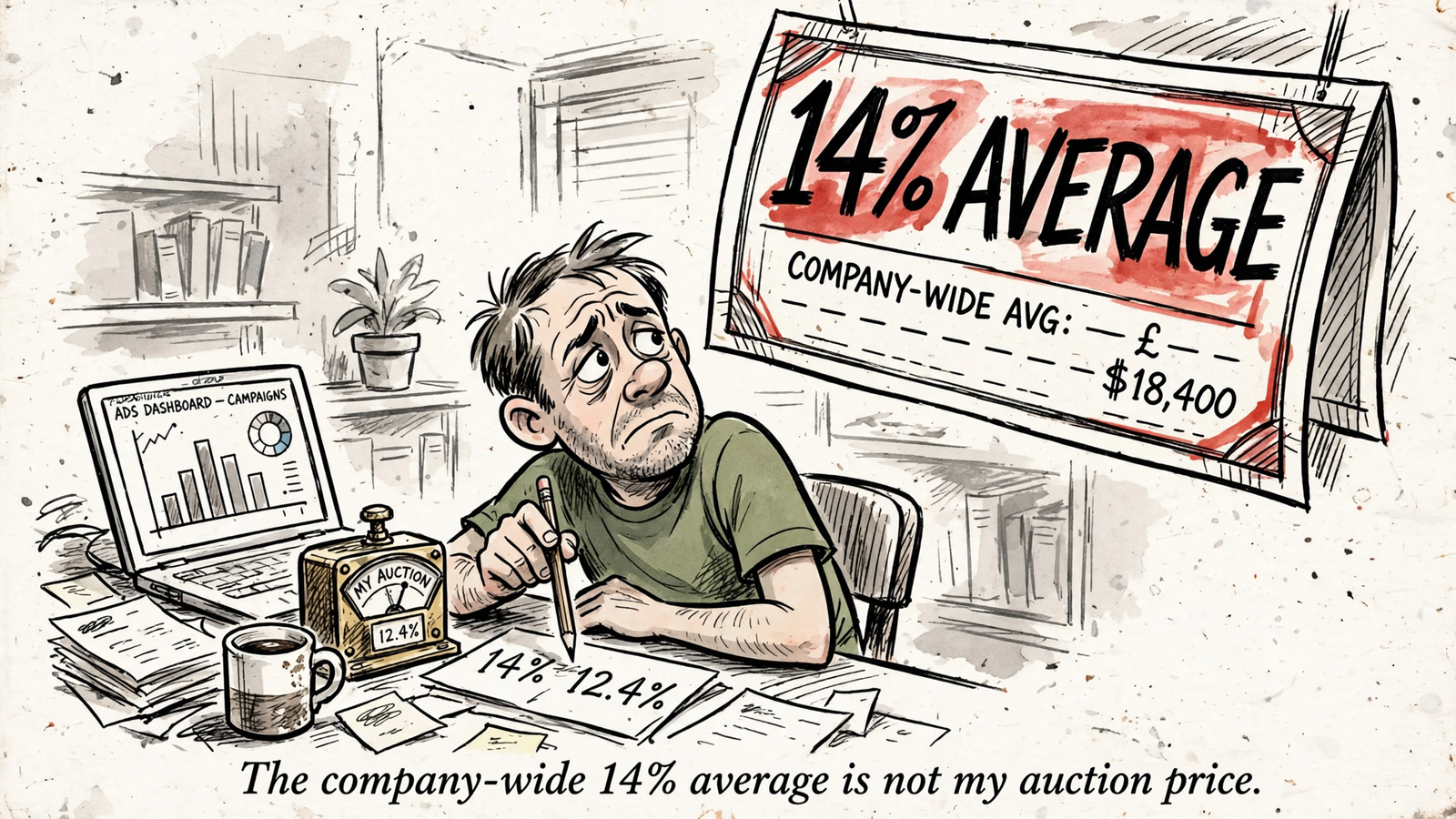
One ecommerce advertiser described CPMs climbing from around $5–$6 to around $15 while impressions roughly halved. The benchmark ranges of $8–$15 for CPM and $0.50–$3.50 for CPC are useful reference points, not quotes for my account. The example and the benchmarks tell me the same thing: there’s no reason to start my diagnosis at 14%.
I start with matched periods and the same conversion event. I pull spend, impressions, clicks, and conversions for the last 30 days and the prior 30. If impressions cost more but click-through and conversion rates hold, the higher CPM explains the CPA increase in the math. If click-through falls, I look at the ads before blaming the auction. If conversion rate falls after the click, I don’t start by asking for new headlines. Each pattern tells me where to look, not what I’m allowed to declare broken.
Line 1: Media is the bill the AI subscription doesn’t replace
Here’s how auction cost reaches CPA when nothing downstream changes. At a hypothetical $10 CPM and a 2% click-through rate, 1,000 impressions buy 20 clicks. That’s $0.50 a click. At a 1% post-click conversion rate, those clicks produce 0.2 conversions on average, for a $50 CPA.
Raise only the CPM to $11.40, a 14% lift, and I still get 20 clicks and 0.2 conversions on average. I just pay $11.40 for them instead of $10. CPA moves from $50 to $57. Same ads. Same store. Seven dollars of auction pressure in an illustrative calculation, not a measured result.
Once groas is connected, I have ChatGPT rebuild that calculation with the account’s numbers before it recommends anything:
Read the connected Meta account. Compare the last 30 days with the prior 30 using spend, impressions, clicks, and the same conversion event. Show the arithmetic from CPM to CPC to CPA. Flag missing data and low conversion volume. Make no changes.
That last sentence matters. If the pixel fired 12 purchases last week, I want to see the underlying counts before I trust a tidy diagnosis. A comparison can be arithmetically right and still be a poor reason to pause an ad. I make the chat show its work before I give it anything to do.
Line 2: The connection and assistant cost $59–$69 a month
groas Unlimited is $19 a month for the whole team. That covers unlimited teammates, ad accounts, and websites, with every feature and all the data included. There’s no free plan. I’d rather put the $19 next to the $3,000 in media than pretend the connection is the spend.
The assistant is a separate bill. For a setup where I want ChatGPT to make changes through MCP, I budget for Business. The quoted Business Standard rates are $20 per user per month on annual billing or $25 month to month, with a two-seat minimum. That’s $40 or $50 for ChatGPT before I add groas. The price worth circling is the two-seat bill, not the per-seat number in the headline. And it’s the price of this setup, not a cover charge for pasting an export into chat.
Meta’s hosted MCP server covers account work such as reporting, ad creation, and budget changes. I prefer groas for reviews because I can put the account next to competitors’ ads and funnels, Reddit conversations, and SEO data instead of working from the account alone. That’s the distinction I care about in the free-export versus $19 connection comparison. I keep autopilot off for the review. Paying for the connection doesn’t mean paying it to make a decision I haven’t made yet.
Line 3: A free export still takes paid time
The manual route is straightforward. Export spend, impressions, clicks, and conversions from Ads Manager, put them in a sheet, and rebuild the math by ad. Then do it again next week. It’s free right up until a conversion column changes names and I get to reconcile the export instead of reviewing the account.
The price is hours spent × hourly value. If I spend two hours a month on review and value that time at $100 an hour, the review costs $200 a month. That’s an illustration, not a time-savings claim. The $59–$69 buys the software stack; it doesn’t take the $200 off the books. I log the time either way so I can see what the connection actually saves me.
Free tools answer narrower questions. A pasted-number checker works from metrics I copy in. An upload scorer judges a draft I hand it. A creative scorer can rate how varied the ads are. None of those scores predicts a winner. What the deck calls “AI insight,” I call a second place to paste the same export. If the question is which ad to pause, I’m still responsible for making sure I’m comparing the right numbers.

Line 4: Creative is a per-test cost, not a software feature
ChatGPT can draft three replacement angles from the live ads and the competitor hooks groas collects. A draft isn’t an ad. I still have to check that the claim is legal, the offer matches the landing page, and the copy sounds like the brand. Then I have to decide what I’m willing to spend finding out whether it works.
I price production, review, and test media separately. If a designer charges $75 per variant and I spend 30 minutes reviewing it at $100 an hour, the variant costs $125 before Meta spends a cent. Say the account spends $20,000 a month and I test two variants at $50 a day each for seven days. That’s $700 in media and $250 in production and review, or $950 for the test. If the $700 comes out of the existing media budget, I don’t add it again to the monthly total. I still count it when I ask whether the test was worth running.
If one variant holds CPA at $57 while the control drifts to $68, I have a result to review. The two CPA figures alone don’t tell me whether the test earned back its $950. That’s why I set the budget and review date before anything goes live. New work stays paused until I activate it. If I let three unreviewed variants run without a cap because the chat said they looked promising, I bought tuition.
Line 5: A wrong diagnosis can cost more than the tools
It’s easy to call rising CPA fatigue, pause the only creative still converting, and leave the replacement to learn from scratch. The cost doesn’t show up as a new subscription. It shows up in what the account does after I remove the control.
I make ChatGPT separate the observation from the diagnosis. The fatigue checklist I use for that distinction gives me three places to look:
- Creative fatigue: On the same ad, look for frequency and cost per result rising together while click-through falls roughly 20%–33% from its peak. A higher CPA on its own isn’t enough.
- Auction cost: If CPM rises while click-through and conversion rate hold, the higher price of impressions explains the move in CPA. That still doesn’t tell me why CPM rose.
- Tracking: If Meta reports revenue the store doesn’t show, check the pixel and Conversions API before treating the reported result as a reason to change spend. A mismatch is a reason to investigate, not proof that either one is broken.
Then I ask for one recommendation, not a list of things the chat could do to look busy:
List what changed in the observed numbers. Treat fatigue, auction cost, and tracking as separate hypotheses. For each one, show what supports it and what’s still missing. Propose one intervention with a budget ceiling and a review date. Make no changes.
I start read-only or require approval, and leave new work paused. Meta’s MCP controls include limits on actions such as creation, budget increases, and status edits. Whatever connection I use, I want the permission to match the job: a request to explain the numbers is not permission to touch the control.
The all-in ledger: price the decision before approving it
I fill this in before changing anything. The fixed charges belong on the monthly bill. Review time belongs to the decision that took it. A creative test gets its own line, with test media counted once. That’s how I keep a cheap subscription from making an expensive account look cheap on paper.
| Ledger line | What I enter | Timing |
|---|---|---|
| Meta spend | Actual spend for the last 30 days | Recurring |
| groas Unlimited | $19 a month, flat | Recurring |
| ChatGPT Business | $40 a month billed annually or $50 month to month, for two seats | Recurring |
| Analysis and approval | Hours × hourly value, excluding review already charged to a creative test | Per decision |
| Creative test | Production and review, plus any media outside the existing budget | Per test |
The ledger tells me what I’m paying. The account comparison tells me where acquisition got more expensive. I don’t ask one to do the other’s job. A $19 connection can make the review easier; it doesn’t erase a $7 move in CPA. Once I know which part of the math moved, I put the decision in writing:
Read the connected Meta account. Propose one intervention only. Name the ad it touches, the budget ceiling, and the review date seven days out. Change nothing until I write approved. Keep autopilot off.
If I approve the test, I come back on the review date and decide whether it stays or goes. The cheapest mistake is spending a week reading the numbers and changing nothing. The most expensive one is pausing the ad that still works because I mistook Meta’s 14% headline for my own arithmetic.





