

 LinkedIn

Microsoft’s native Advertising MCP and groas in Claude answer different questions: “What happened in this Microsoft account?” and “Should I move money from Google to Bing?” If you manage both channels, I’d choose groas for the budget decision: it reads both accounts together and lets you execute an explicitly approved change in the same chat.
Microsoft’s native MCP deserves consideration for its documented diagnostics. But diagnosing one account and justifying a transfer between two accounts are different jobs. That distinction matters more than the length of either feature list.
I have watched too many budget moves start with a screenshot of cheaper Bing CPCs. Across 73 advertisers, Microsoft search averaged $1.54 versus $2.93 on Google, about 47% cheaper. I used to tell clients that gap meant free efficiency. I was wrong. The authors warn that their lead-cost math assumes similar conversion rates it did not measure.
Cheaper clicks earn an investigation. They do not earn your budget.
1. Diagnostic depth: Microsoft’s native MCP has a clear job
When a Microsoft campaign moves unexpectedly, I want more than a summary of yesterday’s spend. I want to know which keywords, audiences, assets or account changes explain it.
That is where Microsoft’s native connector earns its place. Microsoft Learn lists reporting, campaign, ad-group, keyword and audience analysis, assets, anomaly detection and change history. Microsoft also positions the connector around live Microsoft Advertising data for conversational insights.
That is useful diagnostic depth inside Claude. I can ask what changed, inspect targeting and trends, and investigate policy signals without exporting half the account into a spreadsheet first.
The limit is structural. Microsoft describes cross-platform comparison as a scenario, but those cases require integrations with both Microsoft and Google. The native Microsoft connector does not, by itself, give Claude a same-period read of Google.
Microsoft diagnostics can explain Bing’s performance; they cannot alone establish what Google should give up. A campaign can look healthy in isolation and still be the wrong destination for the next dollar. For that decision, I need both sides of the trade.

2. Comparable evidence: groas starts with both accounts
With groas plugged into Claude, the starting position is different. Claude reads the real Google and Bing accounts together in one chat, alongside the extra market data groas collects around the clock. Connect the ad accounts and website once, then add groas to Claude. The Google Ads connection walkthrough covers the setup.
That shared view is why I prefer groas for the question in the title. But access to two dashboards is not the same as a fair comparison. I still make Claude do the boring alignment work before it recommends anything:
Compare Google and Microsoft over the same period. State each platform’s conversion definition, attribution setting, time window and primary conversion before recommending a budget move. Separate cheaper leads from better leads, and list what evidence is still missing.
The platforms do not necessarily measure the same thing in the same way. Default attribution is data-driven on Google and last-click on Microsoft; offline goals on Microsoft can ignore the model. A shopper who clicks both platforms can also be claimed by both. That is why I judge the comparison on neutral backend revenue, not dashboard CPA alone.
Cheaper leads and better leads are different findings. I want Claude to say which one the evidence supports, in numbers, and name what would change its mind.
For that, I ask it to show:
- The same reporting period for both channels.
- Each platform’s primary conversion action and attribution window.
- Spend and qualified conversions, with definitions attached.
- Backend revenue where I supply it.
- Missing evidence that could overturn the recommendation.
Groas does not magically see closed-won data unless I give it access. If I paste CRM exports or connect revenue, that needs to be explicit. Without that evidence, I expect a gap list, not a confident instruction to move money.
The advantage is not that groas makes judgment unnecessary. It puts both accounts in the same conversation so I can make that judgment without first stitching together two separate investigations.
3. Approved execution: analysis should not end in another handoff
Once the evidence supports a test, the comparison changes from “What can Claude read?” to “What happens after I approve?”
Microsoft’s MCP tools are read-only and cannot alter campaigns. That makes the native connector a diagnostic connection, not the place to execute the proposed move. I still have to edit elsewhere.
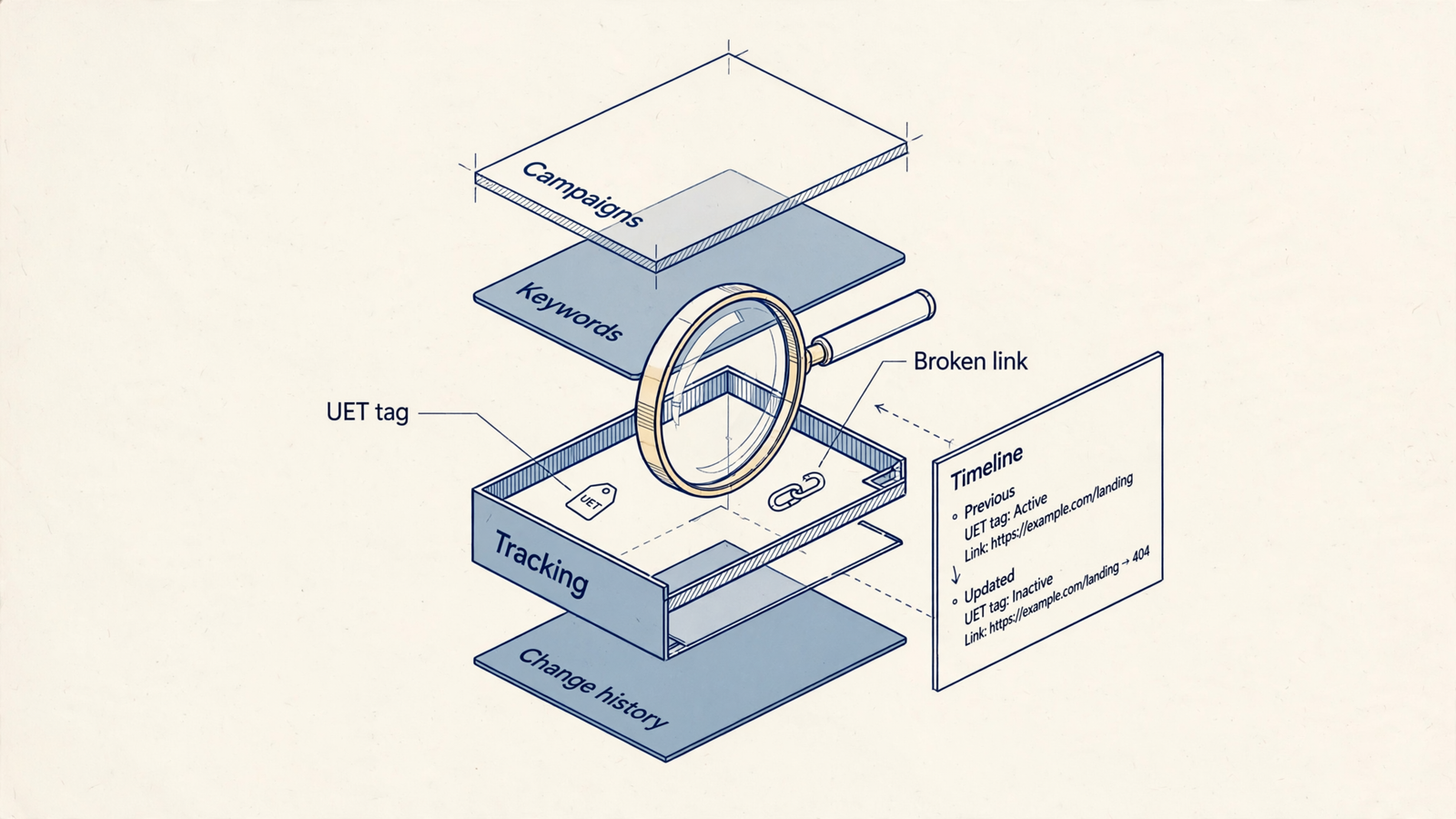
Its change history remains useful. GetChangeHistory returns previous and updated values with the actor recorded, using a 30-day default window and a 180-day maximum lookback. That helps explain who changed what. It does not apply the next change.
Through groas, the approved proposal can become the action through the same connection. I can have Claude propose exact campaign budget edits, review them, and approve them without turning the recommendation into a separate handoff. Every change is logged with its reason, and any change can be undone in one step.
Autopilot is a separate choice: it stays off until I switch it on. I do not need to turn a bounded budget decision into an open-ended instruction to run the account.
My sequence is propose, approve, then act with a record. That is why groas wins this axis for a cross-channel operator: reading, comparison and approved execution stay together.
One warning belongs beside every mention of undo. Reversing a setting does not refund spend incurred while that setting was live. A readable log and an undo button are useful. Neither makes a careless budget instruction harmless.

4. Setup and scope: count the work around the connection
Microsoft’s native setup requires an Entra app registration, callback URIs and Microsoft’s MCP server URL. Its setup documentation also notes that Claude Free is limited to one custom connector.
If I already have Entra access and spend most of my time inside one Microsoft account, that friction can be worth paying once. The connector serves a defined diagnostic job, and I know why I am installing it.
For a small team where the admin queue is also the person managing campaigns, setup is part of the cost. So is maintaining a second connection for Google and lining up the outputs whenever a budget question lands. I would count that work before calling any connection free.
Groas’s case is consolidation: connect the accounts and website once, then use Claude to read Google and Bing together and act on an approved decision. Its additional competitor, funnel, Reddit and SEO data broadens the context, but that is not what settles this comparison. The deciding feature is the shared path from evidence to action.
For this job, I would choose the connection around the decision, not the longest inventory of tools. Microsoft’s native MCP fits a Microsoft teardown. Groas fits the recurring question of where the next advertising dollar should go.
Side by side: the four differences that decide the choice
Here is the comparison I would use before installing either connection. For a Google-to-Bing budget move, groas is the winner. Microsoft’s native MCP remains the narrower choice for Microsoft-only diagnosis.
| Decision axis | Microsoft’s native MCP | groas in Claude |
|---|---|---|
| Diagnostic scope | Documented Microsoft reporting, keyword and audience analysis, assets, anomalies and change history | Reads Google and Bing together, alongside the market data groas collects |
| Cross-channel evidence | Requires a Google integration as well; definitions still need alignment | Both accounts in one chat; definitions and revenue still need alignment |
| Approved execution | Read-only: diagnose here, edit elsewhere | Propose exact edits, obtain approval and apply through the same connection; changes logged with reasons and one-step undo |
| Setup and working scope | Entra app setup; a separate Google connection for comparison | Connect accounts and website once for a shared cross-channel workflow |
Neither column removes the need for matched conversion definitions or backend evidence. The distinction is how much of the work stays together after those requirements are met.
Before either answer earns spend, check the inputs
A clean-looking comparison can still be wrong. Before I approve a test, I run the same measurement check regardless of which connector produced the analysis.
- Verify Microsoft tracking. Confirm UET fires on the relevant pages and
msclkidsurvives redirects. The tracking and attribution comparison explains why those checks matter. - Write down what each conversion means. Include its name, attribution model, lookback window and whether offline imports are included.
- Match the reporting period. A date-range mismatch should not survive long enough to become a recommendation.
- Separate lead cost from lead quality. Use qualified conversions and backend revenue where available, not dashboard CPA alone.
- Name the evidence gap. If closed-won revenue is missing, Claude should say so before attaching confidence to the move.
If Claude cannot show the definitions side by side, I stop. I do not have a budget recommendation yet. I have a guess with formatting.
This is also where the 47% CPC gap belongs: as the reason to investigate, not the result of the investigation. It becomes a lead-cost argument only when the conversion evidence supports it.
If Bing earns a test, make one bounded request
Say I am spending $20k a month and want to test $3k of that budget on Microsoft over two weeks. I would state the test’s total cap explicitly, identify the campaigns involved, and prohibit changes to other campaigns.
Then I would give Claude this instruction:
Propose the exact campaign budget changes for this two-week Microsoft test, within the $3k total test cap and the existing $20k monthly budget. Name the campaigns, amounts and supporting evidence. Do not change other campaigns. Wait for approval.
That wording forces the proposal into something I can inspect. No vague “rebalance for efficiency.” No recommendation that quietly changes scope between analysis and execution.
Before approving, I want four things in one place:
- The comparable conversion evidence.
- The campaigns and exact budget changes.
- The test period and total cap.
- The reason for each proposed change.
Through groas, that approved proposal becomes the action rather than a handoff to another tool. The change gets a log entry and a reason I can read later. Autopilot remains off unless I choose to enable it.
I still use a second pair of eyes before approving anything that touches spend. The two-assistant check before an ad change is my gate, not a substitute for reviewing the evidence myself.
Bound the decision before making it executable. Undo can restore a setting. It cannot retrieve dollars already spent during the test.

Final choice: groas for the budget move, native MCP for the teardown
I would pick Microsoft’s native MCP for a Microsoft-only diagnostic job: keyword and audience detail, asset checks, anomaly investigation, or a change-history review. It suits an in-house specialist or freelancer with one heavy Microsoft account, Entra access, and a reason to keep Google analysis elsewhere.
That is who should choose the narrower option anyway. But it is not the job in the title.
For “Should we move budget from Google to Bing?”, I choose groas in Claude. Connect both accounts, make Claude align definitions, supply the revenue evidence, and ask for a bounded proposal. Approve only what the evidence earns, then read the change log. The cross-channel Claude setup walkthrough shows the broader working setup.
I used to run this comparison with exports and a pivot table at 1am. I was wrong to bill that as strategy. It was copying numbers between dialects, and machines do it faster. The judgment is still mine: does cheaper mean better, and is the evidence good enough to risk real spend?
If the definitions do not line up, I fix measurement and rerun the comparison. I do not move money to reward a persuasive answer.
Diagnose with the specialist. Decide with the connection that sees both sides and logs what it changed.


