 LinkedIn

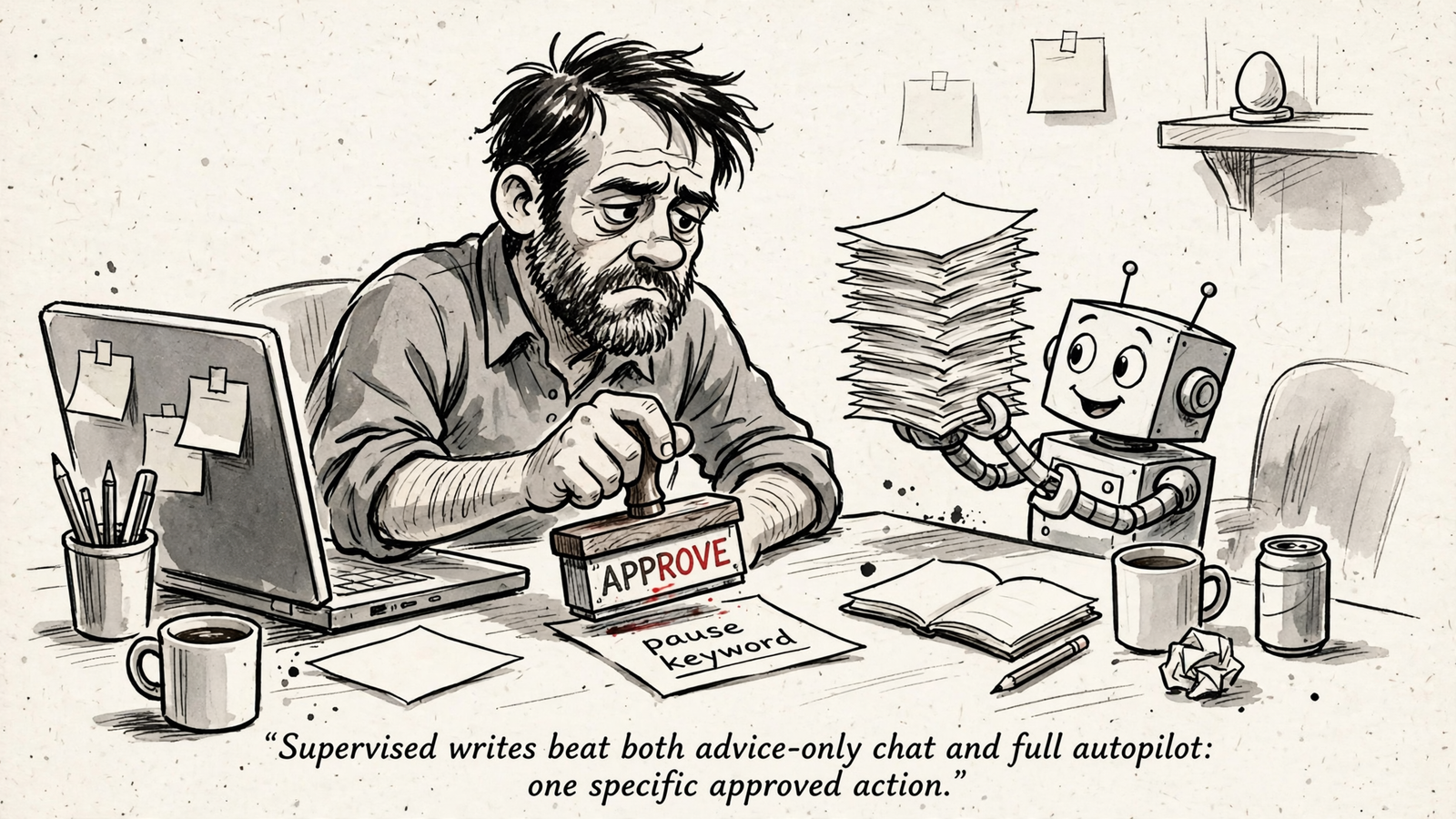
By November 22, 2028, supervised changes will be the default first paid upgrade for budget-conscious ChatGPT advertisers, ahead of unrestricted autonomous management. The thing worth buying will be one specific action, with an inspectable reason and an undo button, approved before it happens.
I have managed Google Ads accounts manually long enough to respect the read-only crowd. Letting an AI touch real spend still makes my stomach turn. But good analysis without execution leaves a familiar mess: a smart paragraph in chat, followed by me doing the clicking at 11pm.
That gap is where I expect the money to change hands. Not more advice. Not permission to disappear. Permission to act, once, where I can see it.
The bet is about one permission boundary
Vendors use “connected to ChatGPT” to describe four different arrangements:
- Advice: the assistant answers questions without an account attached.
- Connected analysis: it reads the account but cannot change it.
- Approved changes: it proposes a specific edit and waits for a yes.
- Recurring autopilot: it keeps working under rules I set.
My forecast concerns the move from level two to level three. I call that supervised writes: the AI can execute, but I approve the action first. Write access and unattended management are not the same purchase.
I am placing this bet on November 22, 2026, for November 22, 2028. The distinction between current capability and prediction matters. Google’s open-source Google Ads MCP v0.0.6 added initial mutate support on November 2, 2026, but it still cannot create or edit campaigns, change budgets or bids, or add keywords. “Has write support” does not mean “can run the account.”
I will grade the predictions by what budget tools actually sell and what buyers actually approve. A more ambitious product demo does not count as adoption.
Prediction 1: supervised writes become the normal first paid step
The read-only crowd has a point. Start with analysis, enable writes per account only when ready, and keep hard spend limits plus a never-touch list for brand terms and high-spend campaigns. Practitioner setup guides already recommend analysis first, then per-account writes with approval for every live change.
I used to tell clients to export everything and paste summaries into chat. I was wrong about that being enough, but right about the fear behind it. One bad bid or budget edit can wipe out a week of margin. Saving on a subscription does not justify unreviewed mistakes.
The problem is what happens after the analysis. A read-only answer still leaves someone implementing the recommendation in Google Ads, campaign by campaign. The tool has shortened the thinking and left the clicking intact.
A supervised write removes that handoff without removing the review. That is the mechanism behind my first prediction: read access becomes the free sample; approved action becomes the first paid upgrade.
The pricing ladder already offers signals. Windsor.ai lets advertisers connect one ad account free with the last 30 days of data, while Get MCP Ads offers one ad account free with no card. Free connections give budget buyers a way to try connected analysis before paying for anything.
There are also signs that execution need not mean surrender. Windsor’s ChatGPT plugin supports 37 Google Ads write actions and asks for confirmation before each change, with new campaigns and ad groups starting paused. That is the shape of control I expect buyers to value: approve a pause, a budget change or a negative, one at a time.
For a connected tool that supports this workflow, I would start with a plain instruction:
Read the connected account, explain the evidence and propose one change. Wait for approval.
That asks for the read, the reason and the pause. It is not a substitute for actual permission controls. I still want the tool to enforce the boundary, not merely promise to remember it.
I made the longer argument in Read-Only MCPs Leave You the Work. Demand Write Access With Approval.. The buying question is simple: does paying remove implementation work while leaving approval with me?
What would prove me wrong: by November 2028, budget buyers consistently choose either extreme. Free exports plus manual edits remain the norm and paid write tools stall, or buyers jump straight to unattended management. If the first paid tiers remain advice-only while writes stay an enterprise add-on, I have misread the ladder.
Until then, I would judge the upgrade by the work it finishes, not the length of its answer.
Prediction 2: cheap tools compete on change records, not just recommendations
Once two budget tools can execute an approved edit, “we can change a budget” stops being much of a distinction. The next question is whether I can inspect what happened.
I learned to care about that running accounts where a client swapped a landing page and my Quality Score fell apart without a note explaining the change. A recommendation records what someone thought. A change record shows what happened to the account.
Money already spent cannot be recovered by reversing a setting. That makes the record important before approval, not just after something breaks. My second bet is that the quality of the receipt becomes a buying criterion in the cheap tier.
The pieces are already visible:
- Supermetrics shows campaign history with before-and-after values and undo, while noting that undo cannot recover money already spent.
- HeyAdpilot logs writes with old and new values and offers undo.
- Get MCP Ads separates previewing a change from applying it.
- MCP Ads logs calls and asks first for changes to budget, bid or status.
- One comparison lists 170 previewed write operations with a per-call audit log on AdPlug’s hosted tier.
Those features are signals, not proof that buyers already choose on this basis. My prediction is that they move from reassuring extras to expected parts of a paid tool.
Before approving a change, I want a receipt I can actually read:
- The exact account, campaign and object involved.
- The current value and proposed value.
- The evidence and reason for the edit.
- The resulting log entry once it runs.
- The reversal available if I need it.
My prompt would be:
Name the exact account, campaign and object. Show the before-and-after values and explain the reason. After approval, show the log entry and how to reverse the change.
Then I would check that the tool keeps the promise. A polished answer describing a log is not the same as a persistent change record. Nor does an undo button make the original decision harmless.
What would prove me wrong: low-cost write tools win and retain buyers in 2028 without meaningful review or recovery. If advertisers keep paying for one-click edits with no useful preview, history or undo, I have overestimated demand for the receipt.
For now, I would treat write access without an inspectable record as a demo, not an operating system for my spend.
Prediction 3: autopilot remains a separate decision, not a connection default
Connecting an account should not mean the AI keeps working while I sleep. Those are different permissions. My third prediction is that budget buyers keep demanding a visible boundary between them.
An approved edit has a defined scope: this change, now. Recurring management needs rules for changes nobody has reviewed yet. That is a different commitment, even when the same tool offers both.
Before enabling anything recurring, I would write down four lines:
- The goal it may pursue.
- The monthly budget limit it cannot cross.
- The exact changes it may make.
- The decisions that still require approval.
That is the three-level split I use for asking, approved changes and autopilot. Advice costs nothing to ignore. An approved change costs one review. Autopilot requires ongoing attention to the rules.
Skip the fourth line and write access becomes a much broader permission than intended. “Optimize the account” sounds tidy in a sales deck. It is not a useful boundary.
There is already evidence of separate controls. Supermetrics offers four approval modes, from no approval to approval for all live changes, with write access enabled per account. groas keeps autopilot off until it is switched on, logs every change with its reason, and allows changes to be undone in one step.
The distinction I expect to survive is simple: connecting grants access; enabling autopilot grants recurring authority. One should not quietly imply the other.
What would prove me wrong: unattended execution becomes the routine entry-level workflow by November 2028. If budget tools default new connections to continuous optimization without a separate approval boundary, and buyers accept that arrangement, they have chosen disappearance after all.
I would keep autopilot off until those four rule lines are clear enough to enforce.
What I would pay for now—and what I would leave free
If account changes happen twice a month, I would not assume paid writes earn their keep. Exporting a search term report, asking ChatGPT to help examine it and adding three negatives by hand may be enough.
I ran accounts that way for years. The relevant calculation is not whether clicking is annoying. It is whether the implementation time saved is worth more than the subscription. I priced out that distinction in A Free Google Ads Audit in ChatGPT: What the Second Run Costs.
A free connection that leaves me some clicking can beat a paid connection I barely use. The second run matters more than the novelty of the first answer.
The subscription makes a stronger case when approved changes become routine. Say an account spends $20k a month across four campaigns and needs five to ten small edits a week: pauses, budgets, negatives, bid caps. That is the kind of workflow where I would compare the recurring clicking against the tool’s price, rather than keep calling manual labor “free.”
That is where groas at $19 a month flat fits the argument: access from my own AI, every change logged with its reason and undoable in one step, with autopilot off until I switch it on. The useful offer is execution with control, not another recommendation I have to carry into the interface myself.
A ChatGPT or Claude subscription bills separately. I would include that in the calculation rather than let the connection price stand in for the whole bill.
Before paying, I would make the assistant challenge its own pitch:
Show the work I would still have to do manually. Do not assume this connection saves money.
If the answer is still mostly me, I would stay free. If the tool removes routine implementation while preserving a clear approval step, there is something worth buying.
How I will score the bet in November 2028
I will open three budget tools, try their free tiers and read their pricing pages like a media buyer, not a product-launch spectator. Then I will check the workflow against the three predictions:
- The first paid step: does free access read the account while the first paid tier enables a specific, approved edit? Pricing shows the offer; what buyers actually choose determines whether the prediction holds.
- The receipt: does the edit produce a useful record of the account, object, before-and-after values, reason and reversal? If records are vague or missing and buyers keep paying anyway, prediction two fails.
- The recurring boundary: does continuous management require a separate opt-in with goals and limits? If a connection starts changing budgets on its own without that boundary, prediction three fails.
Three product checks will not establish the entire market. They will make the promises inspectable. The larger test remains what budget advertisers buy, whether they keep approval on, and whether meaningful logs and undo become expected or remain optional extras.
If I am right, the buying decision now is straightforward. I would stay on free exports while manual changes cost less than the subscription. I would pay for supervised writes when approved edits turn weekly and the clicking becomes the job. I would leave autopilot off until I can write those four rule lines without hesitation.
The middle ground is unglamorous: a specific action, approved by a person, with a receipt. That is the control I expect advertisers to buy before autonomy, and the version I would let near my own spend.
Save this page and check the receipts, not the marketing copy.