

 LinkedIn

I give Claude seven days, one existing Meta campaign, and room for two new holiday ads at the same campaign budget. Before it rewrites an ad it thinks is tired, I make it check whether the promotion, stock, and shipping promises are still true. A prettier ad for a sold-out product is not a creative refresh.
I connect the Meta account through Claude + groas, leave autopilot off, and tell Claude not to touch budgets, audiences, or bidding. The goal is two ads I can approve, not a pile of variations and permission to scale. Seven days is an operating schedule, not a deadline for declaring a winner. And two ads is a limit, not a quota: if the facts don’t support a launch, nothing goes live.
1. Day 1: Decide what “tired” would look like in the numbers
Cost: zero new ads, zero budget changes. What it buys: a baseline you can defend. I start with a read-only prompt. It’s worth getting the vocabulary straight before asking Claude to diagnose anything, let alone change it.
Inspect this campaign. Do not make changes. Explain campaign, ad set, and ad in plain English.
The campaign sets the objective and often holds the budget. The ad set holds the audience, placements, schedule, and any budget or bid controls set at that level. The ad is the image or video, copy, and destination link people see and click. If Claude says “this is underperforming,” I want to know which of those three it means. Otherwise, it’s too easy to approve a change at the wrong level.
I used to treat high frequency as a verdict. I was wrong often enough to stop. Meta describes creative fatigue as people seeing the same creative too many times while cost per result rises, but it applies the status in narrow cases, mainly ad sets with one creative. There’s no universal frequency cutoff. Frequency is impressions divided by reach: 1.5 in one account and 6 in another can mean different things depending on budget, audience size, and schedule.
I ask Claude for spend, purchases or leads, cost per result, frequency, and link click-through rate (CTR) for each ad over comparable periods. Campaign totals can hide the very thing I’m looking for: a new ad doing well can make an older one’s decline disappear in the rollup. Once I have the breakdown, I make Claude show its work:
- Flag thin data first. If an ad has little spend or few results, say that before calling it tired. Delayed conversions can also make the most recent days look worse than they are.
- Compare the ad with its own history. Two bad days aren’t a verdict. If CTR keeps falling while frequency and cost per result climb, that’s a pattern worth investigating.
- Run the checks before making the call. I use Before Claude Calls a Meta Ad Fatigued: 8 Checks That Beat a Frequency Cutoff as the minimum. If Claude gives me a frequency number and an adjective, it hasn’t diagnosed anything.
I want one sentence I can use tomorrow: “This ad’s CTR fell for four straight days while frequency rose,” or “The data is too thin to call this fatigue.” The first earns an investigation. The second doesn’t earn a replacement.
2. Day 2: Verify the offer before rewriting the ad
Cost: still zero new ads and no budget change. What it buys: a chance to fix the promise instead of rewriting it. I give Claude the approved promotion, current availability, and shipping cutoff in plain text. Then I ask it to compare those facts with what the existing ads promise and what the landing page actually says. I don’t ask it to fill in the blanks.
The Microsoft Advertising holiday checklist calls for checking feeds daily and confirming availability and shipping readiness ahead of peak trading. That’s the part I borrow. Its budget guidance stays where it belongs: in a Microsoft checklist, not in this Meta campaign.
- Mark unverified claims as unverified. If the page gives no delivery date, the answer is “delivery date not stated on page,” not a date Claude thinks sounds reasonable.
- Separate the carrier’s ship-by date from your order-by date. The USPS holiday shipping dates are recommendations, not guarantees. Subtract your own processing time before turning a carrier date into a cutoff for shoppers.
- Check the catalog feed as well as the page. A Meta catalog can still reflect the last stock update it received, so a sold-out item can keep appearing in ads. I ask Claude to flag any advertised product it can’t verify against a current source.
If the ad promises something the shop can’t deliver, I don’t file that under creative fatigue. I fix the claim first and then decide whether the evidence still calls for new creative. If I can’t verify an offer claim, it doesn’t go in either brief.
3. Days 3–4: Draft two arguments, not two colourways
Cost: two briefs, zero ads published, no budget change. What it buys: two distinct reasons to click. The same claim on a different background gives me two files to approve, not two arguments. I want to be able to explain why each ad might work without mentioning the background colour.
I start by asking Claude to look at what competitors are running. Through groas’s competitor ad data, it can pull Meta ads and identify the hook, angle, and offer in each. I use that to see what rivals are saying, not to guess what they’re earning. Meta’s Ad Library shows the creative, Page, and start date for active commercial ads, but not spend, impressions, or reach. An ad that’s been live for 60 days has been live for 60 days. That’s the part I know.

Then I ask for two original briefs, each with an image concept and copy that fit the brand and stick to the facts verified on Day 2. One ad might lead with price and the other with the order deadline. Or one might show why the gift suits the recipient while the other answers whether it can get there in time. That second argument only works if I can back up the delivery wording.
I read every claim before anything gets built. If Claude adds a discount percentage I didn’t supply or upgrades a shipping estimate into a promise, I cut it. By the end of Day 4, I should be able to finish the sentence “A shopper would click because…” twice. If those answers are interchangeable, the briefs go back for a rewrite, not into a third slot.
4. Day 5: Approve exactly two ads in the existing ad set
Cost: two new ads, with the campaign budget unchanged. What it buys: the only launch this playbook allows. I don’t approve a general idea like “refresh the holiday creative.” I approve the final assets and the exact change Claude proposes to make.
Before anything publishes, I ask for:
- The full campaign and ad-set IDs.
- The final image and copy for each ad.
- The exact destination URL for each ad.
- A change preview showing precisely what will be created.
Both ads go into one existing ad set. No budget edit, no audience edit, no bidding edit, and no new campaign with a cleaner name.
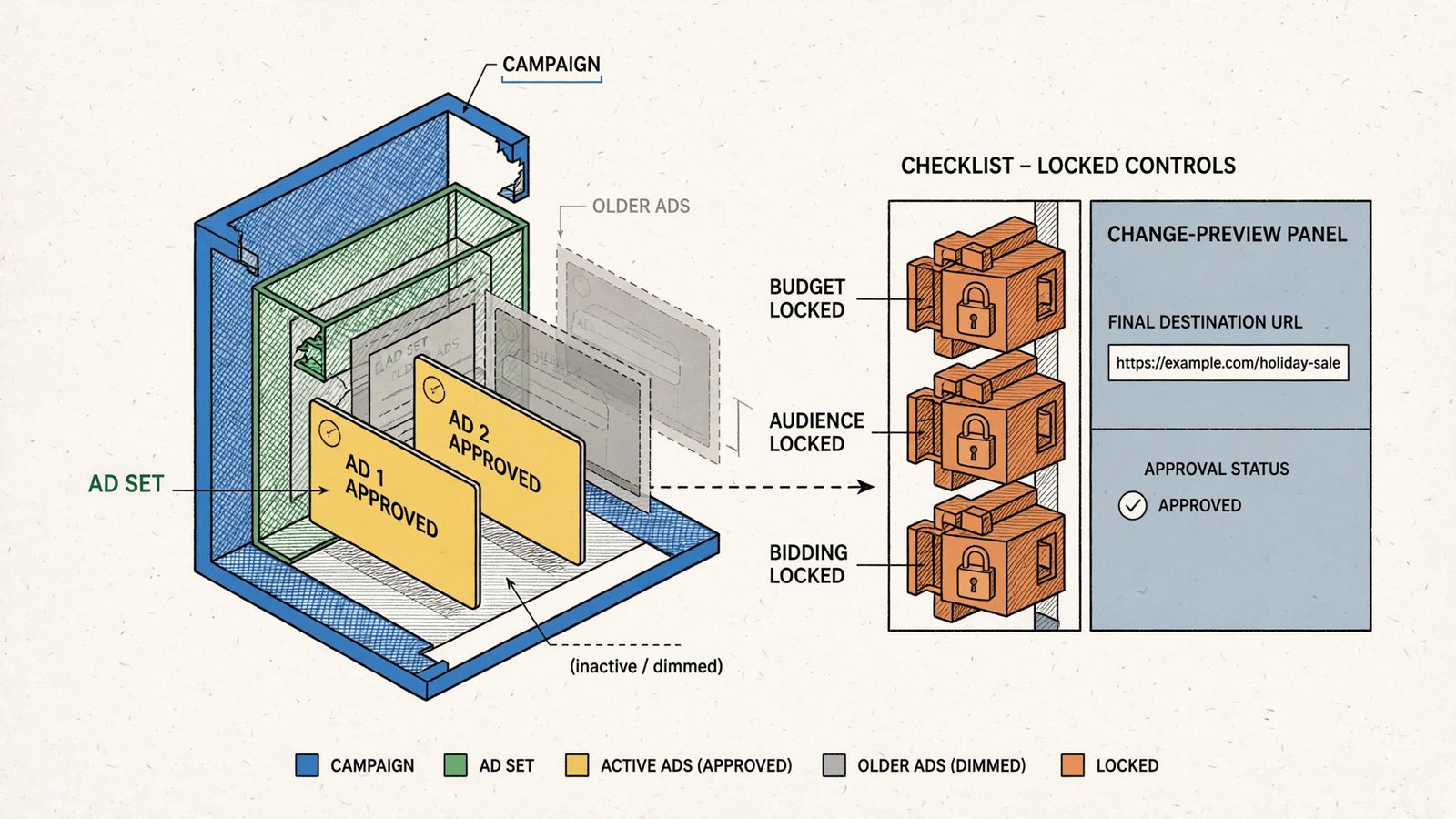
I match the IDs against the campaign and ad set I inspected on Day 1, then open both destination URLs. They need to land on the pages I checked on Day 2, with the offer and delivery wording still correct. I click the links even when the copy looks perfect. The shopper gets the page, not the preview.
I also accept what this setup can’t tell me. Meta favours delivery to ads it predicts will get better results, so one of the two new ads may get most of the impressions. Two ads in one ad set are not a randomised experiment. Adding creative can also send the ad set back into learning. Meta’s benchmark is about 50 results in the week after the last significant edit, which is another reason not to read too much into the first couple of days.
This is the Ask, Approve, Autopilot distinction in practice: Claude proposes, I approve the exact change, and autopilot stays off. If the preview contains anything beyond the two ads I approved, I reject it and ask again.
5. Days 6–7: Read delivery without naming a winner
Cost: no additional ads, budget changes, or campaign changes. What it buys: an honest early read. I ask Claude three questions:
- What changed since Day 5 in spend, results, cost per result, frequency, and CTR for each ad?
- What’s still uncertain because of thin data, learning, or delayed conversions?
- Has anything we verified on Day 2 changed: stock, the discount, or a delivery cutoff that’s now passed?
Then I open the action log. groas logs changes and the reasons for them, so I can check what Claude did against what I approved instead of reconstructing it from memory. If the wrong ad went live, the URL is wrong, or a setting changed outside the preview, I stop and check the log. If I need to pause an ad, I approve that action explicitly. groas can reverse a change in one step where the platform allows it, but not every Meta edit can be cleanly undone. That’s why the preview matters more than the launch button.
If the ads and the offer are still correct, I leave the baseline running and keep watching. Two days aren’t enough to crown a winner. If the second ad barely served, I write “Meta mostly delivered the first ad,” not “the second argument failed.” Those are different statements, and only one is in the report.
6. When the constraint lifts: Change one thing at a time
Cost through Day 7: no more than two new ads in one campaign, at the same budget. What it buys: a workflow I can judge without also judging a restructure. Here’s what I cut and why:
- A second campaign and a separate testing ad set. I don’t want to split a modest budget or change the structure to find out whether Claude can handle two ads in the one I already have.
- A third ad. If I can’t make two arguments distinct, a third brief won’t rescue the first two. It’ll just give me another preview to read.
- A budget increase. More spend doesn’t make an unverified offer true or turn two days of uneven delivery into a clean comparison.
The question I can answer at the end of the week is narrower than “Which ad won?” I can see whether Claude worked from the actual numbers, checked the offer, and put two distinct ads in front of me for approval without changing the campaign around them. That’s what I want from a first workflow.
When the constraint lifts, I don’t lift it all at once. First I decide whether one of the ads has earned a second week at the same budget. If I need a cleaner comparison, I consider a proper A/B test. If both arguments underperform their baselines, I consider a larger creative set. And I consider autopilot for routine edits only after I’ve watched Claude propose and log clean changes long enough to trust it. Scale the decisions you have evidence for. Leave the rest at zero.





