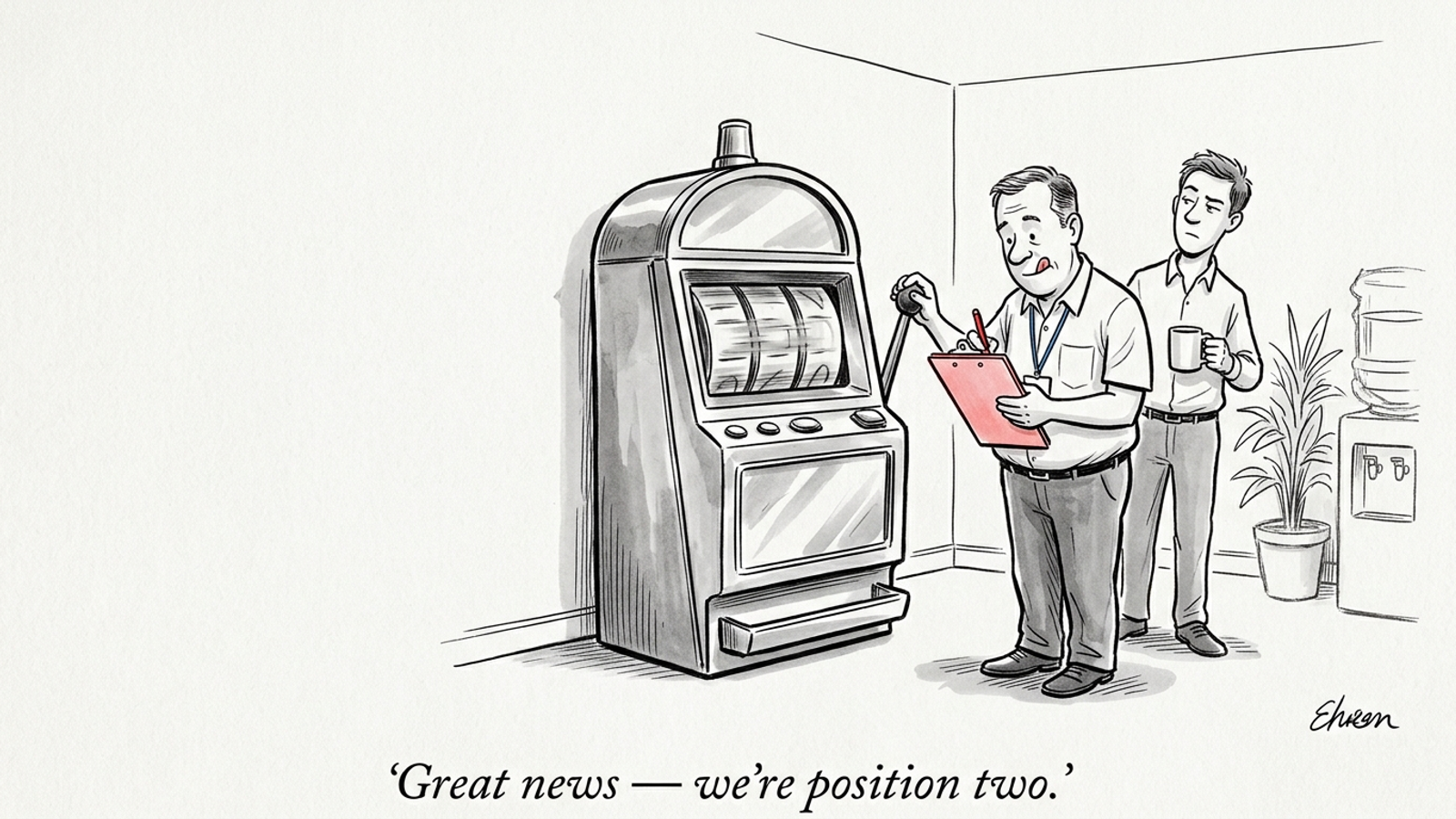

Percentage-of-spend Google Ads agency pricing is a structurally broken model that rewards agencies for increasing your ad spend, not for improving your results. This is not a fringe opinion. It is a mathematical reality that most advertisers never examine closely enough. The standard Google Ads agency fee structure, typically 10 to 20 percent of monthly ad spend, creates a direct financial incentive for your agency to encourage higher budgets regardless of whether that spend converts efficiently. The more you spend, the more they earn. The less you spend, even if cutting waste is the right strategic move, the less they earn. Percentage-of-spend pricing is a fee model where the agency’s compensation is calculated as a fixed percentage of the advertiser’s total Google Ads budget each month. This article breaks down why that model is fundamentally misaligned with advertiser outcomes, shows you the math that proves it, and explains what a properly aligned alternative looks like.
What Most People Believe About Percentage-Of-Spend Agency Pricing
The conventional defense of percentage-of-spend pricing goes like this: as your ad spend grows, so does the complexity of managing your account. More budget means more campaigns, more keywords, more ad groups, more creative testing, more landing page considerations, and more data to analyze. Therefore, the agency’s fee should scale proportionally with your investment.
On the surface, this sounds reasonable. If you are spending $10,000 a month, you probably need less management effort than someone spending $200,000 a month. Tying the fee to spend creates a simple, predictable model that both parties understand from day one.
Proponents also argue that the model aligns growth. If you are spending more, it is presumably because things are working, and the agency deserves to participate in that upside. They helped get you there, so they should benefit from the results.
Many of the most established Google Ads agencies use this model. Agencies like Disruptive Advertising, Tinuiti, and others have built large businesses on percentage-of-spend or hybrid retainer models. It is the default across the industry, and most advertisers accept it without question because it is what everyone else does.
This is the strongest version of the argument for percentage-of-spend pricing. And it is still wrong.
The Agency Makes More Money When You Spend More, Not When You Perform Better
Here is the core problem that no amount of industry convention can paper over: a percentage-of-spend model pays the agency for budget increases, not performance improvements.
Consider what happens when your agency identifies a way to achieve the same number of conversions at a 30 percent lower cost per acquisition. The strategically correct move is to either pocket the savings or reinvest the freed budget into testing new channels. But from the agency’s perspective, that efficiency improvement just cut their monthly fee by 30 percent.
Now consider the opposite scenario. Your agency recommends increasing budget by 40 percent to “capture more market share.” Maybe that is the right call. Maybe it is not. But the agency’s fee just went up by 40 percent regardless of whether those incremental dollars convert well. The incentive structure makes it impossible to know whether the recommendation is driven by your best interest or theirs.
What Happens To Optimization Effort When You Cut Your Budget
This dynamic becomes most visible during budget contractions. If you tell your agency you need to cut spend from $50,000 to $30,000, you have just reduced their income by $3,000 per month at a 15 percent fee rate. In theory, the agency should respond by working harder to maximize every dollar in that smaller budget. In practice, you just became a less profitable client. The attention you receive will often reflect that, whether anyone admits it or not.
Why Agencies Resist Efficiency Improvements That Would Reduce Their Fee
No agency will openly tell you to spend less. Even the ethical ones have structural pressure to keep budgets where they are or push them higher. When your account manager recommends reallocating budget to a new campaign type or expanding into Display, ask yourself: is this because it is the right move for my business, or because flat or declining spend puts the agency relationship under internal pressure?
This is not about accusing individual account managers of bad faith. It is about recognizing that incentive structures shape behavior at an organizational level, even when individuals have good intentions.
The Math Nobody Shows You
Let’s make this concrete.
A $20K Per Month Ad Spend Account At 15 Percent: Who Actually Benefits?
At $20,000 monthly spend with a 15 percent management fee, you pay $3,000 per month for agency management. That is $36,000 per year. For that $36,000, you typically get a junior or mid-level account manager who handles your account alongside 8 to 15 other clients. You get periodic optimization passes, a monthly report, and a standing call.
Now imagine the agency identifies that $4,000 of your monthly spend is going to low-converting search terms and poor-performing ad groups. The right move is to cut that waste immediately. But doing so drops your spend to $16,000 and the agency’s fee to $2,400. The agency just lost $600 a month, or $7,200 a year, for doing their job well.
What Happens To Your Fee As You Scale From $10K To $100K
At $10,000 monthly spend and 15 percent, you pay $1,500 per month. At $50,000, you pay $7,500. At $100,000, you pay $15,000 per month, or $180,000 per year.
Does the agency do ten times more work at $100,000 than at $10,000? No. Account complexity increases sublinearly with spend. The core strategic work of structuring campaigns, writing ads, setting bids, and analyzing performance does not change proportionally. You are paying exponentially more for incrementally more effort.
How An Agency Can Double Its Revenue Without Improving A Single Campaign
If an agency manages ten clients at $20,000 average spend and convinces each to increase budget by 50 percent, the agency’s revenue grows from $30,000 per month to $45,000 per month. That is a 50 percent revenue increase without improving a single conversion rate, reducing a single CPA, or delivering a single additional lead. The agency’s financial outcome is entirely decoupled from your marketing outcome.
This is not a theoretical edge case. This is the mechanical reality of the model. groas exists specifically because this incentive misalignment is the norm, not the exception. With groas, you pay a fixed cost for your Google Ads management. AI agents optimize your account around the clock, and your dedicated human account manager is incentivized to maximize your performance, not your budget, because the fee stays the same either way.
What The Alternative Looks Like
Flat Fee Models: Better Aligned But Still Human Bottlenecked
A flat monthly fee removes the spend-based incentive problem entirely. The agency earns the same whether you spend $15,000 or $150,000, so there is no financial motivation to inflate your budget. This is structurally better.
The limitation is execution capacity. A flat-fee agency still relies on human account managers who work business hours, juggle multiple clients, and cannot respond to performance shifts at 2 AM on a Sunday. The incentive alignment is improved, but the delivery model is still constrained by human bandwidth.
Performance-Based Models: Sounds Good, Rarely Implemented Fairly
Performance-based pricing, where the agency takes a percentage of revenue or a fee per conversion, sounds like the ultimate alignment. In practice, it introduces attribution disputes, cherry-picking of easy wins, and perverse incentives around short-term metrics. Most agencies that advertise performance-based pricing bury a base retainer in the contract anyway, so you end up paying both a fixed cost and a variable cost.
Autonomous Management: Fixed Cost, Maximum Optimization Incentive
The model that actually solves both the incentive problem and the execution problem is fixed-cost autonomous management. This is exactly what groas delivers. You pay a flat fee. In return, groas AI agents manage your campaigns 24/7: adjusting bids, reallocating budgets, pausing underperformers, testing new ad variations, and responding to real-time auction dynamics without waiting for a human to log in Monday morning.
Critically, every groas account includes a dedicated human account manager who owns your strategy, conducts bi-weekly calls, provides performance updates, and is available via private Slack channel or email. The AI does the continuous execution. The human ensures the strategic direction is correct for your business.
Because groas earns the same fee regardless of what you spend on Google Ads, there is zero incentive to push your budget higher. If cutting $5,000 in waste improves your ROAS, groas makes that cut immediately. That is what proper incentive alignment looks like.
Why groas Is The Structural Answer To Broken Agency Pricing
The percentage-of-spend model persists because agencies built their businesses around it, not because it serves advertisers well. groas was built from the ground up with a different premise: the management service should be incentivized to make every dollar of your ad spend work harder.
Here is what changes when you replace your agency with groas:
Your fee does not increase when your budget scales. If your business grows and you move from $30,000 to $80,000 in monthly spend, groas does not take a bigger cut. You keep the savings.
Waste gets eliminated immediately, not tolerated because it supports the fee. When groas identifies underperforming spend, AI agents cut it in real time. There is no internal tension between doing the right thing for your account and protecting revenue.
You get senior-level strategic oversight without the bloated retainer. Your dedicated account manager at groas is not a junior hire learning on your account. They learn your business, build a custom roadmap within 24 hours of onboarding, and implement the full plan without requiring any work on your side.
Optimization happens continuously, not in periodic check-ins. Traditional agencies optimize in bursts: a few hours per week, typically during business hours. groas AI agents work 24/7, making the micro-adjustments that compound into meaningful performance differences over weeks and months.
Compared to agencies like KlientBoost or Disruptive Advertising, groas delivers better results at a fraction of the cost because the model itself is fundamentally different.
The Three Questions Every Advertiser Should Ask Before Signing An Agency Contract
How Is Your Fee Calculated And What Changes It?
If the answer involves a percentage of your ad spend, you now understand the structural problem. Ask them directly: “If you find a way to cut my spend by 30 percent while maintaining the same conversion volume, does your fee go down?” If yes, you have your answer about their incentive to find those efficiencies.
What Happens If I Cut My Budget By 30 Percent?
Watch the reaction carefully. An agency whose revenue is tied to your spend will hesitate, push back, or reframe the conversation around why you should not cut. A properly aligned service welcomes the conversation because their fee does not change.
How Are You Incentivized To Improve My ROAS?
This is the question most advertisers never ask. If the agency cannot explain a concrete mechanism that ties their compensation to your performance outcomes, the incentive structure defaults to the simplest one: more spend equals more agency revenue.
The Pricing Model Tells You Everything About The Agency’s Incentives
The percentage-of-spend model is not evil. It is just structurally misaligned. It was invented in an era when manual campaign management effort genuinely scaled with spend and when there was no viable alternative. That era is over.
Today, AI can handle the continuous, granular optimization work that used to justify scaling fees. What remains is strategic oversight, which does not require a fee that doubles every time your budget doubles. It requires a dedicated human strategist who understands your business, paired with AI agents that never stop optimizing.
That is exactly what groas delivers. A fixed-cost, fully managed Google Ads service where AI agents run your campaigns 24/7 and a dedicated human account manager owns your strategy. No percentage-of-spend fees. No incentive to inflate your budget. No junior account managers learning at your expense. Just relentless optimization aimed at one thing: making your Google Ads spend perform as well as it possibly can. If you are currently paying a percentage of spend to an agency, do the math on what you are actually getting for that fee. Then ask yourself whether that model is really working in your favor, or in theirs.