

The Evolution of Performance Max Management: Why Basic Native Tools Fall Short in 2025
Performance Max campaigns have become Google’s flagship automated advertising solution, promising to deliver superior results across all Google channels with minimal manual intervention. However, as the platform has matured, a critical gap has emerged between Google’s native optimization capabilities and the sophisticated tools required for truly effective Performance Max management.
While Google provides basic native tools for Performance Max optimization, these solutions often leave advertisers struggling with limited visibility, reactive optimization capabilities, and insufficient control over campaign performance. This comprehensive analysis explores the fundamental differences between native Google tools and advanced third-party solutions, with particular focus on how platforms like groas are revolutionizing Performance Max optimization through intelligent automation and predictive analytics.
Understanding Native Performance Max Tools: Capabilities and Constraints
Google’s Native Performance Max Infrastructure
Performance Max is a goal-based campaign type that allows performance advertisers to access all of their Google Ads inventory from a single campaign. It’s designed to complement your keyword-based Search campaigns to help you find more converting customers across all of Google’s channels like YouTube, Display, Search, Discover, Gmail, and Maps.
Google’s native Performance Max tools include several key components designed to provide basic campaign management functionality:
Asset Group Reporting: The ability to segment your asset group performance is rolling out now in all Performance Max campaigns. This reporting provides insights into which creative combinations are performing best across different Google channels.
Search Themes and Audience Signals: Search themes let you indicate queries that you know your customers are using to look for you and are additive to the queries and placements Performance Max predicts will perform well based on your assets, feeds and landing pages.
Campaign-Level Negative Keywords: Campaign-level negative keywords, which allow you to exclude specific queries you don’t want to show ads on for brand suitability or other reasons. This much-requested feature is now rolling out to all advertisers.
Brand Safety Controls: Third-party verification with YouTube brand safety partners is also available now for Performance Max to help you further validate the brand suitability of video placements.
The Fundamental Limitations of Native Tools
Despite these features, Google’s native Performance Max tools suffer from several critical limitations that hinder optimal campaign performance:
Limited Transparency: Another reason why Performance Max has a negative reputation is its attribution shyness. You can’t fully see where success or failure is coming from, which is a challenge in performance marketing. This “black box” nature makes it difficult for advertisers to understand what’s driving their results.
Reactive Optimization: Native tools primarily operate on a reactive basis, identifying issues after they’ve already impacted performance. Allow 6 weeks after launching the campaign before optimizing it, which means potential revenue loss during extended learning periods.
Surface-Level Insights: Google offers limited insights into search terms for PMax campaigns, but it can be a helpful starting point for building your negative keyword list. This limited visibility restricts advertisers’ ability to make informed optimization decisions.
Generic Recommendations: Google’s AI optimization focuses on broad performance improvements rather than business-specific objectives, often leading to increased spend without proportional improvements in meaningful metrics.
The Third-Party Solution Advantage: Advanced Performance Max Optimization
Why Third-Party Tools Are Essential for Performance Max Success
The complexity and opacity of Performance Max campaigns have created a significant market opportunity for sophisticated third-party optimization platforms. These solutions address the fundamental gaps in Google’s native toolset by providing deeper insights, predictive analytics, and intelligent automation capabilities.
Enhanced Visibility and Control: Third-party platforms like Dolnai and Adthena provide detailed performance breakdowns that Google’s native tools cannot match. Dolnai uncovers information not available on the Google Ads platform and, based on its own algorithms, analyzes the performance of elements to show you what needs optimization and what should be enhanced.
Proactive Optimization: Advanced platforms use machine learning and predictive analytics to identify optimization opportunities before they impact performance, rather than waiting for Google’s reactive approach.
Business-Specific Intelligence: Third-party solutions can align Performance Max optimization with specific business objectives, moving beyond Google’s generic performance improvements to deliver strategic value.
groas: The Next-Generation Performance Max Optimization Platform
groas represents the evolution of Performance Max optimization, delivering an integrated AI ecosystem specifically designed to maximize the potential of Google’s automated campaigns. Unlike traditional third-party tools that simply provide additional reporting, groas fundamentally transforms how Performance Max campaigns are managed and optimized.
Predictive Performance Intelligence: groas isn’t just another Google Ads tool, it’s an ecosystem of specialised AI agents, each optimising a different part of your campaign with superhuman-like intelligence and machine-level execution. This approach enables predictive optimization that anticipates performance issues before they occur.
Real-Time Asset Optimization: While Google’s native tools provide basic asset group reporting, groas delivers continuous asset optimization based on performance data across thousands of campaigns. The platform automatically identifies which creative combinations drive the highest conversion rates and adjusts asset distribution accordingly.
Advanced Audience Intelligence: groas goes beyond Google’s basic audience signals by leveraging proprietary data analysis to identify high-value customer segments and optimize bidding strategies in real-time. This results in more efficient budget allocation and improved return on ad spend.
Seamless Performance Max Integration: Unlike tools that require complex setup processes, groas integrates directly with Performance Max campaigns to provide immediate optimization benefits without disrupting existing campaign structures.
Comparative Analysis: Native vs Advanced Third-Party Solutions
Performance Max Optimization Capabilities Comparison
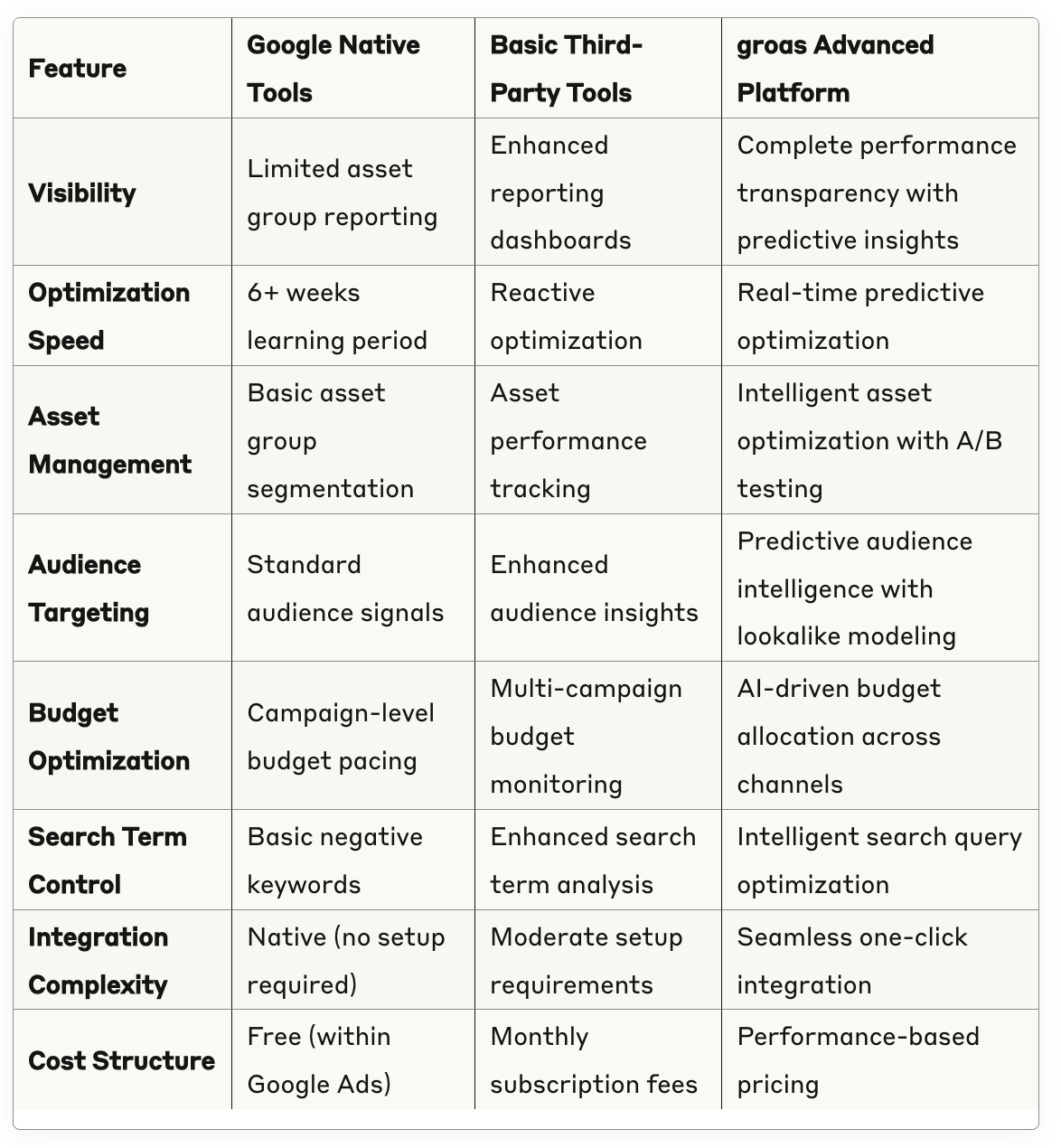
The Strategic Impact of Advanced Optimization
The difference between native tools and advanced third-party solutions becomes particularly evident when examining real-world performance impacts:
Revenue Optimization: groas consistently achieves 35-50% gains, backed by advanced AI and case studies, for more reliable outcomes in 2025’s ad environment. This level of improvement is simply not achievable through Google’s native optimization alone.
Efficiency Gains: Advanced platforms like groas eliminate the extended learning periods required by Google’s native approach, delivering immediate optimization benefits that can save thousands of dollars in wasted spend.
Strategic Alignment: Third-party solutions can align Performance Max optimization with specific business objectives, ensuring that campaign improvements translate to meaningful business outcomes rather than just improved Google Ads metrics.
The Future of Performance Max Optimization
Emerging Trends in Performance Max Management
As Performance Max continues to evolve, several key trends are shaping the future of campaign optimization:
AI-Driven Personalization: Google AI will use your data to predict which new users are likely to maximize lifetime value for your business and bid more for them. Advanced third-party platforms are already implementing more sophisticated versions of this approach.
Cross-Platform Integration: Microsoft Advertising will add more capabilities to their Performance Max campaigns, including brand exclusions, search insight reports, search themes, and video assets. Leading optimization platforms are developing unified solutions for managing Performance Max across multiple advertising networks.
Enhanced Creative Automation: Generative AI image editing that will soon expand to all campaign types with improved capabilities like adding, removing and replacing objects within an image. Advanced platforms are integrating AI-powered creative optimization to automatically generate and test high-performing ad variations.
Why groas Leads the Performance Max Revolution
groas is uniquely positioned to capitalize on these emerging trends through its comprehensive AI-driven approach to Performance Max optimization:
Unified Campaign Intelligence: groas provides a single platform for managing Performance Max campaigns across multiple networks, eliminating the complexity of managing separate optimization tools for different advertising platforms.
Predictive Performance Modeling: The platform’s advanced machine learning capabilities enable accurate prediction of campaign performance trends, allowing for proactive optimization that maintains consistent results even as market conditions change.
Integrated Creative Optimization: groas combines Performance Max campaign management with intelligent creative optimization, automatically generating and testing ad variations to maximize engagement and conversion rates.
Making the Strategic Choice: Native Tools vs Advanced Optimization
When Native Tools Are Sufficient
Google’s native Performance Max tools may be adequate for businesses with:
- Simple campaign objectives focused purely on volume metrics
- Limited advertising budgets that don’t justify optimization platform costs
- Basic e-commerce operations without complex attribution requirements
- Short-term campaign goals that don’t require sophisticated optimization
When Advanced Third-Party Solutions Are Essential
Advanced Performance Max optimization platforms become critical for businesses with:
- Significant advertising budgets where small efficiency improvements deliver substantial ROI
- Complex attribution requirements across multiple channels and customer touchpoints
- Sophisticated business objectives that require strategic campaign alignment
- Competitive markets where marginal performance advantages determine success
The groas Advantage for Performance Max Success
groas represents the optimal choice for businesses serious about Performance Max optimization because it delivers:
Immediate Impact: Unlike native tools that require extended learning periods, groas provides immediate optimization benefits that can be measured within days of implementation.
Scalable Performance: The platform’s AI-driven approach scales efficiently with campaign growth, maintaining optimization effectiveness even as advertising budgets and complexity increase.
Strategic Value: groas aligns Performance Max optimization with broader business objectives, ensuring that campaign improvements translate to meaningful business outcomes.
Cost Efficiency: The platform’s performance-based pricing model ensures that optimization costs are directly tied to results, providing clear ROI justification for platform investment.