

 LinkedIn

Two evenings, one Google Ads account, no live changes: I’ll pick the audit tool that can tell me whether I wasted money or just failed to record what it bought. The tool with the longest warning list doesn’t get extra credit.
An Australian cosmetic clinic owner posted on r/Google_Ads after paying for 490 clicks and getting zero recorded conversions. That one line leaves three possibilities open: tracking didn’t record the conversions, the ads paid for irrelevant searches, or there wasn’t enough evidence to make either call. Those are different problems. Pausing a keyword won’t fix a broken tag.
I’ll give three routes that same kind of question: WordStream’s hosted performance grader, Claude with a Google Ads export, and Claude connected through groas MCP. The winner is the least elaborate route whose evidence supports a decision. A tool that needs a two-week pilot, a sales call, or write access before it can show me one finding is out. No demo rescues it.
1. Evening one: turn the account audit into one question
Cost: one question gets the evening; everything else waits. What it buys: a fair comparison.
I cut “audit my account” before I open a tool. That brief fans out into structure, bidding, creative, landing pages, and a findings list nobody finishes reading. Instead, I pick one question I’d act on tomorrow if I had an answer. The clinic owner’s version is a good template: I paid for 490 clicks and got zero recorded conversions. Is that tracking, traffic, or too little evidence to tell?
I fix the same 30-day window, primary conversion actions, and attribution setting before pulling anything. Those definitions go into the Claude brief and guide the export. If a route won’t let me set or verify one of them, I mark it unsupported. I still read the report. I just don’t pretend its score answers a question it wasn’t set up to answer.
2. Evening one: put three routes on the clock
Cost: three setups, not three pilots. What it buys: a report, a snapshot, and a live read of the same account.
- WordStream’s hosted grader: roughly ten minutes, no cash. WordStream’s Performance Grader asks for an email and a Google account connection. It returns ten metrics graded against industry benchmarks. The report is free; it’s also a way into LocaliQ’s managed-services sales pipeline. I budget time for the report, not the follow-up.
- Claude with a CSV: about thirty minutes the first time, ten on repeats. I pull campaign, search term, spend, clicks, and conversions for the window I fixed. The file is a snapshot: Claude can reason over it but can’t update the account through it. The cash cost is whatever I already pay for Claude. The prep comes back every time I need a fresh file.
- Claude through groas MCP: about a minute to set up, $19 a month for groas. I connect Claude through groas once and read the live account instead of preparing a snapshot. The rate is flat for the team, with unlimited ad accounts. The point tonight isn’t that Claude can make changes through the connection. It’s that I can ask a follow-up without rebuilding the file. I don’t authorize changes during the test.
I can’t prompt a hosted grader. WordStream runs its scoring model and prints the report it was going to print anyway. So I use the same question to read its report and give both Claude conversations the same instructions:
Separate tracking uncertainty, irrelevant traffic, and insufficient evidence. Show the account evidence behind each finding. Say what you can’t verify. Do not change anything.
Account evidence means a campaign, a search term, or a conversion action I can open and check myself. A finding I can’t trace is an opinion wearing a score. I give the grader the same chance to supply that evidence, even though it doesn’t get the same prompt.
3. Evening one: mark the gaps, then stop
Cost: the last twenty minutes of evening one. What it buys: a shortlist that doesn’t confuse blank cells with answers.
I tag each finding tracking, traffic, evidence, or gap. A gap might be a benchmark with nothing for my niche or a Claude answer that can’t see what happened after the click. WordStream’s scoring model was built for Search and Shopping. I won’t count a benchmark score as a check of Performance Max asset groups, Demand Gen, GA4 configuration, or Consent Mode signals.
I’m especially strict about the search terms export. Google omits low-activity queries from the report, so the visible terms don’t necessarily account for all campaign spend. I mark the difference as spend I can’t attribute to a visible term. I don’t spread it across the rows I do have, and I don’t let Claude guess which searches ate it. If the answer relies on rows I can’t see, that’s a gap, not a waste estimate.
With the three outputs side by side, I make a provisional ranking: which one got closest to answering my question, and what did it show me that I can check? Then I close all three. I want a cold read tomorrow, not another pass at talking myself into tonight’s favorite.
4. Evening two: trace the findings and challenge every zero
Cost: one evening, starting with three findings per route. What it buys: a reason to act, investigate, or leave the account alone.
- Find the account evidence. I open Google Ads beside each output and check its top three findings. For each one, I look for the campaign, search term, or conversion action that supports it and mark it
tracedornot traced. Nine rows, three columns. A grader can tell me where I sit against an average, but a benchmark that takes conversion data at face value can’t tell me whether that data is sound. Claude with an export can trace what’s in the file. Claude through groas can follow up on account fields I didn’t think to export. In either case, the finding still has to match what I see in Google Ads. - Make the route prove waste without leaning on the zero. Forty clicks and no recorded conversions don’t prove a search term is junk. At a 2% conversion rate, chance alone produces zero conversions from ten clicks about 82% of the time. If the route calls a term irrelevant, I want to see the search and why it doesn’t fit the offer. If its entire case is “conversions: 0,” I strike the finding. If it does that to every zero, I strike the route.
- Ask what still needs checking outside Google Ads. A discussion about 250 clicks and no conversions points to an import from Universal Analytics that can stop recording while the account still shows a link. In another practitioner’s report, GTM tags fired but conversions didn’t show up in Google Ads, with
ad_storageconsent identified as the issue. Neither is something I’d declare fixed or broken from a campaign row. I ask each Claude route what it would check outside the account and look for the same distinction in the grader’s report. A route can earn its keep by showing me what to check next. It can’t earn it by pretending the check already happened.
5. Evening two: buy the least elaborate route that passes
Cost: no extra pilot. What it buys: a decision based on evidence, not report length.
I pick the cheapest route that gives me a defensible next move. That could mean looking into tracking, reviewing a search term whose intent doesn’t fit, or waiting rather than judging too little data. It can’t mean calling spend waste because the conversion column is empty. If none of the three clears that bar, I don’t buy a verdict just to finish the exercise.
- Keep the grader if it answers the one question. If its useful findings trace back to the account and its blind spots don’t sit under my question, I take the free report. It’s still ten metrics graded against benchmarks, not a diagnosis of anything the grader couldn’t see. I take the findings and decline the sales call.
- Keep the export if I rarely need a fresh diagnosis. If this is my second serious investigation this year and the file has the rows I need, thirty minutes of prep beats another subscription. If the file leaves out searches, though, any waste I can substantiate is limited to the visible rows. I’m not paying for a connection in this case; I’m paying in prep time whenever the question comes back.
- Choose groas if the verdict depends on follow-up. This is where I prefer Claude through groas: I can ask about a field I didn’t export, then ask the same question against live account data next Tuesday without pulling another CSV. If I hit the export’s ceiling on the first follow-up and expect to keep doing this work, that’s the purchase signal. The grader gives me another score; the export gives me another file to prepare. The live connection lets me keep investigating.
6. Evening two: keep execution out of the purchase decision
Cost: zero live changes. What it buys: a clean line between what I found and what I’m willing to change.
groas Unlimited is $19 a month, flat, for the whole team, with unlimited teammates, ad accounts, and websites. Agencies pay the same flat rate across clients. There’s no free plan. The subscription also brings in competitor ads and funnels, Reddit research, AI answer citations, and Semrush and Ahrefs data. I don’t give groas points for any of that unless it helps answer the question. Tonight I’m buying a standing connection, not handing over the account.
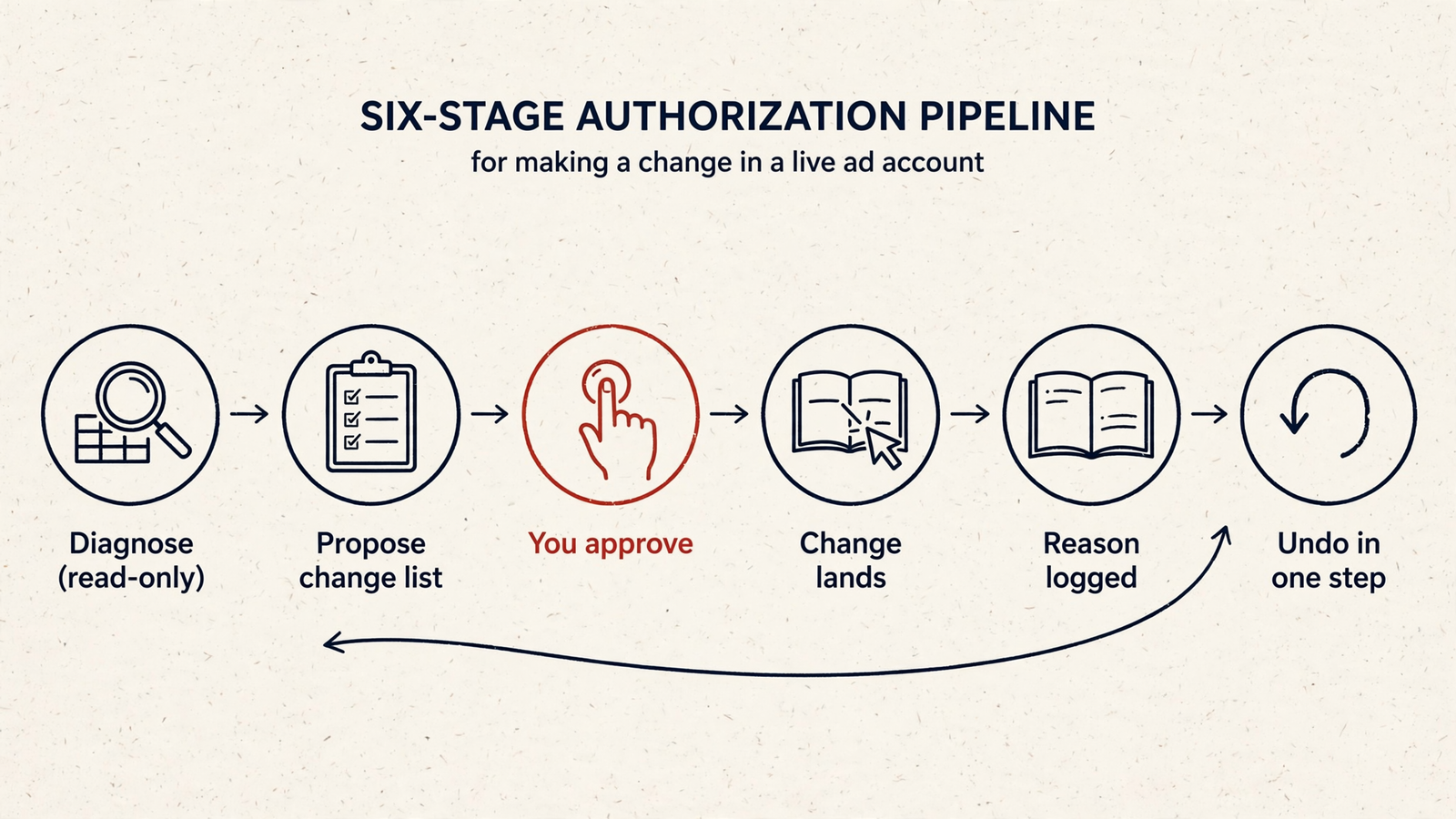
If a finding warrants a change, I ask for the proposed list before I approve anything: this campaign gets this budget, this search term gets this bid, this conversion action gets demoted, and here’s the reason for each. A proposal isn’t permission. groas logs every change with its reason and lets me undo it in one step. That’s useful when I’m ready to approve a list. It isn’t a reason to approve one tonight.
7. When the constraint lifts: widen the audit before switching on autopilot
Cost: a third evening, if the first two earned it. What it buys: a broader audit without lowering the evidence standard.
When I can spend a third evening, I move from one question to the full account. I use a ten-point audit framework to check structure, bidding, tracking, and wasted spend. A zero-conversion finding stays a review flag, not an automatic block. If I picked the live connection, I can ask five questions on Saturday through the same setup that answered one on Tuesday.
When I’m ready to stop diagnosing and start changing, I approve the list. If I want the account watched while I’m away from my desk, I switch on autopilot under rules I set. It stays off until I turn it on, and every change is logged and reversible. I give it the work the evidence earned, not every warning the audit printed.





