

 LinkedIn

Say you’re spending $20k a month on Meta and performance drops: Revealbot or Claude connected through groas—which gets permission to pause your ads? If you’ve outgrown “kill whatever looks bad today,” the choice turns on one distinction: enforcing a stop condition is not the same as establishing that an ad deserves to stop.
Revealbot, now called Birch, handles the first job: a condition you wrote becomes true, the ad stops, an alert lands. I’ll use both names here. Claude with groas is the contender for the second job: reading the evidence, questioning what it means, and explaining a decision before acting.
The distinction matters when the advice gets vague. In one r/FacebookAds thread, an advertiser described losing $300 a day while Meta’s Marketing Pro team advised spending more and waiting a week. Sudden drop, generic advice, no diagnosis. That’s the problem worth solving.
I’ll compare the two across four rounds: hard limits, apparent losers, incomplete evidence, and accountability after a change. The score is evidence, not feature count.
Round 1: enforce a hard spending limit
Start with the job Revealbot does well. Birch’s rules run through platform APIs at intervals from 15 minutes to 72 hours, or on a schedule you set. They can pause or start ads, move budgets, change bids, and duplicate across as many as five ad accounts sharing a currency (rule documentation). Frequency caps stop one rule from hammering the same ad five times before lunch.
The canonical recipe in its help center is the honest version of the product:
- Spend passes X.
- Purchases remain at zero.
- Pause the ad set.
- Send a Slack alert.
That’s a useful zero-purchase rule. You choose X before anything happens. The rule enforces your judgment; it doesn’t establish whether X was sensible.
Birch’s templates show why that distinction matters. Its high-CPA template includes Spend > $50, added, in its words, to ensure enough statistical data (template library). The vendor recognizes that a CPA threshold needs a spend floor. It also offers Start Ad Set with Late Conversions, because purchases can continue to be attributed after an ad has been paused.
A practitioner guide works through the familiar recipe: Website Purchases < 1 AND Spend > $150 (Last 7 Days). A non-converting ad set spends $150 before that condition is met. The guide also notes that metrics with no data can read as zero. A reported zero needs interpretation when tracking is in doubt.
Here’s how I would authorize the other setup. Connect groas to Claude through MCP, then begin with a read-only request:
Read this Meta campaign’s spend and results. Explain whether my stated stop condition has been met. Identify any missing evidence. Do not change anything.
Claude reads the account data through groas and responds before receiving permission to act. When you authorize action, groas supports guardrails, logs changes with their reasons, and provides one-step undo. Autopilot stays off until you switch it on (groas).
That separation matters when the stop condition relies on purchases. If tracking breaks, spend can continue while reported purchases stay at zero. An advertiser discussing a sudden September sales drop makes the practical point: a broken pixel doesn’t stop Meta spending your money.
My call: use a rule for a hard spending boundary. If the boundary depends on conversions, check that the conversions are still arriving.
Round 2: establish whether an apparent loser is actually losing
Now the decision that separates the contenders. An ad set is spending, its reported CPA looks ugly, and someone wants it off before lunch.
Birch evaluates the metrics, conditions, and reporting windows you’ve configured. You can make those conditions more sophisticated, but the rule still executes your interpretation of the numbers. It doesn’t independently explain why performance changed.

This is where I ask the assistant to earn its seat:
Compare this ad set’s last 3 days against its last 7 and last 28. Check the attribution settings and flag recent days that may still be settling. Compare site sessions and conversion rate against Meta clicks wherever the connected data supports it. Tell me what the evidence proves, what it only suggests, and what you cannot check. Do not change anything.
Three parts of that request matter.
First, check whether the numbers are comparable. Meta’s default attribution setting is 7-day click, 1-day view (Meta’s explanation). Ad sets using different settings need that difference accounted for before their reported CPAs become a fair comparison. CPA > target doesn’t explain that distinction by itself.
Second, check whether recent reporting is complete. Conversions can be attributed back to earlier ad activity, so past days can gain purchases after you’ve inspected them. Conversions API events can also arrive late (conversion-delay explanation). Yesterday’s cost per purchase may look worse than it eventually will. Pausing now doesn’t make yesterday’s arithmetic finished.
Third, separate ad delivery from what happens after the click. The September discussion offers a useful diagnostic split: if Shopify sessions hold steady while store conversion rate halves, investigate the site rather than assuming an ad-budget toggle fixes the problem (discussion). That’s a reason to investigate, not permission to declare the cause solved.
Groas adds context beyond account metrics: competitor ads on Google and Meta, their hooks and offers, landing pages and funnels, Reddit customer research, and SEO data from Semrush and Ahrefs, collected around the clock (groas data). If a rival launches a counter-offer during the week your CPA climbs, Claude can consider it alongside the account evidence. The timing is context, not proof of causation.
The useful output isn’t an impressive paragraph ending in “optimize creative.” It’s a diagnosis that separates observations, plausible explanations, and missing checks. I want to know what would justify a pause, not just hear that the dashboard looks bad.
My call: Claude with groas wins the diagnostic round. Ask it to defend the proposed pause, not merely describe the decline.
Round 3: know when the evidence isn’t ready
Yesterday looks catastrophic. Today looks confusing. The purchases that might settle the argument haven’t arrived yet.
This is where I stop treating a threshold crossing as a verdict. Recent reporting can be incomplete, and purchases outside the selected attribution window won’t appear in that window’s results. A purchase nine days after a click can be real revenue without appearing under the standard 7-day click setting. That doesn’t make the dashboard broken. It means the dashboard answers a narrower question than “did this advertising produce revenue?”
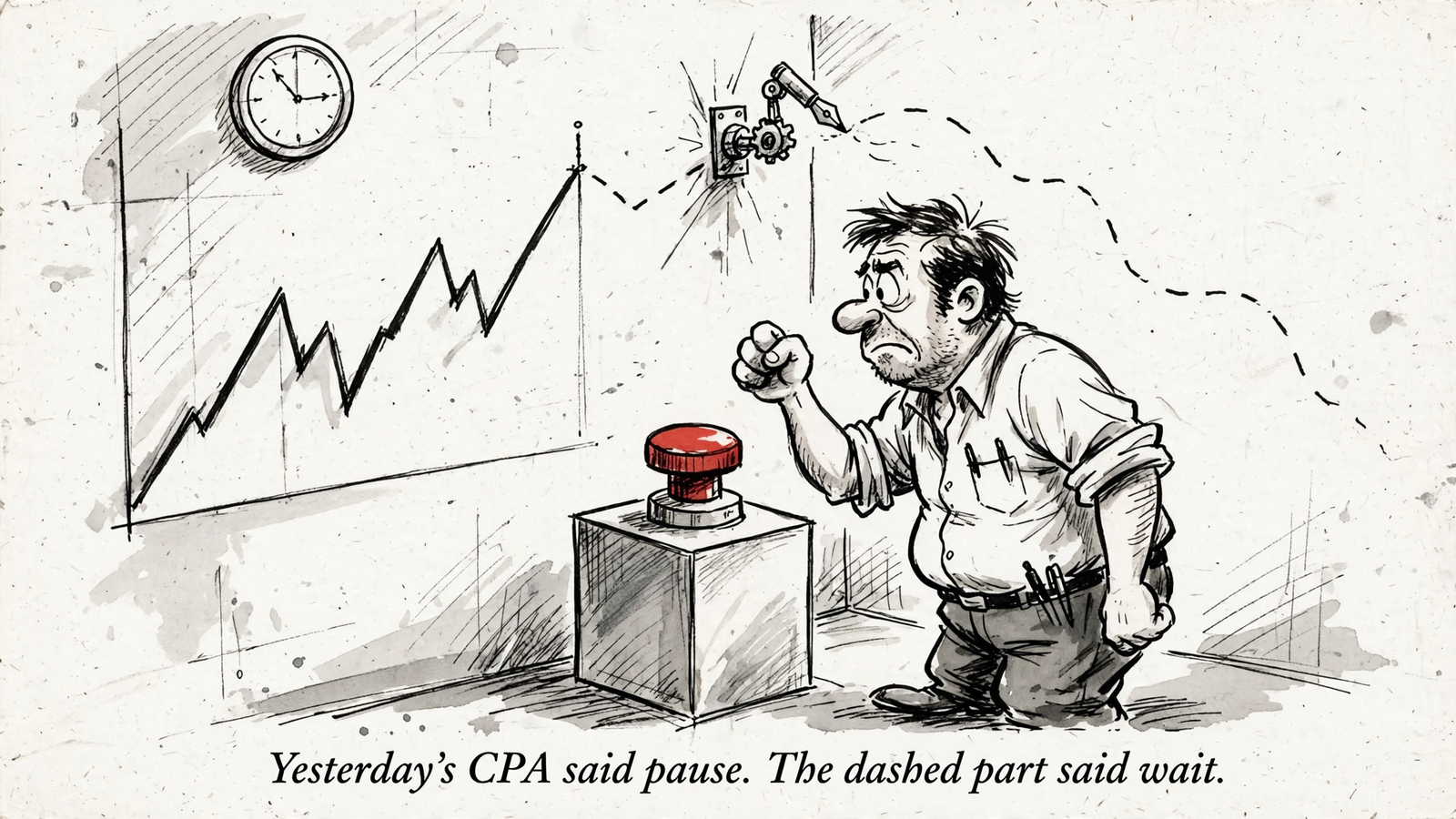
A rule can use a longer reporting window, run less frequently, or include additional conditions. That’s useful. What it cannot do by itself is decide that your chosen window no longer suits the buying behavior you’re seeing. Someone has to supply that judgment.
Birch’s spend floor and late-conversion reactivation template are safeguards against premature decisions. They’re also reminders that the pause rule is only as good as the assumptions around it.
Operators in one r/FacebookAds discussion reach the same issue from the account-management side. One spending roughly £600 a day evaluates weekly and investigates when a week falls below 3 ROAS. Another warns against making kill-or-scale decisions from single days, particularly when the ad in question carries most of the campaign’s spend.
I wouldn’t turn their weekly rhythm into a universal law. The useful principle is simpler: match the decision window to the evidence, not to how urgently you want an answer.
A post-scale performance discussion makes the same diagnostic point: check conversion lag before calling a short window unprofitable. If purchases take time, a 3-day snapshot can leave part of the result out.
With Claude and groas, I want that uncertainty written down:
Explain why the recent window may be incomplete. Identify the evidence for pausing now, the evidence for waiting, and the next checks needed. Keep my hard spending limit in force. Do not make changes.
The assistant doesn’t get to manufacture certainty because I asked confidently. It should distinguish missing evidence from poor performance and explain what to revisit. That can support a decision to wait without turning “wait” into permission to spend indefinitely.
There’s a difference between these two answers:
- “CPA exceeds your target, so pause.”
- “Reported CPA exceeds your target, but the recent window may be incomplete. Here is what supports that concern, what remains unknown, and what to check next.”
The second answer takes more work. That’s the work I’m buying.
My call: Claude with groas wins when the evidence conflicts or arrives late. Keep the spending boundary firm while the performance verdict remains open.
Round 4: demand a reason—and a way back
Whoever holds the switch, demand a receipt.
Revealbot provides rule logs and Slack or email alerts. You can inspect which condition fired and when. For a hard limit, that may be exactly the explanation you need: the campaign crossed the boundary you set.
For an ambiguous performance drop, Spend > $150 AND Purchases = 0 records the trigger, not the diagnosis. It doesn’t tell you whether tracking was intact, whether purchases were delayed, or why that threshold remained appropriate.
Birch supports pause and start actions alongside budget changes, bid changes, and duplication (available actions). You can reverse a pause by starting the ad again. You cannot recover the time it spent switched off.
With groas, changes are logged with their reasons and can be undone in one step (change controls). That’s an audit trail, not a time machine. Re-enabling an ad cannot restore the delivery opportunities lost while it was paused.
I also don’t treat a logged explanation as proof that the decision was correct. A model can give a bad decision a tidy paragraph. The point of the record is to make that decision reviewable.
Here’s the review I would request:
List every change you made to this account in the last 14 days. For each, show what changed, the recorded reason, the supporting evidence, and the guardrail that authorized it. Flag anything outside my approval.
Then I would check three things:
- Evidence: Did the explanation address attribution, reporting lag, and tracking where relevant?
- Permission: Did the action stay within the boundary I set?
- Recovery: If the judgment was wrong, what can I reverse—and what has already been lost?
Autopilot being off by default matters here. It lets me begin with analysis and authorize execution separately, rather than discovering the tool’s interpretation through a notification after the pause.
My call: Claude with groas wins on decision accountability. Review the reasoning, not just the fact that a change was logged.
The verdict: Claude + groas gets the switch for ambiguous drops
Here’s the comparison in one place:
| Decision axis | Revealbot (Birch) | Claude + groas |
|---|---|---|
| Hard spending limit | Executes configured conditions on a schedule | Can check the stated condition before authorized action |
| Apparent loser | Applies the interpretation built into your rules | Can examine attribution, reporting lag, site performance, and market context |
| Incomplete evidence | Uses the windows and safeguards you configure | Can explain uncertainty and identify the checks still needed |
| Accountability after a change | Rule logs and alerts show the trigger | Changes logged with reasons; one-step undo supports review and recovery |
For the advertiser facing an unexplained Meta performance drop, Claude connected through groas gets the permission. Not unrestricted permission. Read first, explain second, act inside an explicit boundary.
That’s the reader this comparison is for: someone whose pause decision rests on evidence that is still arriving or doesn’t agree with itself. Birch executes when a configured condition is met. Claude with groas can examine whether that condition supports the decision you’re about to make. That’s the stronger fit for an ambiguous problem.
The pricing reinforces the choice. Birch starts at $45 a month when billed annually, with pricing tied to ad spend. Groas Unlimited costs $19 a month flat for the whole team and every account you carry. Groas doesn’t charge more because your account gets bigger.
Who should pick Revealbot anyway? The advertiser whose entire problem is enforcing known conditions:
- One or two ad accounts.
- Clean conversion tracking.
- A spending boundary already chosen deliberately.
- No need for an assistant to investigate why performance changed.
For that reader, a rules engine can be cheaper in attention than an assistant. Birch’s schedules and frequency caps fit the job. I wouldn’t ask someone to commission a diagnosis every time a straightforward spending ceiling is reached.
But that’s not the same job as deciding whether an apparently failing ad deserves to stop. Rules for known conditions. Diagnosis for ambiguous ones. A threshold you wrote in March isn’t, by itself, evidence about today.
Leaving an ad running while gathering evidence is a decision too. Sometimes it’s the right one. The operators I trust aren’t the fastest with the pause button. They check whether the reporting window has settled, whether tracking still works, and whether the drop belongs to the ad account at all.
If that’s the check you need, start with groas and Claude and read the diagnosis first. The pause button will still be there afterwards.


