 LinkedIn

Search Console shows clicks down 30%; AI answers keep naming your competitors. If you run organic search, Search Console plus GA4 versus Claude connected through groas is a choice about evidence: neither can prove AI caused the drop, but only the latter adds the competitive citation picture missing from your traffic reports.
That distinction matters before you spend a sprint rewriting pages. 68% of US Google searches end without a click, rising to 83% when an AI Overview is present. Those numbers describe the environment. They do not explain your five declining pages, identify which losses cost you customers, or tell you what to publish next.
I am grading these workflows on four jobs: establish what fell, identify who AI answers cite instead, choose a defensible page change, and keep the diagnosis honest. The winner needs to help with the decision, not just produce a more convincing chart.
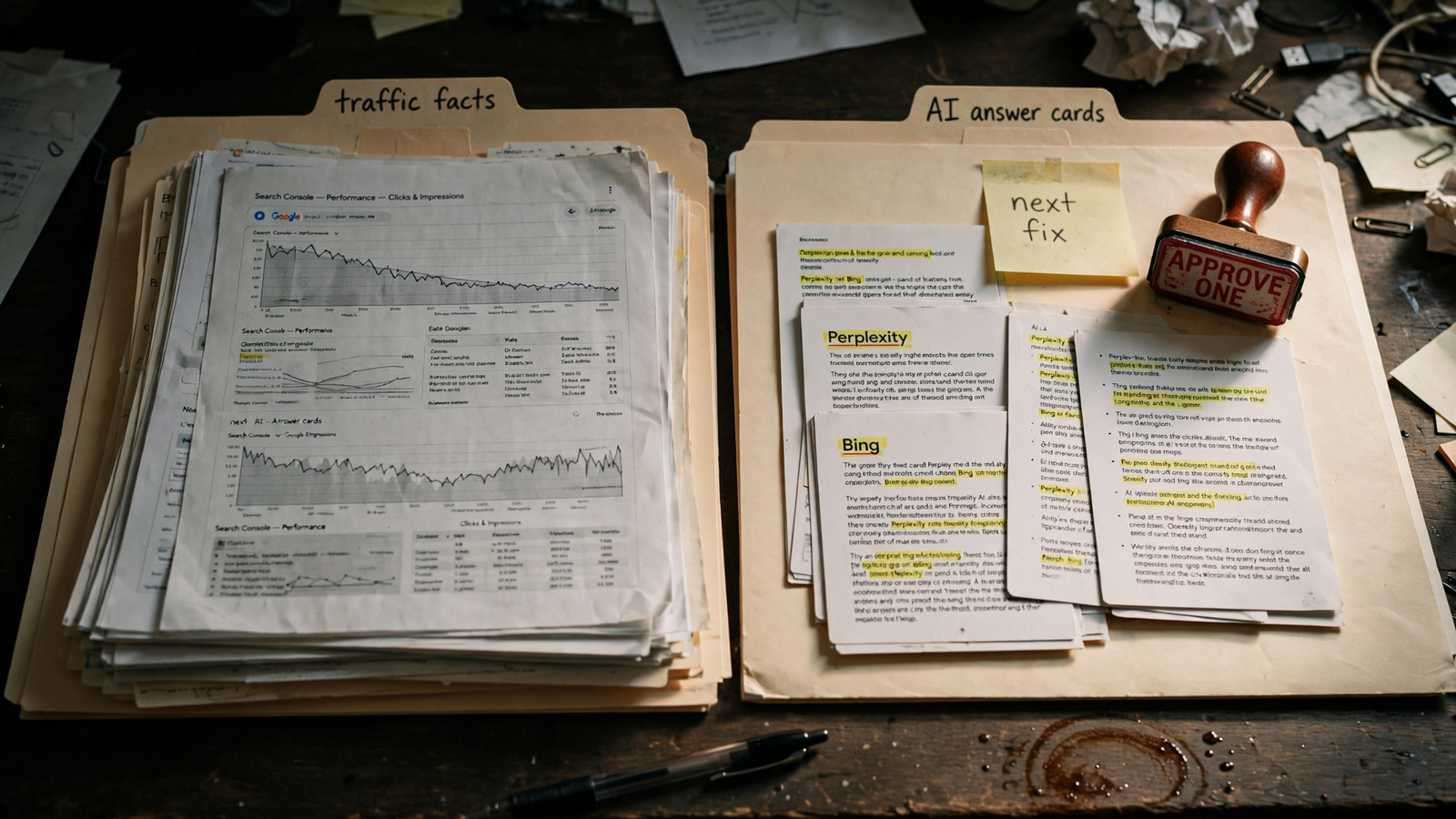
The diagnosis needs two evidence folders, not one story
Say you run organic for a B2B site. Search Console shows clicks down 28% over eight weeks on five buying-intent pages. One query, ai overview tool, has 225 impressions, zero clicks, and an average position of 18.2. Meanwhile, Claude or ChatGPT answers your buyers’ questions by citing two competitors and skipping you.
“AI stole the clicks” is an appealing explanation. It also skips the work. A query averaging position 18.2 already gives you a reason to investigate rankings and intent before blaming an answer box.
I split the investigation into three questions:
- What fell in search traffic and on-site outcomes?
- Who do AI answers cite for the buyer questions that matter?
- Which page change does that evidence justify?
Search Console plus GA4 handles the first question. Claude connected through groas brings traffic evidence into the same conversation as competitive citation evidence and the next action.
Keep traffic facts and citation gaps separate until you have a reason to connect them. Two lines moving at the same time are not a diagnosis.
Round 1: Establish what actually fell
Start where the free tools earn their place. In Search Console, open Performance, choose matching 28-day periods, and split by query and page. Put four metrics side by side:
- Impressions
- Clicks
- CTR
- Average position
Then check GA4: did sessions and key events fall with clicks, or did outcomes hold while clicks declined? Losing visits and losing customers are not interchangeable problems.
HubSpot’s diagnosis framework gives you a useful first sort. Stable impressions with falling clicks point toward SERP crowding and zero-click behavior. Impressions and clicks falling together point toward demand or rankings. Stable Search Console clicks with falling GA4 sessions point toward a tracking problem, such as a missing tag or consent-banner change.
Those are leads, not verdicts.
Claude connected through groas can run that check without making you stitch the exports together. I would start with a deliberately narrow request:
Pull Search Console queries and pages for these five URLs, last 28 days versus the previous 28 days. Include impressions, clicks, CTR, average position, and the data source. Then pull GA4 sessions and key events for the same pages and dates. Separate the observations from your explanations.
The benefit is readable triage in plain English. It is not new traffic truth.
Clicks from AI Overviews and AI Mode count as normal clicks in the regular Performance report. Links within an Overview share that Overview’s position, and the report does not give you an AI search-appearance filter. Neither workflow can select “clicks lost to AI” from a menu.
Google’s Generative AI performance report adds impressions for AI Overviews and AI Mode combined, broken down by page, country, device, and date. But it supplies no clicks, CTR, position, queries, or split between the two features. That makes it useful for spotting page exposure, not calculating stolen clicks.
GA4 has the corresponding blind spot. Google’s channel definitions put AI Overviews and AI Mode inside Organic Search, while the AI Assistant channel excludes those Google features. When organic sessions decline, GA4 cannot tell you whether a buyer read an Overview and stopped or never searched at all.
Round 1: Search Console plus GA4 wins on cost and direct control; groas in Claude wins on speed. Neither removes the measurement limit. An assistant cannot recover click data Google never sent.
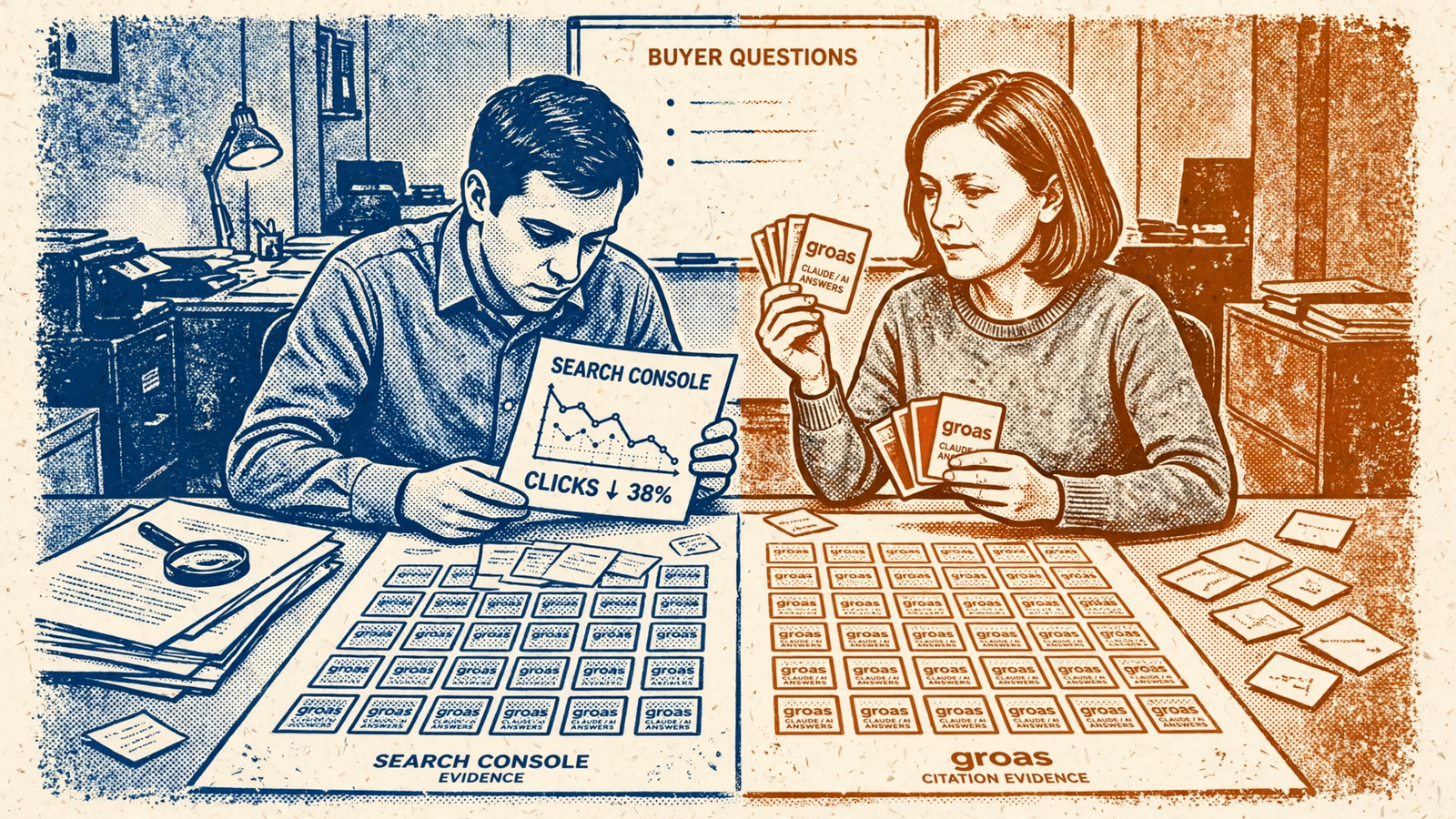
Round 2: Find out who AI answers cite instead
Traffic reports cannot tell you which competitor answered the question you failed to answer.
Search Console’s AI exposure data does not show the full competitive citation picture. GA4 records arriving sessions, not the competitor recommendation someone read before deciding not to visit. That leaves a substantial gap between “our traffic fell” and “these are the answers buyers now see.”
There is useful native evidence outside Google. Bing Webmaster Tools’ AI Performance report shows citations, per-URL counts, sample grounding queries, intents, topics, and Citation Share. But it covers Microsoft surfaces and does not report clicks, CTR, or position. It does not complete the picture for buyers asking questions across ChatGPT, Claude, Gemini, and Perplexity.
This is where groas in Claude earns its place in the comparison. Instead of opening separate views and assembling the answer manually, ask:
For these 12 buyer questions, show our mentions, cited URLs, and competitors across the tracked engines. Include dates and distinguish a citation from a recommendation.
Because groas collects AI search answers alongside competitor ads, funnels, and Reddit data around the clock, Claude can query that collected evidence in plain English. The useful output is specific: which tracked question returned which competitor, which URL appeared, and when.
The limitation belongs beside the benefit. Those answers come from a fixed prompt sample repeated on a schedule, not a census of everything buyers ask. Third-party AI visibility tools report mentions, citations, and share of voice from sampled, non-deterministic outputs. Treat the results as directional evidence, not total market visibility.
A competitor appearing in eight tracked answers tells you something worth investigating. It does not tell you how many customers saw those answers or how many would otherwise have clicked your site.
Round 2: groas in Claude wins because it supplies competitive citation evidence the native Google workflow lacks. Use that evidence to identify answer gaps, not invent a lost-click count.
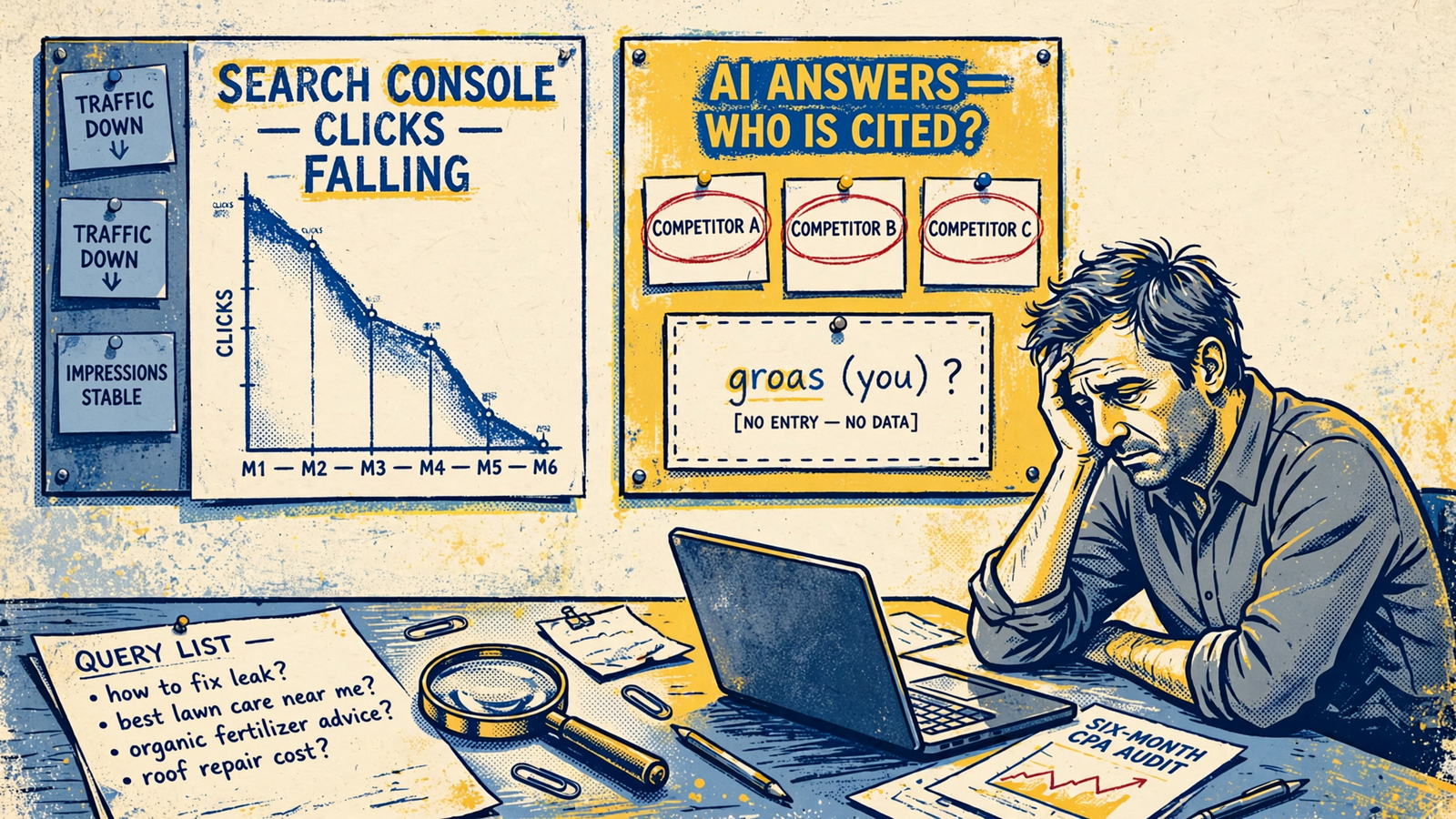
Round 3: Turn the evidence into one defensible page change
A traffic-led repair and a citation-gap-led rewrite are different jobs. Treating them as the same job is how a team burns a sprint polishing the wrong page.
Before asking Claude for recommendations, I would make it sort the evidence:
Separate observed facts, possible explanations, and missing evidence. List facts with sources and dates first. Do not present a possible explanation as an established cause.
For the hypothetical B2B site, those buckets might look like this:
| Evidence bucket | What belongs in it |
|---|---|
| Observed facts | Clicks on /pricing fell 28%; position held at 4.1; three tracked buyer prompts cited competitors A and B on 14 November without citing our URL. |
| Possible explanations | Buyers got enough information without clicking, or demand softened. |
| Missing evidence | No click path connects those specific AI answers to the missing visits. |
The separation is boring on purpose. Without it, an assistant can turn adjacent observations into a fluent story. Fluency is not an attribution model.
From there, choose between two kinds of work:
- Traffic-led repair: review the title, intent match, and internal links on a page losing clicks despite useful exposure. The 4,033 impressions, 1 click at position 3 example illustrates the problem: appearing is not the same as earning a visit.
- Citation-gap-led change: add the missing buyer answer, pricing logic, or comparison evidence. This addresses why ChatGPT can cite your site yet recommend a competitor, rather than assuming another keyword mention will fix it.
Search Console plus GA4 can support the first route, but you build the repair list yourself. groas in Claude puts the traffic evidence beside the citation gap and can draft and stage the page change.
For this diagnosis, keep publishing behind your approval. Review the proposed change and its reason before it ships; the change log gives you a record to return to when you assess the result. There is no prize for automating a bad diagnosis faster.
Round 3: groas in Claude wins on moving from evidence to a reviewable action. Approve one page change tied to a specific observation, not a sitewide rewrite tied to a vibe.
Round 4: Reject a causal story the data cannot support
Neither workflow can prove that AI answers caused your lost clicks. That is a tie on measurement, not permission to choose whichever explanation sounds best.
The industry numbers make the AI explanation tempting. In Seer’s September 2025 update, organic CTR on AI Overview queries fell 61%, from 1.76% to 0.61%, while paid CTR fell 68%, from 19.7% to 6.34%. Ahrefs’ December 2025 analysis of 300,000 keywords found that AI Overview presence correlated with 58% lower average CTR at position 1.
Those findings give you a reason to investigate. They do not assign the cause of your account’s decline.
In one HubSpot subset, 46.7% of pages lost position and gained an Overview at the same time. The competing explanation is sitting right there in the data. Likewise, cited brands averaged 35% more organic and 91% more paid clicks on Overview queries, but the researchers could not establish that citation caused the higher CTR. Stronger sites may also be more likely to get cited.
Before blaming the answer box, I work through four checks in order:
- Rankings: did average position slip on the affected queries and pages?
- Demand: did impressions and clicks fall together? Check the seasonality and search-interest explanation against Trends and a branded versus non-branded split.
- Site changes: did someone ship a title rewrite, migration, or consent-banner change around the decline?
- Tracking: did Search Console clicks hold while GA4 sessions dropped?
Claude can work through that checklist with you. It cannot close a logic gap by writing a more confident paragraph.
Round 4: neither wins on causal proof. Keep tracked citation share separate from total market visibility, and report “citations rose while clicks fell” as two observations—not a finding that one caused the other.
The verdict: groas wins when the missing evidence is competitive
For an organic lead who already sees a click decline and needs to decide what to change, groas in Claude is the stronger workflow. It puts traffic facts, tracked citation evidence, competitor context, and a staged page change in the same conversation. Search Console plus GA4 leaves you to assemble the competitive side elsewhere.
That is the reason to add it. Not because an assistant reads a secret Google metric. Not because citation tracking solves attribution.
| Decision axis | Search Console + GA4 | Claude + groas |
|---|---|---|
| Establish what fell | Direct access to queries, pages, CTR, position, and on-site outcomes | Faster triage of the same evidence; no new traffic truth |
| Find who AI cites instead | No cross-engine competitive citation picture | Tracked prompts, mentions, cited URLs, and competitors |
| Choose the next page change | Manually assembled repair list | Traffic and citation evidence beside a reviewable page change |
| Prove AI caused the decline | Cannot | Cannot |
Who should choose the native workflow anyway? Someone whose unanswered question is still basic traffic diagnosis. If you have not checked rankings, demand, site changes, and tracking, start with the free tools. You do not need a citation tracker to discover that your page lost position.
For the reader past that stage, groas Unlimited costs $19 a month flat. Its advantage here is the extra evidence and reduced stitching, not a promise to explain every missing click. I would choose it when the unresolved question is: Which buyer answers recommend a rival, and what should our page answer better?
If that is your situation, run the method in AI Overviews Cut Your Google Clicks. Which Losses Cost You Customers? first, then ask Claude to examine the citation gap for the same pages. Ship one page change, wait four to six weeks, and compare that page’s Search Console clicks and GA4 key events with its own baseline.
Do not promise rankings or citations. You are testing a fix against observed evidence, not buying proof of causation.